Press release: October 2018 Price Paid Data

This month’s Price Paid Data includes details of more than 106,800 sales of land and property in England and Wales that HM Land Registry received for registration in October 2018.

In the dataset you can find the date of sale for each property, its full address and sale price, its category (residential or commercial) and type (detached, semi-detached, terraced, flat or maisonette and other), whether it is new build or not and whether it is freehold or leasehold.

The number of sales received for registration by property type and month

Property type October 2018 September 2018 August 2018
Detached 25,066 22,902 23,132
Semi-detached 27,567 25,127 26,430
Terraced 28,352 25,333 26,426
Flat/maisonette 19,345 17,081 17,471
Other 6,553 5,912 6,306
Total 106,883 96,355 99,765

Of the 106,883 sales received for registration in October 2018:

  • 81,051 were freehold, an 8.6% increase on October 2017
  • 13,443 were newly built, a 12.5% increase on October 2017

There is a time difference between the sale of a property and its registration at HM Land Registry.

Of the 106,883 sales received for registration, 31,119 took place in October 2018 of which:

  • 594 were of residential properties in England and Wales for £1 million and over
  • 326 were of residential properties in Greater London for £1 million and over
  • 5 were of residential properties in West Midlands for more than £1 million
  • 5 were of residential properties in Greater Manchester for more than £1 million
  • 2 were residential properties in Cardiff for more than £1 million

The most expensive residential sale taking place in October 2018 was of a semi-detached property in Kensington and Chelsea for £17,850,000. The cheapest residential sales in October 2018 were terraced properties in Ferryhill and Burnley for £19,000.

The most expensive commercial sale taking place in October 2018 was in Hammersmith for £109,800,000. The cheapest commercial sale in October 2018 was in New Forest for £250.

Access the full dataset

Notes to editors

  1. Price Paid Data is published at 11am on the 20th working day of each month. Due to Christmas, the next dataset will be published on 2 January 2019.

  2. Price Paid Data is property price data for all residential and commercial property sales in England and Wales that are lodged with HM Land Registry for registration in that month, subject to exclusions.

  3. The amount of time between the sale of a property and the registration of this information with HM Land Registry varies. It typically ranges between 2 weeks and 2 months. Data for the 2 most recent months is therefore incomplete and does not give an indication of final monthly volumes. Occasionally the interval between sale and registration is longer than 2 months. The small number of sales affected cannot be updated for publication until the sales are lodged for registration.

  4. Price Paid Data categories are either Category A (Standard entries) which includes single residential properties sold for full market value or Category B (Additional entries) for example sales to a company, buy-to-lets where they can be identified by a mortgage and repossessions.

  5. HM Land Registry has been collecting information on Category A sales from January 1995 and on Category B sales from October 2013.

  6. Price Paid Data can be downloaded in text, CSV format and in a machine readable format as linked data and is released under Open Government Licence (OGL). Under the OGL, HM Land Registry permits the use of Price Paid Data for commercial or non-commercial purposes. However, the OGL does not cover the use of third party rights, which HM Land Registry is not authorised to license.

  7. The Price Paid Data report builder allows users to build bespoke reports using the data. Reports can be based on location, estate type, price paid or property type over a defined period of time.

  8. HM Land Registry’s mission is to guarantee and protect property rights in England and Wales.

  9. HM Land Registry is a government department created in 1862. It operates as an executive agency and a trading fund and its running costs are covered by the fees paid by the users of its services. Its ambition is to become the world’s leading land registry for speed, simplicity and an open approach to data.

  10. HM Land Registry safeguards land and property ownership worth in excess of £4 trillion, including around £1 trillion of mortgages. The Land Register contains more than 25 million titles showing evidence of ownership for some 86% of the land mass of England and Wales.

11.For further information about HM Land Registry visit www.gov.uk/land-registry.
  1. Follow us on Twitter, our blog, LinkedIn and Facebook.


Press release: UK’s biggest road upgrade reaches half-way point

Main construction on a project to upgrade 21 miles of the A14 between Cambridge and Huntingdon started on Monday 28 November 2016 and is on target to be completed by December 2020.

Since work started, more than eight million working hours have gone into the project, and eight million cubic metres of earthworks have been moved across the site – equivalent to more than three Great Pyramids of Giza. Nine new bridges will have opened to traffic by the end of the year and construction is well under way on 25 more. Along the way, the project team has started delivering extensive protection for the environment and uncovered astonishing archaeological finds which shine new light on thousands of years of history.

Project Director for the A14 Cambridge to Huntingdon improvement scheme David Bray said:

Our amazing team has been working incredibly hard to deliver this upgraded A14, and most days we have up to 2,700 staff working across more than 20 miles to build the new roads and bridges that are needed, in addition to all of the environmental measures we are implementing. This is the biggest road building project currently taking place in the country and yet drivers will only see around a quarter of it from the existing road at present.

Working on this epic project has been remarkable so far: from seeing the new road emerge as we moved earth into place for its foundations, to the wide array of bridges and structures being built, the fantastic discoveries of our archaeological team and the industry-leading work our environmental team is carrying out.

We know drivers can be frustrated by roadworks, particularly when they’re in place for a long time, but we’re delighted to announce at this two-year anniversary that we’re on time and on budget, having completed more than 50% of the work, to get this new road opened for drivers by the end of 2020.

Highways England is upgrading a 21-mile stretch of the A14 between Cambridge and Huntingdon to three lanes in each direction including a brand new 17-mile bypass south of Huntingdon, with four lanes in each direction between Bar Hill and Girton. The project, which includes 34 main bridges and structures, will add capacity, boost the local and national economy and cut up to 20 minutes off drivers’ journeys.

Since work started in November 2016, 80% of the 10 million cubic metres of material needed for the £1.5 billion project has been moved, with the spoil used for new earthworks and embankments. More than eight million construction hours have been worked, and the 750m long River Great Ouse Viaduct, with its 6,000 tonne steel structure, is 85% complete.

The project team has worked hard to keep traffic flowing through the roadworks, leaving all lanes open to traffic during the day, with extra restrictions, when needed, in place overnight and at weekends. The free recovery service has also responded swiftly to every incident within the existing roadworks, recovering more than 700 broken-down vehicles, with 95% of these cleared within an hour, and 184 cleared within 30 minutes.

The team has won eight industry awards for innovative working, including ‘Best Construction Project to Work On’ and a RoSPA Gold Health and Safety Award. The project is also the first of its type to be recognised as by the Considerate Construction Scheme as an ‘Ultra’ site, for the way the project is delivered.

The project’s diverse workforce includes more than 100 apprentices and 63 graduates, in addition to 28 internships and two Groundwork outreach programmes.

Some 250 archaeologists have been involved in the scheme, investigating 33 sites across 360 hectares. Their remarkable discoveries include 40 pottery kilns, 342 burials, a Roman camp, an abandoned Medieval village, rare Roman coins from the third century, and a variety of Ice Age animals, including a woolly mammoth from 130,000 years ago.

Some 866,000 plants from 50 different species will be replanted alongside the new A14, with trees in keeping with those found locally including oak, elm, hawthorn, blackthorn, elder and field maple. Several rare plant species have also been moved so that they can be replanted. In all, twice as many trees will be replanted as those which have had to be felled for the construction of the new road and cleared vegetation has been used within the local community for energy production. All the electricity used in the project has come from renewable energy.

The team has also been working hard to support local charities and good causes, with 30 local projects receiving £280,000 to benefit around 2,000 people. as part of the A14 Community Fund. Around £60,000 has been raised for local charities through various initiatives too.

In partnership with Cambridgeshire County Council, a £3.5 million programme of works has started to build new pedestrian, cyclist and horse rider routes in addition to the 18 miles which are provided as part of the scheme. Funding has also been secured to support four local flood prevention projects. Communities have engaged with the project thanks to the team’s mobile visitor exhibition centre attending 70 events, reaching around 5,000 people.

In recent weeks, a new bridge over the A14 at Swavesey has opened to traffic, and an old bridge demolished. Two massive new bridges at Bar Hill were also moved into place during a weekend operation in September, having been pre-fabricated next to the A14. Looking ahead, the project team expects to open a new local access road between Cambridge and Dry Drayton this winter, and the new A1 between Brampton and Buckden is expected to open early in 2019.

The fully upgraded A14 is due to be opened to traffic by December 2020.


Press release: Court shuts down fraudulent interior design company

Bluethorne Trading Limited was wound up in the public interest at the High Court on 20 November 2018, with the Official Receiver appointed as liquidator.

The company claimed to be an interior design business, operating from an office in Medway, Kent.

But the Insolvency Service was made aware of complaints about Bluethorne Trading and following an investigation, the High Court ordered the company be put into provisional liquidation on 28 September following a petition presented by the Secretary of State.

It was discovered that the company relied on false and inflated accounts to give the impression it was a profitable business in order to apply for credit for a wide variety of products, some not typically associated with their stated business.

Investigators found no evidence that the company ever carried out any legitimate business to support the accounts filed with the Registrar of Companies and Bluethorne Trading failed to co-operate with enquiries, providing further evidence that they couldn’t back-up their activities.

In making his ruling, Judge Jones found that the company’s 2017 and 2018 accounts were false and applications made on the back of those accounts were also fraudulent.

Judge Jones added that the conduct of the company and its officers was wrong and ‘such conduct cannot be allowed to continue’.

Irshard Mohammed, Case Manager for the Insolvency Service, said:

The company was used as a vehicle for the fraudulent application for credit relying on the false accounts filed to make the company appear a good credit risk.

These winding-up proceedings show that we will use the full weight of our powers to take firm action against companies that operate in such an unscrupulous way.

All public enquiries concerning the affairs of the company should be made to: The Official Receiver, Public Interest Unit, 4 Abbey Orchard Street, London, SW1P 2HT. Telephone: 020 7637 1110; email: piu.or@insolvency.gsi.gov.uk.

The registered office of Bluethorne Trading Limited, registration number 09532254, is now at the office of The Official Receiver, at Public Interest Unit, 4 Abbey Orchard Street, London, SW1P 2HT.

Farid Hachimi is the current recorded director of the company.

The petition was presented under s124A of the Insolvency Act 1986. The Official Receiver was appointed as provisional liquidator of the company on 28 September 2018 by Judge Jones.

Company Investigations, part of the Insolvency Service, uses powers under the Companies Act 1985 to conduct confidential fact-finding investigations into the activities of live limited companies in the UK on behalf of the Secretary of State for Business, Energy & Industrial Strategy (BEIS).

Further information about live company investigations can be found here.

The Insolvency Service administers the insolvency regime investigating all compulsory liquidations and individual insolvencies (bankruptcies) through the Official Receiver to establish why they became insolvent. The agency also authorises and regulates the insolvency profession; deals with disqualification of directors in corporate failures; assesses and pays statutory entitlement to redundancy payments when an employer cannot or will not pay employees; provides banking and investment services for bankruptcy and liquidation estate funds; and advises ministers and other government departments on insolvency law and practice.

Further information about the work of the Insolvency Service is available here.

Media enquiries for this press release – 020 7637 6498

You can also follow the Insolvency Service on:


Press release: Marketing bosses landed with six-year disqualifications

With offices in London and Sheffield, White Space Communications Ltd was incorporated in September 2000, providing web design and marketing services.

Jeffrey Alexander Roberts (65) and Anthony John Samuel Barry (56) were both appointed directors of the agency in 2013.

Two years after their appointment, however, the company went into administration in April 2015 and just under a year later, entered into liquidation in January 2016 owing at least £364,000 to creditors.

This triggered an investigation into the company’s affairs by the Insolvency Service and investigators found that from May 2014, the two directors caused or allowed White Space to make £831,000 worth of payments or loans to companies they had connections with.

The directors failed to provide any explanation or valid commercial reason to investigators for the loans and the monies paid were unrecoverable, which meant creditors who were owed money in the liquidation lost out.

Jeffrey Roberts and Anthony Barry have now given disqualification undertakings to the Secretary of State for Business, Energy & Industrial Strategy having accepted they breached their fiduciary duties.

The bans prevent them from becoming directly or indirectly involved in the promotion, formation or management of a company for six years. Jeffrey’s disqualification was made effective from 6 November 2018, while Anthony Barry’s ban came into affect on 19 November 2018.

Martin Gitner, Deputy Head, Insolvent Investigations, part of the Insolvency Service said:

The Insolvency Service will not hesitate to investigate and seek to disqualify directors who have caused a company to loan or pay monies to connected parties rather than to the benefit of either the company or its creditors.

Mr Roberts, date of birth is October 1953 and resides in Lorgues, France.

Mr Barry, date of birth is December 1961 and resides in London.

The Company went into administration on 14 April 2015 and Creditors Voluntary Liquidation on 27 January 2016 with an estimated deficiency of £401,239.

Matters of unfitness, which Mr Roberts and Mr Barry did not dispute, were that from 22 May 2014, they breached their fiduciary duties in that they caused or allowed White Space Communications Limited (“White Space”) to make payments or loans to connected companies, which were to the risk and ultimate detriment of creditors accrued from that point:

  • They were both appointed as directors on 12 June 2013. In the period between 12 June 2013 and 22 May 2014 loans of £554,492 were recorded as having been made to companies connected to them and these companies were debtors of White Space in the sum of £554,492.
  • During the period 22 May 2014 and 15 April 2015, further net payments of £178,662 were made to the connected companies with the sum being shown in the accounting records as owed to White Space at liquidation increasing to £831,394.
  • From 22 May 2014 onwards returns totaling at least £184,636 were submitted in respect of Value Added Tax (“VAT”). In the same period, payments of £55,000 were made in respect of VAT, such that tax authorities submitted a claim for VAT totaling £183,152 (including surcharges) at liquidation.
  • Sums outstanding in respect of Pay As You Earn/National Insurance Contributions increased from £212 due following month 5 of the 2014/2015 tax year (05/09/2014), to £106,369 being claimed by tax authorities at liquidation.
  • Creditors outstanding at liquidation totaled at least £364,246 while loans outstanding from companies connected to the directors totaled £831,394 and were unrecoverable. The directors failed to provide any explanation or valid commercial reason for the loans.

A disqualification order has the effect that without specific permission of a court, a person with a disqualification cannot:

  • act as a director of a company
  • take part, directly or indirectly, in the promotion, formation or management of a company or limited liability partnership
  • be a receiver of a company’s property

Disqualification undertakings are the administrative equivalent of a disqualification order but do not involve court proceedings. Further information on director disqualifications and restrictions can be found here.

The Insolvency Service administers the insolvency regime, investigating all compulsory liquidations and individual insolvencies (bankruptcies) through the Official Receiver to establish why they became insolvent. It may also use powers under the Companies Act 1985 to conduct confidential fact-finding investigations into the activities of live limited companies in the UK. In addition, the agency authorises and regulates the insolvency profession, deals with disqualification of directors in corporate failures, assesses and pays statutory entitlement to redundancy payments when an employer cannot or will not pay employees, provides banking and investment services for bankruptcy and liquidation estate funds and advises ministers and other government departments on insolvency law and practice.

Further information about the work of the Insolvency Service, and how to complain about financial misconduct, is available.

Media enquiries for this press release – 020 7637 6498

You can also follow the Insolvency Service on:


Press release: Pair caught fishing illegally land over £1200 in fines and costs

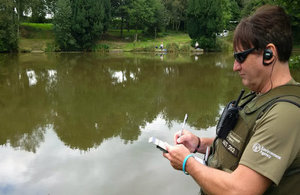
Environment Agency fisheries officer on patrol

Dumitru Stancu, (24) and Adrian Diaconescu (21), both of Newhampton Road West, Wolverhampton, were found guilty in their absence at Telford Magistrates’ Court on 26 November for using an unlicensed fishing rod and line on the Shropshire Union Canal in Telford and for contravening a national byelaw of removing fish without permission, on 3 June 2018. Both men were fined £440 and each ordered to pay costs of £127, plus a £44 victim surcharge.

A spokesperson from the Environment Agency said:

An annual fishing licence costs just £30, yet a small number of anglers continue to flout the law and risk prosecution for fishing without a licence and breaching byelaws in place to protect fish stocks.

It’s important anglers have a licence before fishing; the money from licences is invested into England’s fisheries and rivers; improving the sport of angling. Anglers should also ensure that they are familiar with our byelaws, which are available on the Environment Agency web pages.

Environment Agency officers are out checking licences and byelaw compliance regularly throughout the year. A licence costs just £30 and lasts for 12 months from the day it is purchased, and becomes valid around 30 minutes after buying online.

Money from fishing licence sales is invested in England’s fisheries and is used to fund a wide range of projects to improve facilities for anglers including; protecting stocks from illegal fishing, pollution and disease, restoring fish stocks through re-stocking, eradicating invasive species and fish habitat improvements. Fishing licence money is also used to fund the Angling Trust to provide information about fishing, to encourage participation in the sport and to manage a voluntary bailiff scheme.

Children aged 12 and under can fish for free without a licence. Anyone aged 13 to 16 also fish for free, but does need to have a valid Environment Agency fishing licence. Anyone over 16 must pay for an Environment Agency fishing licence to fish for salmon, trout, freshwater fish, smelt or eel in England.

Anyone witnessing illegal fishing can report it directly to the Environment Agency hotline, 0800 80 70 60. Information on illegal fishing and environmental crime can also be reported anonymously to Crime stoppers on 0800 555 111.

Published 28 November 2018
Last updated 28 November 2018 + show all updates

  1. Correction: Children aged 12 and under can fish for free without a licence. Anyone aged 13 to 16 also fish for free, but do need to have a valid Environment Agency fishing licence.
  2. First published.