News story: UK medical support to largest UN peacekeeping mission in South Sudan continues after hospital handover to Vietnam

As one of the 5 permanent members of the Security Council, the UK has demonstrated its commitment to international security within the United Nations (UN) since its inception in 1945. Financially, the UK is the sixth-largest contributor to both the regular and peacekeeping budget. In 2015, the Strategic Defence and Security Review saw the Prime Ministers intent to double the number of military personnel that the UK contributes to UN PKO met; South Sudan being the mission of choice.

The UN Mission in South Sudan (UNMISS) commenced in 2011 when they declared independence, and is now the largest peacekeeping mission, with over 14,000 contingent troops from 65 countries . Providing medical care over a country 3 times the size of the UK is challenging, with large areas of swamps, armed clashes and a substantial wet season.

UNMISS currently has 40 Level 1 Clinics (29 Troop Contributing Countries (TCC) provided; 11 UN provided), 8 Forward Medical Teams and 8 casualty evacuation/medical evacuation (CASEVAC/MEDEVAC) helicopters for urgent aeromedical evacuation. UNMISS has 5 Level 2 hospitals across South Sudan, with Level 3 hospitals for further specialist care in Entebbe with a dedicated fixed wing aeromedical aircraft available; the Level 4 hospital for the mission is in Nairobi.

In 2017, Operation Tenton commenced with the deployment of a UK engineering task force across two sites; Bentiu and Malakal along with the supporting medical footprint for UNMISS. On arrival, the UK erected a tented Level 2 hospital in Bentiu from a bare patch of scrubland prior to the UK engineers being tasked to build a hardstanding Level 2 hospital in close vicinity which is due to be completed in Dec 2018.

Hardstanding. Image Crown copyright

The UK medical deployment for the Level 2 hospital was unprecedented in its roulement; Army deployed and set-up the tented capability, Royal Navy developed the capability before handing over to the RAF to manage and mentor the Vietnamese through the successful transition. This is the first time that a UN hospital has had unbroken clinical cover; the UN have formally recognised this transition as best practice, with other Troop Contributing Countries being encouraged to follow suit .

The relationship between the UK and Vietnam has grown over 2 years as the UK provided an ‘Advise, Assist and Mentor’ package as the Vietnamese prepared for their first ever peacekeeping mission. America and Australia have also provided supporting roles, celebrating the international effort, Vietnamese medics, trained by the UK, using American equipment, flown in by the Australians. This deployment epitomises what can be achieved through defence engagement with new and old partners alike, to fulfil a UK goal to get more nations involved in UN peacekeeping. The Vietnamese officially took command of the Level 2 Hospital in Bentiu on 27 October 2018.

United Kingdom and Vietnamese personnel on parade. Image: Crown copyright

In wider support to UNMISS, 8 UK Staff Officers (SO) are deployed under the Op VOGUL banner. One of the SO positions is the Deputy Force Medical Officer (DFMO) based at the Level 2+ Hospital in Juba. The DFMO post will endure until 2020, which will see the position held by a doctor from all 3 UK Services for a tour length of 9 months each.

The current DFMO, Wg Cdr Adam Manson, has described the role as monitoring and co-ordinating all the Level 1 and 2 facilities, improving the health of the force through education, clinical advice, facility inspections and hygiene inspections to allow the force to implement the mandate for UNMISS.

Force Medical also co-ordinate CASEVAC/MEDEVACs to ensure patients are moved in a timely fashion with the right level of escort to the right medical facility. Having a UK doctor as the DFMO has already reaped huge benefits from within the UN, not only to ensure the required standard of care for UK personnel deployed, but also through the soft power of medical to relationship build with other TCCs to open avenues for defence engagement to support both the Global Britain and prosperity agendas.

Rwanda medals parade. Image: Crown copyright

The DFMO highlights that the UN provides a unique working environment with every day being different with the challenges of language, culture and communication. He highlights that it is culturally fascinating working day to day with a Chinese Lieutenant Colonel, Major Staff Officers from Rwanda and Sri Lanka and a Marine Warrant Officer from Bangladesh. Living in a UN camp with a mixture of civilian and military personnel brings a real sense of unity and friendship, whether it is undertaking exercise, over lunch or even when catching lifts for the 30-minute drive across Juba between the two main UN camps.

The roles within the UN Mission are varied and often the result of the ground-realities; a third of the 12 million population of South Sudan are displaced, either internally or as refugees in external countries, with children often suffering the most. A memorable day for UK personnel in Juba was the cleaning of a local orphanage which is home to 50 orphans ranging in age from several months old up.

Over 60 UNMISS personnel got together and between them rooms were emptied, cleaned and tidied, food stores were emptied and rats removed, the teaching room was organised and dormitories and eating areas were cleaned and disinfected. Swings were repaired and grass areas cut to allow for vegetable patches and new play areas.

Over 60 UNMISS Personnel assisted with the cleaning of a local orphanage in Juba. Image Crown copyright

The UK support to UNMISS continues until 2020 with the engineers on Op TRENTON and Staff Officers on Op VOGUL. The small numbers of UK personnel have not only greatly assisted the mission to implement the mandate but each individual has found it personally rewarding and seen actual results to improve the lives and relieve the suffering of the South Sudanese population. With new peace efforts ongoing it is hoped these may result in a longstanding solution and allow the country to prosper in the future.


Press release: Planning application submitted for further £112.1m of Leeds flood defences

Plans for the next phase of the Leeds Flood Alleviation Scheme to reduce flood risk along the River Aire have now been submitted.

Leeds City Council has worked alongside the Environment Agency to put forward a planning application for phase two of the Leeds Flood Alleviation Scheme, which will invest £112.1million in flood prevention measures for areas upstream of Leeds city centre.

A range of measures have been put forward to reduce the risk of flooding along a 14-kilometre stretch along the River Aire catchment, including the A65 Kirkstall Corridor which was badly hit by the impact of Storm Eva at Christmas 2015 and ending at Apperley Bridge, Bradford.

These plans include both parts of the two-step process that has been developed to give a one-in-200-year level of enhanced protection against flooding for Leeds, helping to better protect 1,485 homes and 370 businesses. If approved, work to deliver the first step, a one-in-100 year level of protection, is expected to start next summer. The plans feature measures such as new defence walls, embankments and a large flood storage area. As part of the application it focuses on four key areas of Leeds Industrial Museum at Armley Mills, Kirkstall Abbey and Kirkstall Meadows, Apperley Bridge and Calverley.

The scheme also incorporates a flagship Natural Flood Management programme. Leeds City Council and the Environment Agency will work with partners and landowners across the catchment to deliver a range of measures, such as the creation of new woodland and other natural features. These will help reduce the flow of rainwater into the river and help reduce the impacts of climate change. Additional planning approvals will be sought from the relevant authorities as the catchment wide programme develops.

Leader of Leeds City Council Councillor Judith Blake said:

This planning application is an important step in our commitment to providing Leeds with the level of flood defences it needs.

If it is approved it would mean we can get on with starting the work we can carry out now, which is vital to provide our residents and businesses with reassurance and confidence as we come up on three years since the devastation caused by the impact of Storm Eva.

We will continue to pursue all options to secure the remaining funding to deliver the scheme to one-in-200-year level in full.

Flood risk manager at the Environment Agency, Adrian Gill said:

The joint project team have worked hard to get to this point. We are keen, through this consultation process, to understand what the public think about the proposed scheme.

If approved, it will enable our team to begin works at pace, extending the level of protection in the city centre out to the Kirkstall area, whilst we continue to work towards our ambition of a 1-in-200-year level of protection from the River Aire for the whole city.

At Leeds Industrial Museum at Armley Mills, which suffered significant flood damage in 2015, the defence works include new protective walls, a new pipe bridge to improve water flow and two new control structures on the goit. At Kirkstall Meadows the proposal is to transform 2.4 hectares into a wetland habitat to hold flood water and also feature kingfisher banks, otter holts and wetland scrapes for fish.

A series of sketches to show how the works could look have also been released as part of the application. Other features of the scheme, which include new bridges and footpath improvements, will be handled in a separate planning application.

Also to follow will be the second element of the process if further funding is secured. This will complete the River Aire scheme in full by the creation of a flood storage area near Calverley, which will use the moveable weir technology used in phase one of the scheme in the city centre to allow water to be stored and then be released slowly back into the river in a controlled way.

Details of the planning application can be viewed here


Press release: David Mundell speaks on PM’s Brexit Deal

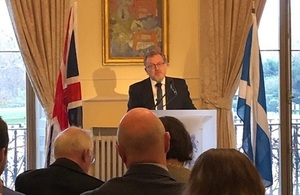
David Mundell speaks on the PM's Brexit Deal in London

In a speech to stakeholders in London today [6 December 2018] Mr Mundell pointed to the businesses the length and breadth of Scotland who have urged MPs to vote for the deal. He said:

I have engaged closely with the business world in Scotland, and the Prime Minister was in Scotland last week. We’ve heard concerns. We’ve faced some difficult questions. But a clear view has also emerged. There is a recognition that there are currently only two options on the table – and that one of them, a no deal Brexit, would be a disaster for the economy. There is a consistent view that the Withdrawal Agreement provides a workable basis on which to move forward. Over the past fortnight, calls to support the deal have grown steadily louder.

The Scottish Secretary set out that the deal – while a compromise – was the best alternative to a ‘no deal’ which would be bad for businesses and individuals across Scotland. He said:

I am more and more convinced the deal is right for Scotland and the whole of the UK. I’m not saying it is perfect. And let me be clear, I’m not pretending organisations and business leaders believe it is perfect. It is a compromise. No-one gets things all their own way in a negotiation and we have had 18 months of tough negotiations with the EU. But it is increasingly clear that both sides have had to give ground. Parts of the Withdrawal Agreement are as uncomfortable for other EU member states as they are for us – and that’s why I do not believe it is realistic to suppose there is a better deal on offer.

The Scottish Secretary stressed the Prime Minister’s robust assurances on protecting Scotland’s fishing industry. He said:

It is essential that Brexit delivers for our fishermen. They want out of the CFP. They want the UK negotiating on quotas and access to waters as an independent coastal state. They do not want a future deal that links EU access to our fishing grounds to our access to EU markets. We can and will deliver all that. The Prime Minister has defended our fishing industry in negotiations so far – and has pledged 100 per cent to do so in future. Claims that Scotland’s fishermen have been ‘sold out’ are demonstrably false. It’s old fashioned scaremongering.

Mr Mundell reiterated his view that the proposed Irish backstop will protect the integrity of the UK. He said:

I accept the backstop remains a concern. It would result in a limited number of additional checks on livestock and goods entering Northern Ireland from the UK. This is an extension of the already existing unique circumstances in order to prevent a hard border. As a Unionist I’m wary of anything that might appear to weaken the UK’s vital internal market. But I’m a Unionist and a devolutionist. I’ve been a champion of doing things differently within our Union since I became an MSP nearly 20 years ago. And what I see proposed for Northern Ireland – in the event of the backstop kicking in – are effective, carefully tailored arrangements that take account of their special and unique circumstances. That means avoiding a hard border with Ireland. It means honouring the Belfast Agreement and fostering the still fragile peace process. What I do not see proposed – crucially – is a border down the Irish Sea. Nor do I see ‘special treatment’ that would give Northern Ireland a competitive advantage and should be extended to Scotland. In short, I see a pragmatic solution to a difficult problem.

Published 6 December 2018


Press release: Fishing trip cost Leicester man over £1,400 – a licence costs £30

A 44-year old man from Leicester has been found guilty of fishing without a licence, failing to state his name and address, and obstructing a constable in the execution of his duties in June 2018.

The case was brought to Leicester Magistrates Court by the Environment Agency on 5 December 2018 where Matt Ralton, of St Stephens Road, Leicester was proved guilty in his absence and ordered to pay a total penalty of £1,428.

The penalty includes fines of £800 plus costs of £548 and a victim surcharge of £80 after Ralton was found in breach of the Salmon and Freshwater Fisheries Act (1975) and the Police Act (1996) on 2 June 2018 at Watery Gate, Normanton Turville, Thurlaston.

Following the verdict, Peter Haslock, Area Enforcement Team Leader for the Environment Agency said:

This case shows anglers how seriously the courts take these offences and highlights how we do not tolerate obstructive behaviour towards our officers under any circumstances. It acts as a reminder to anglers of the importance of having a rod licence and we hope it will provide a deterrent to any angler who is thinking of fishing without a licence or of failing to give details to an officer.

All of the money raised from rod licence sales is used to protect and improve fish stocks and fisheries, benefitting anglers and, for those caught cheating the system, we will always prosecute.

Every year across the country, thousands of anglers are prosecuted for not having a fishing licence. As well as cheating other anglers, fishing illegally can carry a hefty penalty. Getting caught without a licence could land a fine of up to £2,500.

Any angler aged 13 or over, fishing on a river, canal or still water needs a licence. A 1-day licence costs from just £6 and an annual licence costs from just £30 (concessions available). Licences are available from www.gov.uk/get-a-fishing-licence or by calling the Environment Agency on 0344 800 5386 between 8am and 6pm, Monday to Friday.

Anyone with information about illegal fishing activities can contact the Environment Agency Incident Hotline on 0800 80 70 60 or anonymously to Crimestoppers on 0800 555 111.


News story: Exports continue to rise across the UK

New figures released today (6 December) by HMRC reveal that in the year ending September 2018:

  • Exports of goods from England increased by 3.1% to £247.6 billion
  • in Scotland, goods exports increased by 6.2% to £29.6 billion
  • in Wales, goods exports increased by 3.0% to £16.9 billion
  • in Northern Ireland, goods exports decreased by 0.2% to £8.6 billion

Between July and September 2018, the average value of goods exported in the UK per exporter was £0.8m.

Businesses were also taking advantage of global interest as the number exporting to non-EU countries in the latest quarter rose to 49,000. The most popular non-EU destinations include USA, that 19.9% of exporters sold goods to, Australia (7.9%) and Switzerland (7.3%).

Comparing the year to the previous year, the growth in goods exports came from regions across the UK with the East Midlands seeing the greatest rise in the value of exports (up 10.9%) followed by Yorkshire and the Humber (8.6%) and South West (6.3%).

International Trade Secretary, Dr Liam Fox MP said:

The continued rise in exports across the country is fantastic news for Britain – driving job creation and prosperity.

More than 110,000 businesses are expanding their horizons and making the most of the demand for quality British goods.

Through our Export Strategy, my international economic department has set out an offer for all businesses to ensure they are able to make the most of the global opportunities this presents.

Export Strategy

Launched in August, the Export Strategy set out how DIT will support businesses of all sizes to make the most of the opportunities presented by markets around the world.

A government-led collaboration with business, developed after extensive engagement with a range of UK firms – the Strategy sets a new ambition from government to increase exports as a proportion of UK GDP to 35%.

ONS investment figures

Separate figures released this week by the ONS show the UK remains a top destination for foreign direct investment (FDI), with inward stock at the highest level since records began 12 years ago.

The figures show stocks from across Asia have increased by more than 33% in 2017 to £128bn and stocks from Japan increased by 71% to £78bn.

The greatest growth from any country has come from Indian investors, rising 321% to £8bn.

  • The HMRC figures on number of exporters focus on Q3 2018 (July to September) and the comparison to Q3 2017 (July to September). HMRC figures on values of exports compare the year to Q3 2018 with the year to Q3 2017.
  • The Export Strategy sets out how the government will support businesses of all sizes to make the most of the opportunities presented by markets around the world.
  • Research shows that companies that export have increased growth potential, are more productive and have better paid jobs

Top 5 export markets for goods from the Midlands Engine were:

  • USA (£8.8bn, accounting for 15.8% of total goods exports from the midlands engine)
  • Germany (£6.0bn, 10.8%)
  • China (£4.5bn, 8.0%)
  • France(£4.2bn, 7.5%)
  • Ireland (£2.8bn, 5.1%)

Top 5 export markets for goods from the Northern Powerhouse were:

  • USA (£6.3bn, accounting for 10.6% of total goods exports from the northern powerhouse)
  • Germany (£5.9bn, 10.0%)
  • Netherlands (£5.2bn, 8.7%)
  • France(£3.7bn, 6.2%)
  • Ireland (£3.5bn, 5.9%)