Speech: Getting the right leadership is vital for patient safety

“Trust me, I’m a doctor.” A phrase so reassuring that it’s a punchline.

We trust doctors and nurses more than any other profession. It’s a bond of trust that is both implicit and unspoken. You see us at our weakest, our most vulnerable. You hold our lives, and the lives of our loved ones, in your hands.

I was reminded of this unspoken bond of trust last week on a visit to The Princess Alexandra Hospital in Harlow. I met a mother with her newborn. Everything had gone well with the delivery and she was looking forward to taking her healthy baby home.

The visible joy, and relief, in her face is something every parent has felt. I’ve felt it myself with all 3 of my children.

We trust nurses and doctors, we trust the NHS, with something more precious to us than life itself. You have saved the lives of people I love.

We trust you because we know that you’ll do everything you can to help us. That you won’t give up on us. That the safety and life of my child is as important to you as it is to me.

But we can’t take that trust for granted. It has to be earned, and it must be protected. I think that’s why, when that trust is forsaken, the shock is so profound. When I learned what happened at Gosport, I was shocked.

Families had entrusted their loved ones into the care of doctors and nurses. Elderly relatives, at their most vulnerable and frail, were failed by a system that took that trust for granted. Think about your grandmother, your grandfather: how would you feel if the people you trusted most had let you down?

I get it. I understand. As Health Secretary, I’m sorry to those families in Gosport, Liverpool Community Hospital, Mid Staffs and everyone else who has been let down. But I’m not here today to point fingers and blame people.

Instead, we must learn the right lessons about creating a caring, compassionate culture, about protecting and renewing the bond of trust between the public and the NHS – our nation’s most loved and respected institution.

Because the other thing I was reminded of last week is that leaders create the culture. Because after I spoke to that new mother I spoke with the Chief Exec, Lance McCarthy, and I asked him what they do when things go wrong. What’s his approach to mistakes?

And he gave me a brilliant answer. He said: “If we’ve made a mistake, then we’ve made a mistake. We should be open and honest, and apologise. And not be afraid to apologise because of any potential legal action.”

As Secretary of State, that’s exactly what I want to hear. Because we all make mistakes. We should strive to avoid them, of course, but the fact of a mistake isn’t the biggest problem. It’s how we respond to them and how we learn from them, that’s what’s most important. And we must never let our fear of the consequences, stop us from doing the right thing.

So what Lance has done at his Trust is introduce a ‘behaviour charter’. Patients, their families and medical colleagues know what they can expect: openness, honesty, trustworthiness.

That way when mistakes do happen there’s an honest conversation: this is what went wrong, we’re sorry, this is what we’re doing to fix it.

It’s not an admission of liability. It’s an acknowledgement that we can do better. It’s often the first step towards acceptance for the patient and their family. And it’s a vital part of the process of continuous improvement we need to see everywhere in the NHS. Taking responsibility, learning the lessons that need to be learned, continuous improvement.

And what Lance has found is that clinical negligence claims haven’t gone up at his trust since they introduced this new charter. In fact, Lance believes, when people feel like they’ve been treated with honesty and candour, they’re less likely to resort to legal action.

The simple act of saying sorry maintains the bond of trust with the public even when things don’t go as planned. But this isn’t just a moral issue for the NHS ‒ as important as that is ‒ it’s a financial issue as well.

Compensation pay-outs have quadrupled from half a billion to £2 billion pounds a year over the past decade. That is unacceptable and it’s clearly unsustainable.

If we don’t do something about the growing number, and value, of clinical negligence claims, it threatens to swallow up the record £20.5 billion a year we’re putting into the NHS, and derail our Long Term Plan to transform the health service.

And that infuriates me, because it’s an injustice for taxpayers and our hardworking NHS staff. This is a once in a generation opportunity to put our health service on a forward footing so we can look to the future with confidence.

We can’t afford to let it go to waste. There is a moral and financial urgency to act. We must improve patient safety, so there’s:

  • less paperwork for medical staff and more time for patients
  • faster resolution for those who are wronged
  • more money for frontline NHS services and less taxpayers’ money going to lawyers

That’s what I want to see. That’s the approach we’ll be taking in our new patient safety strategy.

Creating a more just culture in the NHS, a more open, honest and trustworthy culture, starts at the top. Getting the right leadership is vital. We need more people with clinical backgrounds and more people from outside the NHS.

We need to ensure they get the right support, training and development so they can lead their organisations effectively and create the right culture for staff and patients.

How do we strengthen this leadership? How do we encourage more inspirational leaders into the NHS? And how do we ensure we can hold to account that leadership once in place?

First, and perhaps counter intuitively, I think we must cut the turnover rate at the top. To improve leadership in the NHS we must fire fewer people and attract the best talent. NHS leaders have some of the toughest ‒ yet most rewarding ‒ jobs in the country. So let’s support them to do the job they need to do ‒ and that will encourage more to step up.

Next, we need to have a better structure, both to support and hold to account. Today we’re publishing Tom Kark’s review into how we can improve NHS leadership. I’d like to thank Tom for his work on this and I welcome his recommendations.

Kark recommends that all directors must meet minimum competency standards to sit on the board of any health organisation, and where training is needed to meet those new standards, then it should be made available

He also recommends a central directors’ database where information about qualifications and employment history can be easily accessed

These new recommendations will ensure the fit and proper persons test is met and that unqualified or unsuitable staff can’t just move somewhere else in the NHS. We accept these recommendations in full and will get on with implementing them immediately.

I’ve asked Dido Harding to consider the further recommendations, and how we can implement these recommendations, throughout the health service.

Third, we’re working with the Healthcare Safety Investigation Branch and NHS Improvement to give more support to families when things go wrong.

A new family engagement model will ensure relatives play an integral part in any investigation, that their concerns, and their complaints, are listened to and acted on.

Nobody should feel like they’re being fobbed off or a nuisance. We must give families all the information in an open and transparent way. And ensure they’re treated with sensitivity and compassion before, during and after any investigation.

That’s the same approach we’ll be taking when independent medical examiners start being introduced across England from April. Every death will be scrutinised by either a coroner or a medical examiner.

Medical examiners will be someone bereaved families can talk to about their concerns. They will ensure investigations take place when necessary, help detect and deter criminal activity, and promote good practice.

This new system will be overseen by a new independent National Medical Examiner. And training will take place to ensure a consistency of approach and a record of scrutiny.

Finally, we need to encourage whistleblowing. Despite our best efforts, mistakes happen. We’re all human, we’re all fallible. Any doctor who says they’ve never made an error isn’t telling the truth. And the truth is more important than any one error.

Mistakes should be seen as an opportunity to learn and improve, not a need for cover-up and denial. Honest feedback is a gift.

So whistleblowers are doing the NHS a great service. Someone, who has the courage to speak up and put their head above the parapet, should be encouraged and embraced. Yet, sadly, all too often, they’re ignored, bullied and worse: forced out.

Making someone choose between the job they love and speaking the truth to keep patients safe, is morally abhorrent and operationally foolish. It’s an injustice I am determined to end.

We must change the way the system views whistleblowers: from a problem, to part of the solution. We must embed a ‘learn not blame’ culture in every part of the NHS, and ensure there are protections for staff and the public who speak up to save lives.

So we must get the right leaders to create the right culture. A just culture, an open, honest and trustworthy culture. A culture of learn not blame. Saying sorry when we get it wrong, earning the public’s trust, never taking it for granted. Encouraging and supporting people with the bravery to speak up.

There’s no one solution to patient safety. It’s a series of steps. It’s a path of continuous learning and improvement. There will always be more we can do, and we must always keep striving to do better.

I want Britain to be the best country in the world to be born. That begins with making the NHS the best – and safest – place in the world to give birth. I want every parent to experience the same joy the mother of that newborn did, thanks to our brilliant NHS. Thanks to our brilliant NHS staff.

So let us renew that bond of trust with the public. Make it a public, spoken, bond of trust: we will always be open with you, we will always be honest with you.

When things go right and when things go wrong, you can always trust the NHS to be there for you and your family.


Press release: Low Pay Commission’s 2019 visits announced

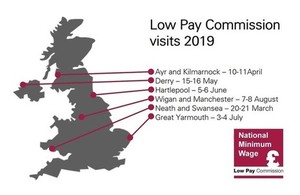
2019 visits map

The Low Pay Commission (LPC) has announced its visits programme for 2019. It is looking to meet businesses and workers affected by the National Minimum Wage and National Living Wage.

Commissioner Professor Sarah Brown said:

These visits are a vital part of our evidence base – talking to employers and employees allows us to find out what is going on more quickly and to gather more detail than aggregate statistics can ever tell us.

The LPC organises an annual programme of visits to gather evidence in support of its recommendations to government. The visits are attended by members of the Commission and LPC Secretariat. The purpose of the visits is to hear first hand evidence from employers, workers and anyone else with a view on the National Minimum Wage rates and their effects.

The visit locations were chosen because most have a higher than average proportion of workers paid the minimum wage. The LPC also seeks to visit a combination of cities and more rural areas, and places with a different industrial make-up, to gain a rounded view of the effects of the minimum wage across the UK.

On the visits, the LPC hosts meetings and travels to businesses and workers at their place of work to see the effects of the minimum wage ‘on the ground’. Meetings with colleges, public sector organisations and charities are also welcomed.

2019 visit locations

20-21 March Neath and Swansea
10-11 April Ayr and Kilmarnock
15-16 May Derry
5-6 June Hartlepool
3-4 July Great Yarmouth
7-8 August Wigan and Manchester

Contact the LPC for more information or to arrange a meeting in any of the locations

Current and future minimum wage rates

  Current rate Future rate (from April 2019) Increase
NLW £7.83 £8.21 4.9%
21-24 rate £7.38 £7.70 4.3%
18-20 rate £5.90 £6.15 4.2%
16-17 rate £4.20 £4.35 3.6%
Apprentice rate £3.70 £3.90 5.4%
Accommodation offset £7.00 £7.55 7.9%

Notes

  1. The Low Pay Commission is an independent body made up of employers, trade unions and experts whose role is to advise the Government on the minimum wage. The LPC’s 2018 Report was published on gov.uk on Tuesday 27 November. Evidence gathered on previous visits contributed to the 2018 report.
  2. The National Living Wage is the statutory minimum wage for workers aged 25 and over. It was introduced in April 2016 and has a target of 60% of median earnings by 2020, subject to sustained economic growth. The April 2019 increase will maintain the path to this target.
  3. Different rates apply to 21-24 year olds, 18-20 year olds, 16-17 year olds and apprentices aged under 19 or in the first year of an apprenticeship.
  4. Rates for workers aged under 25, and apprentices, are lower than the NLW in reflection of lower average earnings and higher unemployment rates. International evidence also suggests that younger workers are more exposed to employment risks arising from the pay floor than older workers. Unlike the NLW (where the possibility of some consequences for employment have been accepted by the Government), the LPC’s remit requires us to set the rates for younger workers and apprentices as high as possible without causing damage to jobs and hours.
  5. The Accommodation Offset is an allowable deduction from wages for accommodation, applicable for each day of the week. In April 2019 it will increase to £7.55 per day.
  6. The National Living Wage is different from the UK Living Wage and the London Living Wage. Differences include that: the UK Living Wage and the London Living Wage are voluntary pay benchmarks that employers can sign up to if they wish, not legally binding requirements; the hourly rate of the UK Living Wage and London Living Wage is based on an attempt to measure need, whereas the National Living Wage is based on a target relationship between its level and average pay; the UK Living Wage and London Living Wage apply to workers aged 18 and over, the National Living Wage to workers aged 25 and over. The Low Pay Commission has no role in the UK Living Wage or the London Living Wage.
  7. The nine Low Pay Commissioners are:
  • Bryan Sanderson
  • Professor Sarah Brown
  • Professor Richard Dickens
  • Kate Bell
  • Kay Carberry
  • Simon Sapper
  • Neil Carberry
  • Clare Chapman
  • Martin McTague

Published 6 February 2019


Press release: Glasgow boss banned for flouting director requirements

George Fry (36), from Glasgow, was the sole director and shareholder of Connect Pavers Limited. Incorporated in September 2015, the company carried out domestic and industrial groundwork contracts.

However, just two years later in October 2017, Connect Pavers entered into liquidation following a petition at Glasgow Sheriff Court by the tax authorities for an unpaid bill of more than £140,000.

Insolvency practitioners were tasked with winding-up Connect Pavers but George Fry failed to ensure the company maintained adequate accounting records and as a result, the company could not deliver any records to the liquidator. He also caused Connect Pavers to pay no taxes throughout the two-years the company was in operation.

Further work by the Insolvency Service found that between 18 May 2016 and 3 November 2016 George Fry withdrew £101,100 from the company’s account but because he failed to maintain adequate accounting records, George Fry could not adequately explain whether these transactions were legitimate or not.

On 19 December 2018, at Glasgow Sheriff Court, Sheriff Anwar granted a disqualification order for a period of 7 years.

Effective from 10 January 2019, George Fry is banned from directly or indirectly becoming involved, without the permission of the court, in the promotion, formation or management of a company.

Robert Clarke, Chief Investigator for the Insolvency Service, said:

From day one, George Fry had a responsibility to ensure the company maintained proper accounting records and pay the correct levels of taxes. But he failed on both accounts, amounting to a dereliction of duty.

Seven years is a substantial ban, severely restricting George Fry’s activities, and we hope others take heed that we can stop people from running companies if they do not take their directorship duties seriously.

Mr George Fry is of Glasgow and his date of birth is 19 June 1982

Connect Pavers Limited (Company Reg no. SC516148).

A disqualification order has the effect that without specific permission of a court, a person with a disqualification cannot:

  • act as a director of a company
  • take part, directly or indirectly, in the promotion, formation or management of a company or limited liability partnership
  • be a receiver of a company’s property

Disqualification undertakings are the administrative equivalent of a disqualification order but do not involve court proceedings.

Persons subject to a disqualification order are bound by a range of other restrictions.

The Insolvency Service administers the insolvency regime, investigating all compulsory liquidations and individual insolvencies (bankruptcies) through the Official Receiver to establish why they became insolvent. It may also use powers under the Companies Act 1985 to conduct confidential fact-finding investigations into the activities of live limited companies in the UK. In addition, the agency deals with disqualification of directors in corporate failures, assesses and pays statutory entitlement to redundancy payments when an employer cannot or will not pay employees, provides banking and investment services for bankruptcy and liquidation estate funds and advises ministers and other government departments on insolvency law and practice.

Further information about the work of the Insolvency Service, and how to complain about financial misconduct, is available.

You can also follow the Insolvency Service on:


News story: NHS leaders: government commits to new support and improvement measures

The Kark review of the fit and proper persons test was led by Tom Kark QC. It includes 7 recommendations for how the government can better support NHS senior leaders to deliver high-quality and safe care in the NHS.

Of these recommendations, the government has accepted in principle to:

  • set up a central database of information about the qualifications, previous employment and performance of directors
  • make new competency standards to help people know what to expect of senior managers

The remaining recommendations will be considered as part of the workforce implementation plan later this year, which will be led by Baroness Harding, chair of NHS Improvement.

These include:

  • setting up a new organisation that can suspend directors who are found to have committed serious misconduct, such as bullying and harassment of staff
  • requiring old employers to provide references to potential new employers

The Department of Health and Social Care commissioned Tom Kark QC, previously counsel to the Mid Staffordshire public inquiry, to lead a review into the effectiveness of the NHS fit and proper persons test last year.

The test is overseen by the Care Quality Commission as part of their regular inspections of NHS trusts and aims to ensure executive-level managers are fit to carry out their roles to the highest standard.

It came under scrutiny following a report into the severe failures at Liverpool Community Health NHS Trust between 2010 and 2014, where poor leadership was found to have resulted in a widespread culture of bullying and harassment and declining patient care.

The government accepted the call from Dr Bill Kirkup for a wider review into the fit and proper persons test, following his examination of the failures at Liverpool Community Health NHS Trust.


Press release: UK to host NATO 70th anniversary meeting

placeholder

Prime Minister Theresa May said:

The UK is one of the founding members of NATO and I am very pleased that the Secretary General has asked us to host a meeting of NATO leaders this year to mark its 70th anniversary.

For 70 years NATO has been the cornerstone of our national security. But today’s challenges are very different from those we faced when the Alliance established its first headquarters in London.

The UK has played a central role throughout NATO’s history as it has adapted to deal with new and complex threats to our security.

So as we pay tribute to the service men and women who have worked so hard over so many years to keep us safe, December’s meeting is an important opportunity to determine the steps we must now take to modernise the Alliance and ensure its continued success.

Published 6 February 2019