Government response: Joint statement following the first meeting of the Swindon Taskforce

placeholder

More than 30 leaders from local and national government; local MPs Robert Buckland MP, Justin Tomlinson MP and James Gray MP; trade unions, workers from Honda UK, representatives from business groups and local civic leaders yesterday (20 February 2019) came together for the first meeting of the Swindon Taskforce. They agreed on the central importance of making the case for Swindon’s world class production facility and its highly-skilled workers and for Honda’s continued investment in the plant.

The Taskforce, co-chaired by the Business Secretary Greg Clark, the Leader of Swindon Council David Renard and the Chair of Swindon Local Enterprise Partnership John Mortimer, jointly agreed the following:

Yesterday we convened the first meeting of the Swindon Taskforce to come together to discuss the future of Honda in the UK, and to support the workers at Honda’s Swindon plant along with those working in the supply chain and the wider community across Swindon, and the whole of Wiltshire.

Our first priority is to make the case to Honda that investment in vehicles of the future is best done in Swindon. We are united in that mission. We have some of the best talent in the world and the government is already investing in future car manufacturing, batteries and electrification infrastructure to ensure the UK retains its world-leading edge.

The Taskforce is also working to ensure that Swindon continues its record of attracting investment from advanced manufacturers, maintaining and creating highly-skilled jobs that offer fulfilling careers for many years to come.

Published 21 February 2019


News story: An update on existing trade agreements if the UK leaves the EU without a deal

Our priority is to avoid disruption to our global trading relationships as we leave the European Union.

The United Kingdom already trades with countries all over the world and will continue to do so regardless of whether we leave the European Union with a deal or not.

Nearly half of our trade is with the EU and a further 11% of our trade is covered by the existing EU trade agreements we are looking to continue as bilateral deals after we leave the EU: the 20 smallest of these agreements account for just 0.8% of UK trade. The remaining 40% of trade takes place with other countries.

The best way to avoid any disruption to our trade after Brexit is to leave the EU with a deal. This can secure our trade with the EU and trade with countries covered by the existing EU trade agreements. This is because leaving the EU with a deal will ensure UK businesses can continue to trade with the whole world on the same terms as they do today for the implementation period.

However, it is only responsible for Government to prepare for all eventualities. That’s why the Department for International Trade is continuing to work with countries to transition the existing EU trade agreements which the UK participates in as a member of the EU, in the event of a no deal to avoid disruption for businesses. This is our top priority and we have significantly increased resources transition these agreements.

We have already secured agreements with countries that account for more than a quarter of UK trade covered by these agreements. This includes signing agreements with Switzerland, which is worth over 20% in terms of value of these agreements, as well as Chile, the Faroe Islands, Eastern and Southern Africa, Israel and the Palestinian Authority.

We have also signed Mutual Recognition Agreements with the United States of America, Australia and New Zealand, which ensures that businesses don’t face additional bureaucracy and allows them to continue trading as freely as they do today after we leave the European Union.

Many of the other trade agreements are at an advanced stage, and the UK Government will be signing more in the coming days and weeks.

We will continue to update businesses and they should continue to plan for range of Brexit scenarios, including the possibility of leaving the European Union without an agreement.

Notes to editors


Press release: New guidance on the movement of horses and other equines in a no deal scenario

The Government has today issued guidance for owners of horses, ponies and other equines on the preparations they need to made in the event of a ‘no deal’ Brexit.

Leaving the EU with a deal remains the Government’s top priority. This has not changed. We are continuing with our ‘no deal’ preparations to ensure the country is prepared for every eventuality.

The guidance will help owners to navigate the new processes for moving horses and other equine animals from the UK to EU member states. This will also apply to those owners who currently move their animals between the UK, Ireland and France under the Tripartite Agreement (TPA) – an agreement relied on by many in the horseracing industry and the competition sector.

If the UK leaves the EU on 29 March without a deal:

  • equines travelling from the UK to the EU may need to undergo additional blood tests, which will need to be carried out within 30 days or less of travelling to satisfy EU regulations
  • owners will need to consult with a vet at least six weeks before they are planning to travel
  • all equines will need an Export Health Certificate in order to travel to EU states, instead of current documents, and will need to enter the EU via a Border Inspection Post (BIP)
  • some equines will also need a Government issued travel ID document, as well as their existing equine passport

The UK has already committed to allowing continued movement on all equine animals from EU member states to support the industries that rely on these animals and ahead of major horseracing events, such as the Grand National Festival at Aintree.

The government is continuing to negotiate with the European Commission on securing listed status for the UK, which would enable the continued movement of equines to EU member states.

The guidance published today is designed to give the owners of horses and other equine animals as much time to prepare for these new processes and factor in any extra travel time they may require when travelling to and from the EU.

Animal Welfare Minister David Rutley said:

Delivering a negotiated deal with the EU remains the Government’s top priority, but it is our job to responsibly ensure we are prepared for all scenarios, including no deal.

This guidance will help businesses and owners prepare for life after 29 March if we do leave without a deal. However, it is in the interest of the EU to reciprocate our commitment on the movement of horses. This will ensure horseracing and competition events across the continent can continue to be attended by all of Europe’s top equine talent.

Julian Richmond Watson, Chairman of the Thoroughbred Breeders Association, said:

The British thoroughbred racing and breeding industry welcomes publication of this important guidance and will be communicating it to our participants to help them prepare for all potential Brexit negotiation outcomes.

We fully support the Government’s welcome and pragmatic position to allow continued equine movement under current systems from EU member states to the UK in a no deal scenario.

Nick Fellows, Chief Executive of the British Equestrian Federation (BEF), said:

The BEF has worked closely with government and leading figures in equestrian sport to make sure that all horse owners have as much information as possible for when the UK leaves the European Union. It’s important to prepare for all eventualities and we’d urge all horse owners to take notice of the material provided by Defra.

If the UK is not provided with listed status by the European Commission, no movements of equines from the UK to the EU will be possible after we leave the EU until listed status is secured.

Businesses that may be affected should read the latest guidance on equine movements.


Press release: Ex-mental health worker has sentence increased

A mental health crisis worker who sexually abused a teenage girl in his care has today had his sentence increased after the Solicitor General, Robert Buckland QC MP, referred it for being too low.

Givemore Tonderai Gezi, 40, met the victim through his role as a team leader with the Child and Adolescent Mental Health Services crisis team. The two kept in contact after their first meeting, with Gezi falsely telling her that he was single, and lying about his age.

Over the next few weeks, Gezi engaged in repeated sexual activity with the victim. They had sex for the first time within a few days of the victim’s 16th birthday, and continued to have unprotected sex after this. Gezi’s offending was eventually discovered by his wife, who reported him to the police.

Gezi was originally sentenced in December 2018 to 7 years and 8 months in prison at Exeter Crown Court. Today, the Court of Appeal has increased this to 10 years.

Commenting on the increase, the Solicitor General said:

Gezi lied to and manipulated a young, vulnerable victim into an inappropriate sexual relationship. It is only right that he should spend longer in prison given the heinous abuse of trust he committed


News story: Countering Drones: finding and neutralising small UAS threats

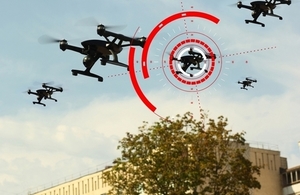
Swarm of Quadcopters Drones In The Air Over City, drones digitally modified

Background

The introduction of Unmanned Air Systems (UAS), often referred to as drones, has been one of the most significant technological advances of recent years and represents a shift in capability of potential adversaries. The threat from UAS has evolved rapidly and we are seeing the use of hostile improvised UAS threats in overseas theatres of operation. There is a similar problem in the UK with the malicious or accidental use of drones becoming a security challenge at events, affecting critical infrastructure and public establishments; including prisons and major UK airports.

Small commercially available UAS have already delivered direct impact effects and have allowed those hostile to UK interests to deploy cheap, pervasive, low observable surveillance capability. This threat often bypasses traditional air defence and ground security measures.

The UAS threat to UK national security is a cross-Government issue. There are many different UAS threats, each of which may require a different mitigation approach. The challenge will deepen with the predicted future advancement in UAS capability and as the civilian and military airspace becomes more crowded.

The Competition

This Defence and Security Accelerator (DASA) call aims to address the increasing UAS threat to the defence and security of UK both at home and abroad.

What are we looking for?

We are aiming to harness recent technology advances in a range of areas such as sensing technologies, autonomy, Artificial Intelligence and non-lethal effectors to improve the ability of the UK defence and security community to counter an adversary’s use of UAS. This needs to be achieved whilst preventing or minimising collateral damage.

We would like to focus on two key areas:

  • Next generation counter-UAS (C-UAS)
  • The future threats from UAS such as swarms, autonomy and congested air space

The solutions could include complete systems or components that deliver or enable:

  • automated and networked sensing systems over wide and complex areas
  • cost effective sensors
  • Plug and play (e.g. SAPIENT) compliant integration (more detail will be provided in the full competition document)
  • methods of robustly defeating or denying current and next generation drones in a range of scenarios and environments
  • significant and rapid improvements to extant systems for deployment
  • autonomous decision making
  • signal processing to improve discrimination and identification
  • networked approaches which may use existing sensing systems such as CCTV etc.
  • ability to identify and track the UAS operator
  • airborne, mobile or expendable solutions

What we are not looking for

  • manpower intensive detect, track and identification solutions
  • standard barrage jamming
  • highly bespoke, closed or crude integration
  • low potential for cost efficiency

The competition is envisaged to have a number of phases; Phase 1 of this competition is intended to demonstrate proof of concepts that can be further developed and integrated during later phases. Successful projects in this first phase may be encouraged to work with other suppliers in future phases in order to integrate solutions into a deployable system, and it is hoped successful projects will be able to be demonstrated at key showcasing events in 2020.

Competition key information

The total funding for this competition is expected to be at least £2M, split over multiple phases. The total funding for Phase 1 is expected to be at least £800K.

This DASA competition is currently planned to open in April 2019 when the full document will be released on our website. Proposals must be submitted to the DASA submission service, for which you will have to register.