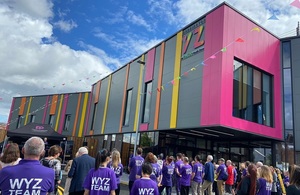
State-of-the-art Warrington Youth Zone opens its doors

News story

A new youth zone in Warrington town centre, which will bring a range of activities to young people has opened its doors.

The youth zone opened its doors to the young people of Warrington.

The youth zone opened its doors with a grand opening ceremony.

As one of the Founder Patrons of Warrington Youth Zone, Sellafield Ltd is delighted to see the opening of a state-of-the-art facility in the centre of Warrington.

The facility provides young people across the town with a safe and inspiring place to spend leisure time away from the pressures of home and school.

Pauline Deans, Sellafield Ltd’s community liaison officer said:

The youth zone is an amazing facility, providing young people with a place to enjoy a range of activities while also being given much needed support.

We are delighted to be a supporter as part of our Social impact, multiplied (SiX) programme and look forward to seeing the outcomes it will achieve in years to come.

The climbing wall is one of many activities on offer at the new facility.

The youth zone will ensure that every young person in Warrington, regardless of their circumstance or background, can access first-rate facilities alongside expert mentoring and employability programmes; levelling the playing field and tackling specific issues that might otherwise hold back our young people.

Pauline added:

With help from local partners like ourselves, the building will transform the lives of young people in the area with the aim of making them happier, healthier and better equipped with the skills they need to forge their own positive futures.

Warrington Youth Zone CEO, Dave McNicholl said:

I’m extremely grateful to our partners, including Sellafield Ltd. This facility will transform and enhance the lives of thousands of young people in Warrington.

Our incredible universal offer will provide so many opportunities alongside a network of support, that young people need now more than ever.

Published 4 July 2022


Introducing the Ideas Marketplace

  • The Ideas Marketplace is an online networking Collaboration Platform for innovators to discuss, collaborate and share ideas to meet defence and security challenges
  • The Ideas Marketplace enables innovators to get their ideas in front of an array of government stakeholders and end users

The Defence and Security Accelerator (DASA) is pleased to launch the Ideas Marketplace. The Ideas Marketplace is an online networking Collaboration Platform where innovators can discuss, collaborate and share ideas with like-minded users to overcome defence and security challenges and help deliver the next generation of defence and security tools and services.

Welcome to the Ideas Marketplace

The Ideas Marketplace is designed to enable innovative organisations to engage with the best people in defence and security, easily. It encourages collaboration between organisations of all shapes and sizes, to foster new and dynamic relationships to make innovations a success.

From helping innovators gain expertise and specialist support to develop technologies, to forming longstanding partnerships and finding new funding opportunities. The Ideas Marketplace will help innovators to:

  • hear about funding opportunities from across government

  • access exclusive competitions

  • collaborate with another innovators to make ideas a success

  • engage with industry leaders and learn more about the defence and security landscape

  • foster collaborative relationships and partnerships

Join the Ideas Marketplace here.

Key Features: Innovate. Collaborate

The Ideas Marketplace connects industry to stakeholders. Once a user has signed up, they can:

  • list abstracts on project hubs and collaborate with other innovators

  • get updates on funding opportunities from across the defence and security community

  • learn about the latest defence and security industry news and see how they can get involved

  • gain access to networking and collaboration events

  • find expert knowledge to make innovation a success

  • get help to understand the market for an idea and help to build the business behind it

How does the Ideas Marketplace work?

The Ideas Marketplace functions similarly to an online forum. Once a user has created an Ideas Marketplace profile, they can upload an abstract of their idea or challenge area that they need help with. Like-minded innovators with the same interests will easily be able to find each other through the abstract and specialism search functions, and foster collaboration opportunities.

To help find collaborators, users can also follow areas of interest, specialisms, write posts and spark conversation by sending messages.

The Ideas Marketplace community comprises 10 UK defence and security innovation organisations. Innovators can visit each Ideas Marketplace hub page to see what funding opportunities are available, and if their innovations are relevant.

  • DASA: DASA finds and funds exploitable innovation to support UK defence and security quickly and effectively, and support UK prosperity.

  • jHub & jHub digital: jHub is the Innovation centre for Strategic Command, seeking innovation and technology to enhance and improve the operation of the UK armed forces.

  • Discover, Analysis and Rapid Exploitation (DARE), the DARE team explores ways of providing cutting-edge technology and operational prototypes to show where the Royal Navy could go in the future.

  • RAFX: RAFX develops technology for the RAF to discover how it can help deliver safer, more efficient and predictable operations, and create the next generation Air Force.

  • Army Rapid Innovation & Experimentation Lab (ARIEL) seeks to work with innovative industries in a shared space, allowing ideas to be developed, and technology and equipment to be refined.

  • DE&S Future Capabilities Group: The DE&S Future Capabilities Group (FCG) works with industry to explore and de-risk new capabilities against Front-Line Command needs.

  • Regional Defence and Security Clusters: These are regional collaboration clusters led by industry and academia with the support of government and its ministerial departments such as the MOD and its innovation directorate, and the Defence and Security Accelerator (DASA).

  • UK Space Command: UK Space Command is a joint command staffed by the Royal Navy, British Army, Royal Air Force, civil servants, and commercial partners. It aims to deliver space equipment programmes that integrate with other defence capabilities.

Checklist: How to sign up and use the Ideas Marketplace

Signing up for the Ideas Marketplace is an easy process:

  • Step 1: Visit the Ideas Marketplace homepage and register for an account

  • Step 2: Wait for your registration request to be approved

  • Step 3: Complete your Ideas Marketplace profile and choose how you want to be contacted

  • Step 4: Use the ‘Home ’ tab to upload your abstract, so other like-minded users can engage with you

  • Step 5: Use the ‘Collaborate’ tab to see your feed, follow your areas of interest; find collaborators and write posts

  • Step 6: Search the Ideas Marketplace for Abstracts by area of specialism

  • Step 7: Spark conversation by sending messages to other innovators

Join the Ideas Marketplace

Want to collaborate with like-minded innovators and get your ideas in front of government stakeholders and end-users?

Join the Ideas Marketplace here.


Introducing the Ideas Marketplace

  • The Ideas Marketplace is an online networking Collaboration Platform for UK-registered innovators and organisations to discuss, collaborate and share ideas to meet defence and security challenges
  • The Ideas Marketplace enables innovators to get their ideas in front of an array of government stakeholders and end users, other parts of industry and academia.

The Defence and Security Accelerator (DASA) is pleased to launch the Ideas Marketplace. The Ideas Marketplace is an online networking Collaboration Platform where UK innovators can discuss, collaborate and share ideas with like-minded users to overcome defence and security challenges and help deliver the next generation of defence and security tools and services.

Welcome to the Ideas Marketplace

The Ideas Marketplace is designed to enable innovative UK organisations to engage with the best people in defence and security, easily. It encourages collaboration between organisations of all shapes and sizes, to foster new and dynamic relationships to make innovations a success.

From helping innovators gain expertise and specialist support to develop technologies, to forming longstanding partnerships and finding new funding opportunities. The Ideas Marketplace will help innovators to:

  • hear about funding opportunities from across government

  • engage with industry leaders and learn more about the defence and security landscape

  • foster collaborative relationships and partnerships with other innovators

Join the Ideas Marketplace here.

Key Features: Innovate. Collaborate

The Ideas Marketplace connects industry to stakeholders. Once a user has signed up, they can:

  • seek out partnerships and collaborations with organisations that can help you develop their innovation

  • get updates on funding opportunities from across the defence and security community

  • learn about the latest defence and security industry news and see how they can get involved

  • gain access to networking and collaboration events

  • get help to understand the market for an idea and help to build the business behind it

How does the Ideas Marketplace work?

The Ideas Marketplace functions similarly to an online forum. Once a user has created an Ideas Marketplace profile, they can find like-minded innovators with the same interests by using the abstract and specialism search functions, and foster collaboration opportunities.

To help find collaborators, users can search for common areas of interest or technical specialism, write posts and spark conversation by sending messages.

The Ideas Marketplace community comprises 8 UK defence and security innovation organisations. Innovators can visit each Ideas Marketplace hub page to see what funding opportunities are available, and if their innovations are relevant.

  • DASA: DASA finds and funds exploitable innovation to support UK defence and security quickly and effectively, and support UK prosperity.

  • jHub & jHub digital: jHub is the Innovation centre for Strategic Command, seeking innovation and technology to enhance and improve the operation of the UK armed forces.

  • Discover, Analysis and Rapid Exploitation (DARE), the DARE team explores ways of providing cutting-edge technology and operational prototypes to show where the Royal Navy could go in the future.

  • RAFX: RAFX develops technology for the RAF to discover how it can help deliver safer, more efficient and predictable operations, and create the next generation Air Force.

  • Army Rapid Innovation & Experimentation Lab (ARIEL) seeks to work with innovative industries in a shared space, allowing ideas to be developed, and technology and equipment to be refined.

  • DE&S Future Capabilities Group: The DE&S Future Capabilities Group (FCG) works with industry to explore and de-risk new capabilities against Front-Line Command needs.

  • Regional Defence and Security Clusters: These are regional collaboration clusters led by industry and academia with the support of government and its ministerial departments such as the MOD and its innovation directorate, and the Defence and Security Accelerator (DASA).

  • UK Space Command: UK Space Command is a joint command staffed by the Royal Navy, British Army, Royal Air Force, civil servants, and commercial partners. It aims to deliver space equipment programmes that integrate with other defence capabilities.

Checklist: How to sign up and use the Ideas Marketplace

Signing up for the Ideas Marketplace is an easy process:

  • Step 1: Visit the Ideas Marketplace homepage and register for an account with your company email address (Please note, you will need to be a registered UK company to complete this step)

  • Step 2: You will receive a verification email from the Ideas Marketplace. Click the link to verify your email address.

  • Step 3: Wait for your registration request to be approved

  • Step 4: Complete your Ideas Marketplace profile and choose how you want to be contacted

  • Step 5: Use the ‘Home ’ tab to upload your abstract, so other like-minded users can engage with you

  • Step 6: Use the ‘Collaborate’ tab to see your feed, follow your areas of interest; find collaborators and write posts

  • Step 7: Spark conversation by sending messages to other innovators

Join the Ideas Marketplace

Want to collaborate with like-minded innovators and get your ideas in front of government stakeholders and end-users?

Join the Ideas Marketplace here.

Published 4 July 2022
Last updated 27 July 2022 + show all updates

  1. Users can now upload abstracts of proposals that have not been funded by DASA

  2. Change to eligibility for Ideas Marketplace – must be a UK registered company Clarification of sign up steps to include verification email

  3. First published.


Foam merger raises competition concerns

Press release

The CMA has found that the merger of 2 firms that make foam used in products like bedding and cleaning sponges could lead to higher prices and less choice.

The Competition and Markets Authority (CMA) is concerned that the loss of competition brought about by the merger of Carpenter and Recticel’s global engineered foams business could result in a worse deal for manufacturers. This could ultimately mean that consumers face higher prices and less choice. The firms must now address the concerns identified or face a further, more in-depth, Phase 2 investigation.

US-based Carpenter agreed to buy Belgian firm Recticel’s global engineered foams business in a €656 million (Euros) deal announced in 2021. The firms both make flexible polyurethane foam used in the manufacture of products like mattresses and sponges. They also produce processed foam, sometimes called converted foam. Both companies own and operate plants in the UK.

The CMA’s initial Phase 1 investigation has found that the merger would remove a close competitor of Carpenter’s, with the firms representing 2 of just 3 foam producers with plants in the UK. The CMA is concerned that, if the deal goes ahead, the combined companies will face limited competition in the UK in 3 foam-related markets.

Sorcha O’Carroll, Senior Director at the CMA, said:

Carpenter and Recticel may not be household names but their products can be found in homes throughout the UK.

We’re concerned that this merger could reduce competition in the supply of foam and foam products. This could ultimately lead to shoppers paying more for bedding products as well as everyday items like kitchen sponges.

If the firms fail to address our concerns, the deal will be referred for an in-depth investigation.

The firms now have 5 working days to submit proposals to address the CMA’s competition concerns. The CMA then has a further 5 working days to consider whether to accept any offer instead of referring the case for an in-depth Phase 2 investigation.

For more information, visit the Carpenter / Recticel merger inquiry page.

  1. The CMA found that the merger gives rise to a realistic prospect of a substantial lessening of competition in the supply of comfort foam; the supply of technical foam; and the supply of converted comfort foam in the UK.
  2. The CMA found that the relevant foam markets are national markets. The CMA is concerned that the firms represent 2 of only 3 foam producers with plants in the UK and, if the deal goes ahead, the combined companies will face limited competition in the UK. The German (Bundeskartellamt), Polish (UOKiK) and Turkish (Rekabet Kurumu) competition authorities have been notified of, and have subsequently cleared, the merger based on conditions in their national markets. While the CMA will consider the findings of other authorities, its concerns are specific to the UK market.
  3. Under the Enterprise Act 2002 the CMA has a duty to make a reference to Phase 2 if the CMA believes that it is or may be the case that a relevant merger situation has been created, or arrangements are in progress or contemplation which, if carried into effect, will result in the creation of a relevant merger situation; and the creation of that situation has resulted, or may be expected to result, in a substantial lessening of competition within any market or markets in the United Kingdom for goods or services.
  4. For media enquiries, contact the CMA press office on 020 3738 6460 or press@cma.gov.uk.
Published 4 July 2022
Last updated 4 July 2022 + show all updates

  1. First published.


Prevention and prosecution of war crimes: UK remarks at OSCE Parliamentary Assembly event

Thank you Mr Whittingdale and Madam President. I am honoured to be part of this panel with Professor Ibrahim and Dr Elliott.

What I want to do today is focus on two key elements – the first is the UK Government’s position on accountability for war crimes and sexual violence – with a focus particularly on Ukraine. Secondly I will talk about actions which we and others within the OSCE have taken in terms of transparency and political accountability.

Firstly, the pursuit of justice and accountability is an integral part of UK’s support to Ukraine.

As we are all aware, the appalling war by the Russian government has caused untold suffering and shattered the foundations of security in the region. Mariupol, Bucha, Irpin, Kramatorsk and now Kremenchuk and incidents in Odesa will be forever seared in our memories. We’re horrified by instances and allegations or rape and sexual violence being committed by Russian forces in the invasion of Ukraine. We are being very clear, and we all should be clear, that the use of sexual violence in conflict zones constitutes a war crime.

We are determined as the UK Government to hold to account the individuals who have undertaken these atrocities – members of the Russian Government and individual members of the Russian military – to hold the responsible for these atrocities so we can make sure this doesn’t ever happen again. And that is why we are heavily supporting justice and accountability efforts, alongside our military, economic and humanitarian assistance. And we are working through the OSCE, with Ukraine’s Prosecution General and with international bodies like the International Criminal Court to bring this issue to light.

Secondly, we believe it is critical to support Ukraine’s own accountability mechanisms.

National jurisdictions will always bear the greatest burden of cases. And so we are supporting investigation efforts by Ukrainian authorities, working in particular the Office of the Prosecutor of Ukraine, who has been doing some outstanding work in investigating war crimes on Ukraine’s territory.

We have appointed Sir Howard Morrison as an Independent Adviser to the Ukrainian Prosecutor General. And our Attorney General also led a scoping mission to Ukraine in May, to assess how the UK can further support Ukraine itself to identify and collect evidence.

In conjunction with this we have procured over 30,000 forensic medical kits to support accurate, reliable and consistent evidence collection. We’ve deployed specialist UK war crimes and conflict-related sexual violence experts to Poland to identify options for further UK support.

And we are supporting grassroots efforts, having launched a £10m Civil Society Fund to support Ukrainian organisations, including those gathering evidence and supporting survivors. We are also funding trusted humanitarian partners to provide protection services and reporting mechanisms.

Putting survivor’s voices up front and centre is paramount. This month we are co-sponsoring a Human Rights Council side event with Global Survivors Fund on reparations for survivors of conflict-related sexual violence in Ukraine. This will provide a platform for survivor voices to highlight challenges, needs and prospects.

Thirdly, we are supporting international mechanisms.

In March, the UK led a group of 37 other states to refer the atrocities in Ukraine to the Court – the largest group referral in the ICC’s history – now supported by 42 states.

The ICC investigation is now underway, led by the ICC Prosecutor, Karim Khan. We are working with allies in terms of providing financial and technical support as appropriate, including war crime experts to support the investigation.

In addition, in March the Metropolitan Police War Crimes Team set up an online reporting tool for witnesses, including refugees, to submit evidence in support of the ICC investigation. They are submitting evidence both to the ICC and for Ukraine’s own domestic investigation.

Fourthly, we are making use of the OSCE

We see this organization as being key and complementary to the work, particularly in terms of political accountability and increasing transparency. And we’ve been using the OSCE as a bridging mechanism for other structures, such as the ICC and elsewhere until they are fully established and reporting.

In March, a group of 45 participating States in the OSCE, together with Ukraine’s support invoked the Moscow Mechanism. This is an independent fact finding mission to investigate allegations of abuses and violations of International Human Rights Law and International Humanitarian Law in Ukraine. And that large number of participating States invoking the mechanism – 46 out of 57 – was in and of itself a strong signal of the support by the international community.

In April, this produced the first independent fact-finding report by an international institution and that covered the period from the invasion on 24 February through to 1 April.

What it found was credible evidence of war crimes, from the torture, rape and killing of innocent civilians to the forced deportation of over 500,000 people. There are allegations of rape, including gang rape documented across numerous regions in Ukraine. One particularly grave incident recorded in Bovary village where a drunken soldier allegedly broke into a private house, killed the owner and then raped his wife in the presence of her small child.

The report also outlined evidence of humanitarian convoys and healthcare facilities being attacked and of arbitrary arrests and extra-judicial killings.

What we have done in terms of a follow up, is the same group of 45 States with Ukraine’s support was to invoke the Moscow Mechanism for the second time. That report will come out in 2 weeks’ time and will cover the period of Russian atrocities in Bucha, and Kramatorsk and further atrocities in that period in Mariupol. We will be calling on as many as we can to help disseminate these findings far and wide. We see it as a key part of political accountability, but also helping to frame the issue of the horrific incidents and use these as a bridging mechanism.

Fifth, it is important to join up the dots and minimise risks of duplication of initiatives.

What we have done with US and EU is announce the creation of the Atrocity Crimes Advisory Group (ACA), which a mechanism aimed at ensuring efficient coordination of all of our respective support to accountability efforts on the ground. This will include putting survivors’ voices up front and centre.

Sixth, the preservation and collection of evidence is vital. The UK is funding independent organisations to gather robust evidence of war crimes.

We believe that ensuring survivors can have their experiences record safely and in a way that strengthens the pursuit of justice is a vital, first step towards accountability. But despite numerous sets of guidance for those collecting evidence and information from survivors and witnesses, mistakes continue to be made in this area.

In many settings around the world, many survivors still face re-traumatisation and unnecessary re-interviewing due to poor practices and lack of coordination between actors involved in this work.

As Lord Ahmad and Prof Elliott have already said, we launched the ‘Murad Code’ at the United Nations Security Council back in April. We see this Code as being a vital step to ensure justice for survivors of sexual violence by setting global standards for the safe and effective gathering of evidence from survivors and witnesses.

And we are urging governments, UN agencies, NGOs and human rights institutions to champion the goal of survivor-centred documentation and ensure adherence to the standards set out in the Murad Code.

In concluding, we continue to be shocked and horrified by the barbaric acts we are seeing from the Russian Government and the Russian military in Ukraine. President Putting clearly underestimated the resolve and bravery of the Ukrainian people, but also the resolve of the international community.

Ensuring accountability for war crimes is a vital tool and it requires international governance, NGOs in Ukraine and international organisations to work together effectively. All hold different bits of the puzzle on building evidence through to ensuring individual accountability and justice.

It’s vital we do this precisely because we need to ensure what has happened with Russia’s invasion of Ukraine never happens again.

Thank you.