Gemini containers return to action

News story

The first active shipment of legacy waste drums from Magnox Harwell to Sellafield has been completed using the NDA’s Type B Gemini container fleet following a multi-million pound refurbishment.

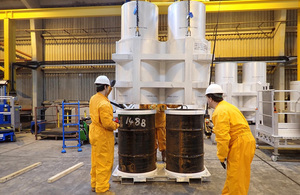
Around 800 concrete-lined drums of Intermediate Level Waste will be transferred over the next three years for interim safe storage at Sellafield under the project, which forms a critical part of the NDA’s Nuclear Materials Transfer (NMT) programme, ahead of eventual disposal in a Geological Disposal Facility (GDF).

As part of Nuclear Waste Services’ Type B programme, the three-strong Gemini fleet of specialist packages spent two years in France with ORANO NPS undergoing a condition assessment and refurbishment before undergoing extensive Site Acceptance Testing at Sellafield and Harwell to ensure their readiness for a return to service.

Steve Chester, NWS Type B Programme Manager, said:

The Gemini fleet was brought back into service specifically for its role in this project and the launch of shipments is a major milestone for the NDA Site Decommissioning and National Waste Management Strategy, its Nuclear Material Transfer Programme, and for NWS’s Type B Packaging Programme.

Teamwork proved vital to the success of the project with an integrated programme/ project management strategic approach adopted, led by NWS, with Sellafield, Magnox and ORANO NPS, to manage risk and respective site interfaces, and drive efficiencies wherever possible.

Intermediate Level Waste is loaded into a Gemini container.

Darren Holt, NWS Gemini Project Manager, said:

It is testament to the collaborative efforts and professionalism of all three site teams culminating in the successful return to service of the TN Gemini package and demonstrates the benefits of a fully integrated and collaborative approach to delivery.

Samantha Berryman, Senior Project Manager at Magnox, said:

This project has been an excellent example of teamwork, both within Magnox, the wider NDA estate and overseas. Learning from Experience has been readily shared culminating in a number of safety improvements and process optimisation.

Published 28 July 2022


Human rights in Russia: invocation of OSCE Moscow Mechanism

I am delivering this statement on behalf of the following delegations: Albania, Andorra, Austria, Belgium, Bulgaria, Canada, Croatia, Republic of Cyprus, Czech Republic, Denmark, Estonia, Finland, France, Greece, Ireland, Italy, Latvia, Liechtenstein, Lithuania, Luxembourg, Malta, Monaco, Montenegro, Netherlands, North Macedonia, Norway, Poland, Portugal, Romania, Slovakia, Slovenia, Spain, Sweden, Switzerland, Ukraine, the United Kingdom, the United States, and my own country, Iceland.

We have all been following very closely and with increasingly deep concern the human rights situation in the Russian Federation. As a participating State in the OSCE, the Russian Federation has freely committed to upholding human rights and fundamental freedoms. It has also recognised their universal significance and acknowledged that respect for human rights and fundamental freedoms is an essential factor for the peace, justice and well-being necessary to ensure the development of friendly relations and co-operation among States.

However, numerous laws imposed in the Russian Federation over the last years, such as the “foreign agents” law, regulation of the so-called “undesirable” organisations, as well as countless decrees by the Federal Service for Supervision of Communications, Information Technology and Mass Media (Roskomnadzor), along with individual administrative decisions, have all been used by Russian authorities to crack down on independent civil society, independent media, and political opposition, targeting in particular non-governmental organisations, anti-corruption activists, human rights defenders, journalists, other media actors, researchers, and lawyers. Allegations of extremism have also been used to outlaw dissenting opinions or beliefs, as well as to ban peaceful organisations.

During Russia’s ongoing war of aggression against Ukraine, freedom of expression, as well as freedom of assembly and association, have been restricted further. On 4 March 2022, the Russian Parliament amended the Criminal Code to impose a penalty of up to 15 years in prison for spreading allegedly “fake” information about the war in Ukraine; on 22 March 2022, the law was broadened to criminalise the sharing of “fake news” about any activities of Russia’s official bodies abroad; on 4 March 2022, the Russian Parliament criminalised the spreading of allegedly “fake” information discrediting the Russian armed forces and any calls for restrictive measures against the Russian state, its nationals or any Russian legal entities. Also, on 4 March 2022, the Russian Parliament banned demonstrations against the war in Ukraine.

According to a statement made by the OSCE Representative on Freedom of the Media on 16 March 2022, “the Russian Federation is rapidly moving towards a situation of complete censorship and isolation of its citizens from any form of independent information”. As reported by the citizen monitors, the Russian Federation continues to hold more than 430 political prisoners. There are also widespread reports of torture and other mistreatment in places of detention throughout Russia. The censorship of the media and of content on the internet, political repression, impunity for violence, the spread of hate speech, engagement in propaganda for wars of aggression, the imposition of severe restrictions on freedom of assembly and association, on the right to liberty and security of person, and on the right to vote and to be elected all indicate a clampdown on democracy, the exercise of human rights and the rule of law in Russia. All this requires further assessment of the impact of these severe measures on the human dimension of security. Any failure to respect and protect human rights and fundamental freedoms runs counter to OSCE commitments.

Our delegations, as well as many others at the Permanent Council, have repeatedly raised growing concerns about these developments. The Russian Federation’s response has been inadequate. We note that Russia has also failed to provide an adequate response to the findings and recommendations of the 2018 Moscow Mechanism Experts Mission report on allegations of impunity for reported human rights violations and abuses in the Republic of Chechnya, and that alarming information continues to emerge from Chechnya about abuses and violations of human rights.

Today we take the step of invoking paragraph 12 of the 1991 Moscow Document of the Conference on the Human Dimension of the OSCE (Moscow Mechanism) to establish a mission of experts to look into and report on the ongoing concerns we have identified as particularly serious threats to the fulfilment of the provisions of the OSCE human dimension by the Russian Federation, to assess Russia’s legal and administrative practice in light of its OSCE commitments, to establish the facts, and to provide recommendations and advice.

The mission of experts will be tasked, inter alia, to report on the following:

  • Firstly, to assess the state of Russia’s adherence, in law and in practice, to its OSCE Human Dimension commitments and to identify actions taken by the Russian Government over recent years that have led to the current human rights and fundamental freedoms situation in the country.
  • Secondly, to assess ramifications of such developments on Russian civil society, on free media, on the rule of law, and on the ability of democratic processes and institutions to function in Russia, as well as on achieving the OSCE’s goal of comprehensive security.

We encourage the mission of experts to apply a gender-sensitive approach to their assessment. In addition to establishing the facts, we also encourage the experts to offer recommendations and give advice to the Russian Federation, to the OSCE, and to the international community on how to address the matters of concern. In particular, we encourage the experts to offer recommendations to the OSCE and its participating States on identifying early warnings and addressing such emerging challenges in a timely and effective manner.

We look forward to working with OSCE’s Office for Democratic Institutions and Human Rights (ODIHR) on arrangements for the mission.

I thank you, Mr Chairman.


Belarus regime flagrantly violated aviation law: joint statement to the OSCE

Thank you, Mr. Chair. I am delivering this statement on behalf of Canada, the United Kingdom and my own country, the United States.

On May 23 last year, the Lukashenka regime purposefully concocted a false bomb threat in order to force the pilots of Ryanair Flight 4978 to land in Minsk for the sole purpose of arresting and detaining opposition journalist Raman Pratasevich. Pratasevich remains under house arrest in Belarus and continues to be victimized as a prop in the Lukashenka regime’s propaganda efforts.  Meanwhile, Sofiya Sapega, who was traveling with Pratasevich on May 23, is serving a six-year prison sentence based on politically-motivated charges.

The Lukashenka regime flagrantly violated international aviation law to repress dissent, silence independent voices, and send an ominous signal to opponents that being outside the borders of Belarus was no guarantee of safety.  It was a blatant act of transnational repression.  We welcome the International Civil Aviation Organization’s (ICAO) July 19 report on the incident and its condemnation of the Lukashenka regime’s unlawful interference and misuse of civil aviation.  Following a detailed investigation, the ICAO Council determined that the bomb threat against Ryanair Flight 4978 was “deliberately false and endangered its safety, and furthermore that the threat was communicated to the flight crew upon the instructions of senior government officials of Belarus.”

We condemn the Lukashenka regime’s continued efforts to brutally repress the exercise of human rights and fundamental freedoms and its crackdown on the pro-democracy movement, including its acts of transnational repression targeting members of the democratic opposition, journalists, and civil society located outside of Belarus. We also condemn the Lukashenka regime’s facilitation of Russia’s illegal invasion of Ukraine. The regime must end its support to Russia’s invasion and respect Ukraine’s territorial integrity and sovereignty in line with its international obligations.

The Lukashenka regime has expressed no remorse for its actions regarding the Ryanair flight and has not cooperated meaningfully with international investigations into the incident.  The Lukashenka regime continues to take repressive measures against political opponents, journalists, students, human rights defenders, strikers, civil society activists, and ordinary Belarusians – both those inside the country and those who have fled the regime’s continuing crackdown.

Ahead of the 2nd anniversary of the fraudulent August 9 presidential election in Belarus – and against the grim backdrop of two years of the Lukashenka regime’s violent crackdown against the pro-democracy movement –  we reaffirm our commitment to working with our partners to hold accountable those responsible for its human rights violations and abuses, as well as its acts of transnational repression. The forced diversion of Ryanair Flight 4978 not only violated international law, but endangered the lives of innocent passengers on board the plane that day.  We call on Belarus to implement the Moscow Mechanism Expert Mission’s recommendation to release all political prisoners immediately, including Pratasevich and Sapega, to stop its repression of the pro-democracy movement in Belarus, and to allow for free and fair elections.

Thank you, Mr. Chair.


New government hub housing roles moved from London opens in Birmingham

  • New hub houses 20 government departments, with space to accommodate 1700 staff
  • Hub will house some of the 2100 Civil Service roles moving from London to the West Midlands by 2025, with 880 already relocated
  • Consolidation of eight sites into one is expected to save £2 million per year

A new government hub which can accommodate up to 1700 civil servants has been hailed as an example of Levelling Up in action by helping spread more jobs to the West Midlands, as it was opened today (28 July).

Minister Rees-Mogg, responsible for Government Efficiency and Brexit Opportunities in the Cabinet Office, cut the ribbon on the building which will house 20 government departments and public bodies across nine newly refurbished floors. The government teams had previously been spread across eight different buildings, but consolidating them under one roof is expected to save the taxpayer around £2 million per year.

Civil Service roles are being relocated to Birmingham out of London via the Places for Growth programme, which will move 22,000 roles out of the capital by 2030. The government has committed to relocating more than 2,100 roles across the West Midlands by 2025 to Birmingham, Coventry, Stoke-on-Trent and Wolverhampton.

The new modern offices, built on the old site of the Theatre Royal and Woolworths at 23 Stephenson Street, form part of the Government Property Agency’s strategy to consolidate the number of public buildings and concentrate them in town and city centres.

Minister for Brexit Opportunities and Government Efficiency Jacob Rees-Mogg said:

The new Government Property Agency hub which I have opened in Birmingham today is a clear demonstration of Her Majesty’s Government’s commitment to the West Midlands.

This is good news for businesses in Birmingham, who will benefit from the increased footfall in the city centre, as well as for people from the area who will now have more opportunities to build a successful career in government.

This hub is an important part of our plans to create a leaner and more efficient public estate, which will save taxpayers’ money and serve the entire United Kingdom.

It is expected that these jobs will provide a significant boost for local business and enterprise, with government research having shown that workers put around 50% of their salaries back into the local economy.

Six thousand roles have already been moved out of the South East and across the UK as part of plans to relocate 22,000 roles by 2030.

So far 880 Civil Service roles have moved to the West Midlands, with many based in the new hub. More than 400 roles in central government teams are now based in Birmingham, including teams in the Department for Transport, Cabinet Office and other departments.

Wolverhampton has also benefited from the relocation of around 200 roles at the Department for Levelling Up, Housing & Communities following the establishment of the department’s second HQ in the city.

GPA Director of Capital Projects Clive Anderson said:

The Birmingham Hub represents another significant achievement for the GPA’s Government Hubs Programme and our ambition to deliver great places to work across the UK.

The formerly disused retail space is now refurbished into a modern, digitally-connected and inclusive workspace for civil servants across government with greater energy efficiency and smarter ways of working.

The sustainability of 23 Stephenson Street has been rated ‘Very Good’, using intelligent lighting and energy sources to power the offices. The repurposing of the building will help the government deliver on its promises to make the public estate carbon neutral in line with wider government ambitions.


“The Judge Over Your Shoulder”

Today the 6th edition of “the Judge Over Your Shoulder”, or JOYS for short, has been released. Since first publication in 1987 it is still a pivotal piece of guidance for civil servants on what to expect when working with government lawyers, allowing for effective collaboration and lowering the risk of legal challenge.

JOYS focusses on Administrative Law – the branch of law that governs the relationship between the government and citizens, and how it is applied. It is highly regarded across the legal profession and is an important resource for civil servants advising Ministers and supporting government decision making.

Last published in 2016, the new guidance has been modernised, updated and discusses the significant legal changes of recent years, including the Judicial Review and Courts Act 2022. The cases considered reflect current legal positions as of May 2022, with insight provided by government lawyers. It also considers legal concepts, including consultation, proportionality and justiciability.

We encourage you to share the document with your Civil Service colleagues.

Published 28 July 2022
Last updated 24 October 2022 + show all updates

  1. The Judge Over Your Shoulder accessible PDF

  2. Lead image updated

  3. First published.