Border Force and French Police Aux Frontières joint statement

News story

Joint statement from UK and French agencies on the management of the shared border.

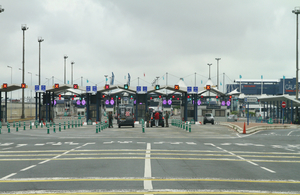
An image at the Dover port.

The Director General of Border Force, Phil Douglas and the Deputy Director General of the French Police Aux Frontières, Brigitte Lafourcade, have made a joint statement today on the management of the shared border.

Statement by UK Border Force and French Police aux Frontières

France and the UK have been working closely together over recent days to prepare for the management of our shared border through the current period of increased passenger traffic.

Both Police Aux Frontières and UK Border Force, in partnership with the port operators, have put plans in place at the juxtaposed controls on both sides of the Channel this weekend to maximise passenger flows.

France and the UK will continue to work together intensively to support fluidity of freight and passengers across the Channel through the summer period and beyond.

Communique de la Police Aux Frontières et de la Border Force Britannique

La France et le Royaume-Uni ont travaillé en étroite coopération au cours des derniers jours afin de planifier la gestion de notre frontière commune au cours de la période actuelle marquée par une augmentation du nombre de passagers.

La Police aux Frontières française et la « Border Force » britannique ont, en partenariat avec les opérateurs portuaires, pris les mesures nécessaires aux points de contrôles juxtaposés de chaque côté de la Manche afin d’optimiser les flux de passagers au cours de ce week-end.

La France et le Royaume-Uni continueront à mettre en œuvre tous les efforts pour assurer la fluidité du trafic des passagers et des véhicules de fret à travers la Manche tout au long de la période estivale et à l’avenir.

Published 29 July 2022


Kenya launches 2050 calculator to advance Climate Change mitigation in East Africa

Kenya’s Ministry of Energy, the British High Commission Nairobi, and Strathmore University have jointly launched the Kenya Carbon Emission Reduction Tool (KCERT 2050), a bespoke energy and emissions model to assist Kenya in achieving its climate goals.

The interactive energy model – the first in East Africa – was delivered under the UK Government’s international 2050 Calculator programme, which is funded by the UK’s International Climate Finance, and led by global engineering, management and development consultancy Mott MacDonald, and a consortium which includes Imperial College London, Climact and Ricardo.

KCERT 2050 allows users to trial options for reducing climate change-inducing carbon emissions at a faster rate and to build a pathway that meets long-term emission targets to 2050 and beyond. It can be used to support policy-making to allow governments to increase national action on climate change and strengthen ambition in line with the 2015 Paris Agreement.

KCERT 2050 will play a key role in helping policy-makers, energy producers and consumers, including the public, in Kenya to understand the energy and emissions related choices they are making. It also provides a platform for engaging in dialogues on the challenges and opportunities of the future energy system and the responses to climate change. The project gives Kenya the opportunity to pioneer climate mitigation approaches across the East African region.

H.E Jane Marriott British High Commissioner to Kenya said:

As part of strengthening our UK-Kenya Strategic Partnership on climate action, the British High Commission welcomes the launch of the Kenya Carbon Emissions Reduction Tool 2050. This tool, which is a first in East Africa, will support government departments in Kenya to design and deliver evidence based, inclusive policies on emissions reductions, energy access, and matching energy supply and demand. I look forward to Kenya acting as a pioneer in championing the use of this innovative tool that will provide options for implementing Kenya’s emission reduction strategies and achieving net-zero development pathways by 2050.

In his remarks, the Principal Secretary Ministry of Energy, Maj. Gen (Rtd). Dr. Gordon Kihalangwa noted;

Energy is about security, about development, but if we use it badly it will affect us negatively. Kenya has complied with the Paris Agreement by submitting a revised NDC. A country like this is privileged to use renewables, and the tool will help us work out how we will get to net-zero by 2050.  This KCERT 2050 will be used to support the reduction of emissions and create resilience to climate change in the energy sector in Kenya

Dr John Olukuru, Head of Data Science and Analytics at Strathmore University and Lead KCERT Modeller said:

The Kenya Carbon Emission Reduction Tool (KCERT) 2050 is an important data driven policy making tool in climate change. It will help every Kenyan, expert or non-expert, to engage in a well-informed climate change debate. The calculator considers all sectors, stakeholders’ input and various scenarios that provide enormous volume of data and hence sets a foundation to applying AI and machine learning to monitor and decrease carbon emissions, streamline operations to empower every policy maker to recognize that climate action provides an opportunity to create value by tapping into new markets and meeting growing demand for low-carbon plus greener services.

David Orr, Emerging Markets Trade and Investment Lead for Mott MacDonald and Programme Country Manager for Kenya, noted:

It has been such a pleasure working with the team to build the KCERT 2050 tool. Over the coming years, the tool will play a core role in advancing Kenya’s net zero transition, inspiring policy-makers across East Africa.

Dr Onesmus Mwabonje, a Research Fellow at Imperial College London’s Centre for Environmental Policy and core member of the Consortium team for Kenya, added:

KCERT will support and stimulate the decarbonisation debate in Kenya, helping to break down silos and generate the consensus across government departments needed to effectively combat, mitigate and adapt to climate change. The decision support capacity that the International 2050 Calculator programme has developed on the modelling of complex transitions and technological options will have a lasting impact in the country and beyond.

The KCERT is available at http://kcert.ilabafrica.ac.ke/

Further information

Background to the 2050 Calculator programme in Kenya

  • KCERT 2050 is an integrated model of energy demand and supply, emissions, and land use in Kenya. It aims to identify energy secure pathways for energy demand and supply between 2015 and 2050. It is developed on the framework of the UK 2050 Calculator and was built in Kenya, by Kenyans, for Kenya.
  • In 2010, the UK Government developed the original 2050 Calculator for the UK; although it has a very flexible structure which can be (and has been) adapted and updated to integrate and suit different economies. Since 2012, UK International Climate Finance has supported the creation of 19 national and 6 regional energy models, which have been used to develop NDCs and action plans, raise awareness and inform long-term energy strategies. In 2020, BEIS launched an updated 2050 Calculator, the MacKay Carbon Calculator.
  • It is a uniquely open, transparent and interactive energy model that allows users to explore options for reducing emissions in a city, region or country, develop evidence-based policies and build pathways to meet long-term emission targets. It sets out a range of four trajectories for the types of changes that might occur, ranging from business as usual to high ambition. These trajectories are intended to reflect the whole range of potential future scenarios that might be seen in that particular sector.
  • The 2050 Calculator and other UK ICF programmes play a critical role in enabling countries to set, plan for, and ratchet ambitious climate targets to act with the urgency that we need today.

Objectives of the KCERT 2050

  • To help users (government, businesses, academia and individuals) to understand the wide range of possible energy pathways available to the country as Kenya develops its green growth transition.
  • To provide quantities of energy demand, supply, emissions, and potential implications for key sectors in Kenya on issues such as import dependence and land requirement.
  • To offer a platform to facilitate policy debate about the possible future pathways for the Kenyan energy sector and enable potential policy interventions for deeper analysis.
  • To help planning to meet Kenya’s updated NDC, which commits to abate GHG emissions by 32% compared to the business-as-usual scenario in 2030. To help attain this target, the Calculator will support Kenya to undertake sophisticated multisectoral planning.

Benefits to Kenya

  • The KCERT 2050 will increase capacity of departments across the Government of Kenya to carry out strengthened energy systems analysis. The tool allows planners, decision-makers to answer important questions, such as how much greenhouse gas emissions can be reduced and how energy demand can be met, with four different levels of effort and respective emissions levels over years.
  • The tool also allows users to verify the viability of long-term goals, encouraging the participation of disparate opinions, facts, and scientific analysis.
  • It can engage Kenya energy experts and non-experts alike in debate around policy-making towards a more secure, sustainable, and affordable energy future for the country; improving inclusivity of energy policy assessment, policy formulation, and energy planning. The tool also allows users to verify the viability of long-term goals, encouraging the participation of disparate opinions, facts, and scientific analysis.

References


Russia’s record of barbarism and criminality in the five months since they invaded Ukraine: UK statement to UN Security Council

Thank you President. And I join others in thanking Ambassador Byrne-Nason for her stalwart and eloquent defence of international peace and security during your tenure on the Security Council and elsewhere. We will miss you.

President, I’d like to start by thanking Under-Secretary-General DiCarlo for her briefing.

First, we join others in welcoming the 22 July deal agreed in Istanbul to export the grain trapped by Russia’s blockade of Odesa and other ports.

We commend the role of the UN and Turkiye in brokering this solution.

The agreement is undoubtedly important. Its implementation is now vital.

So that Ukrainian farmers’ grain can once again be baked into bread in markets and on tables around the world – and enable the World Food Programme to address pressing famine conditions in Somalia and Ethiopia.

Second, we cannot forget the record of Russia’s atrocities and crimes in the over five months since Russia invaded Ukraine. Before the ink was even dry on the 22nd of July grain agreement, Russia brazenly attacked Odesa port. This latest attack follows others: breaches of international humanitarian law in Bucha and Irpin, the attacks on civilians in the Mariupol theatre, Kramatorsk train station, Kremenchuk shopping mall, apartment buildings in Chasiv Yar and Vinnytsia, and the widespread torture and abuse of detainees, including women and children, as identified by Human Rights Watch and the OSCE Moscow Mechanism.

The video this week of the castration of a Ukrainian prisoner of war by Russian soldiers is an illustration of Russia’s barbarism and criminality.

Third, Russia has violated the UN Charter and breached its obligations under that charter. For five months, Russia has been engaged in an illegal invasion of another Member State in breach of its obligations under the UN Charter, and in complete disregard of resolutions of the General Assembly and orders of the ICJ.

Preparations for sham referenda in Kherson and Zaporizhzhya are the latest examples of Russia’s breaches of Ukrainian sovereignty and territorial integrity.

So, Mr President, we continue to demand that Russia end its invasion, withdraw from Ukraine and uphold its obligations under the UN Charter.


GAD’s wide-ranging skills

News story

GAD’s wide ranging work including the use of data science and modelling, was discussed at a recent event attended by analysts from local authorities.

Decorative image depicting an artist's impression of a digital pattern.

The wide remit of work undertaken by the Government Actuary’s Department (GAD) and the changing roles of actuaries were discussed at a recent local government webinar.

Actuaries from GAD joined members of the Local Government Advanced and Predictive Analytics Network (APAN) at its 10th webinar. This virtual event was attended by analysts from local authorities across England and Wales.

Current challenges

GAD presenters explored examples of how we use data science, insurance mechanisms and quality assurance processes as part of projects. We also considered how this work could be relevant to the current challenges being faced by local government.

The session included case studies on:

  • COVID-19 – covering our work with the Department of Health and Social Care, to identify and prioritise vulnerable people during the pandemic
  • data science – we shared information about models and predictive data analytics when it comes to modelling potential drought outcomes in sub-Saharan Africa
  • quality assurance – we shared tips and examples of good quality assurance in projects, using projects relevant to local government
  • insurance – where protection is important and how we help departments address deficiencies in insurance cover
  • contingent liabilities – we shared expertise on the complex area of contingent liability in projects, including commercial insurance and indemnities

Sharing expertise

GAD actuary Jon Day said: “As an advocate for the use of data science and predictive analytics across the public sector, we were able to share our case studies with the APAN members.

“We help the network consider how predictive analytics, model quality assurance and insurance principles could help provide solutions to the challenges facing local authorities.”

Published 29 July 2022


Ministers take action to tackle travel disruption

Ministers from across government have introduced a package of new measures to tackle travel disruption, helping to minimise the impact of ongoing rail and underground strikes and prevent long queues for passengers crossing the Channel.

Ahead of another busy weekend of holiday travel, this morning, Ministers and senior officials met for the second time this week, to discuss the preparations being put in place to ease any potential disruption, bolstering existing support for UK industry.

To ensure people can still easily get to the Commonwealth Games this weekend, contingency measures have been put in place, including extra capacity on rail lines that are running and laying on coaches for sports fans and spectators.

To minimise queue times in Kent, and prevent a repeat of the disruption seen last weekend, UK and French officials and Ministers have had regular discussions this week and a new UK-French Passenger Technical Working group has been established. This group will meet weekly throughout the summer to avoid any further disruption for passengers travelling to either side of the Channel.

Traffic enforcement has also been put in place to keep roads passable around Dover and Folkestone.

Flight cancellations have also recently fallen back to their 2019 levels following changes to regulations on airport slot rules to help airlines make sensible decisions about their schedule; avoiding last minute cancellations and providing passengers with more certainty.

Chancellor of the Duchy of Lancaster and Lead Minister for Resilience Kit Malthouse said:

“I know that travel disruption can affect all of us, whether you need to commute to work, travel to visit your friends, family or loved ones, get away on your well earned Summer break or even attend an event like our fantastic Commonwealth Games. I am working with ministers and officials right across government, as well as our partners and industry, to assess and mitigate any disruption, including any knock on effects from the rail strikes.

“We have already taken action, and continue to work with the Port of Dover, Eurotunnel, and the French Government, National Highways, local police and the Kent Resilience Forum on minimising traffic disruption, and also with our airport operators to avoid last minute cancellations, and we will continue to take all the necessary steps to help people travel easily.”