North London restaurateur banned for under-declaring tax

Village Mangal Limited was incorporated in December 2012 and Ifras Coruk (43) was appointed the sole director at the same time.

The company traded as a Turkish Restaurant called Village Mangal in Amersham, Buckinghamshire, but began to struggle and by January 2019, Village Mangal Limited entered into creditors voluntary liquidation.

The insolvency process, however, triggered further investigations into Ifras Coruk’s conduct as director of Village Mangal Limited due to the company’s tax irregularities.

Investigators uncovered that Ifras Coruk had caused the company to under-declare its sales in various tax returns between December 2012 and September 2015.

At the point of liquidation, Village Mangal had liabilities of just over £220,000 connected to the undeclaring of its sales, which resulted in penalties of over £98,000 also being issued by the tax authorities.

On 19 May 2020, the Secretary of State accepted a disqualification undertaking from Ifras Coruk after he did not dispute that he had caused Village Mangal to submit inaccurate tax returns

The ban is effective from 9 June 2020 after which the restaurateur is banned for 6 years from acting as a director or directly or indirectly becoming involved, without the permission of the court, in the promotion, formation or management of a company.

Lawrence Zussman, Deputy Head of Insolvent Investigations for the Insolvency Service, said:

Ifras Coruk failed to take his responsibilities as a director seriously and the risks he took ultimately ended up in his removal from the business environment for a substantial amount of time.

Much of the public service is funded by the correct amount of taxes being declared and paid and Ifras Coruk’s ban should serve as a warning to other directors that you risk being disqualified if you do not comply with the law.

Ifras Coruk, is from Edmonton, North London, and his date of birth is October 1976.

Village Mangal Limited (Company registration number: 08329803)

Persons subject to a disqualification order are bound by a range of restrictions.

Further information about the work of the Insolvency Service, and how to complain about financial misconduct.

You can also follow the Insolvency Service on:


Letter from the Prime Minister to the Chair of the Public Inquiry into the Grenfell Tower fire


Public health border measures to come into force next week

The rules covering new measures to be imposed at the UK border from next week to protect against coronavirus will be published on 3 June 2020.

The self-isolation measures being introduced from Monday are designed to prevent new cases being brought in from abroad and to prevent a second wave of the virus.

Key measures being introduced include:

  • All arrivals – bar a short list of exemptions – will be required to complete an online locator form to supply contact details, travel details and the address of where they will self-isolate for 14 days. Where international travellers are unable to safely self-isolate in their own accommodation the Government will support them finding appropriate accommodation at their own expense.
  • Passengers arriving in the UK will be required to self-isolate for 14 days and could be contacted regularly throughout this period to ensure compliance. Public Health England will contact people at random to ensure they understand the requirements and are self-isolating. Removal from the country would be considered as a last resort for foreign nationals who refuse to comply with these public health measures.
  • Anyone failing to comply with the mandatory conditions may face enforcement action. A breach of self-isolation would be punishable with a £1,000 fixed penalty notice in England or potential prosecution and unlimited fine.
  • The level of fine could increase if the risk of infection from abroad increases. The Devolved Administrations will set out their own enforcement approaches.
  • Border Force will undertake checks at the border and may refuse entry to any non-resident foreign nationals who refuses to comply with these regulations and isn’t resident in the UK. Failure to complete the form is also punishable by a £100 fixed penalty notice.

The rules do not apply those travelling from within the CTA (Ireland, the Isle of Man and the Channel Islands) – unless they have arrived in the CTA from overseas within the last 14 days, in which case they will have to provide locator details and self-isolate on arrival here. This will help make sure that those who could have come into contact with the virus overseas cannot bypass the self-isolation measures.

Those who have arrived in the CTA longer than 14 days ago will not have to provide locator details or self-isolate if they travel to the UK.

Home Secretary Priti Patel said:

Protecting the public’s health and avoiding a second peak that overwhelms the NHS will always be our top priority.

As we get the virus under control here, we must manage the risk of cases being imported from abroad. We owe it to the thousands who’ve lost their lives not to throw away our progress.

These measures are informed by science, backed by the public and will keep us all safe.

The new measures will be in place across the United Kingdom from 8 June, although enforcement measures will be set individually by the Devolved Administrations. The measures will be subject to review, to ensure they are in line with the latest scientific evidence and remain effective and necessary. The first review will take place by 29 June.

We will take a number of factors into account within the reviews to satisfy that, in line with scientific advice, the risk of imported cases is suitably low. The factors will include:

  • The rate of infection and transmission internationally and the credibility of the reporting.
  • The measures that international partners have put in place.
  • Levels of imported cases in other countries where there are more relaxed border measures.
  • And the degree to which antibody and other testing methodologies prove effective in minimising the health risk.

We will also continue to take account of the impact on the economy and industry.

Secretary of State for Transport Grant Shapps said:

To get the country and our economy back up and running, we must do everything to avoid a second wave of the virus, because if we get this wrong we will all suffer, and that’s why introducing these measures now is so important.

These measures will be reviewed every few weeks, and we are working with the transport industry to see how we can introduce agreements with other countries when safe to do so, so we can go abroad and tourists can come here.

As the Home Secretary confirmed at her recent press conference, the Government continues to look at other options to increase travel when it is deemed safe to do so. These include arrangements, known as “air bridges” or international travel corridors, which would remove self-isolation measures and safely open up routes to and from countries with low transmission rates.

Agreement would need to be made with individual countries before these measures take effect and the UK would seek assurances that any safe corridors met the needs of both countries.
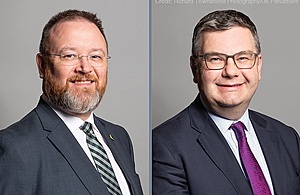


Ministerial appointments at the office of the Secretary of State for Scotland

News story

Alister Jack has welcomed two new ministerial appointments at the Office of the Secretary of State for Scotland.

David Duguid and Iain Stewart

Secretary of State for Scotland Alister Jack said:

It is great news that Iain Stewart and David Duguid have been appointed as UK Government Ministers for Scotland. Talented and experienced, they will both bring a great deal to government at this critical time.

There are huge challenges and great opportunities ahead for Scotland. As we continue to tackle coronavirus and protect the public’s health, start to recover our economy, and look forward to a new relationship with the EU, we will make sure that Scotland’s interests are at the forefront.

I would like to take this opportunity to again thank Douglas Ross for his very valuable contribution in his time as a minister, and to wish him well for the future.

Following his appointment as Parliamentary Under Secretary of State for Scotland, Iain Stewart said:

It is a great honour to have been appointed by the Prime Minister as UK Government Minister for Scotland.

We are facing a global crisis, and the UK Government is working tirelessly to tackle the pandemic in all parts of our country. We have stepped up to help Scottish businesses with financial support, furloughed millions of workers across the country, and supported the Scottish Government with £3.7 billion of extra funding.

As we start to slowly ease the restrictions, our focus must be on continuing to keep our citizens safe. But it must also be on beginning to recover Scotland’s economy, protecting jobs and ensuring our future prosperity.

I look forward to working with the ministerial team at the Scotland Office as part of a UK Government which is delivering for people in Scotland. I am very proud to be given the opportunity to make a contribution at such a vital time for our country.

Following his appointment as Parliamentary Under Secretary of State for Scotland, David Duguid said:

I am honoured to have been appointed as a UK Government minister for Scotland.

My focus will be very much on Scotland’s economy as we get things moving after the coronavirus pandemic. As part of that, I will continue to champion our transformative investment of more than £1.4 billion in Scottish city and growth deals, as we extend their cover to the whole of Scotland.

Looking ahead, we will ensure that our new relationship with the EU works for Scotland, bringing new opportunities for many of our vital industries, including Scotland’s farmers. We will ensure that Scotland’s fishing industry has a bright future as we leave the unfair common fisheries policy and become, once again, an independent coastal state.

Published 2 June 2020


Coronavirus recovery in prisons and probation

In March, temporary restrictions were put in place to minimise movements between jails and reduce face-to-face probation meetings to avoid thousands of offenders and staff becoming infected with the virus. Since then, strong further measures have been implemented, including the early release of low-risk offenders, temporary expansion of the prison estate, and work to reduce the number of those held on remand.

This action has helped to reduce the prison population, allowing jails to implement ‘compartmentalisation’, meaning staff have isolated those prisoners with symptoms, shielded the vulnerable and quarantined new arrivals.

As a result of the success of those measures, which have helped to contain the spread of the virus and limit deaths, consideration can now be given to how these restrictions can be cautiously

Prisons and Probation Minister, Lucy Frazer QC MP, said:

As a result of the strong measures we introduced, lives have been saved and the NHS is being protected from the impact of widespread local outbreaks.

I want to first pay tribute to the hard-working staff across the country who have enabled this to take place. They have been striving tirelessly to make sure those in their care are safe and the public is protected.

The decision to introduce restricted regimes across our jails was not taken lightly, and I want to acknowledge the impact of that.

While safety must remain our paramount concern, the sacrifices of recent months mean we are now in position to consider how to cautiously restart aspects of daily prison life, such as social visits, education and work – with adaptations where necessary to ensure safety.

This cannot happen in a uniform way across all prisons and decisions will take account of individual circumstances. Inevitably this will mean some prisons move faster than others. The national guidance we are publishing today will allow governors to make decisions in a consistent way.

In probation, the restrictions have been necessary for the safety of staff and offenders, while ensuring the public is protected and the monitoring of high-risk offenders remains tough. However, we will now look to resume certain activities, such as gradual increases in office visits, unpaid work and accredited programmes. Like in prisons, this will only happen with appropriate safety measures in place and when local circumstances make it appropriate to do so.

This will not be a straightforward return to normality and local restrictions may need to be re-imposed if outbreaks occur.

We are only able to consider these steps due to the extremely careful handling of the initial phase of the pandemic. This is a direct result of the extraordinary efforts of our staff and the resilience of all those affected.

Her Majesty’s Prison and Probation Service national frameworks can be read on GOV.UK: