Government launches climate change consultation for pension scheme

News story

The consultation proposes more effective governance, strategy, risk management and targets for the assessment and management of climate related risks and opportunities for the Local Government Pension Scheme.
The government has launched a consultation today (Thursday 1 September) on new requirements for the Local Government Pension Scheme (LGPS) to manage and report on their climate-related risks, including the carbon emissions attributable to their investments.

The proposals include a requirement for LGPS authorities to calculate their carbon footprint, and to assess how different temperature rises could affect their assets and liabilities.

Authorities would also need to report annually on how well their assets are aligned with the Paris agreement.

The move seeks to improve the management of climate-related financial risk and brings the LGPS in line with requirements which are already in place for private pension schemes.

Minister for Levelling Up, Paul Scully MP said:

Managing risks and opportunities related to climate change is essential for the future of the financial sector. It will empower better decision making and ultimately help us on the road to net zero.

The UK is a world leader in implementing the recommendations of the Taskforce for Climate-related Financial Disclosures, which are a key factor in greening the financial sector.

I am pleased that we are proposing to extend these requirements to the Local Government Pension Scheme, which has assets in excess of £300 billion and enormous potential to have a positive climate impact.

The consultation puts forward proposals which will require LGPS administering authorities to have more effective governance, strategy, risk management and targets for the assessment and management of climate related risks and opportunities.

The requirements do not encourage funds to divest from energy companies, which will be key to the transition to clean energy in the UK.

Government will invite people to respond to the consultation on the proposals raised.

Published 1 September 2022


Update to DBS customer contact centre services – 5 to 10 September 2022

News story

Planned industrial action from contractors is set to affect DBS contact centre services.

Decorative graphic that reads: Update to DBS customer contact centre services, with an icon of a telephone on a purple background.

Customers contacting the Disclosure and Barring Service (DBS) between 5 to 10 September 2022 by telephone, email, or webchat may face some disruption and delays. This is due to industrial action by staff working for one of our contractors, Hinduja Global Solutions (HGS). HGS is contracted to provide DBS customer contact centre services, as well as a number of other administrative functions.

During the industrial action, HGS is putting additional resources in place to try and minimise the inconvenience to customers as much as possible.

The industrial action is not expected to have any significant impact on turnaround times for DBS checks or barring decisions. Our core services will not be affected, and employers and customers should continue to access these as normal.

During the industrial action, the times of the customer contact centre will be reduced to:

  • Monday 5 September to Friday 9 September: 9am to 5pm
  • Saturday 10 September: Closed

Webchat services will still be available to customers in normal operating hours (Monday to Friday, from 9am to 5pm). Webchat becomes available to customers when they access online services such as applying for a DBS check, making a barring referral, or logging onto the Update Service.

Published 1 September 2022


UN Human Rights Chief’s report on Xinjiang, China: Foreign Secretary’s statement

Press release

Liz Truss gave a statement after the United Nations High Commissioner for Human Rights report provided new evidence of China’s human rights violations in Xinjiang.

UK Foreign Secretary Liz Truss

UK Foreign Secretary Liz Truss said:

The report by the UN High Commissioner for Human Rights provides new evidence of the appalling extent of China’s efforts to silence and repress Uyghurs and other minorities in Xinjiang.

It includes harrowing evidence, including first-hand accounts from victims, that shames China in the eyes of the international community, including actions that may amount to crimes against humanity.

This includes credible evidence of arbitrary and discriminatory detention, torture, sexual and gender-based violence, violations of reproductive rights, and the destruction of religious sites. UN member states must now be given the opportunity to consider the report fully.

The UK has already led international efforts to hold China to account at the UN, imposed sanctions on senior Chinese government officials, and announced measures to help ensure no UK organisations are complicit in these violations through their supply chains.

We will continue to act with international partners to bring about a change in China’s actions, and immediately end its appalling human rights violations in Xinjiang.

Published 1 September 2022


RAIB Inspector vacancies

Do you feel you could make a significant contribution to railway safety in the United Kingdom?

Are you looking for a job that enables you to travel and get out and about in the railway industry, as well as working in a highly collaborative and supportive office environment?

If the answer is yes, we’re currently recruiting Inspectors with experience in the disciplines of:

  • Geotechnics
  • Crashworthiness
  • Rail Vehicle Dynamics
  • Railway Safety/Risk Management and Assurance
  • Causal Analysis and Consequence Modelling
  • Railway or Tramway Operations

If you have the experience and knowledge we are looking for visit Civil Service Jobs to find out more about the role.

Published 1 September 2022
Last updated 6 September 2022 + show all updates

  1. Link to Civil Service Jobs updated providing latest information about the application

  2. First published.


Almost £5million investment brings boost to Yorkshire environment

Press release

More than 82 hectares of habitat has been created or improved in the past year as part of the Environment Agency’s programme of improvements across Yorkshire.

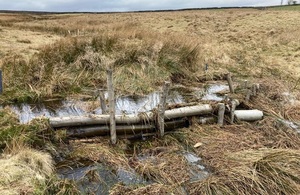
Image shows a leaky dam on the landscape

A leaky dam as part of the Sheffield Lakeland Landscape project

The programme, which includes almost 40 projects, also includes 15km of riverbank improvements and has seen 53,000 trees planted.

Projects include removing barriers to fish movement, habitat restoration, measures to improve water quality and natural flood management, which protect the natural environment, make rivers more resilient to climate change and boost wildlife.

The Yorkshire Environment Programme is managed and delivered by the Environment Agency working mainly in partnership with government-backed Catchment Partnerships, bringing together river and wildlife trusts, local authorities and other organisations to improve the environment.

There were over 100 partners involved in this year’s £5million programme contributing more than £2.1million in funding to the projects.

Key projects progressed in 2021/22 include:

  • The Upper Aire Habitat and Land Management Project has improved habitat and water quality across over 350km² through landowner engagement.
  • Connecting the Calder is investigating five potential weir removals on the River Calder.
  • Derwent Upland Streams has been working with landowners in the North York Moors National Park and surrounding areas to improve land management and boost ecological status across eight waterbodies.
  • The BEACH Esk project has worked with local communities and landowners to reduce marine pollution and increase habitats like saltmarsh in the Esk estuary.
  • Other projects on the Esk include the ongoing Pearl Mussel captive breeding programme to drive the recovery of the endangered species, and research work to discover if invasive signal crayfish are present in the river.
  • A new Yorkshire Coast Catchment Partnership was set up to bring together expertise to benefit the 320km Yorkshire coastline.
  • Sheffield Lakeland Landscape Partnership has reduced the run-off of water from the land and sedimentation in the Don and Rother Catchment and slowed the flow – reducing flood risk downstream.
  • The Leven Canal was de-silted delivering 1.6km of improvements to what is a Site of Special Scientific Interest (SSSI).
  • The Rivers in Elmet project addressed sediment and nutrient pollution through tree and hedgerow planting and making improvements on farms.

Victoria Slingsby, Environment Planning and Engagement Manager for the Environment Agency in Yorkshire, said:

This year’s environment programme has yet again seen some significant improvements right across the county, from natural flood management solutions, improved fish migration and interventions to enhance water quality.

The scale of delivery and achievement reflects the appetite of ourselves and our partners in Yorkshire to be at the forefront of managing environmental improvements for people and wildlife.

Published 1 September 2022