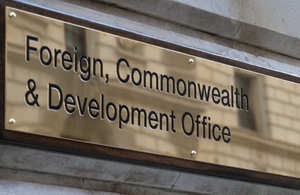
Expulsion of two British diplomats from Belarus: Foreign Secretary statement

Government response

Foreign Secretary Dominic Raab gave the following statement on the expulsion of two British diplomats from Belarus.

Foreign Secretary Dominic Raab said:

“The expulsion of two British diplomats for legitimately observing protests in Minsk is wholly unjustified. As independent reports show, this is part of a concerted campaign of harassment aimed at activists, media and now diplomats.

“Instead of trying to bully those shining a light on his repression, Mr Lukashenko must agree to free and fair elections and enable those responsible for violence against demonstrators to be held to account.”

Published 9 November 2020


More rapid COVID-19 tests to be rolled out across England

  • Next stage of partnership between NHS Test and Trace and local directors of public health will enable increased testing of priority and high-risk groups in local communities on a weekly basis
  • Increase in asymptomatic testing will help pick up more cases, stop the spread of the virus and support communities and critical industries

Over half a million rapid-turnaround lateral flow tests will be sent out by NHS Test and Trace to local public health leaders this week, signalling the next phase of the government’s plan to expand asymptomatic testing for COVID-19, the Prime Minister announced today.

Test kits will be issued to over 50 directors of public health across England this week, to enable local teams to direct and deliver community testing based on their local knowledge. Each will receive a batch of 10,000 antigen lateral flow devices as part of a new pilot to enable them to start testing priority groups.

Directors of public health will determine how to prioritise the allocation of these new tests, based on the specific needs of their communities, and will determine how people in the local area are tested. They will be supported by NHS Test and Trace to expand testing programmes in their area through access to training and clinical and operational guidance.

This initial 600,000 batch will then be followed up with a weekly allocation of lateral flow antigen tests. The Secretary of State for Health and Social Care has now written to all upper-tier local authority leaders, confirming that all directors of public health will be offered this weekly allocation, equivalent to 10% of their population. This will build on the existing partnerships between NHS Test and Trace and local leaders.

Directors of public health were prioritised for the first phase of rapid community testing based on the local prevalence of COVID-19 and expressions of interest to the Department of Health and Social Care (DHSC). Any director of public health who wants to start rolling out local testing using lateral flow tests can do so by contacting DHSC.

Proactively testing asymptomatic individuals will help identify those who unknowingly have the virus and enable those who test positive and their contacts to self-isolate, which can help drive down the R rate locally and save lives. This is crucial to break the chains of transmission of the virus and to support critical industries, key workers and institutions. With lower rates of transmission, those at highest risk from the virus will be more protected and residents will feel more confident in getting back to their day-to-day lives.

Health and Social Care Secretary, Matt Hancock, said:

Last week we rolled out mass testing in Liverpool using new, rapid technology so we can detect this virus quicker than ever before, even in people who don’t have symptoms. Mass testing is a vital tool to help us control this virus and get life more normal.

I am delighted to say 10,000 of these tests will now be sent out by NHS Test and Trace to over 50 directors of public health as part of our asymptomatic testing strategy. I want to thank all directors of public health for their support and efforts over the past months to help us tackle this virus, bring it under control and get the country back to what we love doing.

This rollout will further develop the evidence base for how testing with fast, reliable COVID-19 tests can be delivered at scale. Local leaders will also benefit from a more accurate picture of the number of cases in their area, by picking up those who may not have symptoms, supporting local decision-making to manage the spread of the virus and support their communities.

This innovative new testing technology – which is already being rolled out as part of whole-city testing in Liverpool that began on Friday – can provide results within an hour without needing to be processed in a lab.

Liverpool has set up 16 testing sites for asymptomatic testing, a number of mobile test units and is delivering a significant number of home testing kits across the city.

Interim Executive Chair of the National Institute for Health Protection Baroness Dido Harding said:

I am delighted that as part of our expansion of testing we are able to partner with local authorities to deliver these new rapid turnaround tests to our local communities. Building on national capacity of 500,000 tests a day, we are now moving to the next stage of testing tailored around the individual needs of local areas with control in the hands of local directors of public health.

There has been a huge amount of work to develop these new testing capabilities and I want to thank colleagues across NHS Test and Trace, Public Health England and the wider scientific community for ensuring that we are one of the first countries in the world who are able to deploy these new tests for the benefit of our public.

Anyone who tests positive must self-isolate along with their household immediately and their contacts will be traced. Eligible individuals who test positive – and contacts who are required to self-isolate – will be entitled to the £500 Test and Trace Support Payment in the same way as a regular swab test ordered through NHS Test and Trace.

Those who test negative will need to continue to follow all national guidance.

Today’s announcement follows the Prime Minister’s commitment on 16 October that lateral flow antigen tests would soon be made available to directors of public health in England for them to direct and deliver an expansion of asymptomatic testing in line with local priorities.

The government has also committed to providing the Devolved Authorities with an allocation of lateral flow tests as they are made available, as part of UK-wide collaboration to stop the spread of the virus. Eligibility and deployment of testing in devolved administrations will be determined by the respective administrations.

NHS Test and Trace is already working closely with local authority leaders to tailor testing to local need. This includes agreeing the sites of mobile testing units and local (walk-in) test sites, surging in testing to support outbreak management and in managing regular testing in care homes. This deeper partnership with local authorities builds on this with NHS Test and Trace providing the tests, clinical and operational expertise, designs of test sites and protocols and creating a best-practice network to share learning across local areas and with the national team.

Lateral flow antigen tests are a new kind of technology that could be used to test a higher proportion of asymptomatic people, better enabling us to identify and isolate more people who are at high likelihood of spreading virus, and break the chain of transmission.

Lateral flow devices do not require a laboratory to process the test. Swabbing and processing of these tests must currently be conducted at a dedicated testing site by trained personnel. The devices are designed to be intuitive and require minimal training to operate, and we are looking at how this test could be self-administered.

The devices will be issued to directors of public health in the following local authorities:

  • Barking and Dagenham
  • Bexley
  • Birmingham
  • Blackburn and Darwen
  • Blackpool
  • Bolton
  • Brent
  • Bristol
  • Bury
  • Calderdale
  • Camden
  • City of London
  • County Durham
  • Coventry
  • Darlington
  • Doncaster
  • Dudley
  • East Riding of Yorkshire
  • Enfield
  • Essex
  • Gateshead
  • Greenwich
  • Hackney
  • Halton
  • Hammersmith and Fulham
  • Hartlepool
  • Hertfordshire
  • Kingston upon Hull
  • Islington
  • Kensington and Chelsea
  • Kingston upon Thames
  • Knowsley
  • Lambeth
  • Lewisham
  • Luton
  • Manchester
  • Middlesborough
  • Newcastle upon Tyne
  • Newham
  • North Tyneside
  • Northumberland
  • Nottingham City
  • Nottinghamshire
  • Oldham
  • Redbridge
  • Redcar and Cleveland
  • Richmond upon Thames
  • Rochdale
  • Salford
  • Sefton
  • South Tyneside
  • Southwark
  • St Helen’s
  • Staffordshire
  • Stockport
  • Stockton-on-Tees
  • Sunderland
  • Tameside
  • Tower Hamlets
  • Trafford
  • Wakefield
  • Waltham Forest
  • Wandsworth
  • Warrington
  • Wigan
  • Wirral
  • Wolverhampton

Stoke on Trent, Liverpool and Lancashire have already been provided with lateral flow tests before this week.


A letter from Rishi Sunak to Sir David Norgrove on the date of the government and UK Statistics Authority’s response to their joint consultation on reform to the Retail Prices Index

Today, the Chancellor has written to the Chair of the UK Statistics Authority (UKSA) Board announcing that the Government and UKSA will publish their response to the consultation on reform to the Retail Prices Index (RPI) alongside the Spending Review on 25 November.

The consultation launched at Budget on 11 March. It was scheduled to close on 22 April, however, owing to the coronavirus (COVID-19) pandemic, the consultation period was extended to 21 August.


UK government response to Pfizer/BioNTech’s publication of efficacy data of their COVID-19 vaccine

Government response

Pfizer/BioNTech published positive efficacy results from Phase 3 studies of their potential COVID-19 vaccine.

Pfizer/BioNTech today (Monday 9 November) published positive efficacy results from Phase 3 studies of their potential Covid-19 vaccine, showing it to be more than 90% effective in preventing coronavirus in participants.

A government spokesperson said:

The results from Pfizer/BioNTech are very promising and we have procured 40 million doses of their vaccine.

While we are optimistic of a breakthrough, we must remember that there are no guarantees.

We will know whether the vaccine meets robust standards of safety and effectiveness once the safety data have been published, and only then can the medicines regulator consider whether it can be made available to the public.

Once approved, the NHS stands ready to begin a vaccination programme for those most at risk, as currently recommended by the independent Joint Committee on Vaccination and Immunisation (JCVI), before being rolled out more widely.

Read Pfizer’s full announcement.

Published 9 November 2020


Prime Minister’s statement on coronavirus (COVID-19): 9 November 2020

Across the country and around the world this evening,

people are asking one question about our fight against Covid,

does the news of progress towards a vaccine – that’s been announced today – mean we are at the beginning of the end of our troubles?

So, let me set out our assessment.

The Pfizer/BioNTech Vaccine has been tested on over 40,000 volunteers and interim results suggest it is proving 90 per cent effective at protecting people against the virus.

But we haven’t yet seen the full safety data,

and these findings also need to be peer-reviewed.

So we have cleared one significant hurdle but there are several more to go before we know the vaccine can be used.

What I can say is that if and when this vaccine is approved, we, in this country, will be ready to start using it.

Earlier this year the UK Government ordered 40 million doses of the Pfizer vaccine – enough for about a third of the population, since you need two doses each.

That puts us towards the front of the international pack on a per capita basis – and I should add we’ve ordered over 300 million doses from 5 other vaccine candidates as well.

If the Pfizer vaccine passes all the rigorous safety checks and is proved to be effective then we will begin a UK-wide NHS led programme of vaccine distribution.

We will decide the order in which people are offered the vaccination taking account of recommendations from a group of scientific experts, the Joint Committee on Vaccination and Immunisation.

They’re looking at a range of factors, including the different characteristics of different types of vaccines, to work out the most effective way to protect as many people as possible and save as many lives as we can.

And we will be setting out more detail about that in due course.

But – and you know I am going to say this –

I must stress, these are very, very early days.

We have talked for a long time, or I have, about the distant bugle of the scientific cavalry coming over the brow of the hill

And tonight that toot of the bugle is louder.

But it is still some way off.

And we absolutely cannot rely on this as a solution.

The biggest mistake we could make now would be to slacken our resolve at such a critical moment.

On Friday, SAGE reported that the R is above 1 in England – though this does not take into account the current national restrictions.

Alas, the death figures are tragically rising, running at an average of over 300 a day – sadly double where they were 24 days ago

The number of Covid patients in hospital has risen from just over 10,000 two weeks ago to nearly 13,000 on 5 November,

and we are heading towards the levels of the previous peak.

Irrespective of whether there is a vaccine on the way or not

we must continue to do everything possible right now to bring the R down.

And that is why we hope and believe that mass testing will help.

Our first pilot began in Liverpool on Friday, in partnership with Liverpool City Council.

We’ve tested thousands of people there but there are still a lot more to do, so please if you are in Liverpool, get yourself along to a testing centre – there are 19 at the moment with more still to come.

The more people get tested the better we can protect that great city, and drive the disease down in Liverpool

so do it for your friends, for your relatives, for your community.

And I want to thank the fantastic support of the army, the people of Liverpool and Liverpool City Council.

And we are now going further by sending out hundreds of thousands of rapid lateral flow tests to local authorities right across England – and also of course to the Devolved Administrations.

We’re also working with universities to establish, as soon as possible, similar mass testing capacity for students up and down the country.

But while we are making progress this project is still in its infancy.

And neither mass testing nor progress on vaccines –both vital arrows in our epidemiological quiver, both key parts of our fight against Covid – are at the present time a substitute for the national restrictions, for social distancing, for hand hygiene and all the rest.

So it is all the more important to follow the rules.

I know it’s been a tough first weekend of these Autumn restrictions

and I’m especially grateful to the Royal British Legion and all those who worked so hard to ensure that no virus would stop us yesterday from honouring the memory of those who gave their lives for our freedom.

But we must get through this to 2nd December, when these measures expire and we plan to move forward with a tiered approach.

Remember the basics, hands, face, space,

and the follow the rules,

that is how we can together protect our NHS, save lives and get this virus back in its box.

And that is what we will do.

So thank you.

And I’m now going to hand over to Brigadier Fossey to talk about how the unrivalled logistical expertise of the British army that’s helping to deliver mass testing to Liverpool.