CMA considers next steps in JD Sports/Footasylum merger

News story

The CMA is considering its next steps following today’s Competition Appeal Tribunal judgment in the JD Sports/Footasylum case.

Sports shoes

JD Sports had appealed the Competition and Market Authority’s (CMA) final decision to block its takeover of Footasylum, arguing that the assessment of the effects of the merger on competition was too broad and that the CMA had failed to gather enough information regarding the effects of the coronavirus (COVID-19) in the retail sector.

Today’s judgment has supported the way in which the CMA assessed the effects of the merger on consumers but found that it did not go far enough in its information gathering about the impact of the coronavirus.

The CMA welcomes the Tribunal’s endorsement of the CMA’s analytical framework for assessing the effects of the merger on consumers. The judgment supports the CMA’s analysis of the evidence which led the CMA to conclude that JD Sports and Footasylum are close competitors and that the merger would lead to a substantial lessening of competition to the detriment of consumers. The judgment states that the CMA had “very substantial evidence” on which to base its decision and provided “substantial reasons for its assessment”.

Coronavirus hit the UK heavily including with the first lockdown in the final weeks of the CMA’s inquiry. This meant that the CMA’s assessment of the impact of the pandemic on its decision about the likely future effects of the merger was undertaken in the context of great uncertainty about the longer term impact of the coronavirus on the retail sector. The CMA therefore decided in early April that asking suppliers, and Footasylum’s bank, for updated forecasts would not be fruitful because it would have been speculative and unreliable evidence on how the coronavirus would affect the retail sector over the longer term.

CMA Chief Executive Andrea Coscelli said:

The CMA welcomes the Tribunal’s strong endorsement of its approach to making sure that mergers don’t leave UK shoppers worse off. Today’s judgment reinforces the way in which we analyse and assess the evidence we receive in these cases, and the decisions we make to protect consumers.

However, we are disappointed that the Tribunal disagreed with the CMA’s approach to information gathering about the specific impact of coronavirus on the sector given the circumstances at that time. We will now take stock of today’s judgment and carefully consider our next steps, including whether to appeal.

For more information, visit the JD Sports / Footasylum merger inquiry case page.

For media queries, contact the CMA press office on 020 3738 6460 or press@cma.gov.uk.

Published 13 November 2020


CMA welcomes Tribunal judgment in Facebook and Giphy case

The Competition and Markets Authority (CMA) is currently investigating Facebook’s purchase of Giphy, which completed on 15 May 2020.

On 9 June, the CMA imposed an initial enforcement order (IEO) on both companies, which prevents Facebook and Giphy from further integrating their businesses while the CMA’s investigation is ongoing.

After the CMA issues an IEO, merging companies can request a ‘derogation’. This is a reprieve from part of the IEO and gives the business consent to do certain things that would have been banned as part of the IEO. This can often involve sharing information or appointing personnel.

Facebook requested a derogation asking for a large part of Facebook’s business to be released from the IEO. The CMA was unable to grant this request because it believed it did not have the necessary information from Facebook to reach a decision. This led to Facebook applying for a review of the CMA’s position.

Today’s judgment from the Competition Appeal Tribunal dismissed all of Facebook’s grounds of appeal, and endorses the CMA’s cautious approach to assessing derogation requests at an early stage in its investigation, and stresses the importance for merging companies to engage with the CMA when seeking a derogation.

The judgment importantly confirms that “The corollary of the voluntary regime is that the CMA is given wide powers to suspend the integration of merging companies and it is for merging parties to satisfy the CMA that the relaxation of any interim measures imposed by the CMA is justified. It is therefore incumbent upon merging parties to co-operate with the CMA, particularly when making derogation requests”.

CMA Chief Executive Andrea Coscelli said:

This is an important judgment from the Competition Appeal Tribunal and sends a clear message – initial enforcement orders are an essential part of the CMA’s merger toolkit, enabling it to protect both market competition and consumers as it undertakes merger reviews.

Companies seeking a reprieve from an IEO must provide sufficient information to the CMA before a decision can be made to release them from parts of it – it is therefore vital that they engage with the CMA as early as possible.

We look forward to engaging further with Facebook in our ongoing review of this case.

For more information, visit the Facebook, Inc / Giphy, Inc merger inquiry page.

Media queries should be directed to press@cma.gov.uk or 020 3738 6460.


MyHMCTS introduces Multi-Factor Authentication

News story

Introduction of multi-factor authentication, to provide additional security protection to account users.

MyHMCTS, the online case management tool for solicitors and other legal professionals to submit, pay for and manage online case applications is introducing multi-factor authentication, which provides additional security protection to account users. The service upgrade is being implemented from 18 November, from which users will be asked to authenticate their login when using MyHMCTS.

After logging in as usual, users will be sent an email with a verification code (see example below). They will then need to type in this code on the login screen in order to enter the system and access their cases. This won’t change the way MyHMCTS functions and the verification code is required every time users log in. It will be valid for one login only and after one hour of inactivity, users will be logged out and asked to revalidate.

The verification code will come from this email address hm.courts.and.tribunals.registrations@notifications.service.gov.uk and users will need to add this email address to their safe senders list, to ensure this is not sent to spam or junk email folders.

For users experiencing any issues, email myhmctsupport@justice.gov.uk.

See our guidance page for more infomation on using MyHMCTS: online case management for legal professionals

Published 13 November 2020


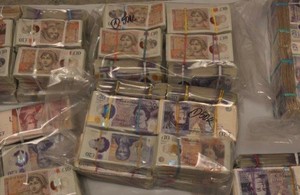
Two charged after cash stuffed into suitcases seized at Heathrow airport

News story

Two people have been charged with money laundering after approximately £1.2 million in cash was seized by Border Force officers at Heathrow airport.

Two charged after cash stuffed into suitcases seized at Heathrow airport article

Czech nationals Zdenek Kamaryt, 37, and Michala Repperova, 26, were questioned by Border Force officers at around 9am on Sunday, 8 November before they were due to leave on a flight to Dubai from Terminal 2. Officers searched three suitcases, where they found £1.2 million, and two hand luggage bags which contained a further £30,000. The cash was in mixed denomination notes.

The pair were arrested and the investigation was referred to the National Crime Agency (NCA).

Chris Philp, Minister for Immigration Compliance and the Courts, said:

This is the second largest individual cash seizure at the border in the space of five weeks and shows that Border Force will not relent in their search for money believed to be connected with criminality.

Clamping down on the export of undeclared cash from the UK is vital in our fight against organised criminal gangs.

Zdenek Kamaryt and Michala Repperova, of no fixed UK address, appeared at Uxbridge Magistrates Court on Tuesday, 10 November where they were remanded in custody until their next appearance at Isleworth Crown Court on 10 December.

On 3 October, Border Force officers at Heathrow airport Terminal 2 seized almost £2 million in cash.

Published 13 November 2020


Businesses in England to receive £2.2 billion to see them through national restrictions

  • Grants of £2.2 billion to be distributed to businesses across England by councils
  • support aimed at businesses that have been required to close restrictions, with local authorities given extra cash to help other businesses at their discretion
  • package builds on £200 billion already provided to support jobs, incomes and businesses since the start of the pandemic

Small businesses in England will receive a significant £2.2 billion from the government to help them through the current period of national restrictions.

Businesses will benefit from 2 grant schemes: one for businesses that have had to close, and another scheme for further business support as a result of the coronavirus pandemic, helping support people’s jobs and livelihoods and protect communities.

Money is being transferred to councils in England today (13 November) and businesses can expect to receive money covering the 4-week period of national restrictions in the coming days and should check their council’s website for details.

Business Secretary Alok Sharma said:

We know that this is a really tough time for businesses across the country, which is why we are continuing to deliver a wide-ranging package of urgent support.

This much-needed cash will help to sustain businesses, protect jobs and keep communities ticking as we continue to tackle the virus in the coming weeks.

Minister for High Streets Kelly Tolhurst MP said:

This funding will help to protect jobs and give businesses on the high street added security at this time. The ban on commercial evictions until the end of the year provides landlords and tenants with an opportunity to reach an agreement which can help businesses to continue operating.

The grant schemes are:

The Local Restrictions Support Grants, for businesses which have had to close or have been severely impacted by local restrictions (hospitality, leisure and non-essential retail sectors):

  • business owners will receive £1,334 per 4 weeks if they have a rateable value below £15,000
  • they will receive £2,000 per 4 weeks if they have a rateable value between £15,000 and £51,000
  • they will receive £3,000 per 4 weeks if they have a rateable value above £51,000

The Additional Restrictions Grant, provided by councils on a discretionary basis.

Local authorities will receive a sum of money equivalent to £20 per head of their local population to distribute to businesses which have been severely impacted by restrictions. For example, a council covering an area with a population of 100,000 would receive £2 million for this purpose. Those likely to be in receipt of these grants include large employers with significant fixed costs such as seaside attractions or local manufacturers, as well as sole traders, tour operators and market traders who do not have a rateable value.

This includes businesses like pubs not serving substantial meals, betting shops, arcades and soft play centres in areas like Liverpool, Greater Manchester and South Yorkshire. Some places such as South Yorkshire and Liverpool City Region negotiated their support under this scheme prior to the national lockdown.

In total, £2.2 billion will be given to businesses across England to support jobs, livelihoods and local communities.

Businesses are urged to engage with their local authority and ensure that council officials have contact and payment information for them. They risk not receiving this vital support if they do not.

The 2 new grants schemes are designed to support jobs and livelihoods. As well as the grants, the government has also announced:

  • an extension to the furlough scheme until March – with government covering 80% of wages
  • more generous support to the self-employed – equivalent to the generosity of the furlough scheme
  • an extension to the existing government-backed loan schemes
  • an extension to the mortgage payment holiday for homeowners
  • reduced VAT for hospitality, accommodation and attractions until the end of March 2021
  • business rates relief for hospitality, retail, leisure and nurseries until the end of March 2021
  • the £1.57 billion Culture Recovery Fund
  • extended support to prevent business evictions until the end of the year
  • total money allocated to local authorities in each region has been calculated in proportion to local population size and estimates of the numbers of businesses required to close
  • the Local Restrictions Support Grants (Closed) Addendum is mandatory grant funding for businesses that have a rateable value (but note the scheme is not based on eligibility for rate reliefs, commonly applied thresholds in the rating system are used to set different grant rates)
  • during this period a single grant to cover the 4-week period will be paid to each eligible business. The grant amounts will be fixed. Businesses with more than one qualifying property will receive more than one grant.
  • to allow funding to be paid to local authorities, each will get an allocation. Where this is insufficient to meet needs, top-up payments will be made so each local authority has the funding it needs
  • the Additional Restrictions Grant (ARG) will provide local authorities with additional funding to enable them to support other businesses that have had their trade affected by the restrictions
  • the ARG is a one-off payment for local authorities in financial year 2020/2021 and is to be used in 2020/2021 and 2021/2022 and will not be renewed
  • local authorities in LCAL High (Tier 3) will receive the amount they negotiated at the time of moving into that Tier. Areas that agreed collective payments (for example to a Mayoral Combined Authority or Upper Tier Local Authority) will have those arrangements honoured)
  • Local Restrictions Support Grant (Sector) will allow grants of up to £3,000 per 4-week period to be made to businesses like nightclubs that were required to close. This grant scheme is effective from 1 November