The UK and Thailand sign Letter of Intent to promote inclusive economic growth in the energy sector

World news story

The UK and Thailand’s Department of Alternative Energy Development and Efficiency (DEDE), Ministry of Energy signed Letter of Intent to promote inclusive economic growth in the energy sector.
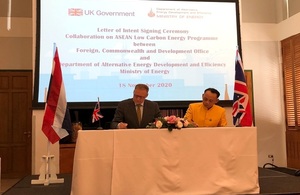
On 18 November 2020, the UK’s Foreign, Commonwealth and Development Office (FCDO), and the Department of Alternative Energy Development and Efficiency (DEDE) under the Ministry of Energy of Thailand signed the Letter of Intent (LoI) to establish a long-term partnership to work together on energy efficiency under the UK’s ASEAN Low Carbon Energy Programme. The programme aims to encourage the transition to low carbon energy in Thailand while creating real energy cost savings for people and businesses, and so promoting economic growth in Thailand.

The planned partnership will provide technical assistance and knowledge sharing to support shared learning and Thai efforts to improve energy efficiency in 4 strategic areas:

  • developing a more advanced methodology and analysis of data to assess energy efficiency;
  • creating an appropriateregulatory environment and market opportunities for energy service companies or ESCOs, companies which support the implementation of energy efficiency measures;
  • supporting the implementation of Thailand’s Energy Efficiency Plan 2018 (EEP 2018); and
  • enhancingthe development and implementation of energy performance standards for electric motorsin industrial sector.

The two sides hope that the cooperation will help strengthen Thailand’s energy efficiency policy and practices, enhance the local energy efficiency market, and assure Thailand’ sustainability.

Speaking at the signing ceremony, H.E. Brian Davidson, the British Ambassador to Thailand said

Energy efficiency is about creating real cost savings for people and businesses. In the UK energy efficiency measures to improve insulation and heating efficiency alone have cut the annual energy costs of households by the equivalent of up to 25,000 Baht per year.As the co-Presidency of the COP26 UN global climate change negotiations next November, the UK believes energy efficiency has a key role to play in preventing catastrophic climate change. We applaud Thailand for its efforts to improve energy efficiency and so help businesses and people save money. I am sure that the signing of this Letter of Intent today with the Department of Alternative Energy Development and Efficiency will ensure the continuation of our ambitious partnership to lower carbon emissions, cut energy costs, and create job opportunities.

Dr. Prasert Sinsukprasert, DEDE Director General said

The technical cooperation under the ASEAN Low carbon Energy programme that United Kingdom provides to Thailand such as implementing MEPS (Minimum Energy Performance Standards), advancing the methodology and analysis of energy data for key industrial sub sectors, and improving regulatory and market opportunities for ESCOs are top priority items for the Ministry of Energy’s agenda. Consequently, the programme also strengthens the implementation of Thailand Energy Efficiency Plan (EEP2018) which aims to reduce energy intensity by 30% in 2037, comparing with the level in 2010. DEDE have been working on promoting energy efficiency and conservation in Thailand and our focus covers 5 economic sectors consisting of industry, building, household, agriculture and transport. There are 3 categories of energy efficiency measures including compulsory measure, voluntary measure and complementary measure. Example of the measures implemented in Thailand such as building codes, energy efficiency resources standard, financial support, EE innovation support, human resource development, public relation and awareness, etc. These initiatives do not only help Thailand’s energy efficiency improvement, but also Thailand’s environmental footprint by lowing energy use and reducing greenhouse gas emissions. Upon signing up to the Paris accord, Thailand voluntarily committed to reducing greenhouse gases by 20-25% by 2030 based on 2005 emission levels.

Energy transition is a pathway toward transformation of the global energy sector from fossil-based to zero-carbon. Renewable energy and energy efficiency measures can potentially achieve 90% of the required carbon reductions. The energy transition will be enabled by information technology, smart technology, policy frameworks and market instruments. Thus, Thailand needs to develop our potential to achieve this transformation by learning more from others. I hope we can do it together with UK in the future.

For more information:

  1. Thailand has set out plans to cut energy demand by 6% by 2037 in its Power Development Plan.

  2. As of 2017, energy intensity in the UK was 17% below that in 2000 (i.e. energy efficiency had improved by 20%). The UK calculates that energy efficiency is the most cost effective way to cut greenhouse gases and so prevent climate change. It is targeting net zero greenhouse gas emissions by 2050.

  3. The ASEAN Low Carbon Energy Programme (ALCEP) is funded by the UK’s Overseas Development Assistance budget under the UK Government’s Prosperity Fund. The programme seeks to support ASEAN countries to transition to low carbon societies and realise economic and wider benefits as a result. The programme runs from 2019 to 2022.

  4. The ALCEP is part of wider collaboration between the UK and Thailand on energy and low carbon transition. The UK has also been working closely with various departments under the Thai Ministry of Energy. For example, we support a.) the study of Peer to Peer Energy Trading in Thailand to enable households and premises with micro generation to sell excess electricity to their community, improving their return on investment and incentivising uptake; b.) the study of Renewable Energy Certificate to encourage greater expansion of renewable energy; and c.) development of Thailand 2050 Calculator which helps policy makers and members of the public to explore the energy options available for the future. We also collaborate with financial regulators to encourage sustainable finance and equip financial institutions with knowledge to manage impact of climate related risks in the financial sector through capacity building and experience sharing.

Published 19 November 2020


UK Export Finance appoints four senior trade representatives overseas

UK Export Finance (UKEF), the UK government’s export credit agency, has increased its international business development network in key emerging markets by hiring senior trade representatives in China, Colombia, Kenya and South Africa.

Jiang Wu joins UKEF as Country Head for China, Camilo Neira as Country Head for Colombia, Isaac Kahara as County Head for Kenya and Dirk Van den Berg as Country Head for South Africa.

Working alongside HM Trade Commissioners and British Ambassadors overseas, UKEF’s Country Heads work with overseas governments and multinational companies looking to buy from the UK to create trading opportunities for British businesses.

The global economic impact of the pandemic means UKEF are currently identifying overseas projects with robust fundamentals and long-term growth potential that could benefit from UK expertise.

This includes helping to put UK companies at the heart of the green recovery from coronavirus, following the £2 billion allocated to UKEF’s direct lending facility to finance green projects in the latest budget.

UK Export Finance now has 12 Country Heads operating across 11 countries and will increase this to 20 in strategic trading markets from Asia to North America in the coming months.

UK Minister for Exports, Graham Stuart, said:

We are determined to build the UK into an exporting superpower. Having overtaken France last year to become the world’s fifth largest exporter we are conducting the most ambitious trade policy programme ever pursued by a major economy. We are negotiating free trade agreements and providing improved access to markets around the world, and will ensure that British businesses have access to finance and advice to take advantage of the opportunities created.

That’s why I am delighted that we are adding to the overseas roster of our award-winning export credit agency, UK Export Finance. UKEF’s new experts will work with DIT and FCDO staff to help UK businesses – with a particular focus on green industries and sustainable projects.

Richard Simon-Lewis, Director & Head of Business Development, Marketing & Communications at UKEF, said:

The global financial disruption caused by COVID-19 is likely to be felt for some time. We are building a robust business development pipeline that has sector and regional breadth – with an increasing focus on clean growth – so that UK exporters and suppliers remain in a strong position to trade internationally.

UK Export Finance is the UK’s export credit agency. It exists to ensure that no viable UK export lacks for finance or insurance from the private market, providing finance and insurance to help exporters win, fulfil and get paid for export contracts.


PM’s record defence pledge to protect Scottish security and jobs

  • Boost to the defence budget will ensure the UK and allies can defend against traditional and emerging threats while protecting the world’s most vulnerable people
  • Commitment includes an ambition to expand the shipbuilding programme which is already creating thousands of jobs on the Clyde
  • PM to announce a new UK ‘Space Command’, with the first rocket launched from Scotland by 2022

Scotland and the whole of the UK will be better protected and able to play a more active role defending our allies and values following the landmark defence investment announced by the Prime Minister today [Thursday].

A £16.5 billion boost to the defence budget over the next four years will ensure the UK remains the second highest defence spender in NATO and will allow us to invest in the cutting-edge, next-generation technology that will demonstrate to our allies that they can always count on the UK.

The Prime Minister said:

Next year will be a year of British leadership, when we preside over the G7, host COP26 in Glasgow and celebrate the 75th anniversary of the of the first United Nations General Assembly.

Britain must be true to our history and stand alongside our allies, sharing the burdens and bringing our expertise to bear on the world’s toughest problems.

The returns of this investment will go far beyond our Armed Forces, creating thousands of jobs, reinforcing the Union and levelling up our country.

The spending commitment will finance the UK’s order of 8 Type 26 and 5 Type 31 frigates, which are currently being constructed on the Clyde, creating thousands of jobs. The Prime Minister will also set out his commitment to the next generation of warship – the Type 32 – which would also be built in the UK.

The record contribution will also allow the Ministry of Defence to invest in research to create the technology of tomorrow – for conflicts on land and sea, and in the air, space and cyberspace.

As we have seen in the past, and as we’re currently seeing in areas such as autonomous vehicles and aviation, these developments will also have civilian applications.

In his speech the Prime Minister will announce a new ‘Space Command’, capable of launching our first rocket from Scotland in 2022.

Scotland has always played a critical role in the UK’s defence. That is thanks to its important geographical position which makes it an ideal home for half of the UK’s typhoon force and the Royal Navy’s entire submarine service, and to its people, who have always answered the call of duty to serve their country. Around 10,000 regular personnel and 4,000 reservists call Scotland home and this number is growing.

The projects announced by the Prime Minister today will therefore directly benefit the people of Scotland, bringing security and economic benefits for decades to come.


Expanded study tests immune response of care home staff and residents

The Vivaldi 2 study will more than triple in size to provide a detailed picture of coronavirus infection in care homes in England. These findings will help improve understanding of these vulnerable groups’ immune response to COVID-19 and help inform future treatments for the virus.

As part of the major research study led by University College London (UCL), 14,000 care home residents and staff will be tested quarterly for their immune response to COVID-19. The number of care homes taking part will increase from 100 to 340, testing approximately 4,500 residents and 9,500 staff.

Researchers will analyse how antibody and cellular immunity to the virus differs among different groups and help shape the planning and national public health response to COVID-19 as well as wider social-care policy.

This study will help complement the work the department of health and social care (DHSC) is doing to support the care sector. This includes this week’s launch of visitation trials in a number of care homes with a roll out planned across care homes in December. Protection of staff and residents has been a priority throughout the pandemic with 120,000 daily tests ringfenced, free personal protective equipment (PPE) and more than £1.1billion worth of support through the Infection Control Fund.

Minister for Care Helen Whately said:

Expanding this brilliant study, with the support of UCL, is another step towards improving our understanding of the virus.Testing people’s antibody reaction to Covid-19 is crucial in helping us to control the spread of the virus, particularly amongst people who are vulnerable.

The more we know about this virus and are able to control it, the safer it will be for people in care homes.

The expansion will:

  • provide a larger and more nationally representative sample of care home residents and staff, allowing the Vivaldi 2 study team to provide more robust estimates across the population
  • address important immunity research questions such as whether individuals can be infected twice, how quickly neutralising antibodies wane and whether the immune response in the elderly is the same in younger generations
  • link immunity data with epidemiological data to better understand the links between infection, demography and clinical outcome on the elderly and the impact of care-home characteristics on the spread of the virus in the sector
  • offer an opportunity to work with a wider range of small care home chains and independent providers to ensure results are representative of all care homes in England

The Vivaldi 2 study uses trained phlebotomists to draw blood from care home residents and staff which is then used to test for the presence of antibodies for COVID-19. This data is cross-referenced with DHSC-delivered swab testing in care homes to analyse prevalence of the virus over time.

Vivaldi 2 is led by University College London (UCL) and funded by DHSC. It began in June 2020 and is predicted to last to April 2022. The exact end date will be determined by how prevalent COVID-19 is in the tested care homes.

Dr Laura Shallcross of UCL Institute of Health Informatics said:

Expanding the Vivaldi study will tell us how many people living and working in care homes have been infected with COVID-19, and whether being infected once protects against future infections. This study will help us protect the most vulnerable members of society from this devastating infection.

Testing in these new homes is being phased in through November.

Understanding both the antibody immunity and cellular immunity responses as part of the expansion of the original Vivaldi study will provide crucial data to help inform future treatments for COVID-19, including vaccine development.


PM to announce largest military investment in 30 years

  • Multi-year settlement will allow MoD to invest in next-generation military capability, defending our people from new and evolving threats and protecting the world’s most vulnerable while creating 10,000 jobs annually across the UK
  • Defence settlement underpins wider drive to use our foreign policy to defend free and open societies
  • Major announcements mark the first conclusions from the Integrated Review of the UK’s foreign, defence, development and security policy

The biggest programme of investment in British defence since the end of the Cold War will be announced today [Thursday] by the Prime Minister.

In a speech to the House of Commons he will set out a £16.5 billion increase above the manifesto commitment over four years that will protect our citizens, help us build back better from coronavirus by creating thousands of new jobs and demonstrate to our allies they can always count on the UK.

Our defence forces are operating in a rapidly changing world. This spending increase recognises the need for them to undertake a generational modernisation programme in order to defend the UK, our allies and the world’s most vulnerable people.

Since the Cold War the threat from our adversaries has been evolving. Our traditional defence and deterrence capabilities remain vital, and our Armed Forces work every day to prevent terror reaching the UK’s shores. But our enemies are also operating in increasingly sophisticated ways, including in cyberspace, to further their own interests.

Rather than being confined to some distant battlefield, those that seek to do harm to our people can reach them through the mobile phones in their pockets or the computers in their homes. To protect our citizens, UK Defence therefore needs to operate at all times with leading, cutting-edge technology.

Our Armed Forces are also working in a broader range of areas than ever before to protect the most vulnerable people in the UK and around the world. Over the course of the coronavirus pandemic in the UK over 20,000 personnel have been made available to deliver PPE, run testing sites and ensure those in the most remote areas can receive the medical care they need.

Defence has also been on the front line responding to every major international humanitarian disaster of the last decade. In the last year alone HMS Enterprise has come to the aid of Lebanon following the explosion in the Port of Beirut, RFA Argus and Army personnel have delivered disaster relief to Central American countries ravaged by Hurricane Eta, and the RAF has transported vital medical supplies to communities struggling against coronavirus in West Africa and the UK’s Overseas Territories.

The Prime Minister, Boris Johnson, said:

I have taken this decision in the teeth of the pandemic because the defence of the realm must come first.

The international situation is more perilous and more intensely competitive than at any time since the Cold War and Britain must be true to our history and stand alongside our allies. To achieve this we need to upgrade our capabilities across the board.

This is our chance to end the era of retreat, transform our Armed Forces, bolster our global influence, unite and level up our country, pioneer new technology and defend our people and way of life.

The £16.5 billion extra in the Ministry of Defence’s budget over the next four years is the amount over and above the manifesto commitment. The Government has already pledged to increase defence spending by 0.5% above inflation for every year of this parliament. On existing forecasts, this is an overall cash increase of £24.1 billion over four years compared to last year’s budget.

It will also cement the UK’s position as the largest defence spender in Europe and the second largest in NATO.

The commitment will allow the Government to invest in cutting-edge technology, positioning the UK as a global leader in domains such as cyber and space and addressing weaknesses in our defence arsenal that cannot be allowed to continue. To support these advancements the Prime Minister will also announce a new agency dedicated to Artificial Intelligence, the creation of a National Cyber Force to protect our people from harm and a new ‘Space Command’, capable of launching our first rocket in 2022.

This will be underpinned by a record investment of at least £1.5 billion extra and £5.8 billion total on military research and development and a commitment to invest further in the Future Combat Air System. This reverses the systematic decline in this crucial area in the last thirty years, creating new advances which surmount the old limits of logistics and go beyond military use with a vast number of civilian applications such as autonomous vehicles and aviation.

These projects are expected to create up to 10,000 thousand jobs annually across the UK. These will reflect the expertise and ingenuity of British people both inside and outside our Armed Forces, harnessing the UK’s skills in construction and science and reinvigorating those industries in the coming decades.

The Defence Secretary, Ben Wallace, said:

This is excellent news for Defence, and provides us with the financial certainty we need to modernise, plan for the future and adapt to the threats we face. It demonstrates the Prime Minister’s recognition of how important Defence is to our resilience and to the reputation of the United Kingdom.

This settlement secures UK jobs and livelihoods, allows us to invest in our fantastic shipyards and aerospace industry, spreading prosperity to every corner of the UK.

Next year represents a huge opportunity for this country, and Defence will be at the forefront of creating the jobs and business opportunities that will help us build back from the pandemic.

Over the next few months I will set out in more detail our ambitious agenda for Defence.

Today’s announcements mark the first outcomes from the Integrated Review of the UK’s foreign, defence, development and security policy. The full conclusions of the Integrated Review will be announced in the new year.