European Commission refers review of Virgin and O2 deal to CMA

Press release

Following a request from the CMA, the European Commission has referred the proposed merger of Virgin Media and Virgin Mobile with O2 to the CMA for investigation.

Person using a mobile phone

Following the announcement of the deal on 7 May 2020, the Competition and Markets Authority (CMA) publicly indicated that it would make a formal request to the European Commission (EC) to review the proposed merger, given its potential impact on competition in several retail and wholesale telecommunication markets in the UK.

The CMA made its formal request for the case to be transferred on 8 October 2020, shortly after the opening of the EC’s investigation. That request has today been accepted by the EC and the case will be transferred for the CMA’s formal investigation to begin immediately.

Andrea Coscelli, Chief Executive at the CMA, said:

We welcome the European Commission’s decision to transfer the proposed deal between Virgin and O2 to the CMA for investigation.

These are incredibly important UK markets, that continue to evolve, and the deal needs to be carefully reviewed to make sure that consumers are protected.

We have worked closely with the European Commission so far and we will build on the work that has already been carried out to make sure that the case can be investigated as quickly and efficiently as possible.

Virgin and O2 have asked the CMA to move quickly to the in-depth Phase 2 stage of its review through a ‘fast-track’ process.

In most merger cases, a full Phase 1 investigation is needed to determine whether a deal can be cleared or whether further scrutiny is required.

However, merging companies can ask for the CMA’s probe to be moved more quickly to Phase 2 where it is clear from an early stage that the deal requires an in-depth investigation.

The CMA expects to accept this request unless it receives any valid objections to the use of the fast-track process.

The CMA is now inviting views by 26 November on how the merger could affect competition, and on the companies’ request for a fast track process. Further opportunities to submit views will also be provided during the Phase 2 investigation.

Please visit the Liberty Global plc / Telefónica S.A. merger inquiry case page for more information.

Notes to Editors

  1. Liberty Global plc (Liberty) owns Virgin Media and Virgin Mobile in the UK, and Telefónica S.A. (Telefónica) owns O2 in the UK.
  2. Under the Enterprise Act 2002 (the Act) the CMA has a duty to make a reference to Phase 2 if the CMA believes that it is or may be the case that a relevant merger situation has been created, or arrangements are in progress or in contemplation which, if carried into effect, will result in the creation of a relevant merger situation; and the creation of that situation has resulted, or may be expected to result, in a substantial lessening of competition within any market or markets in the United Kingdom for goods or services.
  3. Media enquiries to the CMA should be directed to press@cma.gov.uk or 020 3738 6460.

Published 19 November 2020


Statement on government procurement following this week’s NAO report

On Wednesday the National Audit Office (NAO) published their report into government procurement during the COVID-19 pandemic.

At the height of the crisis in April, health services around the world faced an unprecedented urgent situation where demand for personal protective equipment (PPE) far exceeded supply, and global production and supply chains were under severe pressure. The British Medical Association rightly warned at the time that “no doctor should ever have to be in harm’s way when they go to work”. The government pledged to do whatever it took to protect the people who protect us, deploying hundreds of officials to work night and day to source as much PPE as quickly as possible to protect the NHS and care sector and save lives.

We welcome the NAO report which recognises that the government ‘needed to procure with extreme urgency’ and ‘secured unprecedented volumes of essential supplies necessary to protect front-line workers’. So far we have delivered over 4.4 billion items of PPE to the frontline with over 32 billion items on order to ensure a continuous supply over the next few months. We are proud of our response and pay tribute to the hard work of officials who have secured these supplies.

We also note the NAO’s recent investigation of the government’s efforts to increase NHS ventilator capacity, which found that we put in place effective programme management, controlled costs where we could and recovered some costs where appropriate.

The government has rigorous due diligence and robust processes in place for contracts. These processes are led by impartial officials with commercial expertise and as the NAO acknowledged, they found no evidence ministers were involved in procurement decisions.

The vast majority of the PPE procured by the government during the coronavirus crisis met the required clinical safety standards, which is especially impressive given the supply chain issues, the urgency of the situation and the need to explore novel routes. So far only 0.5% of products bought have not met our high clinical standards. We note that governments and public authorities across the UK and around the world faced similar pressures and equivalent challenges.

We thank the NAO for their work, which was based on an analysis of just 20 out of 8,600 contracts. We have always accepted that there are lessons to be learned from how we responded to this unprecedented global pandemic and the government is fully committed to doing so. We will address the report’s recommendations in due course.

Claim: The government ‘ripped up’ procurement rules

Response: This is untrue. All procurement has been done under existing procurement regulations, which predate the pandemic and explicitly allow for emergency procedures, as set out under paragraph 32 2.c of the Public Contract Regulation 2015. Many other countries including Japan, New Zealand and Finland, allow similar approaches to procurement, using direct awards to speed up the process of sourcing PPE to protect frontline workers. Direct awards were made by public authorities across the UK, with the Welsh Government adopting central government guidance on emergency procurement, including direct awards. We make no apology for doing everything to secure as much PPE as quickly as possible.

The shortest amount of time possible to run a competition is 25 days. Therefore in situations of genuine crisis, and extreme urgency, as presented by the COVID-19 pandemic, it was important that we acted quickly and decisively to secure the necessary PPE for front line medical and other services.

The NAO report itself recognises the need for urgency. In their report they say that “in responding to the COVID-19 pandemic, public bodies have needed to procure enormous volumes of goods, services and works with extreme urgency” (page 5), and our procurement activity “secured unprecedented volumes of essential supplies necessary to protect front line workers”.

Claim: There was a ‘secret referrals’ inbox

Response: This is untrue, the inbox was available across government and with MPs.

The government received over 15,000 offers of support from businesses to help with PPE, and MPs were inundated with offers of help from their constituents. MPs rightly were keen to pass on offers.

The government remains hugely grateful for the outpouring of offers of help and the high priority mailbox allowed officials to more quickly assess offers from more credible sources, such as large companies with established contacts and more capable of suppling at speed. The government also ensured that offers of support raised by Opposition MPs, including in the letter of the shadow Chancellor of the Duchy of Lancaster of 22 April, were dealt with expeditiously.

As the NAO report notes, all PPE offers, no matter from where they came, went through the same eight step official assurance process, including quality checks, price controls and other due diligence. This eight step process has been published in the NAO’s report.

Claim: There are ministerial conflicts of interest in the government’s procurement

Response: We completely reject this. As the NAO makes clear “we found that the ministers had properly declared their interests, and we found no evidence of their involvement in procurement decisions or contract management” (pg 10, para11).

Claim: There has been a lack of transparency in the government’s procurement efforts

Response: We publish all contracts as part our commitment to transparency. We regret that some contracts have not been uploaded in a timely fashion as a result of prioritising staff’s time on securing life saving PPE for the NHS. All will be published as soon as possible and significant information is already available online.

Claim: Work started before contracts were put in place

Response: In line with the rules for urgent procurement, and due to the urgency of the work required to respond to the unprecedented situation, in some cases work started before final contract details were put in place. All PPE procurement went through the same eight checks, including quality checks, price controls and other due diligence, and assessed against the same standards.

Claim: There was a lack of transparency on how contracts were awarded

Response: All offers were prioritised by officials based on volume, price, clinical acceptability and lead time. Suppliers were selected based on the product type, forecasted delivery dates, rigorous technical compliance and due diligence checks. These checks included company due diligence checks and systematic price benchmarking.

At the start of the pandemic, guidance was issued by Cabinet Office outlined that procuring with extreme urgency was permissible under the regulatory framework. The guidance referred to the need to keep proper records of decisions, transparency and publication requirements and the need to achieve value for money and use good commercial judgement during any direct award. This guidance is publicly available here



Fish Export Service trial period

The service will open for a trial and test phase to allow businesses to sign in, familiarise themselves with the system and create sample documents before it goes fully live on 29 December 2020.

Exporter businesses and fishers who land catch in the EU will be contacted directly inviting them to join the trial and, importantly, provide their feedback. They will be able to test and try the service up to 14 December.

The MMO has expanded its team of specialist advisors and opened a dedicated helpline to provide support and advice. The helpline – 0330 159 1989 – will be open Monday to Friday from 9am to 5pm from 19 November. It will be open 24/7 when the service goes live.

Any business that has not yet registered can do so now. There is more information and guidance on this link.

Here are a few notes to help users and MMO get the most out of this trial period:

1) If you are registering your company for the first time please follow the registration guidance.

2) If your business is already registered, have to hand the access details that were used – the email address and password.

3) We’re inviting businesses to help us test the Fish Export Service in this final phase of development to ensure we are ready before we go live. In this trial phase, the system may time out if you try to record more than ten different landings on one catch certificate. To avoid the issue while you are testing the system, please ensure you only create catch certificates with no more than ten landings.

4) If you use the Internet Explorer 11 browser, you may receive an error message. You should switch to another browser, such as Chrome or Edge. You may notice some blank fields – you can ignore these and they won’t affect your trial.

5) To ensure you get the most value out of this trial phase, the system will verify data and validate certificates exactly as it will when live, and you may find some may fail. Our extended support team is on hand to help guide you through this or any other issues.

6) If you are unable to access your online account, have any issues relating to registration or the Fish Export Service, or need assisted digital support, you can call our dedicated helpline on 0330 159 1989 Monday to Friday from 9 am to 5 pm from 19 November.

7) Prior to going live at the end of December we will remove all sample documents that have been created.

8) If you are exporting over the Christmas period and are likely to need UK catch certificates 72 hours in advance of the go live date, you will be able to use the existing catch certificate process for exports to third countries and contact MMO for assistance by email on ukiuuccc@marinemanagement.org.uk on 28 December, from 9 am to 5 pm.


134,000 trees to be planted through Urban Tree Challenge Fund

More than 50 projects led by community and volunteer groups, councils and individuals have been awarded a share of a £10 million pot to increase tree numbers in urban areas through small-scale planting projects.

The funding has been awarded as part of the second and final round of the Forestry Commission’s Urban Tree Challenge Fund.

The second round will result in the planting of over 84,000 trees in towns and cities across England. The new trees will provide benefits to health and wellbeing, connect people with the outdoors, improve biodiversity, as well as play a crucial role in the fight against climate change.

Today’s announcement means that there will be a combined total of up to 134,000 new trees planted across England’s towns and cities, which surpasses the Fund’s original target to plant 130,000 trees.

Successful projects include:

  • The Darlington Forest project in County Durham, which will extend an existing green corridor in the area with the planting of 6,800 trees to improve the environment for wildlife as well as local communities. The area runs alongside the trackbed of the first passenger steam railway and will help showcase Darlington’s heritage.
  • 7,500 new trees in Eastbourne, East Sussex, to form part of a wider programme of natural environment improvement across the area.
  • 952 new trees across two sites for the Christchurch project in Dorset. The planting of native species will provide a natural traffic noise and pollution buffer, improve their look and provide a refuge for wildlife.
  • 8,234 new trees in Durham which will be planted at a number of locations to extend and link existing woodlands to enhance biodiversity and habitat connectivity, and improve areas of reclaimed land whilst also benefiting local communities.

Sir William Worsley, Chair of the Forestry Commission, said:

Community tree planting is a passion of mine which is why I am so excited to see projects like these benefitting from our Urban Tree Challenge Fund.

Trees give life to our streets and our parks, help improve the health of communities, and provide homes for precious wildlife, and the thousands of new trees that will be planted will bring many benefits for generations to come.

Forestry Minister, Lord Goldsmith, said:

Trees play a crucial role in the fight against the climate and biodiversity loss. In urban areas they can link up our valuable green spaces and connect local communities with nature – something which has never been so important.

Ahead of our forthcoming England Tree Strategy, and to complement our manifesto ambition to have every new street lined with trees, the success of the Urban Tree Challenge Fund provides a fantastic example of how trees can be planted, managed and enjoyed, wherever you live.

Cllr Brian Stephens, Durham County Council’s Cabinet member for neighbourhoods and local partnerships, said:

The funding we have received from the Urban Tree Challenge Fund has been a wonderful opportunity to plant in our county’s urban environment, in places where tree cover is low. Trees are so important – they help to enhance existing green areas, bring back lost open space, support and increase biodiversity, as well as give significant benefits to our own health and wellbeing.

Grants from the Urban Tree Challenge Fund are administered by the Forestry Commission, and successful applicants are match-funding the money they receive. The money will fund the planting of trees and the first three years of their care to ensure they can flourish into the future.

The Government is committed to plant 30,000 hectares of trees a year across the UK by 2025. Our £640m Nature for Climate fund will help us deliver the English portion of this tree planting commitment, alongside peatland restoration and nature recovery. The Prime Minister also recently announced £40 million additional investment into the government’s Green Recovery Challenge Fund – this will go towards creating and retaining thousands of jobs in areas including tree planting, horticulture, and equipment and seed supply.

Today’s announcement comes ahead of National Tree Week, the UK’s largest annual tree celebration, which is taking place between 28 November and 6 December 2020. For more information visit: https://treecouncil.org.uk/take-action/seasonal-campaigns/national-tree-week/

The Forestry Commission will continue to contact additional successful applicants who may be awarded funding in the coming weeks.


AAIB Report: Bombardier BD-700-1A10 Global 6000, runway excursion, Liverpool John Lennon Airport

News story

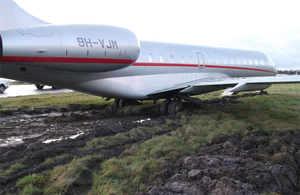
A Bombardier BD-700-1A10 Global 6000 suffered a nosewheel steering failure after touchdown, 11 December 2019.

9H-VJM

The aircraft, a Bombardier BD-700-1A10 Global 6000 (9H-VJM), suffered a nosewheel steering failure shortly after touchdown. During the subsequent landing roll, directional control was lost due to the inadvertent application of right braking and the aircraft departed the runway surface onto the grass.

Read the report.

Media enquiries call: 07814 812293

Published 19 November 2020