Letter from CDL to Michael Russell MSP

The Chancellor of the Duchy of Lancaster, Michael Gove MP, has responded to a letter from Michael Russell MSP (Cabinet Secretary for the Constitution, Europe and External Affairs, Scotland) regarding the UK’s negotiations with the EU and preparations for the end of the transition period.


Action to remove contaminated fire-fighting water

Press release

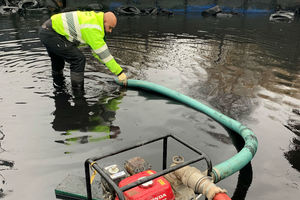
Environment Agency officers remove contaminated fire-fighting water which has collected in pools on the site of a major fire in Bradford

An officer from the Environment Agency uses a pump at fire site

Pumping away contaminated water

Officers from the Environment Agency are taking action today to support communities impacted by a tyre fire in Bradford.

They are supporting teams from West Yorkshire Fire and Rescue Service and Yorkshire Water to remove contaminated fire-fighting water which has collected in pools on site at Upper Castle Street.

Pumps will be brought on site to direct the water, which has become contaminated by the tyres, into the sewer and away from nearby becks.

A spokesperson for the Environment Agency, said:

We are monitoring Bowling Beck and Bradford Beck to minimise any environmental impacts from the fire or from surface water as a result of the fire fighting. This is likely to continue as we move into the next week.

More than 40 Environment Agency staff are working round-the-clock to respond to this incident and officers have been on site throughout the incident.

An air quality monitoring unit has been set up at two sites and the information from this monitoring will be used to confirm the public health risk advice being given. Dye tracing tests and river water quality sampling is also taking place to closely monitor any potential impact on the local watercourses.

Public Health England’s current advice to members of the public is that if the smoke is in your area, keep doors and windows shut and minimise exposure if you must go out. If the smoke isn’t affecting where you live, you can take the opportunity to ventilate your property.

Anyone wanting to share information on this incident can contact our Incident Communication Hotline on 0800 80 70 60 or anonymously via Crimestoppers on 0800 555 111 both 24 hour services.

Published 20 November 2020


Highways England project manager awarded with top accolade

Emma Simpson, originally from Doncaster, in Yorkshire, scooped the Young Professional of the Year Award at the Association of Project Management 2020 Awards (APM) thanks to her incredible work on many road improvement schemes across Lancashire, Cheshire and her home county.

Emma applied to join Highways England’s three-year graduate programme in 2017 after studying Business and Economics at University of Northumbria and has since been promoted to an assistant project manager role based in Manchester, a job in which she’s thriving.

Emma, aged 25, who found out she won via a virtual awards ceremony earlier this month (November), said:

Being recognised by my peers is an incredible feeling and receiving this award is something I’ll forever appreciate.

The Highways England Graduate Programme gave me a wealth of opportunities, several chances to move around the business in different placements, amazing support from my managers and an industry recognised qualification. All of which provided me the skills to be recognised with an APM award at this early stage of my career.

Jon Stokes, Senior Project Manager at Highways England, added:

We are incredibly proud of Emma and what’s she’s achieved. Approaching everything with high professionalism, building constructive relationships with a variety of stakeholders and her colleagues, Emma has successfully delivered her own scheme and is now deputising for the lead Project Manager on a nationally significant infrastructure project.

Emma’s experience is a fantastic example of what the Highway England Graduate Programme can provide, offering work across a variety of roles, such as; project management, cyber security, data analysis and many more – all helping to keep people safe, connect businesses and improve community life around our roads.

Recruitment for Highways England’s 2021 graduate intake has recently closed with hundreds of applications submitted in recent weeks. However, applications for apprenticeships within the company which manages, operates and maintains England’s motorways and major A-roads, are now open.

Earlier this year, Highways England unveiled £27 billion roads investment plans for our strategic road network which will help support 64,000 construction industry jobs. From finance and operations to communications and engineering, the company has a variety of apprentice opportunities available to help build a network for the future and get careers off to a flying start.

Find out about opportunities via the Highways England careers website.

General enquiries

Members of the public should contact the Highways England customer contact centre on 0300 123 5000.

Media enquiries

Journalists should contact the Highways England press office on 0844 693 1448 and use the menu to speak to the most appropriate press officer.


Abseiling, crawling and diving – all in a day’s work for highways engineers and inspectors!

A two-year routine maintenance programme on a bridge used by around 23,000 drivers a day has recently completed – with hardly any impact on road users.

A team of highly skilled engineers began work on site on the Ouse Bridge on the M62 in Yorkshire in May 2018 and over the past two years they have replaced over 200 bridge bearings largely out of sight of drivers. The bearings support the bridge and allow it to move in a controlled way during changes in temperature and weather.

Now they have just finished replacing the bridge parapets, leaving a bridge fit for many more years to come.

The Ouse Bridge was opened in 1976, the last section of the main part of the M62 which stretches east to west from Liverpool to Hull. The maintenance is just one example of the type of work which Highways England teams do every day to ensure its 22,000 structures – including bridges and tunnels – that are used daily by millions of people remain safe.

Abseiling, crawling and diving are all ways bridge engineers and inspectors get up close and personal with the country’s structures to keep them safe.

Highways England’s Chief Highways Engineer Mike Wilson said:

Our roads connect the country and everyday millions of people rely on our structures to get safely to their destination. We carry out thousands of inspections every year looking at all aspects of structures, from the condition of the paint through to the integrity of the materials. Considering all these assessments together helps us assess the overall maintenance needs, programme maintenance to reduce disruption and reduce the likelihood of emergency repairs.

Highways England has a rigorous inspection regime for all its structures, which identifies maintenance needs and required repairs. General inspections are undertaken every two years with more detailed principal inspections typically every six years involving close examination of all parts of a structure.

Most of the inspections and repairs take place overnight or underneath the structures, meaning that often drivers are unaware of the work. This can include abseiling down a bridge, examining tunnels and diving to inspect underwater parts of our structures.

Bridge engineers use a variety of techniques to ensure that the structures, tunnels and associated equipment are all in working order. Abseiling allows engineers to examine parts of a structure that are difficult to access, such as tall piers in river estuaries. Engineers can also examine bridges and tunnels by getting underneath the road surface to check the drainage systems are still functioning correctly. And where structures – like the Orwell Bridge are partially submerged, diving is required to complete the tasks.

Taking into account all of the available inspection and testing data, Highways England is able to plan its maintenance programme to ensure all its structures remain safe. As key elements of a structure come to the end of their serviceable life, maintenance can be carefully planned to minimise disruption for drivers.

Over the next five years, Highways England is planning on spending over £4.1 billion on the biggest renewals programme it has ever embarked on. The plans include the renewal of 170 bridges and other structures.

General enquiries

Members of the public should contact the Highways England customer contact centre on 0300 123 5000.

Media enquiries

Journalists should contact the Highways England press office on 0844 693 1448 and use the menu to speak to the most appropriate press officer.


Academy Seminar: Responding to the ever changing world of cyber crime