Animal medicine seizure notice: Parcel addressed to County Tyrone

News story

Details of seizure notice served following a parcel addressed to premises in County Tyrone stopped at a Belfast Depot.

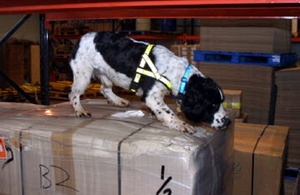
Cargo Sniffer dog

The following veterinary medicines were identified by a courier company based at Belfast depot. The products were then detained and subsequently seized by Department of Agriculture, Environment and Rural Affairs (DAERA).

This parcel was addressed to residential premises in County Tyrone and was shipped from Australia. The parcel contained:

  • 100 boxes of 20 ml of Hippiron Iron Injection

This product is intended for use in horses and is not an authorised veterinary medicine in the UK.

The medicines were seized under Regulation 25 (Importation of unauthorised veterinary medicinal products) of the Veterinary Medicines Regulations 2013.

Published 30 November 2020


November interim findings from COVID-19 transmission study published

  • Interim findings show a 30% fall in infections nationally between 13 and 24 November, with 96 people per 10,000 infected

  • New tiering system will be crucial to safeguarding these gains, bringing down infections further and keeping infection rates low

Interim results from the seventh report of one of the country’s largest studies into COVID-19 infections in England have been published today by Imperial College London and Ipsos MORI.

Over 105,000 volunteers were tested in England between 13 and 24 November as part of the REACT study, to examine the levels of infection in the general population.

The findings show cases were rising as the country entered lockdown but this was followed by a decrease as national measures successfully lowered infection rates across the country. This supports findings from SAGE that stronger measures would be needed in some areas to prevent the epidemic from growing and that local tiers needed to be toughened to keep the virus under control once national measures end this week.

Infections fell by over 50% in the North West and North East, with prevalence highest in the West Midlands, East Midlands and Yorkshire and the Humber.

While gains have been made to bring down infections, prevalence of the disease remains high with around 1 in 100 people testing positive compared to 1 in 80 between 16 October and 2 November.

The main findings from the seventh REACT study show that between 13 and 24 November:

  • 96 people per 10,000 infected, down from 132 per 10,000 between 26 October and 2 November
  • the virus was halving every 37 days
  • the national R rate was estimated to be 0.88
  • prevalence halved in the North West (1.08% down from 2.53%) and North East (0.72% down from 1.88%), and fell in Yorkshire and The Humber (1.17% down from 1.8%)
  • prevalence remained high in the East Midlands (1.27% down from 1.31%), and West Midlands (1.55% down from 1.56%), where rates are now the highest in the country meaning 155 people per 10,000 have the virus
  • people of Asian ethnicity had increased odds of testing positive compared with white people
  • people living in the most deprived neighbourhoods had higher odds of testing positive than those living in less deprived neighbourhoods
  • there is an increase in prevalence among people living in the largest households

Health and Social Care Secretary Matt Hancock said:

Thanks to the huge efforts of the public over the last few weeks we have been able to get the virus more under control. This latest data shows we must keep our resolve and we cannot afford to take our foot off the pedal just yet, despite the encouraging fall in cases and progress on vaccines.

The next few weeks and months are the busiest time of year for our NHS, so it’s vital we all continue to follow new local restrictions, wash our hands, wear a face covering and observe social distancing.

Professor Paul Elliott, director of the programme at Imperial, said:

Our robust data offers encouraging signs for England’s epidemic, where we’re seeing a fall in infections at the national level and in particular across regions that were previously worst affected. These trends suggest that the tiered approach helped to curb infections in these areas and that lockdown has added to this effect.

As we approach a challenging time of year, it’s even more vital that through our actions and behaviours we all play our part in helping to keep the virus at bay.

This report is the latest from the REACT study, which was commissioned by DHSC and carried out by a world-class team of scientists, clinicians and researchers at Imperial College London, Imperial College Healthcare NHS Trust and Ipsos MORI.

While infections have fallen across England and the spread has slowed, it is crucial we safeguard gains made and keep R below 1. The new regional, tiered system has been strengthened to ensure infections continue to decrease and stay low. Mass community testing using rapid lateral flow tests will be offered to areas facing the toughest restrictions. It will enable areas to detect asymptomatic cases and isolate them to protect others, stop the virus from spreading and help move out of the toughest restrictions.

Decisions on tiers are made by ministers based on public health recommendations. These are informed by a variety of criteria including local context, pressure on the NHS as well as case detection rate, how quickly cases are changing and positivity in the general population.

Kelly Beaver, Managing Director of Public Affairs at Ipsos MORI, said:

The REACT study programme has processed over one million tests as we track in real time the prevalence of COVID-19 across England. We’re incredibly grateful to all those members of the public who’ve taken part, who have contributed to this vitally important study.

See the pre-print report.

See the GOV.UK summary of the November 2020 interim results.

See more information on the Real-time Assessment of Community Transmission (REACT) programme of work.

This study falls under pillar 4 of the COVID-19 National Testing Programme, which focuses on mass surveillance in the general population.


Alumni event and celebration of St Andrew’s Day at the British Ambassador’s residence


St Andrew’s Day 2020: Alister Jack’s message

St Andrew’s Day is a chance for us to celebrate all that is great about Scotland, and Scots, and to reflect on what it means to be Scottish.

In 2020, St Andrew’s Day will feel very different.

We are living through a global pandemic. Our lives are almost unrecognisable from a year ago.

But I believe that, this year more than ever, we should take the time to mark just how much we have collectively achieved.

Over the past few months, we have risen to the challenge of the, frankly terrifying, virus. We have, and are, all doing our bit to defeat it. We have made huge personal sacrifices because we know it will save lives and protect our precious NHS.

Our frontline workers – from health care staff to supermarket workers, teachers and everyone in between – have been nothing short of heroic. Looking after the ill, supporting the vulnerable, and keeping the country going. You are an inspiration to us all.

So many others have also done their bit. From picking up shopping and prescriptions, to organising spirit-lifting video chats and amazing charity fundraisers – individuals up and down the land have gone out of their way to look after friends, relatives and neighbours, and also strangers in need.

We have much to be proud of. In 2020, it seems to me, being Scottish is about fortitude and kindness. And also optimism. With new vaccines on the way we are starting to see some light at the end of the covid tunnel.

So, this St Andrew’s Day, I ask you to join me in thanking everyone who has done their bit to help us all get through 2020 so far. I have never felt more proud to be Scottish.


UKHO and Cefas launch new innovation challenge to support offshore renewable energy growth

The UK Hydrographic Office (UKHO) has partnered with the Centre for Environment, Fisheries and Aquaculture Science (Cefas) to launch the latest marine innovation challenge, focused on the offshore renewable energy sector.

As part of the ADMIRALTY Marine Innovation Programme, the latest challenge invites participants to develop solutions that use marine geospatial data to help identify new areas for offshore renewable energy and optimise the performance of existing infrastructure.

To support planners in this sector, access to marine geospatial data is essential to find suitable sites for offshore wind and tidal wave energy generation. Accurate data also helps mitigate potential environmental issues, while ensuring the longevity and optimised performance of these installations.

Throughout the challenge applicants can access a wide range of geospatial and scientific data to help them develop key solutions. Selected applicants will then get to work alongside experts at both the UKHO and Cefas to develop a prototype product to test with users. The winner of this challenge will receive a chance to develop an alpha product to test in the offshore renewable energy market, which is estimated to be worth £178 billion and employ more than 1.5 million people globally by 2030.

Mark Casey, Head of Research, Design and Innovation at the UKHO, commented:

The offshore renewables sector is a vital pillar in the blue economy and has an important role to play in the fight against climate change. With significant potential, this sector must be supported with access to data to enable better decision-making.

The ADMIRALTY Marine Innovation Programme is dedicated to harnessing the power of innovation to explore how data can support ocean sustainability. To achieve this, we must be collaborative. We are proud to partner with Cefas for this challenge and we welcome applications from any organisations with a creative solution for how marine data can accelerate growth in offshore renewables.

Stuart Rogers, Chief Scientist at Cefas, said:

We are pleased to partner with UKHO again to build on our previous successful collaborations. We recognise the global potential for offshore renewables and are keen to work with the sector to ensure that future development can proceed in an environmentally sustainable way. We believe this project has the potential to accelerate high quality data synthesis relevant to offshore renewables and contribute to the de-risking of future developments, allowing the sector to contribute to meeting the UK government’s targets for renewable energy generation and net zero.

Find out more

To participate in this challenge, applications must be submitted by Thursday 31 December 2020. You can find out more about the challenge and access the application form below: