Welsh Secretary visits north Wales football club following lottery support

Press release

Gresford Athletic FC will receive a share of financial package facilitated by the UK Government

Welsh Secretary Simon Hart has visited a grassroots football club in north east Wales to hear how it has been affected by the Covid-19 pandemic and about how it will receive a share of a financial support package which the UK Government helped arrange.

Gresford Athletic FC is one of 44 Cymru League clubs who will receive a share of a £750,000 package created by the FAW and the National Lottery and facilitated by the UK Government. It will see clubs in the three Cymru League divisions receive support while matches are played behind closed doors because of Covid-19 restrictions.

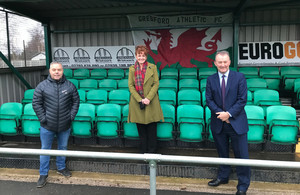
Mr Hart visited Gresford Athletic on Monday (30 November) alongside local Wrexham MP Sarah Atherton where he heard from the club’s Chairman Julian Davies, members of the committee and players about the effect of the pandemic on the club and its supporters.

Secretary of State for Wales Simon Hart said:

Clubs like Gresford Athletic play a huge role in their local communities and, like many others, they have been struggling during the pandemic without supporters watching matches, money coming in over the bar or the ability to raise funds.

That’s why I was delighted that the UK Government could help bring the National Lottery and the football authorities together to deliver a financial support package and I hope the money will provide some help to fantastic grassroots clubs like Gresford.

Gresford Athletic Chairman Julian Davis said:

The Covid situation has had a real financial impact on clubs like ours with no spectators coming through the gates, sponsorship down and community fundraising on hold.

It’s been extremely difficult for all clubs, so the help from the FAW and the Lottery is appreciated while we wait to get back to playing football, which we hope will happen very soon.

MP for Wrexham Sarah Atherton added:

I understand the importance of Gresford Athletic to the community, as well as the importance of football to Wrexham. Providing some certainty to football clubs such as Gresford during these times is crucial and we must ensure their survival post-lockdown.

I was thrilled that the UK Government was able to facilitate support for 44 clubs, including Gresford, from the FAW and the National Lottery. It is the boost they needed and deserved.

The £750,000 funding partnership follows a similar National Lottery initiative between the FA and National League in England, facilitated by the UK Government. Work continues on partnerships with the Scottish and Northern Ireland FAs.

Published 3 December 2020


Facilitating ambition within a green recovery

Greetings to everyone on this event and thank you so much for dialling in. Many of you will be dialling in from places where it is late in the day or really very early. So, thank you so much for your commitment, we really are incredibly grateful.

At the opening of the Climate Change Dialogues last Monday, I made the point that, despite the great difficulties we have faced this year, it is absolutely vital that we that maintain momentum on climate action.

Over the past months I’ve spoken to very many colleagues across the world and individual governments,

I have spoken at almost 50 events virtually. And whilst we’ve all acknowledged the need to do as much as we can to support our populations, protect jobs, protect livelihoods, in terms of our individual countries, it is also the case that climate change hasn’t taken time off. The clock is still ticking and those two hands on the face of the clock are getting closer to midnight.

So, it is important that we keep encouraging ambition across the world. Archie talked about some of the areas that we are looking for leaders to come forward at the Climate Ambition Summit on 12 December. What we want to do is to encourage that ambition on mitigation, on adaptation and support.

So that we are in prime position to realise the full potential of the Paris Agreement in Glasgow next year. We absolutely owe that not just to our generation but actually generations to come in the future.

All of you are vital, you’re absolutely integral to that. That is how we’re going to make progress at COP26. And I’ve said this before but I want to repeat this point – the UK and our friends in Italy may have the presidency of COP but success at COP is going to belong to each and every one of us as individuals and as countries.

It’s only by working together that we will succeed in tackling climate change.

Whether that’s in Governments, regions, cities, indigenous peoples, business, civil society, and or as individuals, it is going to be vital that we all play our part.

That is why events like this Open Dialogue are so important. Bringing together representatives from a whole range of constituencies.

And it is also why our COP26 campaigns are bringing people together to focus on these five critical areas: clean energy, clean transport, adaption and resilience, nature based solutions, and finance, which ties the whole thing together.

I’d like to speak for one moment directly to all our representatives from observer organisations.

The reality is reaching net zero and building our resilience will only be achieved through this joint effort.

And for this, you are absolutely vital. You are vital for helping to raise awareness, for generating support, and asking us to do more.

And very rightly you encourage us to go further.

And help to create the conditions for the Parties to raise their ambition around the negotiating table.

We saw this in Paris in 2015.

And we continue to see this drive for us to go further today as well.

For me what is really important is that you are working on the ground. You are building that resilience you are helping us reduce emissions.

You are creating the changes we need.

Whether that is indigenous leaders applying their knowledge to protect our biodiversity and ecosystems.

Or indeed, International Trade Union Confederation’s campaign to climate-proof work and jobs.

Or the advocacy we have seen from YOUNGO members around the world.

Your role within the official UNFCCC process is equally important. It really matters, and it really matters to me on a personal level.

And I want to thank the nine UNFCCC constituency groups for the leadership they have shown.

As you know, we are committed to a comprehensive agreement in Glasgow.

One that covers each of the key issues.

And, really importantly, any agreement has to be informed by the voices that have too often been marginalised. I make this point again and again in public and private.

By representing those voices. And by contributing your expertise and support. You strengthen our work.

Whether that’s the Women’s Environment and Development Organisation. Supporting equal participation in UN climate negotiations. Through the Women Delegates Fund.

Or indeed, the expertise of the Women and Gender Constituency. Which, at COP25, informed the renewed Gender Action Plan, placing gender equality at the heart of climate action.

This is again a really important thing we need to keep pressing on.

The UK has committed to implementing the Plan. And I urge all Parties to do the same.

I am very much committed to working with observers to make COP26 a success.

I’ve had quite a few engagements over the past few months and will absolutely be ramping up the engagement in the year coming up to COP26.

That is why I spoke at the Local Governments for Sustainability’s event in October. And it was about encouraging climate ambition among city leaders.

And supported Indigenous People’s Day in August. To emphasise how important Indigenous People’s knowledge and experiences are in tackling the climate crisis that we all face.

I know our Italian partners are working closely with YOUNGO too. Preparing for Youth COP, and hosting the Youth4Climate series. And I was very pleased to join one other their webinars recently.

It’s also really good to see the Research and Independent NGOs working closely with our COP26 universities network. Ensuring the academic sector, which is so important, and universities play a role in delivering a successful COP.

And of course, universities are part of the Race to Zero campaign as well.

So I am really looking forward to hearing from you in today’s discussion on the vital issue of the green recovery.

Urging countries to build back better in response to the coronavirus pandemic is absolutely central to the UK’s COP26 presidency.

But we really have to do this in a way that involves the whole of society. We have to excite everyone across the world and ensure that COP26 really has meaning for them.

Just as our work to reduce emissions and build resilience, we must take all interests into account.

That means bringing in the voices of civil society, young people, Indigenous Peoples, businesses and others in government decision-making.

And here, non-state actors can help.

So I urge all parties to look at how you can work more closely with observer groups and non-state actors. To increase ambition in your countries in a way that is fair to all.

And I am keen to hear examples of successful initiatives from both Parties and Observers today.

By listening to each other, learning from each other, and working together, we can boost ambition, take action, and strengthen this process. All of this will help pave the way for a successful COP26.

Thank you so much for being with us today.


Withdrawal Agreement Specialised Committee meeting on UK Sovereign Base Areas in Cyprus: joint statement

Press release

The second meeting of the Committee on 3 December by video conference, co-chaired by European Commission and UK government officials, looked at Sovereign Base Areas.

The second meeting of the Specialised Committee on the Protocol on Sovereign Base Areas was held today, 3 December via video conference, co-chaired by officials from the European Commission and the UK Government. The Committee was established by the Withdrawal Agreement to facilitate the implementation and application of the Protocol.

The UK and the EU examined the progress in the preparation for the implementation of the Protocol, which shall become effective at the end of the transition period, and reaffirmed their commitment to full implementation of the measures outlined in the Protocol.

The co-chairs agreed that the Committee will meet again before the end of the year to finalise the remaining issues and to ensure the smooth and timely entry into effect of the Protocol.

Published 3 December 2020


Travel corridor update, 3 December 2020

There will be no additions to or removals from the travel corridor list this week following data received from the Joint Biosecurity Centre and Public Health England.

The government will continue to take decisive action if necessary, to contain the virus, including removing countries from the travel corridor list rapidly if the public health risk of people returning from a particular country without self-isolating becomes too high.

A range of factors are taken into account when deciding to remove a country from the travel corridor list, including the continued increase of coronavirus (COVID-19) within a country, the numbers of new cases, imported cases, information on a country’s testing capacity, testing regime and test positivity rate. None of these indicate the need to amend the list of travel corridors this week.

The government has also announced today (3 December 2020) a limited number of exemptions for passengers arriving into England, including for business travellers who meet a set of required criteria.

From 4am on Saturday 5 December, individuals undertaking specific business activity which would deliver a significant benefit to the UK economy – including activity that creates or preserves 50+ UK jobs – will no longer need to self-isolate when travelling or returning from non-exempt countries.

Individuals will only be exempt when undertaking the specific business activity and will only be able to meet with others as required by that specific activity. Further information will be available on gov.uk when these exemptions come into force.

Exemptions will also come into force at the same time for domestic and international performing arts professionals, TV production staff, journalists, and recently signed elite sportspersons, ensuring that industries which require specific, high talent individuals who rely on international connections can continue to complete their work.

PHE do not anticipate these changes will raise the risk of domestic transmission, due to the protocols being put in place around these exemptions, however all exemptions will remain under review.

All travellers, including those from exempt destinations, will still be required to show a complete passenger locator form on arrival into the UK unless they fall into a small group of exemptions.

COVID-19 has profoundly changed the nature of international travel. Travellers should continue to check the latest advice from the Foreign, Commonwealth and Development Office, given the potential for changing coronavirus infection rates to affect both the advice about travelling to other countries and rules about self-isolation on return.

Penalties for those breaching the self-isolation rules when returning from non-exempt countries have increased from £1,000 for first offences up to £10,000 for subsequent offences, mirroring penalties for those breaching self-isolation following a positive COVID test or contact from Test and Trace.


Government to add COVID-19 to Vaccine Damage Payments Scheme

  • COVID-19 vaccines will only be deployed once they meet strict standards of safety, effectiveness and quality and are approved for use by the regulator
  • No safety concerns have been reported in clinical trials for COVID-19 vaccines authorised for use
  • Addition of COVID-19 a responsible step and standard process to further prepare for safe roll out

In advance of a rollout of an authorised COVID-19 vaccine and in line with other immunisation programmes, the government is taking the precautionary step to ensure that, in the very rare possibility where someone is severely disabled as a result of taking a COVID-19 vaccine, they can access financial assistance through the Vaccine Damage Payments Scheme (VDPS).

No safety concerns have been reported in vaccines authorised for use following rigorous clinical trials involving tens of thousands of people and extensive analysis of the vaccine’s safety, quality and effectiveness by experts from the Medicines and Healthcare products Regulatory Agency (MHRA).

Pfizer/BioNTech’s vaccine is now the first COVID-19 vaccine to be authorised for use in the UK, and the MHRA will keep safety under continual review.

Adding diseases to the VDPS is not new and numerous diseases have been added as successive governments have rolled out more immunisation programmes, such as HPV and Meningitis B. In response to the H1N1 (swine flu) pandemic, the previous government added swine flu to the VDPS on 10 October 2009.

Generally, only those who were administered vaccines as part of a childhood immunisation programme are covered under the VDPS. However, because COVID-19 vaccines will be rolled out to a large proportion of the adult population, the government will amend the eligibility requirements, ensuring adults who are administered a COVID-19 vaccine in the UK or Isle of Man, or as part of an armed forces medical treatment, will be covered by the scheme too.

This is not a novel approach. Currently, polio, rubella, meningococcal group C, HPV and meningococcal group W (up to age 26) are also exempt from the age requirement, as these vaccines were primarily offered to adults.

Deputy Chief Medical Officer for England Professor Jonathan Van-Tam said:

We are extremely confident in the effectiveness and safety of our immunisation programmes. We will not be rolling out a COVID-19 vaccine unless it has met robust standards of safety, effectiveness and quality and authorised for use by the medicines regulator, the MHRA.

The UK has one of the most comprehensive immunisation programmes in the world, and sensible routine precautions such as these form a huge part of our global-leading standards in safety.

The VDPS is a safety net to help ease the burden on individuals who have in extremely rare circumstances experienced harm due to receiving a government-recommended vaccine. It is not a compensation scheme. Rather, it provides a one-off, tax-free lump sum – currently £120,000 – for those suffering a severe disability as a result of a vaccine against a disease listed under the Vaccine Damage Payments Act.

Currently, in order to qualify for the payment, it must be accepted, on the balance of probability, that there is a causal link between the vaccine and the claimed disability and that the resulting disability amounts to severe (ie at least 60%) disablement.

Claims are assessed and paid where successful by the Department for Work and Pensions.

Existing diseases included within VDPS eligibility