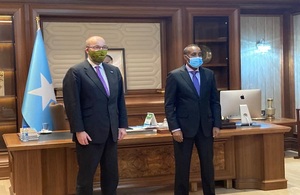
UK Minister reiterates UK commitment to Somalia and the region’s response to the threat of Al-Shabaab

Press release

Minister for Africa, James Duddridge MP visited Mogadishu where he announced new UK contributions to support Somalia’s long-term security and stability.

UK Minister for Africa, James Duddridge and Somali Prime Minister, Mohamed Hussein Roble

UK Minister for Africa, James Duddridge MP, visited Mogadishu this week where he underlined the UK’s continuing commitment to Somalia’s long-term security and stability, and the world’s poorest, with new UK support worth £21.8 million ($29.2 million).

In the first visit to Somalia by a UK government Minister since the start of the COVID-19 pandemic – and the first visit since the UK created a single Foreign, Commonwealth & Development Office to bring together diplomacy and development – Mr Duddridge met President Mohamed Farmajo and Prime Minister Mohammed Roble. They discussed the upcoming federal elections, including the importance of timely and inclusive elections, as well as progress on economic and security sector reform.

In discussions on UK support for Somalia’s operations against Al-Shabaab, the Minister announced new UK contributions to support the Somali Security Forces worth £1.6 million ($2.15 million) to counter the threat from roadside bombs.

The Minister met British troops training the Somali army, and reiterated UK support for the African Union in securing and protecting regional stability. He said that the UK would contribute a further £3.37 million ($4.5 million) for the Somali Security Forces engaged in joint operations with the African Union Mission to Somalia (AMISOM).

The Minister also met development and humanitarian partners working to protect the resilience, health and stability of Somalia’s communities – and announced a comprehensive package of UK support.

This includes:

  • £3.8 million ($4.9 million) to help the thousands of Somalis recently displaced by catastrophic flooding. This is in addition to long-term UK aid-funded food assistance, emergency healthcare and shelter for the country’s most vulnerable
  • £5m ($6.7 million) to support cash-based food assistance for approximately 123,000 vulnerable, food insecure people. This funding will be channelled through WFP Somalia
  • A further £8 million ($10.3 million) to support Somalia’s health services, with a focus on antenatal care and vaccinations. So far this year, UK aid has helped over 120,000 Somali women receive antenatal care, ensured a skilled birth attendant was present for the delivery of 90,000 babies, and vaccinated 100,000 children against the most common childhood killers

UK Minister for Africa, James Duddridge, said:

The UK is a proud partner on Somalia’s journey towards stability and security – from British troops training alongside the Somali Army, to the life-saving UK aid programmes that are safely delivering babies and vaccinating against disease, as well as providing those in desperate need with food assistance.

We remain committed to African efforts to secure and protect regional stability, and today I can announce new UK support to those working alongside the African Union’s peacekeeping mission here in Somalia. Working together, we can tackle the forces who threaten stability across East Africa and around the world.

Notes to Editors:

  • The UK Minister for Africa visited Somalia on 8 and 9 December
  • A biography of the Minister for Africa, James Duddridge MP, can be found here
  • The further £3.8m humanitarian funding for Somalis displaced by catastrophic flooding will support the provision of cash-based assistance to the most vulnerable and much needed relief supplies for the many thousands of Somalis recently displaced by catastrophic flooding. This is part of the UK’s £324m four year humanitarian programme from 2018 to 2022 which also provides food assistance, emergency healthcare, nutrition, shelter, and protection for the most vulnerable
  • The further £8m for the provision of health services, such as antenatal care and vaccination, in Somalia brings the UK’s total health spending from 2016 to 2021 to £96.9m
  • The further £5m ($6.7 million) to support cash-based food assistance comes from the UK’s Crisis Reserve, a £61m funding package recently approved by the Foreign Secretary, targeting 12 countries with rising levels of food insecurity

Published 9 December 2020


New partnership programme to help financial institutions digitise

The Department for International Trade (DIT) has today launched new a global partnerships programme, Leading Edge, to help International Financial Institutions (IFIs) in priority markets access the best British fintech solutions – beginning with Singapore, Australia and the US.

Leading Edge is designed to help create the right conditions for new partnerships and trade and investment opportunities, supporting important global financial and professional services relationships and promoting the adoption of fintech, particularly of UK-grown solutions in areas such as RegTech, robotic process automation and Artificial Intelligence.

Large financial institutions will be able to make the most of the leading fintech scene in the UK, which is home to approximately 1600 fintech firms and this is expected to more than double by 2030. The UK fintech sector is estimated to be worth £11bn in revenue in 2019, up from £6.6bn in 2015, and now accounts for around 8% of total financial services output.

Minister for Investment, Gerry Grimstone, said:

At this year’s Singapore FinTech Festival, the UK is showcasing why collaboration and innovation are key pillars of our fintech philosophy and why digitisation is a core part of the future of financial services.

The digital adoption and transformation support offered by the UK’s leading firms will enable International Financial Institutions to remain not only competitive but also a viable part of the financial services sector of tomorrow.

I welcome the launch of Leading Edge, which will give these global firms in our partner countries, including Singapore, the opportunity to collaborate with and benefit from the UK’s world leading fintech expertise.

DBS CEO, Piyush Gupta, said:

DBS is excited to work with Leading Edge, which offers us the opportunity to tap into the extensive range of capabilities of UK fintechs.

This will further enhance our existing in-house programmes that not only engage, nurture and grow the startup community but through value exchange, create incremental value for our customers.

UOB Head of Group Technology and Operations, Susan Hwee, said:

At UOB, we focus on building on our customers’ trust by making banking simpler, smarter and safer.

In our pursuit to create greater value for them, we continually innovate and work with like-minded partners across the globe.

As the ecosystems we forged have enabled us to break new ground in developing customer-centric banking solutions, we look forward to collaborating with the best of UK FinTech firms in the Leading Edge programme.

In Singapore, DIT has agreed partnerships with the three major banks, DBS, OCBC and UOB. This announcement comes as part of the UK’s involvement in Singapore FinTech festival. DIT has a full programme of events, with speakers including Minister for Investment, Gerry Grimstone, HM Trade Commissioner for Asia Pacific Natalie Black CBE, and CEO of DBS, Piyush Gupta.

The UK and Singapore are both leaders in the global digital economy, with 65% of all UK services exports to the world delivered remotely in 2019. We are working closely with Singapore to ensure business continuity, and working towards the UK joining the Trans-Pacific Partnership; a key priority for government as we focus on strengthening our relationships with dynamic economies in the Indo-Pacific region.


Joint working improving children’s access to mental health services

More children with mental health needs are getting the right support at the right time, with local agencies learning from past failures, a new study finds. Given the impact of COVID-19 on children’s mental health, and increased pressure on services, building on this success is vital.

Published today [9 December 2020], the joint report from Ofsted, Care Quality Commission (CQC), HMI Constabulary, Fire & Rescue Services (HMICFRS) and HMI Probation looks at how partners in 6 local authority areas are working together to help children with mental ill health. The report is based on inspections carried out between September 2019 and February 2020 – before the COVID-19 pandemic.

The report finds that restructures of child and adolescent mental health services (CAMHS), along with a concerted effort by agencies to work together, has broadened the help available for a range of mental health needs. This has also led to more timely identification, referrals and support.

In many cases, professionals are knowledgeable and can recognise the signs of mental ill health. A single point of access for specialist advice on mental health is helping professionals respond more effectively, as are co-located services and improved involvement of voluntary and community sector organisations.

But although much progress has been achieved, this good work is not universal. Some agencies need to get better at identifying children suffering from mental ill health. In some cases, professionals are still focusing on presenting issues, and not looking beyond them for possible risks of mental ill health. This applies to some staff in emergency departments, GPs, police and social workers, even in circumstances where a child has self-harmed or behaves in a way that indicates they have suffered trauma. And too often, a child’s mental health problem is first picked up when they enter the youth justice system.

Schools have an important role to play in supporting children’s mental health, but they cannot do it alone, the report finds. Where schools are supported well by partners, children get specialist help when they need it. But there is wide variation in the quality of support that children receive from school nurses. Nursing services in half of the areas visited did not have the systems in place nor the capacity to identify children with mental health problems, meaning that opportunities to spot issues early were missed.

Many police forces in areas visited have well-developed training and support for officers to recognise and help children with mental ill health, but this is not consistent in all areas. Inspectors saw too many examples of children being kept in custody overnight and who were not helped to get the support that they needed with their mental health.

Despite improvements in partnership working being made in some areas, the report finds that specialist CAMHS are still limited in some areas and resources are overstretched. Some of the most vulnerable children have to wait far too long for their mental health needs to be identified and to get access to specialist services. This includes children with autism, ADHD, some children on child in need and child protection plans, and children in care.

Amanda Spielman, Ofsted’s Chief Inspector, said:

Children’s mental health has taken on a much higher profile in recent years, even before the pandemic, and services have been steadily improving. However, while we saw some excellent partnership work to better support children with mental ill health in the areas we visited, we know this will not be the experience of every child.

Single points of contact, accessible services and strong joint working make a real difference for children. But it’s also vital that each partner recognises their own role, and knows when to seek specialist advice, so that children get the right support at the right time. Given the added pressures that the pandemic is placing on mental health services, it would be tragic if these improvements were lost when they are needed more than ever.

Victoria Watkins, Deputy Chief Inspector of Primary, Integrated and Children’s Health Services at CQC said:

When we published ‘Are we listening?’, our review of children and young people’s mental health services in 2018, we noted that good care was more likely to be seen where local services were working together. Encouragingly, these joint inspections with Ofsted found strong partnership working, with the needs of the child at its heart. This is a testament to the tireless effort of people working in the system to improve the experience of children and young people with mental health needs.

Unfortunately, as we reported in 2018, some young people still wait too long for their needs to be identified or to access the mental health support that they need. There is still also a risk that people working with children and young people focus on immediate issues, such as seemingly disruptive or challenging behaviour, and miss the opportunity to address any mental health needs that might also be present.

It’s vital that we build on the progress made and good practice we have seen, and hold onto these lessons as the whole health and care system continues to respond to the pandemic and any impact it has on services.

Wendy Williams, HM Inspector of Constabulary and Fire and Rescue Services, said:

We know from previous inspections that responding to people with mental health needs is a complex issue that the police are faced with on a daily basis, often at a time of crisis for that individual. We are therefore pleased to see the police service is improving how its officers engage with, and respond to, children suffering with mental ill health. There are still areas we would like to see the police together with other services improve on, such as the early identification and provision of support for those children who suffer from mental ill health and are brought into police custody for other matters. We have seen where there is effective joint working with partner agencies it ensures vulnerable children are given the support they need in environments which improve, and not hinder, their well-being.

Justin Russell, Chief Inspector of Probation, said:

It remains of considerable concern that a referral to a youth offending service is often the first time a child’s mental health needs are identified and addressed. This alone demonstrates that change is crucial, and I welcome the findings of this report demonstrating the efforts being made to diagnose children at the earliest opportunity and tailor support to their individual needs.

We do not yet know the full impact COVID-19 may have had on children’s mental health, and how this will affect already over-stretched services in some areas. I urge all those who have worked together to make improvements to build on the momentum they have established – it is more important than ever that services work collaboratively for the sake of those most vulnerable in our society.

This report describes findings from 6 joint targeted area inspections (JTAIs) carried out between September 2019 and February 2020, along with the Care Quality Commission (CQC), Her Majesty’s Inspectorate of Constabulary, Fire and Rescue Services (HMICFRS) and Her Majesty’s Inspectorate of Probation (HMI Probation).

The 6 local authorities inspected were Bexley, East Sussex, Milton Keynes, Plymouth, Portsmouth and Sefton.

A focused review of children and young people’s mental health services through the JTAI programme was one of the commitments made by CQC in its report, ‘Are we listening? A review of children and young people’s mental health services’ requested by the then Prime Minister in 2017. The JTAI approach demonstrates the joined-up working expected in local systems.


A simple solution speeds up Sellafield decommissioning

A new way of taking intermediate level waste out of Sellafield’s Pile Fuel Storage Pond has been developed.

It means the material can be removed 6 years earlier than planned, saving millions of pounds for the UK taxpayer.

Like most technological breakthroughs, it’s a simple solution to a complex problem.

Originally, it was thought this waste would need to be taken out via a new processing facility called the Box Encapsulation Plant.

But decommissioning teams went back to the drawing board and came up with an alternative plan.

They designed a new waste export route using an existing Sellafield building, the Waste Encapsulation Plant.

It means the material can be removed immediately, rather than waiting until 2026.

The first basket of waste has now been successfully exported. Another 500 baskets will be removed over the next three to four years.

Dorothy Gradden, head of legacy ponds for Sellafield Ltd, said:

This is a major breakthrough. Everyone involved is justifiably proud of what we’ve achieved. It’s particularly pleasing to have it done it during COVID-19.

By finding a simple solution to a complicated problem, we’ve taken a significant step towards emptying the pond and retiring the risk from this legacy facility.

The pond was built in the 1940s to support the production of plutonium for Britain’s nuclear deterrent, Sellafield’s original mission.

It is one of four Sellafield buildings prioritised for clean-up by the Nuclear Decommissioning Authority.

The new waste route is a Sellafield Ltd/supply chain collaboration via the Decommissioning Delivery Partnership.

James Fisher Nuclear played a key role, helping to manufacture new equipment and tools.

Sellafield Ltd teams made a range of contributions including adapting software systems, introducing a micro-digger into the pond, and repurposing existing technologies and equipment.

Introducing a micro-digger

Other intermediate level waste projects at Sellafield will benefit from the lessons learned during this work.


WTO Indonesia Trade Policy Review: UK statement

Thank you, Chair.

On behalf of Her Majesty’s Government, I am pleased to add my welcome to the delegation of Indonesia, led by the Honourable Jerry Sambuaga, Vice Minister of Trade. I would also like to express our appreciation to the Indonesian Government and the WTO Secretariat for their insightful reports, and to you Chair and H.E. Ambassador Villalobos Rodríguez, the Discussant, for your efforts to facilitate today’s Trade Policy Review.

Mr Chairman, the United Kingdom would like to reiterate the importance of the Trade Policy Review as a transparency mechanism in monitoring Members’ trade policies, and express our appreciation for Indonesia’s responses to our written questions.

Since its last Trade Policy Review in 2013, Indonesia has taken notable steps to increase its engagement in multilateral and regional trade, most recently through participation in and facilitation of the Regional Comprehensive Economic Partnership. Indonesia has also been active in enabling investment, with the World Bank describing the new Job Creation Law as one of the most important pieces of investment reform in decades. Once implemented, we understand that this has the potential to greatly improve the ease of doing business in Indonesia. The UK welcomes the new legislation and looks forward to the early issue of the implementing regulations.

Indonesia has made a strong effort to further integrate itself into the multilateral trading system. The United Kingdom commends Indonesia for having ratified the Trade Facilitation Agreement in December 2017 and implemented 88.7% of its commitments to date. We support Indonesia’s efforts to implement its remaining TFA commitments by February 2022. The establishment of the National Committee on Technical Trade Barriers has allowed Indonesia to implement the WTO TBT Agreement effectively, submitting 79 notifications to the TBT Committee in the review period, and to address TBT issues. The UK recognises Indonesia’s commitment to transparency through the submission of WTO notifications.

We are pleased that Indonesia is an Observer to the WTO Government Procurement Agreement. The UK strongly supports this Agreement, which ensures competition as well as value for money on public procurement. We look forward to Indonesia taking the next steps to progress their accession process. We welcome Indonesia’s objectives of reducing greenhouse gas emissions and encouraging more sustainable energy. Reduced barriers to imported components and foreign investment could speed up Indonesia’s energy transition and contribute to meeting its environmental goals. The UK sees Indonesia as an important G20 partner. We welcome the agreement reached by G20 Trade Ministers on 22 September 2020 and look forward to working closely with Indonesia during Italy’s Presidency of the G20 in 2021 and during Indonesia’s G20 Presidency in 2022.

Last year the United Kingdom and Indonesia celebrated 70 years of diplomatic relations, and we continue to bolster our bilateral ties. Our total bilateral trade was worth £2.9bn in 2019, and we are working to develop stronger economic ties as we emerge from the COVID-19 crisis. The United Kingdom is currently conducting a bilateral Joint Trade Review with the Indonesian Government which is due to be concluded in January 2021. Through this, both sides are identifying opportunities to enhance bilateral trade relations and set the groundwork for future cooperation. In doing so we work to strengthen the rules-based international system, fight protectionism, and reduce trade barriers.

In closing, allow me to thank our Indonesian colleagues for their valued cooperation and extend our wishes for a successful Trade Policy Review.

Thank you, Chair.