RFEA and TechVets are bridging the gap for veterans entering cyber and technology industry

News story

The Forces Employment Charity (RFEA) is launching a new partnership with TechVets, an organisation dedicated to building a bridge for veterans into cyber security and the technology sector.

Hands on a keyboard typing.

MOD Crown Copyright 2020.

Advancements in technology and the evolving cyber threat landscape means that the global cyber security market is projected to reach £210-billion by 2026, creating vast job opportunities for veterans and service leavers.

The RFEA and TechVets partnership aims to combat underemployment and unemployment within the veteran community by creating extensive free upskilling and job opportunities for ‘tech-curious’ service leavers and veterans. Through its unique offering of networking, mentoring, signposting and training services, via the new TechVets Academy platform, the blended and flexible learning pathways enable the user to choose the pathway that is best for them.

Read more about TechVets and the partnership with RFEA

Published 11 December 2020


Supporting countries on the frontline of climate change

Thank you very much and good afternoon everyone. And thank you particularly to His Excellency the Honourable Kausea Natano; Dame Meg Taylor; and the Pacific Island Forum Leaders, for inviting me to speak.

The message coming from regions like the Pacific on climate change has a moral urgency and the world cannot ignore it.

I hear what you say. That climate change is the single greatest threat to the livelihoods, security and wellbeing of your people. And I am committed to working with you, throughout my COP Presidency. To make sure that your voices are heard. To address the issues that matter most to you. And to find practical solutions.

I commend the leadership your region has shown on climate change. Which is reflected in the Kainaki II Declaration, the Framework for Resilient Development in the Pacific.

And despite contributing only a fraction of the world’s greenhouse gas emissions, many of you are coming forward with updates to your NDCs.

You are setting a powerful example and encouraging countries around the world to raise their ambition. On mitigation, on adaptation and on finance.

Last week, the United Kingdom announced its NDC. Committing to cut our emissions by at least 68% by 2030, which keeps us on the pathway to our 2050 Net Zero commitment.

Soon we will be submitting our first Adaptation Communication.

And more leaders will announce commitments at the Climate Ambition Summit, which the UK is hosting tomorrow, with the UN and France and in partnership with Italy and Chile.

And the Summit builds on events that have taken place across the world.

From the CARICOM Moment of Ambition Roundtable that the UK is co-hosting with Caribbean partners today.

To this “Kainaki II to COP26” Roundtable.

I would like to thank all those of you who are making announcements at the Summit tomorrow.

And also those who have said they will announce new commitments in the coming months.

Such targets are absolutely vital. But alongside them, we must drive practical solutions for reducing emissions. By working together, we can make progress faster.

So our COP26 campaigns are focusing attention on five critical areas: transport; energy; nature-based solutions; adaptation and resilience; and finance.

And we are highlighting adaptation as a priority and encouraging action. We’ve recently appointed a new international champion for adaptation and resilience, Anne-Marie Trevelyan.

Anne-Marie will help to lead our drive forward towards global ambition and action.

And it’s by supporting countries on the frontline of climate change that we will be able to help the adaptation to its impacts and build resilience.

We’re also working to increase public and private finance, urging donor countries to meet the $100 billion commitment. And to go beyond it.

Leading by example, the UK is doubling its international climate finance commitment to £11.6 billion over the next five years.

We’re also working to make public finance more accessible.

And to get more money for adaptation. We’re working with multilateral development banks, investors, and others.

And I know that this approach is shared by Australia and New Zealand., and I’m committed to our working closely together.

I have heard this forum’s call on averting, minimising and addressing loss and damage.

And over the next year I want to increase our understanding of all the issues that matter to you. And how they can be addressed.

And this includes listening to your views on how best the Kainaki II recommendations can be reflected in the outcomes of COP26.

So we will be increasing our engagement with the Pacific.

In the new year, we’ll be holding events to discuss the issues that matter to vulnerable countries.

And we will also ensure that your priorities are heard at the G7 and the G20. And, of course, at the Commonwealth Heads of Government meeting next year.

Because I am determined to amplify the voices of climate vulnerable countries and put them at the heart of the COP26 process.

So that together, we unleash the full potential of the Paris Agreement in Glasgow. And by doing so build a brighter and more sustainable future for us all.

Thank you.


Correspondence between Rt Hon Ed Davey MP and Lord Evans, Chair CSPL

If you use assistive technology (such as a screen reader) and need a version of this document in a more accessible format, please email public@public-standards.gov.uk. Please tell us what format you need. It will help us if you say what assistive technology you use.


A Christmas stocking gives North East fish numbers a boost

Press release

The Environment Agency has released thousands of fish bred at its national fish farm into North East rivers and stillwaters

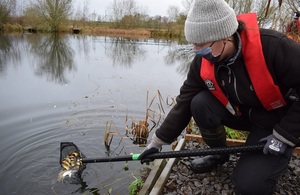
Images shows the EA's Natalie Wallace releasing fish into Dissington Pond using a net.

The Environment Agency’s Natalie Wallace releases fish into Dissington Pond

The Environment Agency’s festive fish release has seen more than 26,000 fish released into rivers and stillwaters in Northumberland, County Durham and Teesside.

All the fish were reared at the Environment Agency’s national fish farm near Calverton, Nottinghamshire, using funding from rod licence sales.

The work is part of the Environment Agency’s ongoing plan to develop, restore and create fisheries in the region to encourage people to get outdoors and enjoy angling safely.

Some of the fish released into Dissington Pond.

‘Very important aspect of our work’

Paul Frear, Fisheries Officer for the Environment Agency in the North East, said: “

Restoration and the creation of new fisheries is a very important aspect of our work. This past week has seen more than 26,000 fish released. We hope it encourages more people to get out and enjoy fishing on the North East’s beautiful waters!

We work closely with our partners to protect and enhance our fisheries. Our teams are on the ground responding to pollution incidents, working to improve habitats and water quality, and removing barriers to fish migration.

The Environment Agency’s Paul Frear releases fish into Willowgarth Pond.

The Environment Agency released:

  • 1,500 chub and 2,000 barbel into the River Tees at Low Coniscliffe near Darlington.
  • 1,500 chub, 2,000 barbel and 2,000 dace into the River Wear at The Sands, near Durham city centre.
  • 2,000 chub, 1,000 barbel and 2,000 dace into the River Skerne split between Newton Aycliffe and Beaumont Hill, near Darlington.
  • 2,000 dace into Clow Beck, south of Darlington.
  • 1,000 bream and 500 rudd at Lockwood Beck, which is just south of Guisborough
  • 9,000 fish – roach, bream, tench, rudd and crucian carp – released into stillwaters at Dissington Pond near Ponteland, Northumberland, Westgate Pond near Yarm, and Willowgarth pond near Croft-on-Tees.

The Environment Agency releases fish into waterways annually. Fisheries officers carry out fish stocking using data from national fish surveys to identify where there are problems with poor breeding and survival, as well as supporting angling clubs to boost local fishing spots.

The Environment Agency has set a target to get 1 million people fishing by 2025.

Anyone fishing must abide by current government coronavirus restrictions in their local area to keep themselves and those around them safe.

All rod licence income is used to fund work to protect and improve fish stocks and fisheries. You can buy your fishing licence online

Published 11 December 2020


UK and Brazil to boost economic relationship

News story

The UK and Brazil made agreements on financial services, taxation, sustainable growth and Green Finance, helping to boost jobs and investments for UK companies.

The Chancellor chairs an EFD with Brazil

The fourth Economic and Financial Dialogue (EFD) between the UK and Brazil on 10 December 2020 saw the Chancellor, Rishi Sunak, and the Brazilian Economy Minister Paulo Guedes, meeting to build further economic ties between the two countries. They were joined by central bank Governors and heads of financial sector regulators.

The UK and Brazil have a strong economic relationship, with over 800 British companies currently operating in Brazil. Total trade between the UK and Brazil, including imports and exports as well as goods and services, currently stands at £6 billion in 2020.

The Chancellor and the Economy Minister discussed the importance of continuing to work together to increase market access and cooperating on clean growth and green finance to help tackle climate change and environmental issues ahead of COP26.

Agreements reached include:

  • commitment to discuss outstanding barriers to a Double Taxation Agreement, with a view to launching negotiations as swiftly as possible
  • a new Financial Markets Dialogue between UK and Brazilian finance ministries and regulators, to discuss financial services issues and support market access asks, opening up new opportunities for British and Brazilian financial services companies
  • a commitment to further equalising the treatment of foreign and domestic financial sector companies in Brazil, in particular in the (re)insurance sector(s) supporting UK industry operating or looking to operate in Brazil
  • a commitment to deepen connections between our bond markets, including through exploring the feasibility of a Brazilian sovereign issuance in London, and to enhance collaboration on asset management, fintech and Open Banking
  • implementation of the UK-Brazil Green Finance programme, to develop the Green Finance market in Brazil, helping to link the expertise of the City with sustainable infrastructure opportunities in Brazil

Ministers also underlined the two countries’ international leadership on greening the financial system. Following the Chancellor’s recent announcement on making climate-related financial disclosures mandatory by 2025, the UK implemented a roadmap to that timeline aligned with TCFD recommendations. The Brazilian Central Bank, which committed to implementation for financial institutions by the end of 2022, has agreed to close collaboration on implementation of mandatory financial disclosures, and in addition to its membership of the Network for Greening the Financial System, commits to perform stress testing. Both countries committed to working together multilaterally on sustainability issues, including on creating international carbon markets, and the UK warmly encouraged Brazil to join the Coalition of Finance Ministers for Climate Action.

Further information

Published 11 December 2020