Sir Tim Barrow appointed as National Security Adviser

He will succeed Sir Stephen Lovegrove who will become the Prime Minister’s Defence Industrial Adviser. In his new role, Stephen Lovegrove will focus on a number of vital national and international defence programmes until the end of this year.

Tim Barrow is currently the Second Permanent Secretary and Political Director at the Foreign, Commonwealth and Development Office (FCDO). He has extensive experience across a range of foreign and national security policy issues, including having served as Ambassador in Kyiv, Moscow, and to the European Union. As Political Director in the FCDO, he has worked on the biggest foreign policy issues facing the country, including playing a leading role in the UK’s diplomatic response to Putin’s illegal war in Ukraine.

Prime Minister Liz Truss said:

Sir Tim Barrow brings with him a huge wealth of experience safeguarding the interests and security of the British people around the world. This includes working on the UK’s response to Putin’s illegal war in Ukraine.

I would also like to thank Sir Stephen Lovegrove for his distinguished service as National Security Adviser. I am pleased he will continue to promote our thriving nuclear defence industry, working with key international partners to keep our people safe every day.

Cabinet Secretary Simon Case said:

I would like to thank Stephen for his remarkable leadership over the last year and a half as National Security Adviser. Stephen has led our national security response during a hugely significant period, encompassing the agreement of the AUKUS pact, the UK’s Presidency of the G7, the UK’s leading role in the response to the invasion of Ukraine and the drawdown from Afghanistan.

Stephen personally has played a vital role in this and I am delighted that he will continue to provide essential support to the Prime Minister and government in his role advising on projects of critical national importance.

I warmly welcome Tim to the role of National Security Adviser. Tim is very highly regarded across government and internationally and is ideally qualified to take up this particularly important role. We all look forward to working very closely with Tim in his new role.

Tim Barrow said:

It is an honour to have been appointed National Security Adviser. I look forward to working with the Prime Minister, the cabinet and colleagues from across Government to deliver the Prime Minister’s foreign policy and national security priorities.

I am grateful to Stephen for his leadership over the last 18 months and particularly for his work to ensure that the UK has the partnerships and capabilities it needs for the future. I look forward to strengthening these partnerships in the UK and overseas to deliver the UK’s national security interests.

Stephen Lovegrove said:

It has been the greatest privilege to serve as the UK’s National Security Adviser, and to have led the women and men of Britain’s incredible national security community. It has been an extraordinary period, and I am immensely proud of what we have achieved together, from the global leadership we have shown in supporting Ukraine to the hugely significant AUKUS partnership, which I look forward to continuing to support.

I know Tim will provide the leadership we need in this vital, often unsung, work and I wish him every success in his new role.

Notes to Editors

  • Tim Barrow will assume the role of National Security Adviser from Wednesday 14th September.
  • Stephen Lovegrove became the National Security Adviser in March 2021. Prior to this he was Permanent Secretary to the Ministry of Defence since 2016, and Permanent Secretary of the Department of Energy and Climate Change since 2013.
  • Prior to being appointed as the Second Permanent Secretary to the FCDO earlier this year, Tim Barrow had a long career in the diplomatic service, as Permanent Representative of the United Kingdom to the European Union in 2017, and as the British Ambassador to the European Union in 2020.

Sir Robert Buckland reappointed as Secretary of State for Wales

Press release

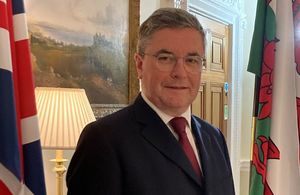
Robert Buckland will continue his role as Welsh Secretary under the new Prime Minister.

Secretary of State for Wales Robert Buckland

Sir Robert Buckland has been reappointed as the Secretary of State for Wales. Following his appointment Sir Robert has pledged to provide a strong voice for Wales at the Cabinet table.

Secretary of State for Wales Robert Buckland said:

It’s an honour and a privilege to be reappointed as the Secretary of State for Wales.

Working alongside our new Prime Minister, fellow Cabinet Ministers and colleagues in Wales, I’m looking forward to delivering for all parts of our great country.

The cost of living and increasing energy bills are having a significant impact on every single person in the country, and it’s a priority for me to make sure that families, businesses and individuals across Wales receive all possible help to see us through this challenging winter.

Wales has a huge part to play in our longer-term energy needs with potential for offshore wind, nuclear and renewable energy schemes. These are projects that create jobs and prosperity, help secure our energy future and deliver our Net Zero targets.

On top of specific measures to tackle the immediate cost of living issue, we will continue to deliver the investment Wales needs through the UK Government’s Levelling Up and Shared Prosperity Funds.

I am a proud Welshman and a proud Unionist and want to see Wales prosper as a strong part of our successful United Kingdom.

Published 7 September 2022


Governor of Bermuda update on Cannabis Licensing Bill

I previously announced that I had reserved the Cannabis Licensing Bill 2022 for the signification of Her Majesty’s pleasure under Section 35 (2) of The Bermuda Constitution.

I have now received an instruction, issued to me on Her Majesty’s behalf, not to Assent to the Bill as drafted.

The Secretary of State for Foreign, Commonwealth and Development Affairs concluded that the Bill, as currently drafted, is not consistent with obligations held by the UK and Bermuda under the 1961 Single Convention on Narcotic Drugs and the 1971 Convention on Psychotropic Substances.

I have informed the Premier and relayed the UK’s continued desire to work with Bermuda on reforms within the scope of our existing international obligations.

Her Excellency Ms Rena Lalgie Governor and Commander-in-Chief of Bermuda

Note to Editors:

  • In terms of cannabis reform, the key international obligations are set out in United Nations Conventions (the 1961 Single Convention on Narcotic Drugs, and the 1971 Convention on Psychotropic Substances). The Conventions permit legislation of cannabis and cannabis products for medicinal and scientific purposes, and for certain industrial purposes, as long as appropriate regulatory oversight is put in place.

  • The legislation of cannabis for other purposes is not permitted under the Conventions. It is possible to decriminalise the possession of limited amounts of cannabis for personal use, but that is not the same as making cannabis legal, for example, for sale in shops and cafes.

  • The Secretary of State for Foreign, Commonwealth and Development Affairs concluded that Bill legalises cannabis for other purposes.

Published 7 September 2022
Last updated 7 September 2022 + show all updates

  1. Governor statement, 6 September, on Bermuda Cannabis Licensing Bill 2022.

  2. First published.


Dstl careers: Emily, working in the world of fast jets

Emily is a scientist and joined the Defence Science and Technology Laboratory (Dstl) on its graduate scheme after completing a Bachelors in Mathematics at the University of East Anglia.

I initially applied for a role as a Missile Analyst with Weapons Systems Group, being attracted to having the ability to apply my Mathematics degree to real world scenarios and make an impact to a sector that isn’t solely motivated by profits. During this interview, I was identified as having sufficient technical knowledge but lacking military awareness and it was recommended that I join the graduate scheme.

During Emily’s time on the graduate scheme, she was given the opportunity to rotate through the many areas of Dstl’s Platforms Division and experience everything it had to offer.

One of my first tasks was with the Combat Air Survivability Simulation team, which gave me an insight into the world of fast jets and their capabilities and developments. This team allowed me to develop my coding skills by teaching me new languages in a hands-on environment, delivering tools and conducting data analysis from the outset.

Emily enjoyed the scheme and working with the team so much that she chose to join them full time, and was offered a permanent position.

The team is close-knit, supporting each other both technically and socially, often working late nights together to ensure deadlines are met and capabilities are delivered. This supportive style of working allowed me to develop my skills from industry leading experts alongside making friends, not just colleagues.

The role has given Emily the opportunity to work closely with the military, which has provided her with countless opportunities to gain insights into the way they work – which she wouldn’t get to see or understand outside of the role.

As part of the 2-year graduate scheme, I was fortunate to complete a 6-month external placement at Combat Air Force HQ, working alongside the pilots and ground staff to deliver a modelling tool to look into their workforce and training pipelines and assess their future capability. This gave me an unparalleled insight into the military and problems they face and allowed me to deliver a tool that could help shape the future of the force.

At the end of the scheme, Emily joined the simulation team full time and has continued to develop her technical skills. She has also been given the opportunity to be a Deputy Team Leader for the technical team and a Graduate Team Leader for the scheme.

This progression has allowed me to develop my leadership skills and confidence and has set me up for a strong career at Dstl.


Searching for innovations to keep submarines clean

  • DASA has launched a new Market Exploration: How Clean is your Hull?
  • Launched on behalf of the Royal Navy
  • This Market Exploration is seeking to find technical solutions to tackle unwanted biofouling on Royal Navy submarine hulls

The Defence and Security Accelerator (DASA) is pleased to launch a new Market Exploration on behalf of the Royal Navy, called How Clean is your Hull? Our aim is to find novel solutions to the issue of bio-fouling on submarines, to help keep Britain’s undersea fleet clean, covert, and capable.

Do you have an innovative solution? Read the full Market Exploration now and submit your idea.

The biofouling challenge and keeping hulls clean

Our Market Exploration seeks to find technical solutions to tackle unwanted biofouling, which is the accumulation of natural organisms on submerged surfaces (such as submarine and boat hulls) that may be detrimental to the overall function of the vessel.

DASA is searching for mechanical and/or chemical methods of cleaning, as well as novel ways of detecting and classifying different biological material.

We are looking for innovations that:

• can deal with complex hull geometry and the small surface areas of submarine structures

• do not damage or interfere with the purpose of acoustic tiles or sensor arrays

• are environmentally compliant and do not pose wider risk to the natural environment

• sit on the Technology Readiness Level (TRL) spectrum and mitigate the negative impact of bio-fouling on a submarine’s signature and performance.

De-fouling could be undertaken when the submarine is at sea or docked in port. If your solution can be used while the submarine is at sea, it should be battery powered and no larger than 1.5m x 1m x 0.5m. It would be advantageous if solutions were easily transportable, allowing them to be used without complex base infrastructure support.

Key dates

The market exploration is currently open. The deadline to submit proposals is 16th November 2022.

Submit your innovation

Let us know if you have a novel solution that can effectively remove the biological material that accumulates on submarine hulls to help preserve the battle-winning edge of the submarine fleet, and support efforts to reduce the environmental impact of the Royal Navy.

Read the full Market Exploration and submit your proposal.