Defence Secretary visits British troops defending NATO’s eastern flank in Estonia

News story

Defence Secretary Ben Wallace gave his personal thanks to British troops deployed in Estonia over the Christmas period, during a visit to the Baltic state.

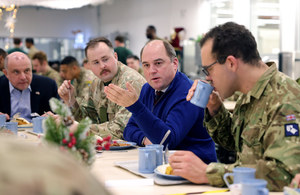
Defence Secretary Ben Wallace and Estonian defence minister Jüri Luik have lunch with troops in Tapa

Defence Secretary Ben Wallace and Estonian defence minister Jüri Luik have lunch with troops in Tapa

At Tapa base, the HQ of the UK’s largest overseas deployment, Mr Wallace discussed with members of the 5 Rifles battlegroup the vital deterrence and defence they provide in Estonia as part of NATO’s Enhanced Forward Presence (eFP).

Members of the battlegroup also provided the Defence Secretary with a visual demonstration of the fearsome capability of the Challenger II battle tanks deployed on the mission.

The UK is the lead nation of the multinational NATO eFP Battlegroup in Estonia with over 900 British troops deployed alongside Danish and Estonian forces. In meetings with Estonia’s Minister for Defence Jüri Luik, Prime Minister Jüri Ratas and parliamentarians of Estonia’s National Defence Committee, the Defence Secretary reaffirmed that the United Kingdom would maintain its persistent presence in the country for as long as necessary.

Defence Secretary Ben Wallace said:

While we celebrate Christmas at home, over 6400 of our Armed Forces personnel will be working away from their families to protect the people of the United Kingdom and its interests.

So I was delighted to be able to pass on all our thanks to troops in Estonia. Their presence provides a concrete deterrence to an increasingly assertive Russia and is a demonstration of the United Kingdom’s unwavering commitment to European security.

Both Mr Wallace and Mr Luik agreed that the UK and Estonia see eye-to-eye when it comes to identifying the threats to regional security and would continue to deepen a tight knit defence relationship that has grown in strength since the UK first took the lead of eFP in the country nearly four years ago.

As well as being trusted NATO Allies, the UK and Estonia are both members of the UK-led Joint Expeditionary Force and the Northern Group of north European nations. In addition to the Army’s persistent presence, the RAF have deployed to Ämari air base in the north of the country for NATO Baltic Air Policing in 2016 and 2019. The UK also contributes around 150 personnel to the US-led NATO efP battlegroup in Poland.

Our soldiers have fought side-by-side in Afghanistan and both are currently contributors to international efforts to bring security and stability to the Sahel region in Africa.

The strength of our defence relationship was also clear this July when the Ministry of Defence loaned four Jackal vehicles to the Estonian Defence Forces until next March for elite soldiers of the Estonian Armed Forces to use on their counter-terror deployment in Mali.

Published 16 December 2020


Spring start for Ulverston’s new Cross-a-Moor roundabout

Highways England is constructing the new roundabout along the A590 at Cross-a-Moor south of Ulverston. It is expected to cost around £7 million with partnership funding from Highways England, Cumbria County Council, Cumbria Local Enterprise Partnership (LEP) and South Lakeland District Council.

The new roundabout will replace the existing staggered junction with Main Road running south off the A590 and Pennington Lane running north of it. Preparation work is scheduled to start in spring with the main construction work following in the summer.

Steve Mason, Highways England senior project manager, said:

“This new roundabout is a significant investment in the infrastructure of the Furness peninsula. It will reduce congestion and improve safety on the A590 and local road network as well as supporting the creation of new jobs and homes. We’re aiming to keep the road open during construction – certainly during the daytime – and minimise any inconvenience to drivers and other road users.”

Minister for Regional Growth and Local Government Luke Hall MP said:

We’re supporting transport improvements in Ulverston by backing this project with a Local Growth Fund investment of over £900,000.

It’s great news that the roundabout will solve ongoing congestion problems, as well as unlocking new homes and jobs, which will improve quality of life for the community.

By investing in transport infrastructure across the country, we’re making all our towns great places to live, work and visit.

Councillor Keith Little, Cumbria County Council’s Cabinet Member for Highways and Transport, said:

I’m delighted with this announcement. We’ve worked closely with the LEP, South Lakeland District Council and Highways England on this over a number of years, and it’s fantastic news for Cumbria that this funding is now secured. If the county is to meet the demands of our growing population, attracting more new businesses and welcoming more visitors, we need to improve and enhance our infrastructure. The new roundabout will make big difference, and is vital to unlocking the economic and commercial potential of Ulverston and surrounding areas.

Steve Curl, Board Member for the Cumbria LEP, added:

We are delighted to provide Growth Deal and Cumbria Infrastructure Fund subsidy to support this project, which will generate significant economic benefits in Ulverston, South Lakeland and more widely, South Cumbria. It will unlock much needed new housing for our residents. It will importantly help our recovery from the economic impacts of COVID-19 by making Cumbria an even more attractive place for people and businesses to locate and grow.

South Lakeland District Council portfolio holder for Economy, Culture and Leisure Councillor Robin Ashcroft said:

The council’s contribution to the junction improvements demonstrates our commitment to support growth in the local economy, deliver new employment opportunities and improve the lives of people living in this area.

We have a key council commitment to help create new affordable homes for rent in South Lakeland by 2025 and the housing being planned for that area of Ulverston represents about 20% of all the new homes to be built in the entire district. Improving the Cross-a-Moor junction will be a critical component in unlocking these developments by improving accessibility to help SLDC to deliver its wider plans and ambitions.

Improving safety on this busy stretch of the A590 will also help ensure that the local transport infrastructure is better protected, which is vital for maintaining strategic connectivity to the M6 corridor, attracting new investment and supporting business growth.

Highways England’s contribution to the project has come from the Government’s growth and housing fund, a special fund earmarked to support the creation of new homes and jobs by tackling congestion ‘hotspots’ acting as a brake on economic investment. The fund is part of the Government’s £27.4 billion investment in the country’s motorways and major A roads in the five years from April 2020.

General enquiries

Members of the public should contact the Highways England customer contact centre on 0300 123 5000.

Media enquiries

Journalists should contact the Highways England press office on 0844 693 1448 and use the menu to speak to the most appropriate press officer.


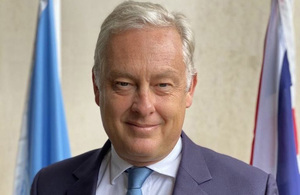
Change of UK Permanent Representative to the WTO, UN and other International Organisations in Geneva: Simon Manley

Press release

Mr Simon Manley CMG has been appointed the United Kingdom’s Permanent Representative to the World Trade Organisation, United Nations and other International Organisations

Mr Simon Manley CMG has been appointed the United Kingdom’s Permanent Representative to the World Trade Organization, United Nations and other International Organisations based in Geneva, in succession to Mr Julian Braithwaite CMG who will be transferring to another Diplomatic Service appointment. Mr Manley will take up his appointment during Spring 2021.

Full name: Simon John Manley

Married to: Maria Isabel Fernandez Utges Manley

Children: Three Daughters

2020 FCO/FCDO, Director General, COVID-19
2013 to 2019 Spain and Andorra, Her Majesty’s Ambassador
2011 to 2013 FCO, Director Europe
2007 to 2011 FCO, Director Defence and Strategic Threats
2006 to 2007 FCO, Head, Counter-Terrorism Policy Department
2003 to 2006 FCO, Head, EU Economic, Ireland and Central Europe Team
2002 to 2003 FCO, Deputy Head, EU (Internal) Department
1998 to 2002 Seconded to the EU Council Secretariat’s Asia Unit
1993 to 1998 New York, Second, later First Secretary (Political), UK Mission to the United Nations
1993 Seconded to DG Competition, European Commission
1990 to 1993 FCO, United Nations Department
1990 Joined FCO

Published 16 December 2020


Army develops spray to kill coronavirus

News story

A novel disinfectant spray developed by the Army that can eliminate 99.99% of the Covid-19 virus will now be made available to the public and used by military personnel on the frontline as they support the battle against the virus.

Image depicts a soldier using the Virusend spray.

Virusend can kill 99.99% of the pandemic strain of Covid-19 in under a minute.

Virusend will complement the existing range of protective products available currently in the UK that help keep people safe, with bottles available for the public to purchase online and in stores, with talks ongoing to up-scale the commercial rollout of the product.

Co-developed by innovation experts in the British Army, the Virusend spray formula is proven to be highly lethal against SARS-CoV-2, the pandemic strain of the coronavirus. Extensive tests by the Centre of Excellence for Infectious Disease Research and the Liverpool School for Tropical Medicine proved that Virusend kills 99.99% of the virus in under 1 minute.

50,000 bottles of Virusend disinfectant are being deployed to personnel across the country who are working alongside the NHS at coronavirus testing stations as part of the military’s ongoing support to civil authorities. It is already being used at testing sites in Medway and Preston.

The spray’s quick kill-time makes it ideal for use on a variety of surfaces within high footfall areas such as the mass testing and vaccination sites. The disinfectant is also being tested for wider use in the NHS including within clinical environments.

The product was developed to provide the Army with enhanced protection in addition to a range of PPE and social distancing measures whilst operating Covid testing facilities

Lt Col James Cackett, CO 35 Engineer Regiment (EOD&S) and commanding the Medway Resilience Unit said:

The troops who are now working in Medway have welcomed the deployment of this additional force protection measure. Virusend is proving easy to use and will help us keep our work areas safe for everyone.

Lt Col Christopher Warhurst, Virusend Project Manager, Manoeuvre Support Plans, said:

I am truly privileged to be at the centre of this amazing partnership and work with such talented and dedicated people. What started out as a good idea has developed into an amazing product that has the potential to have a real impact against the virus. The Army is proud to have been involved in this incredible project.

Virusend boasts a quick kill time and high lethality to the Covid-19 virus. Virusend is supplied through the ‘Anyway Spray’ bottle, a system developed by Pritchard Spray Technology Ltd.

The innovative bottle covers a wide surface area and can be used upside-down, eliminating any wastage. The bottle uses compressed air instead of flammable gasses and is also fully recyclable and re-useable.

Michael Pritchard MBE, CEO Pritchard Spray Technology Ltd. said:

This pioneering spray will change the way we combat this and all future pandemics. This has been a truly unique collaboration that showcases what we the United Kingdom can achieve. We want to give the UK the tools it needs to defeat coronavirus and get back on its feet as soon as possible.

Published 16 December 2020


UK and India to accelerate collaboration on vaccines to prevent future pandemics

Experts from India and the UK will join forces through a new virtual hub to deliver vaccines for coronavirus and other deadly viruses, the UK Foreign Secretary Dominic Raab announced in India today (Wednesday 16 December).

The Foreign Secretary met Prime Minister Modi to discuss the UK and India working together as a force for good and launching the pioneering new vaccines hub which will share best practice for regulation and clinical trials, and foster innovation. He also visited a Delhi health clinic where Oxford/AstraZeneca vaccines will be administered.

India’s Serum Institute is poised to make over a billion doses of the coronavirus vaccine developed by Oxford University and AstraZeneca. Unlike other vaccines, it can be stored at normal fridge temperatures, making it easier and cheaper to produce and keep – and distribute around the world.

Foreign Secretary Dominic Raab said:

This Serum Institute and Oxford University partnership demonstrates the UK-India relationship at its best: a vaccine developed in the UK and made in India, drawing our brightest minds together to save lives as a global force for good.

A global pandemic requires a global solution. Scientific cooperation has made breakthroughs on coronavirus vaccines at record-breaking pace and the UK-India Vaccine Hub will now build on these innovations, to bring this crisis to an end and protect us all against future pandemics.

Millions of the doses made by the Serum Institute will be distributed to the world’s poorest people via the global COVAX initiative, in partnership with the World Health Organization (WHO) and Gavi, the vaccine alliance.

The UK has championed equitable access to any coronavirus vaccine for those who need it and has committed up to £619 million to COVAX to secure both the UK’s access to coronavirus vaccines and distribute Covid-19 vaccines across the world.

India supplies more than 50% of the world’s vaccines and 25% of the NHS’s generic drugs. Closer UK-India cooperation on medicines and vaccines approvals will ensure speedy access for the UK to Indian-produced pharmaceuticals and help safeguard future supplies to the NHS.

The new hub will enable British and Indian experts to share knowledge on clinical trials and regulatory approvals and get vaccines to people who need them most in a safe, secure and energy-efficient way.

It will protect the UK and India by enhancing cooperation on the development and distribution of coronavirus vaccines, better aligning the international regulation of vaccines and fostering partnerships to develop innovation ‘moonshots’ that can define vaccine delivery over the next decade and beyond.

During his meeting with Prime Minister Modi today, the Foreign Secretary signalled his ambition for a closer UK-India relationship as part of a wider UK focus on our partnerships in the Indo-Pacific. They also spoke about the 10-year roadmap which heralds a new era for the UK and India with an ambitious plan for an Enhanced Trade Partnership.

The Foreign Secretary also met Minister for Education Ramesh Pokhriyal and agreed to work together on mutual recognition of academic qualifications, starting with master’s degrees, over the next year.

The Foreign Secretary welcomed the signing of a new agreement between the University of Edinburgh and the Indian State of Gujarat to open a new biotechnology university in Gujarat in July 2021. This will be the first foreign university collaboration of its kind in India.

Notes to editors

  • The UK is one of the biggest global funders of the World Health Organization and the single biggest donor to the Coalition for Epidemic Preparedness (CEPI) and to Gavi.
  • Of the £619 million the UK has committed to COVAX, a global initiative designed to provide countries equitable access to safe and effective vaccines, up to £548 million will go towards helping developing countries get coronavirus vaccines to those who need them. COVAX is co-led by Gavi, CEPI and WHO.
  • The UK and India also announced today a new memorandum of understanding between India’s Central Drugs Standard Control Organisation (CDSCO) and the United Kingdom Medicines and Healthcare Products Regulatory Agency (UK MHRA) agreeing to more frequent discussions on UK-India vaccine and pharmaceutical regulations, improving standards and sharing information to control against the trade of unlicensed products.
  • In addition, the UK and India announced a new partnership to help UK and Indian scientists unlock the power of data, including the data within our genes, to deliver better diagnostics and enhanced life-saving treatments for cancer, diabetes, maternal health challenges and rare diseases.
  • Free-to-use photos from the Foreign Secretary’s visit to India are available to download here.