Targeted community testing extended to 10 more areas

Large-scale community testing is a key part of the government’s COVID-19 Winter Plan to identify those with coronavirus earlier in order to break the chain of transmission and keep the virus under control.

The 10 new areas join 106 others who are already signed up to roll out rapid community testing in December or January, including some areas which are now in Tier 4 such as London and Medway in Kent.

Around 1 in 3 people have coronavirus without symptoms so could be spreading the virus without knowing. Targeted community testing of people with no symptoms will help identify positive cases more quickly and break chains of transmission.

Taking a targeted approach and working with local authorities aims to reduce the prevalence of the virus in the highest-risk areas. Local authorities have created community testing plans, based on their in-depth knowledge of their local community and detailed local data.

Targeted community testing is available for all local authorities in Tier 4, Tier 3 and those in Tier 2 at risk of going into Tier 3, with authorities invited to submit their application.

Health and Social Care Secretary Matt Hancock said:

I am pleased to confirm 10 more local authorities will soon be rolling out enhanced community testing programmes as part of our plan to pick up more cases, more quickly. Working together we will help areas where levels of the virus are highest to reduce their infection rates and break the chains of transmission.

Roughly 1 in 3 people with coronavirus show no symptoms and so it’s essential we broaden testing to help identify those who are infected and infectious, unaware they may be spreading the disease.

We are rolling out community testing more widely at a rapid pace, with 116 areas now planning to take part. If you are offered community testing in your local area, I would strongly encourage you to take up this opportunity to get tested and protect your local community.

The 10 additional areas that are rolling out community testing are:

  • Boston (Tier 3)
  • Calderdale (Tier 3)
  • City of Bristol (Tier 2)
  • Coventry (Tier 3)
  • Hartlepool (Tier 3)
  • Lincoln (Tier 3)
  • North Somerset (Tier 2)
  • Redcar and Cleveland (Tier 3)
  • South Gloucestershire (Tier 3)
  • Walsall (Tier 3)

Scientists at PHE Porton Down have rapidly evaluated the performance of the lateral flow device (LFD) tests against the new variant of SARS-CoV-2 that was recently identified across the South East of England. LFD tests successfully detected the samples with the variant.

NHS Test and Trace has capacity in place to respond to increases in demand and people can have confidence that if they have symptoms and need a test, they can get one. Additional capacity is in place with 2 new London University laboratories launched this week with a third due to go live this coming week.

Individuals should only book PCR tests if they have symptoms of coronavirus – a high temperature, a new continuous cough, or a loss or change to sense of smell or taste. Anyone with one or more of these symptoms should get a test – or through the NHS COVID-19 app or by calling 119.

The government’s COVID-19 Winter Plan sets out ambitious steps to drive down transmission of the virus, reduce its prevalence and so reduce the number of deaths and serious illnesses. Alongside the vaccine roll-out which has now begun, tiering restrictions and investment in NHS capacity, continued developments in our testing programme make it possible to reduce cases in the areas where the need is greatest.

Local authorities can bid for this additional testing and support capability on an ongoing basis, enabling them to create a bespoke testing programme for their community, using a model of local delivery supported by central resource.

Community testing builds on the over 2 million lateral flow test kits which have already been delivered to over 100 local authorities across all levels of tier restrictions to date, through the Directors of Public Health programme. Extensive clinical evaluation has been carried out on the lateral flow tests by Public Health England and the University of Oxford which show these tests are accurate and sensitive enough to be used in the community.

Asymptomatic testing works hand in hand with the existing PCR testing service for those with COVID-19 symptoms as part of the comprehensive NHS Test and Trace testing offer. With over 750 test centres across the country, including 82 drive-through sites, 414 local test sites, 20 satellite test sites, 258 mobile testing units, and home testing, the average distance a person travels to visit a test site is now just 2.3 miles.

Inputting positive PCR test results into the NHS COVID-19 app increases the number of people contact traced and the speed contact tracing happens, which helps reduce the spread of coronavirus and supports the reduction in the R number.

The LFD tests currently in use detect a different type of protein that is not affected by the mutation. The protein that these LFDs detect (nucleocapsid) is found inside the virus, whereas the mutation affects the spike, which is found on the virus’s surface. Our response to the new variant is under constant review.


IOM provides support for UK nationals living in Poland

World news story

The International Organization for Migration (IOM) offers support to UK nationals in Poland in applying for residence documentation

UK nationals and their family members resident in Poland before 31 December 2020 must take some steps to secure documentation which evidences their right to stay is protected.

The Interational Organization for Migration (IOM) offers up-to-date and reliable information on requirements and procedures, as well as support to those who are facing specific challenges, such as people with disabilities, those grappling with chronic illnesses, language and literacy barriers, difficulties in accessing technology, and living in remote areas. IOM services include provision of information, legal consultations, and help with the preparation of required documents for submission.

Anna Clunes, British Ambassador to Poland, said:

I welcome IOM Poland’s service for UK nationals (and their family members) which is designed to help them understand the changes in residency status following the UK’s departure from the EU. This is an important programme assisting UK nationals to register their status so that they can continue to enjoy their residency rights after the end of the Transition period

Hanna Dobrzynska, Officer in Charge of the IOM Office in Poland, said:

After the UK has left the EU, UK nationals who want to continue living in Poland may need to navigate new regulations and requirements associated with prolonging their legal stay beyond the transition period which ends on 31 December 2020. The support offered by IOM involves not only offering reliable information, but also assistance in preparing documents and during submission of an application to a voivodeship office. The support is intended for UK nationals and their families who may find it harder to complete their applications

The project is conducted in cooperation with the British Embassy in Poland, and supported by the Foreign, Commonwealth & Development Office through the UK National Support Fund (UKNSF). It will continue until 31 March 2021.

The IOM helpline for UK nationals is available from 9 a.m. to 5 p.m., Monday to Friday at (+48) 224902044, and via e-mail at UKnationalsPL@iom.int.

Published 23 December 2020


Dounreay’s first ‘home grown’ health physics surveyors qualify

News story

Dounreay’s first batch of home grown health physics surveyors have qualified with flying colours and ahead of schedule.

Health physics surveyors trainees

Health physics surveyors trainees display their certificates

Dounreay’s first batch of home grown health physics surveyors have qualified with flying colours and ahead of schedule.

The 7 trainees were the first to be trained by DSRL and Nuvia Ltd jointly in a programme that was due to take 2 years, but due to the hard work and commitment of both trainees and their supervisors, they completed the course in 19 months. They are now all working at Dounreay.

DSRL Health Physics Service Manager Eann Plowman said:

This is a very encouraging result for both the trainees and their instructors, and shows that hard work really pays off. The health physics surveyors now have formal qualifications that are widely recognised in the nuclear industry.

Workers involved in the Health Physics Service carry out monitoring on and off the Dounreay site, 24 hours a day, to ensure the radiological safety of the workforce, the public and the environment.

The 2020 intake of 8 DSRL health physics surveyor trainees are now working on site after completing their initial courses and exams off-site in Thurso with an external training provider. These trainees are scheduled to qualify in March 2022, while interviews for the 2021 intake of trainees is now taking place.

Dounreay is Scotland’s largest nuclear closure project and the centre of the UK’s fast reactor research and development. It is being decommissioned by Dounreay Site Restoration Ltd on behalf of the Nuclear Decommissioning Authority.

Published 23 December 2020


Report 16/2020: Runaway and derailment of a wagon at Clitheroe

R162020_201223_Clitheroe

This file may not be suitable for users of assistive technology.

Request an accessible format.
If you use assistive technology (such as a screen reader) and need a version of this document in a more accessible format, please email enquiries@raib.gov.uk. Please tell us what format you need. It will help us if you say what assistive technology you use.

Summary

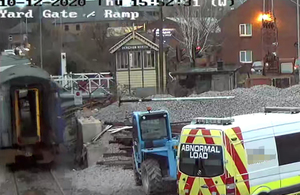
At about 08:16 hrs on 9 March 2020, a loaded wagon ran away from a siding located within the Hanson UK cement works in Clitheroe. It travelled a distance of about 0.75 miles (1.2 km) on a falling gradient, before it derailed at Horrocksford Junction, where the freight only branch line from the cement works connects to the main railway lines.

As it ran away, the wagon broke through the gates at the exit from the works and then ran over a level crossing on a public road, causing two cars to stop. Soon afterwards, the wagon passed over a second level crossing on a private road, which leads to a chemical works. Neither level crossing had its manually activated warning equipment switched on before the wagon passed over it.

On arriving at Horrocksford Junction, the wagon derailed at a set of trap points. As intended, this arrangement prevented the wagon from reaching the main lines. The derailed wagon stopped clear of the nearest main line and no trains were nearby at the time of the derailment. No one was injured in the accident, although there was minor damage to the wagon and severe damage to the track where the wagon had run derailed.

The investigation found that the wagon ran away because its handbrake was not effective at holding it in place on the gradient where it had been stabled. This was due to a combination of insufficient brake force being provided by the applied handbrake and the fully laden wagon being stabled on its own and on a gradient falling towards the exit from the cement works. The staff who stabled the wagon did not know the handbrake would not hold the wagon in place after they applied it, as the wagon’s brakes were already pneumatically applied when they did this, and over time, the air in the brake system leaked away until the air brake was released. It is possible that a maintenance examination that was due before the accident, but which was not carried out, would have found the problem with the handbrake’s effectiveness.

An underlying factor was that the parties responsible for the operation of trains at the cement works had not adequately assessed or controlled the risk of a rail vehicle running away from the cement works. RAIB also observed that the risks to users at one of the level crossings concerned were not being managed by Network Rail, and that potential evidence, which might have explained why the handbrake provided insufficient force to hold the wagon in place, was lost to the investigation.

Recommendations

RAIB has made three recommendations. The first is that GB Railfreight should work with the owners of industrial premises to improve its assessment of the risks of runaway vehicles. The second recommends that Hanson UK should assure itself that a suitable and sufficient risk assessment has been undertaken for all rail operations taking place on its site. The third recommendation is that freight operating companies review the adequacy of the processes followed for stabling vehicles on a gradient using handbrakes, particularly if a laden vehicle is to be left on its own. RAIB also identified two learning points. The first is a reminder of the importance of scheduled examinations of wagons taking place on or before their due dates. The second is a reminder about the importance of preserving items of evidence required for safety investigations.

Notes to editors

  1. The sole purpose of RAIB investigations is to prevent future accidents and incidents and improve railway safety. RAIB does not establish blame, liability or carry out prosecutions.
  2. RAIB operates, as far as possible, in an open and transparent manner. While our investigations are completely independent of the railway industry, we do maintain close liaison with railway companies and if we discover matters that may affect the safety of the railway, we make sure that information about them is circulated to the right people as soon as possible, and certainly long before publication of our final report.
  3. For media enquiries, please call 07814 812293.

Newsdate: 23 December 2020


Dame Glenys Stacey appointed as chair of the Office for Environmental Protection

Press release

The Environment Secretary George Eustice has appointed Dame Glenys Stacey as the Chair of the new Office for Environmental Protection (OEP).

Image of the Defra logo

The Environment Secretary George Eustice today appointed Dame Glenys Stacey as the Chair of the new Office for Environmental Protection (OEP).

The appointment follows a pre-appointment scrutiny hearing by the Environment, Food and Rural Affairs and Environment Audit Committees and Dame Glenys will take up the role in February 2021 working with the Interim Environmental Governance Secretariat before the OEP is established.

Environment Secretary George Eustice said:

I am delighted to appoint Dame Glenys to Chair the OEP. She has an outstanding reputation of being an independent voice, establishing regulators and being able to hold government to account.

The Office for Environmental Protection will be a world leader in environmental regulation – setting how government will have to stand up to its pledge to protect and enhance the environment as we build back better and greener.

Dame Glenys said:

The OEP will one of the most important organisations of our time, dealing with the most pressing issues of our time. We have a hefty job to do, on behalf of the public and our future generations – making sure environmental law works and develops as it should, to truly protect and improve our environment, and holding government and public authorities to account without fear or favour.

I am thrilled have the opportunity to lead and develop OEP, so that it becomes the unstinting and resolute watchdog we all want it to be.

The Office for Environmental Protection:

  • The Environment Bill will create a new, independent statutory body with the principal objective of contributing to environmental protection and the improvement of the natural environment. It will provide the necessary legal authority to implement long-term environmental governance.
    • The OEP will provide scrutiny and advice on the implementation of environmental law. It will also monitor and report on progress against Environmental Improvement Plans and targets.
    • The OEP will be able to receive and investigate complaints on alleged serious breaches of environmental law by public authorities. It will also be able to take legal action in serious cases if necessary as a last resort.

The role of Chair:

  • The Chair of the OEP will provide leadership and strategic vision for the board, ensure good governance and, with the board, hold the executive to account.
    • The Chair will promote a positive and constructive relationship with everyone that works with the OEP including Parliament, government Ministers, departments, and public authorities; along with a wide range of interest groups as well as others.
    • The Chair is appointed by, and is accountable to, the Secretary of State for Environment, Food & Rural Affairs.

Biographical details of Dame Glenys Stacey:

  • Dame Glenys Stacey is (until 31 December) acting Chief Regulator at Ofqual, having re-joined in late August 2020. Dame Glenys has previously served as Her Majesty’s Chief Inspector of Probation and as Chief Executive at Animal Health (now part of the Animal and Plant Health Agency).
    • In 2019, Dame Glenys chaired an independent review of farm regulation at the request of the then Secretary of State for Defra. Most recently, Dame Glenys served as chair of the Professional Standards Authority.
    • A solicitor by profession, she has a wealth of CEO and regulatory experience, having led the start-up or development of a number of public-sector organisations responsible for legal or regulatory services.
    • Dame Glenys was appointed Dame Commander of the British Empire in the New Year’s honours list in 2016 recognising her services to Education.

Published 23 December 2020