Carrier Strike Group hits important milestone

Press release

The UK’s Carrier Strike Group (CSG) has achieved a major milestone ahead of its first operational deployment this year.

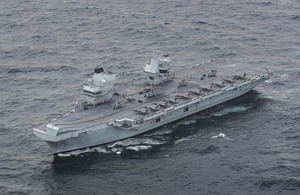
Image depicts HMS QUEEN ELIZABETH.

HMS Queen Elizabeth has achieved Initial Operating Capability (IOC). Crown copyright.

The CSG has reached Initial Operating Capability (IOC), meaning all elements of the group from fighter jets to radar systems to anti-ship weapons have been successfully brought together and operated.

Both the air and naval elements of the CSG have now met this milestone, which includes qualified pilots and ground crews being held at short notice for carrier-based operations and trained to handle weapons and maintain the equipment.

Another marker of success at this stage includes the ability to deploy Anti-Submarine Warfare capabilities such as frigates and destroyers, as well as both fixed and rotary wing aircraft including Merlin helicopters to operate alongside the carrier.

Defence Minister Jeremy Quin said:

This is a hugely significant milestone for HMS Queen Elizabeth, the Royal Navy and the whole country. This achievement is a testament to the determination of our service personnel and industry workforce who have delivered this first-rate military capability, a capability held by only a handful of nations. I wish the entire Carrier Strike Group well ahead of their first operational deployment this year.

Following the success of the NATO Joint Warrior Exercises last autumn, the Carrier Strike Group capability has reached the key IOC milestone for the programme on schedule.

The multinational deployment in 2020 focussed on incorporating all elements of the CSG with 13 of the UK’s allies including Belgium, Canada, Denmark, France, Germany, Latvia, the Netherlands, Norway, Spain, Turkey, Japan, UAE and the US. Exercise Joint Warrior saw the largest number of aircraft on a British Royal Navy carrier since 1983, as well as the most F-35B jets at sea across the globe.

Full operating capability for the CSG is expected by December 2023.

Published 4 January 2021


New Disability and Access Ambassadors to support rights of disabled consumers

News story

The Cabinet Office opens recruitment today for 14 Disability and Access Ambassadors.

Portrait of Justin Tomlinson MP

The Cabinet Office, on behalf of the Minister for Disabled People, Health and Work, is seeking fourteen new Disability and Access Ambassadors to help to ensure businesses are doing all they can to support their disabled customers.

They will join existing Ambassadors who have been helping industry and the Government in their management of the COVID-19 crisis, and supporting work to develop the National Strategy for Disabled People.

The ambassadors are industry leaders who help to drive improvements in the accessibility and quality of services and facilities in their sector for disabled people, as consumers and employees.

There are 14 posts being recruited, which includes four new sectors which have been added to the existing programme. These additional posts will work within the pubs and restaurants, private housing, universities and energy industries.

They will join colleagues already representing the financial sector, the transport sector, the arts, the built and natural environment, technology and web design, and others.

The posts being recruited are for:

  • Airports
  • Arts and Culture
  • Banking
  • Buses
  • Creative Industries
  • Energy
  • Hospitality (Pubs and Restaurants)
  • Housing (Private)
  • Insurance
  • Rail Travel
  • Retail
  • Sports and Physical Activity
  • Tourism
  • Universities

Read the full details of the application process.

Published 4 January 2021


Childcare providers: telling Ofsted about significant events

News story

From the end of January 2021, childminders, nurseries and all other childcare providers must use an online notification form to tell us about significant events.

From 28 January, all childcare providers must use the online notification form to notify Ofsted of significant events. Providers should no longer notify us by phone or email.

We want to make sure we can act on the information that is shared with us as quickly as possible, without any undue delay. The form is accessible and can be used on mobile and tablets, so that you are able to submit information swiftly and at ease.

When notifying us using this form, you will need to have to hand:

  • your unique reference number (URN)
  • the childcare address
  • details of the incident and details of those involved

We will confirm receipt of the information and you can also download a copy for your records. We may contact you for further information.

You should notify Ofsted as soon as practical, and in any case within 14 days of a notifiable event happening. For full guidance on what is classed as a notifiable event or serious incident, you should refer to our early years and childcare compliance handbook.

We understand that some people may have different needs and may not be able to use a form. You can find further information about accessibility for this service.

Published 4 January 2021


Change of Her Majesty’s Ambassador to Somalia: Kate Foster

Press release

Ms Kate Foster OBE has been appointed Her Majesty’s Ambassador to the Federal Republic of Somalia in succession to Mr Ben Fender OBE.

Ms Kate Foster OBE has been appointed Her Majesty’s Ambassador to the Federal Republic of Somalia in succession to Mr Ben Fender OBE who will be transferring to another Diplomatic Service appointment. Ms Foster will take up her appointment during February 2021.

Currivulum vitae

Full name: Kate Foster

Year Role
2018 to Present Cabinet Office, Deputy Director, International Affairs, National Security Secretariat then UK Defence Academy Higher Command and Staff Course
2017 Department for International Development, Head, Africa Strategy
2015 to 2017 Department for International Development, Head, Africa Conflict and Humanitarian Unit then Head, Yemen
2014 to 2015 UK Ebola Response, Chief of Operations, Sierra Leone
2012 to 2014 Crown Agents, Deputy Director, Department for International Development Conflict & Humanitarian Operations Team
2011 to 2012 Save the Children, Programme Director, Emergency Response
2008 to 2011 International Rescue Committee then Save the Children, Programme Director South Sudan
2006 to 2008 International Rescue Committee, Governance Programme Co-ordinator
2004 to 2005 UNHCR/Right to Play, Head Refugee Youth Engagement, Sierra Leone and Liberia
1999 to 2004 Appointments in the Private Sector

Further information

All the latest news is available on the Foreign, Commonwealth and Development Office page of the gov.uk website.

Published 4 January 2021


Over 5,000 Armed Forces deployed in support of the Covid response in the biggest homeland operation in peacetime

This is more than at any previous point in the pandemic and the biggest homeland operation the UK has ever seen in peacetime. Thousands more are supporting efforts through their day jobs in military planning, Defence Medical Services, Defence Science and Technology Laboratories and elsewhere.

More military personnel are being deployed to support community testing in:

  • Manchester – 800 personnel providing community testing support to the Greater Manchester Combined Authority
    • Kent – 390 personnel will support community testing
    • Swadlincote, Derbyshire – 130 personnel to establish and operate four lateral flow testing sites
    • Kirklees, Yorkshire – 75 personnel to establish and operate four lateral flow testing sites
    • Lancashire – 420 personnel to support asymptomatic testing

In Manchester today (4 January) another large scale task starts, with 800 personnel deploying from nine regiments across the British Army at the request of the Greater Manchester Combined Authority (GMCA), through the Department of Health and Social Care (DHSC). These personnel will prepare to work across all ten local authority areas of Greater Manchester to carry out targeted asymptomatic testing of specific populations that may be at a higher risk of infection including social care staff, key workers, public facing occupations such as bus drivers, and those in high risk environments such care homes and shared accommodation for the homeless. The task builds on lessons from previous asymptomatic community testing in Liverpool, Lancashire, Merthyr Tydfil, Medway, and Kirklees.

In addition to community testing, military personnel remain on-task testing hauliers in Dover and helping to establish ten new testing sites to improve the flow of traffic across the Channel. As of today, 515 personnel are on task in Kent and elsewhere providing testing to hauliers.

1,500 Armed Forces personnel have also been provided to support schools testing, with local response teams providing virtual support and phone advice to institutions. Personnel also on standby to deploy at short notice to provide in-person support. Testing will continue as planned with two rapid Lateral Flow Tests available to all secondary school and college students and staff at the start of term to identify asymptomatic cases, break chains of transmission and beat the virus.

Defence Secretary Ben Wallace said:

The new year will see new levels of Armed Forces support to overcoming this pandemic. Thousands of service personnel are working throughout the United Kingdom, wherever they are needed to assist the civil authorities.

Manchester is the latest of those tasks and will be an important contribution to protecting the highest risk groups as the city seeks to recover. As a North West MP I am acutely aware of the considerable time many of us have been labouring under some form of lockdown and I hope our soldiers will help us get to the day when these restrictions will start to lift.

Health Secretary Matt Hancock said:

We are enormously grateful to the Armed Forces for lending their support to these important community testing programmes. Around one in three people with coronavirus showing no symptoms, asymptomatic testing is crucial to identifying those who might be unknowingly infected, and protecting our most vulnerable.

These community testing schemes are part of a national testing programme with millions of lateral flow tests arriving in schools tomorrow, for the testing of students and staff, to add to the hundreds of thousands of asymptomatic tests currently being conducted in care homes, across the NHS and in critical infrastructure workplaces and food manufacturers.

While the Army, alongside thousands of medical professionals and volunteers, help roll out the vaccination programme, we must remember that the first line of defence against the virus remains to wash our hands, cover our faces and keep space.

Lt Gen Sir Tyrone Urch KBE, Commander Standing Joint Commander UK said:

I am incredibly proud of all the servicemen and women who have worked tirelessly for most of this year on Operation RESCRIPT, the military effort in support of the government’s campaign to tackle COVID-19.

In recent weeks, our amazing staff have deployed at short notice to set up and staff community testing centres across the country in support of the NHS, DHSC, Devolved Nations and local communities. They have conducted a successful testing pilot in schools and contributed to vaccine rollout planning. Both Regular and Reservist personnel stepped up on Christmas Eve to help clear the backlog of trucks in Kent, setting up testing facilities overnight when they would otherwise have been spending the festive period with their families.

I am humbled by the sacrifice and dedication of all our people from the Royal Navy, British Army and Royal Air Force as we continue to contribute to our nation’s fight against the coronavirus.

The MOD has deployed 10 military planners to assist the Vaccine Task Force, with over 150 personnel deployed across the UK to support organisational and logistical components of the Deployment Programme. Two separate military planners are seconded to support the Vaccine Task Force Director. Additionally, 20 personnel are assisting with regional vaccine planning, end-to-end logistics and delivery.

From 11th January a Vaccine Quick Reaction Force is being established, with their training for the role beginning today. This will initially be 21 teams of six personnel assigned to the seven NHS England regions, able to provide surge support to the vaccine roll-out if required by local health authorities.

In Wales, 90 service personnel are deployed to support Health Boards in rapidly establishing and operating vaccination centres. For the first-time trained defence medics will also support the administering of the vaccine. Ninety-four military personnel, including medics and drivers, have embedded with the Welsh Ambulance NHS Trust to support them by driving Ambulances.

In Scotland, military planners are supporting the testing and vaccine programmes. Earlier during the pandemic Armed Forces personnel supported healthcare professionals to deliver testing at Glasgow Airport, and RAF Puma helicopters were deployed to Kinloss Barracks in Moray to provide emergency assistance to NHS boards and trusts across Scotland. In Northern Ireland the Defence Estate is being loaned to the PSNI for their use and the Armed Forces have placed medevac capabilities on standby for Covid-19 patients when needed.