Give schools extra money to let pupils retake school year

In a statement, the commission outlined its concerns over contingency plans for pupils affected by the global COVID pandemic.

It said: ‘We, like teachers and parents across the country, share with the Education Secretary his concerns over young people missing out on education, and deeply regret that schools and colleges are now closed.

The loss of a normal exam season is also unfortunate.

‘But exams are only the test of knowledge – the bigger issue is the huge and growing learning loss during a year of massive disruption.

‘We need to think far more carefully, moving beyond sticking plaster solutions, and consider options such as allowing some children to retake a year, funded with extra resources.

‘The lesson of the pandemic has been that delay is costly. This is as true in education as it is in healthcare. The plans put forward in the statement yesterday are adequate – but they are late, and they are incomplete. In future, we would hope that government and the teaching profession can come together, with mutual trust, to plan effectively and holistically for all eventualities, so that plan A can switch to plan B with the minimum of fuss.

‘It is unfortunate that the Education Secretary has not chosen to share with schools the contingency plans he states he has already made so they could move seamlessly to delivering the necessary teaching, remote or otherwise.

Risk of losing motivation

‘And it is a significant problem that these plans are still not at a stage where teachers can get on with engaging year 11 and 13 students with a deliverable assessment process at the critical point when they are most at risk of losing all motivation.

‘All of this was foreseeable – in fact, we, like many others, called for a clear system of gathering centre assessed grades to be published at the beginning of the academic year- and it is not enough for the secretary of state to say the contingency plans are in operation when they so clearly are not ready yet.

‘When it comes to securing the futures of our most vulnerable children, we support the government’s efforts to ensure quality remote learning. But this needs to be backed up on the ground by speedy distribution of technical resources – both laptops and broadband access.

‘The initiative to make access to education sites free is welcome, as is the content being delivered by the BBC. The use of Ofsted to monitor remote learning, however, must be managed very carefully to avoid either the fact or the impression of being punitive – it has a role, but only to support and share best practices.

‘It is good that pupils without access to devices, functioning high speed broadband, or lack of learning space within the home are now considered vulnerable and are free to go back to school during lockdown. ‘Unfortunately, government has failed to communicate this effectively either to parents or schools and teachers. Efforts must be made quickly and loudly to rectify this.

Inequality gap widening by the day

‘The challenge now lies in two things – the speedy delivery of these promises, and the long-term support of the young people for whom this last year represents a catastrophic disruption in their lives. The inequalities in our schools are widening by the day – not just for those labelled as disadvantaged, but also for those who have huge struggles, both socially and economically, even if they don’t fall into limited and blunt categories like free school meals.

‘Vital steps must be taken now:

• The system for teacher assessment must be communicated to schools as a matter of absolute urgency. • Those whose learning loss is too significant to make up must be offered the possibility of resit years – and schools and colleges must be funded properly to provide this. • And Government must convene a new body to plan educational recovery and reassessment over the next five years.

‘We cannot look away from the disaster that will unfold if we yet again do not learn our lesson, and yet again fail to plan for the long term. ‘


UK firm secures Urban Outfitters relationship with UKEF support

About the transaction: Rustin and Mallory
Region Worcestershire
Sector Fashion
Export location USA
UKEF support Export Insurance Policy

Selling vintage and printed women’s fashion, Rustin and Mallory are an experienced exporter selling wholesale to customers in the USA, Europe and Australia as well as retail sales through their website.

Since the start of 2020, their exporting business has soared. 35% of their profits now come from overseas, up from 15% at the start of the year, enabling them to double their staff numbers at their warehouse in Bromsgrove, Worcestershire.

Their biggest overseas customer is Urban Outfitters, who have been clients for 15 years. However, financial uncertainty caused by the COVID-19 pandemic caused them to lose insurance cover, putting this longstanding relationship at risk.

Thankfully, their financial provider Bibby Financial Services put them in touch with UK Export Finance (UKEF), the UK’s export credit agency, who were able to quickly provide the required insurance to enable Rustin and Mallory to keep trading.

Harvey Morrison, Financial Controller at Rustin and Mallory, said:

Without UK Export Finance’s help we could have lost one of most important customers.

UKEF was extremely supportive and obtaining the insurance policy from them was quick and easy. Now we can keep selling to Urban Outfitters, supplying British fashion to the US market.

Phill Potter, Senior UKEF Export Finance Manager, added:

The COVID-19 pandemic has seen demand for our export insurance policy triple, as UK companies look to continue trading overseas. UKEF is here to support exporters like Rustin and Mallory to win overseas contracts, fulfil orders and get paid through these difficult times.

Putting the right finance and insurance in place can give you the exporting edge, helping you to win contracts, fulfil orders and get paid.

Tell us about your business

(Photo by Mike Mozart on Flickr. Used under Creative Commons).


UK Hydrographic Office 2019-2020 Annual Report released


Animal medicine seizure notice: Parcel addressed to Banbridge, County Down

News story

Details of seizure notice served following a parcel addressed to premises in Banbridge, County Down stopped at a Belfast Depot.

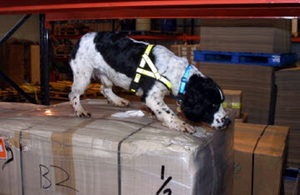
Sniffer dog with cargo

The following veterinary medicines were identified by a courier company based at Belfast depot. The products were then detained and subsequently seized by Department of Agriculture, Environment and Rural Affairs (DAERA).

This parcel was addressed to residential premises in Banbridge, County Down and was shipped from South Africa. The parcel contained:

  • 2 x 1kg bags of Fosbac Plus T water soluble broad spectrum antibiotic compound

This product is labelled for the treatment of bacterial infection in poultry and swine. It is not authorised as a veterinary medicine in the UK.

The medicines were seized under Regulation 25 (Importation of unauthorised veterinary medicinal products) of the Veterinary Medicines Regulations 2013.

Published 7 January 2021


Animal medicine seizure notice: Parcel addressed to Castlederg, County Tyrone

News story

Details of seizure notice served following a parcel addressed to premises in Castlederg, County Tyrone stopped at a Belfast Depot.

Sniffer dog with cargo

The following veterinary medicines were identified by a courier company based at a Belfast depot. The products were then detained and subsequently seized by the Department of Agriculture, Environment and Rural Affairs (DAERA).

This parcel was addressed to residential premises in Castlederg, County Tyrone and was shipped from Australia. The parcel contained:

  • 25 x Folic Acid and Vitamin B12 injection (100ml)
  • 10 x COpHOS B injection (100ml)
  • 5 x Mitachondral injection (100ml)

These products were labelled for the treatment of horses and dogs. They are not authorised as veterinary medicines in the UK.

The medicines were seized under Regulation 25 (Importation of unauthorised veterinary medicinal products) of the Veterinary Medicines Regulations 2013.

Published 7 January 2021