Overspeeding trains between Laurencekirk and Portlethen

News story

Investigation into trains exceeding an emergency speed restriction between Laurencekirk and Portlethen, Aberdeenshire, 4 December 2020.

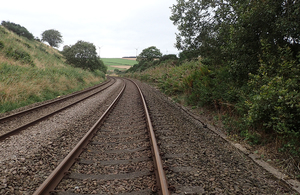
Part of the railway between Laurencekirk and Portlethen

Part of the railway between Laurencekirk and Portlethen

Between about 06:35 hrs and 07:40 hrs on 4 December 2020, two passenger trains passed through an emergency speed restriction located between Laurencekirk and Portlethen stations, at speeds of up to 100 mph (160 km/h), significantly exceeding the temporary maximum permitted speed of 40 mph (64 km/h). The first train was travelling north from Dundee to Inverness, the second was travelling south from Inverness to Edinburgh. The emergency restriction had been introduced as a precaution in case forecast heavy rainfall caused ground movements affecting the safety of the railway.

Neither of the train drivers was aware of the emergency speed restriction at the time they drove their trains over the affected section of track. The events were identified after a Network Rail signaller noticed the relatively short time taken for the second train to pass through the area. The first overspeed was then identified using electronic records of train movements. There were no injuries or damage as a result of these incidents.

RAIB’s preliminary examination found no evidence that any other trains which used the line on 4 December did not observe the speed restriction. However, until the second overspeed was identified by the signaller, the only notification to drivers was a printed notice at their booking on points. Lineside signage was not provided by Network Rail processes applicable to this type of speed restriction. After the second overspeed, the method of working was changed so trains were stopped shortly before reaching the restricted area while signallers reminded drivers about the reduced maximum permitted speed.

Our investigation will determine the sequence of events that led to the incidents and include consideration of:

  • the processes for advising train drivers of emergency speed restrictions
  • any overlap with issues identified during the on-going RAIB investigation of the fatal accident on 12 August 2020 at Carmont, a location within the area covered by this emergency speed restriction (although there was no emergency speed restriction at Carmont on the 12 August)
  • any relevant underlying factors.

Our investigation is independent of any investigation by the railway industry or by the industry’s regulator, the Office of Rail and Road.

We will publish our findings, including any recommendations to improve safety, at the conclusion of our investigation. This report will be available on our website.

You can subscribe to automated emails notifying you when we publish our reports.

Published 8 January 2021


Celebrating success at the Analysis in Government Awards 2020

The virtual awards ceremony for the first Analysis in Government Awards took place on Tuesday 8 December.

Hosted by David Wood (Head of the Government Geography Profession), the Awards celebrated the excellent work being done across the Government Analysis Function. Despite the ceremony being virtual this year, the 150 people that attended made the most of it by congratulating one another on all that analysts have achieved throughout the year. National Statistician Sir Ian Diamond provided an introduction which highlighted the rapid pace at which analysts across government have delivered new analysis to support the pandemic response whilst still delivering analysis in other priority areas.

A recording of the event is available to view at YouTube/GovernmentAnalysisFunction.

Collaboration Award

The first award to be presented was the Collaboration Award which recognises collaboration between teams, departments, other professions and/or external partners to deliver a piece of analysis or analytical project. The joint winners were the COVID-19 Infection Survey Team at the Office for National Statistics for delivering the COVID-19 Infection Survey and the Population Health Analysis and Public Health Data Science teams at Public Health England for their work on excess mortality in England.

The COVID-19 Infection Survey provides estimates of the number of current COVID-19 infections within the community population in the UK and has been a key source of evidence for informing the UK response to the COVID-19 pandemic with user feedback describing it as the “jewel in the crown of the UK response to COVID-19”. The judges were impressed with the range of partners that ONS collaborated with to deliver at rapid pace with the first analytical results provided within a week. The results of the survey have informed key government lockdown decisions impacting every citizen in the UK.

Excess mortality in England provides a weekly measure of excess mortality by date of death registration in different subgroups of the population (for example age, sex or region). This allows decision makers to make accurate and informed decisions during the COVID-19 pandemic. Judges were impressed with the collaboration efforts shown as well as the innovative use of Reproducible Analytical Pipelines to deliver vital analysis to help understand the effect of ethnicity and deprivation on excess deaths. 

Details of the other shortlisted nominations in this category can be found on the Analysis in Government Award shortlist page.

Innovation in Methods Award

The next award to be presented was the Innovation in Methods Award which recognises innovation in methods of analysis. The winner was the Internal Data Linking Team in the Data and Analytical Services Directorate at the Ministry of Justice for developing a piece of record linkage software (Splink) for probabilistic data linkage at scale.

Splink can be used it to link up to around 100 million records with greatly improved accuracy. The software is open source and has been downloaded over 100,000 times. Splink is being used across government and beyond. It featured in ONS’s cross-government review of data linkage, and is now part of their core methods library. The judges felt that this is an impressive tool that will be greatly beneficial across government for large data linking. It has been peer reviewed by academics and methodology experts at ONS and adopted by other departments. It has improved efficiency in MoJ by replacing existing data linking projects. 

Details of the other shortlisted nominations in this category can be found on the Analysis in Government Award shortlist page.

Communication Award

The next award to be presented was the Communication Award which recognises clear and successful presentation and dissemination of analysis using commentary, visualisations, interactives or social media. The winner was the Analytical Products Team in Product Management, Design and Delivery at NHS England and NHS Improvement for their COVID-19 Situational Operational Dashboard.

Since the start of the pandemic, the Analytical Products Team have worked tirelessly to produce an unprecedented 100+ analytical COVID-focused dashboards easily accessible via a single HUB. The work involved an unparalleled level of communication across the entire NHS sector, helping leaders across the NHS make better decisions in response to the pandemic. Judges were impressed by the scale of work which is very innovative due to several inputs and outputs. The dashboard was designed for a wide range of users with user-friendly and interactive visualisation. Feedback from experts was sought and the data is turned around very quickly (updated daily in some cases). 

Details of the other shortlisted nominations in this category can be found on the Analysis in Government Award shortlist page.

Impact Award

The penultimate award to be presented was the Impact Award which recognises analysis which has been impactful through use, influenced decision-making and/or has contributed to the public debate. The winner was COVID-19 Statistical Reporting Team at the Department of Health Northern Ireland for their COVID-19 Dashboard.

The Department of Health’s COVID-19 Dashboard is the primary source of a wide range of COVID-19 information and analysis which has been fully utilised by the media, Government and public alike, inspiring policy changes at all levels and providing the information necessary for sound public debate. Judges felt this work demonstrated significant impact with the dashboard used by large audiences. It was achieved from scratch as the data was not previously collected by the Department of Health. The dashboard is updated at pace (almost daily) by a small team which shows commitment and hard work. Producers sought feedback to improve the dashboard and key policy decisions rely on it, including decisions on local lockdowns. 

Details of the other shortlisted nominations in this category can be found on the Analysis in Government Award shortlist page.

Investment in People Award

The last award to be presented was the Investment in People Award which recognises achievements in the development of our people and the building of an inclusive culture across the Government Analysis Function. The winner was the Data Services Team at the Ministry of Defence for their Happiness Index.

The Happiness Index is a tool that assesses, monitors and improves people’s wellbeing. Different views were sought to develop the tool and make it inclusive for a range of people. It’s helping to promote an inclusive work environment. The impact is also considerable with the tool starting as a small one team initiative but now being rolled out to 12,000 staff.

Details of the other shortlisted nominations in this category can be found on the Analysis in Government Award shortlist page.

Next steps

We’ll be hearing more about the shortlisted work (as well as all the other nominated work) at the first ever Analysis in Government Month being held in Spring 2021 as well as through a programme of sharing webinars that will soon be rolled out across the Government Analysis Function. Further details will be shared in due course. 


Whisky gets into the spirit of building back greener

  • UK distilleries raise a toast to government’s green industrial revolution in first phase of funding to cut carbon emissions and support new green jobs
  • £10 million fund to help UK’s world-famous distilleries go green by switching to low carbon fuels such as hydrogen
  • funding to enable distilleries to cut emissions by almost a million tonnes of CO2 every year – equivalent to taking 200,000 cars off the road

Whisky and spirit lovers are raising a glass to the delivery of new government funding that will ensure they can enjoy their favourite tipple without it costing the earth.

Producers in one of the UK’s most iconic industries will be playing their part in reducing carbon emissions, with 17 distilleries today receiving the first phase of £10 million government funding to go green.

Eleven distilleries across Scotland and a further 6 in England will be able to kick-start green innovations thanks to the government backing, helping them harness energy sources such as low-carbon hydrogen, biomass and repurposed waste to power their operations.

The successful distilleries will receive between £44,000 and £75,000 in the first phase of funding, helping them boost decarbonisation research and development, with schemes including the use of hydrogen and biofuel boilers and geothermal energy in their production processes.

The funding will help prevent pollution equivalent to taking 200,000 cars off the road.

Energy and Clean Growth Minister, Kwasi Kwarteng, said:

Building back greener from the pandemic is something we can all raise a toast to.

Every business can play a part in the green industrial revolution and this funding will allow UK distilleries to lead the way by making their production cleaner while also creating jobs.

In 2019, the UK distilleries industry grew by 20%, highlighting the opportunity for the sector to be at the heart of the UK’s green and resilient recovery from coronavirus.

The Scotch whisky industry supports 40,000 jobs across the UK, with more than 10,000 people directly employed in Scotland.

With 7,000 of these jobs in rural Scottish areas, today’s funding will drive forward support for net-zero innovation in some geographically remote parts of the UK, creating more jobs and skills and providing opportunities for distilleries to develop their fuel transportation and storage technologies.

The announcement is another example of government commitment to build back greener and work towards the UK’s goal of reaching net zero by 2050 and comes in addition to the ambitious green targets announced in the Ten Point Plan and Energy White Paper.

UK government Scotland Minister, Iain Stewart said:

It is fantastic to see so many Scottish distilleries awarded this UK government funding. Scotland is world famous for its whisky and gin, with the spirits industry one of our greatest success stories.

This new funding will help the industry continue to build on its great work in tackling climate change.

From Aberdeen and Glasgow to Orkney and South Uist, this funding will help create jobs, support local businesses and communities and build back greener ahead of COP26 in Glasgow later this year.

Dagmar Droogsma, Director of Industry at the Scotch Whisky Association, said:

The Green Distilleries Fund is an important step on the industry’s journey towards net-zero. It will help the industry test new technologies, like hydrogen, which can be rolled out at scale in future years and enable Scotch Whisky to further drive down emissions and protect the natural environment.

With COP26 taking place in Glasgow this year, the Scotch whisky industry has ambitious plans to build on the success of the last decade when distilleries cut greenhouse gas emissions by 34%. There is more to do, but with continued support from government the Scotch whisky industry can continue to work towards a more sustainable future.

  • The Green Distilleries competition supports the government’s approach for a clean, resilient recovery across the UK to support the creation of new jobs in the distillery sector
  • in the 2020 Budget, £10 million was allocated to R&D to help decarbonise UK distilleries
  • find more information about the Green Distilleries Competition
  • the funding for the Green Distilleries competition is part of the £1 billion Net Zero Innovation Portfolio which aims to accelerate the commercialisation of innovative low-carbon technologies, systems and processes in the power, buildings and industrial sectors

Successful phase 1 distilleries

Name Funding Location Detail
Protium Green Solutions Limited £73,818 Lead in London with a distillery partner in Islay Using a low emission hydrogen boiler.
Locogen Ltd £43,325 Edinburgh Switching a distillery from fuel oil to hydrogen burners.
Protium Energy Limited £57,464 Aberdeen A high temperature heat store.
Cornish Geothermal Distillery Company £75,000 Truro Creating a geothermal distillery.
European Marine Energy Centre £58,781 Orkney Islands Assessing technology pathways to facilitate green hydrogen.
Supercritical Solutions Ltd £53,000 Lead in Horsham with a distillery partner in Glasgow Electrolysers to enable fuel switching to zero emission sources.
The Uist Distilling Company Ltd £44,572 The Isle of South Uist Combination of a hydrogen burner and indirect heating of a thermal oil rather than steam.
Colorado Construction and Engineering Ltd £73,636.80 Edinburgh Hydrogen and dual hydrogen/biofuel burners for distilleries.
Vytok Ltd £57,688.00 London Heat pumps with water as the working fluid.
The Uist Distilling Company Ltd £40,539.23 The Isle of South Uist A high temperature heat store that would allow a distillery to be run purely on electricity.
John Fergus & Co Ltd £71,812.55 Glenrothes The use of hydrogen on site to decarbonise process heat.
The Edrington Group Ltd £56,930.00 Glasgow An innovative stillhouse Condenser Hot Water Recovery System.
St Andrews Brewers Limited £51,547.00 Glasgow A combination of heat pumps, green hydrogen and biomass.
Bennamann Ltd £46,620.11 Cornwall Use of fugitive methane as fuel.
Sunamp Ltd £61,412.50 Edinburgh A large-scale phase change material thermal store.
Environmental Resources Management Limited £68,951.00 London Liquid organic hydrogen carriers.
Colorado Construction and Engineering Ltd £74,768.10 Edinburgh The conversion of waste distillery draff and pot ale into a gasification-gas.


Mandatory COVID-19 testing introduced to bolster border measures

  • all international arrivals to England, including UK nationals, required to present a negative COVID-19 test taken up to 72 hours prior to departure
  • passengers will be subject to an immediate fine of £500 if they fail to comply with the new regulations on pre-departure testing
  • all passengers arriving from countries not on the government’s travel corridor list will still be required to self-isolate for 10 days, regardless of test result
  • passengers will still be required to fill in a passenger locator form and be subject to national lockdown restrictions

Passengers arriving from all international destinations will be required to present a negative COVID-19 test result before departing for England to help protect against new strains of coronavirus circulating internationally.

Transport Secretary Grant Shapps has announced that from next week inbound passengers arriving by boat, plane or train will have to take a test up to 72 hours before departing the country they are in, to help protect against the new strains of coronavirus such as those seen in Denmark and South Africa.

Today’s (8 January 2021) decisive action is in response to the changes seen in the transmission of the virus both domestically and across the globe. Pre-departure testing will protect travel and will provide an additional layer of safety from imported cases of coronavirus on top of the mandatory 10 day self-isolation for arrivals, helping identify people who may currently be infectious and preventing them from travelling to England.

A negative pre-departure test reduces the risk of someone travelling whilst infectious, acting as another safeguard to prevent imported infections. Passengers arriving from countries not on the government’s travel corridor list must self-isolate for 10 days regardless of their pre-departure test result to provide further robust protection from those travelling from high-risk countries.

Prior to departure passengers will need to present proof of a negative COVID-19 test result to carriers, as well as their passenger locator form. The UK Border Force will conduct spot checks on arrival into England to ensure that passengers are fully compliant.

The move further bolsters existing protective measures which helped to safely enable international travel last year, with self-isolation for new arrivals and travel corridors remaining critical in reducing the risk of imported cases from high-risk countries.

Transport Secretary, Grant Shapps said:

We already have significant measures in place to prevent imported cases of COVID-19, but with new strains of the virus developing internationally we must take further precautions.

Taken together with the existing mandatory self-isolation period for passengers returning from high-risk countries, pre-departure tests will provide a further line of defence – helping us control the virus as we roll out the vaccine at pace over the coming weeks.

National lockdown restrictions which came into force on 6 January 2021 remain in place meaning everyone must stay at home unless travelling for a very limited set of reasons, including for work.

Permitted travellers will need to take their test up to 72 hours before departure, and this will apply irrespective of whether a country is on the travel corridor list. The government will set out the standards that these tests will need to meet and what proof passengers will need to present.

Passengers arriving into England who have successfully demonstrated a negative result prior to departure from a country not on the travel corridor list will still have the option to reduce the self-isolation period from 10 to as little as 5 days by paying for a test through the Test to Release scheme. The scheme requires a test to be taken on or after the fifth full day since leaving a country not on the travel corridor list.

Passengers will be required to show their negative test result before boarding, and transport operators will deny boarding if necessary. On arrival back into the UK, Border Force will check passengers test results through the current spot check regime, to ensure that individuals are compliant with the new rules, and passengers will be subject to an immediate fine of £500.

There will be a limited number of exemptions, including for hauliers, children under 11, crews and for those who travelling from countries without the infrastructure available to deliver the tests. Further exemptions will be set out on GOV.UK.

This follows the recent decision to temporarily suspend direct travel from South Africa to England after new evidence emerged from health authorities reporting an outbreak of a variant strain of coronavirus spreading to some local communities.

Those who travel indirectly from South Africa must self-isolate for 10 days.

All travellers will still be required to complete a passenger locator form before arrival into England. This is critical in being able to track the virus in case of any local outbreaks, and those who fail to complete a passenger locator form will be subject to an increased fine of £500.


Coronavirus testing for hauliers to continue following decision by French government

  • testing requirement for hauliers crossing the Channel to continue
  • hauliers must continue to have proof of an authorised negative test, conducted within 72 hours of travelling to the border to cross over
  • government urges all hauliers to seek tests at one of 34 information and advice sites before travelling to Kent to help smooth traffic management

Current testing arrangements for hauliers crossing the Channel – where they must have had a negative coronavirus test within 72 hours of crossing – are set to continue following a decision by the French Government today (Thursday 7 January 2021).

The continuation means that hauliers – including drivers and crew of HGVs, drivers of LGVs and van drivers – planning to cross the Channel should get a negative test before travelling to Kent or other Channel Crossing points.

Following the French Government’s original decision to close the border to the UK, and the subsequent reopening of the border to hauliers on the condition of a negative Covid test on the 23 December (2020), it was agreed the arrangements would be reviewed regularly.

Having met to discuss the situation, the French Government has made the decision to keep current measures in place until further notice.

While the government acted swiftly during December to help hauliers move across the border steadily, drafting in the military to deliver tests in Kent, hauliers are now being urged to get a negative COVID-19 test before travelling to the border, to help further with avoiding backlog or traffic management issues.

Transport Secretary Grant Shapps said:

After the decision by the French Government back in December, we acted swiftly to find a solution to the border closures, so hauliers could continue to travel and people continued to get their deliveries.

Following the French Government’s decision today to extend the current arrangements, I continue to urge all hauliers to get tested before getting to the border, and only travel if they test negative.

To help make this possible we are offering support to businesses to set-up testing facilities at their own premises, assisting the smooth passage of trucks and good across the border, as well as setting up testing at information and advice sites around the country.

To help hauliers get tested before travelling to Kent, 34 information and advice sites have been set up across the country, linked to key haulier stopping spots on their journeys, so they can get their negative test before heading to the border. Further sites are in the process of being set up.

In addition, the government is offering to help any business to set up a testing centre at its own premises to ensure trucks heading for France depart ‘COVID ready’. This includes the provision of testing kits entirely free of charge.

As with the previous arrangements agreed on the 23 December, hauliers must continue to have proof of an authorised negative test, conducted within 72 hours of travelling to the border to cross over.

If they do not meet these requirements, they will be stopped from travelling.