Taking swift action on the economy, humanitarian funding and humanitarian access in Yemen

Thank you, Mr President, and thank you to Special Envoy Griffiths, Mark Lowcock, and David Beasley for their compelling briefings.

I want to be clear that the United Kingdom strongly condemns the appalling attack in Aden on the 30th of December. The deaths and wounding of so many civilians and the targeting of the newly formed cabinet is unacceptable. Amongst the dead was a deputy minister, three members of the International Red Cross and a journalist who was there to document a positive moment. Our condolences to all of their families.

The UK assesses that it is highly likely that the Houthis were responsible for this cowardly and craven attack. Only they had the means, the motive, and the opportunity for this clear and deplorable attempt to destabilise the newly formed Yemeni government. We welcome the UN Panel of Experts’ investigation into this incident, and we hope that the panel’s results will be published swiftly.

The Houthi attack casts a dark shadow over a group who claims to be committed to pursuing peace in Yemen. The UK reiterates its firm support and its gratitude for the efforts of Special Envoy Martin Griffiths and urges all parties to engage in the UN-led negotiations rather than resorting to violent methods.

As the Special Envoy said, this attack mars what is otherwise an extremely positive development: the formation of a new cabinet. It includes members from across the political spectrum under the auspices of the Saudi-mediated Riyadh agreement, although the lack of women is notable.

The UK wholeheartedly welcomes the cabinet’s courageous return to Aden to restore services and supports the efforts of the Prime Minister to bring about the security, and the economic stability that the Yemenis need. We condemn, too, the ongoing Houthi cross-border attacks against Saudi Arabia and share US concerns about the Houthi commitment to peace.

We’ve taken note of the US decision to designate the Houthis and welcome the US commitment to work with the UN, with NGOs, and donors on implementation. It will be critical, as we heard from Mark Lowcock, that there are exemptions immediately put in place to ensure humanitarian activity and commercial imports can continue unimpeded, and for the peace process to continue unhindered.

As Mark Lowcock said, we enter 2021 facing a humanitarian emergency with Yemen. And as we heard from David Beasley, Yemen is in imminent danger of the worst famine in decades. 16,500 Yemenis are already living in famine conditions, which is set to triple by June 2021 and with more numbers in the pipeline. Despite this, 2020 closed with a UN appeal that was only half funded – having a drastic impact, as we’ve heard, on the humanitarian response and its ability to save lives.

As we’ve heard, too, rapid economic decline is driving this crisis, compounded by severe humanitarian access constraints, particularly in the Houthi-controlled north. Aid and humanitarian workers must be able to reach those in need and do so safely.

Swift action is needed now – before it’s too late – on the economy, humanitarian funding, and humanitarian access in order to avert catastrophe in 2021.

While the Yemeni Rial’s value temporarily stabilised after the formation of the new government, it is now depreciating again. Food security is already getting worse in the absence of external financial assistance to the Central Bank of Yemen to support food importers.

The new government has the opportunity now to demonstrate the leadership required to stabilise the economy and seek financial assistance. We urge the new government and agencies to swiftly build relationships with the UN and the wider humanitarian community. We will call on the government to urgently set out plans for how it will pay salaries and support currency stability, working with key donors on setting out a financing plan for the Central Bank and for a package of reform measures.

Thank you, Mr President.


Governo Britânico suspende viagens da América do Sul para evitar propagação de novas variantes da COVID-19

  • Entrada no Reino Unido suspensa para passageiros que chegam da América do Sul e América Central, Portugal, Panamá e Cabo Verde a partir de sexta-feira, 15 de janeiro, às 04h (Horário de Londres).
  • Os cidadãos britânicos, irlandeses e de outros países que tenham residência permanente no Reino Unido e que tenham viajado ou transitado por estes destinos deverão fazer quarentena em casa pelo período de 10 dias, junto com suas famílias.
  • Decisão responde a evidências que destacam o espalhamento de novas variantes do coronavírus na América do Sul e em países com fortes elos de viagens com o Brasil.

O Governo Britânico tomou a decisão urgente de proibir viagens para o Reino Unido a partir de vários destinos sul-americanos, além de Portugal, Panamá e Cabo Verde, para evitar a propagação de uma nova variante de coronavírus.

A partir das 4 da manhã de sexta-feira, 15 de Janeiro (Horário de Londres), os passageiros que tenham estado na Argentina, Brasil, Bolívia, Chile, Cabo Verde, Colômbia, Equador, Guiana Francesa, Guiana, Paraguai, Panamá, Portugal (incluindo Madeira e Açores), Peru, Suriname, Uruguai e Venezuela nos últimos 10 dias já não terão entrada permitida no Reino Unido.

Isto não inclui nacionais britânicos e irlandeses ou cidadãos de outros países com residência permanente no Reino Unido, que poderão entrar no país, mas devem permanecer em quarentena durante 10 dias junto com seu grupo familiar.

A decisão inclui também a suspensão de todos os voos vindos da Argentina, Brasil, Cabo Verde e Portugal, incluindo Madeira e Açores. Voos de carga e carga sem passageiros estão excluídos desta proibição.

A suspensão está relacionada à descoberta de novas variantes do coronavirus identificadas pela primeira vez no Brasil, que podem ter se espalhado por destinos de viagem com ligação direta com o país.

Atualmente, países como Argentina, Brasil. Bolívia, Cabo Verde, Colômbia, Equador, Guiana Francesa, Guiana, Guiana, Panamá, Paraguai, Peru, Portugal, Suriname, Uruguai e Venezuela não fazem parte dos corredores de viagem para o Reino Unido. O Chile será excluído da lista de corredores de viagem. Todos os passageiros vindos desses destinos precisam se auto-isolar por dez dias.

Todas as exceções atualmente em vigor estão suspensas, incluindo aquelas relacionadas a profissões e ocupações. Somente transportadores vindos de Portugal nos últimos dez dias transportando mercadorias essenciais estão isentos das proibições.

O sistema test to release não se aplicará a passageiros vindos de Argentina, Brasil, Bolívia, Chile, Cabo Verde, Colômbia, Equador, Guiana Francesa, Guiana, Guiana, Paraguai, Panamá, Portugal, Peru, Suriname, Uruguai e Venezuela após as 4 da manhã do dia 15 de Janeiro.

A recomendação de auto-isolamento por dez dias se estende para pessoas que moram com passageiros recém-chegados de Argentina, Brasil, Bolívia, Chile, Cabo Verde, Colômbia, Equador, Guiana Francesa, Guiana, Paraguai, Panamá, Portugal, Peru, Suriname, Uruguai e Venezuela.

A partir de sexta-feira, 15 de Janeiro, às 4 da manhã, os passageiros de todos os destinos terão também de apresentar um resultado negativo de testes de COVID-19 antes de viajarem para a Inglaterra, para ajudar a proteger contra novas variantes de coronavírus que circulam internacionalmente e para identificar as que podem ser infecciosas.

As restrições nacionais para a Inglaterra aplicadas no último dia 6 de janeiro continuam em vigor: todos devem permanecer em casa, exceto para motivos específicos, como trabalho. Isso significa que as pessoas não podem fazer viagens de férias ou viagens internacionais, exceto para trabalho ou outras razões essenciais. A violação das regras de quarentena pode ser punida com multas entre £200 e £6400 .

O Governo Britânico trabalha em colaboração direta com parceiros internacionais para compreender as mudanças no vírus que têm sido relatadas nestes países. Estamos, também, realizando investigações adicionais no Reino Unido para garantir nossa avaliação de risco.


PM call with Prime Minister Giuseppe Conte: 14 January 2021

Press release

The Prime Minister spoke to Italian Prime Minister Giuseppe Conte.

The Prime Minister spoke to Italian Prime Minister Giuseppe Conte this afternoon.

They discussed their countries’ responses to the coronavirus pandemic and their progress rolling out vaccinations.

The leaders welcomed the ‘year of UK-Italian presidencies’ as the UK prepares to host the G7, Italy prepares to host the G20 and both our countries work in partnership on the COP26 Summit. They agreed this offered a unique opportunity for the UK and Italy to intensify cooperation on shared priorities, particularly defeating coronavirus and building back better from the pandemic.

The Prime Minister stressed the need for countries to link their economic recovery to efforts to tackle climate change, ensuring that we have a more prosperous planet.

The leaders discussed the current situation in Libya. The Prime Minister underlined the UK’s continued support for the UN-led political process.

The Prime Minister and Prime Minister Conte looked forward to meeting in person soon to enhance the bilateral UK-Italy relationship further.

Published 14 January 2021


Civil news: means, merits and billing update for CCMS users

News story

Change of look aims to improve the user experience for means, merits and billing work in the Client and Cost Management System.

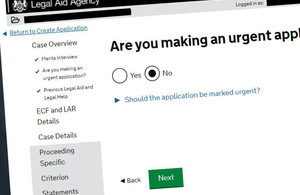
Image of a Client and Cost Management System screen

Providers carrying out means, merits and billing work will benefit from new features in the Client and Cost Management System (CCMS), which has now been released.

The styling changes mean navigation and presentation will look visually different with the aim of making the system easier for assessment work in CCMS.

What is different?

Among changes users will notice are:

  • back and next buttons placed more intuitively
  • partially completed assessments can be restarted where you were last working

The ability to restart partially completed assessments applies when ‘proceedings and costs’ or ‘opponents and other parties’ are unchanged.

Remember also that you have the option of revisiting your answers to completed questions before completing the assessment. This is explained in a new Quick Guide available on Legal Aid Learning.

Is the content changing?

The aim of these styling changes is to improve the user experience. Content and questions remain the same since the software update was released.

Download our Quick Guide on CCMS means and merits assessments and billing new look and feel

For more training resources visit Legal Aid Learning

Published 14 January 2021


Travel from South American destinations, Portugal, Panama and Cape Verde banned to prevent spread of new variant

  • entry to the UK banned for passengers arriving from destinations across South (and Central) America, Portugal, Panama and Cape Verde from Friday 15 January at 4am
  • British, Irish and third country nationals with residence rights in the UK who arrive after 4am and have travelled from or transited through these destinations in the last 10 days will have to self-isolate immediately along with their household
  • move is in response to new evidence highlighting the likely spread of a new coronavirus variant in South America and to countries with strong travel links with Brazil

The government has taken the urgent decision to ban travel to the UK from several South American destinations, Portugal, Panama and Cape Verde in order to prevent the spread of a new strain of coronavirus (COVID-19) into the UK.

From 4am Friday 15 January 2021, passengers who have been in or transited through Argentina, Brazil, Bolivia, Chile, Cape Verde, Colombia, Ecuador, French Guiana, Guyana, Paraguay, Panama, Portugal (including Madeira and the Azores), Peru, Suriname, Uruguay and Venezuela in the last 10 days will no longer be granted access to the UK.

This does not include British and Irish Nationals, or third country nationals with residence rights in the UK, who will be able to enter the UK but are required to self-isolate for 10 days on arrival along with their household.

There will also be a flight ban on any countries with direct flights to the UK. These are Argentina, Brazil, Cape Verde and Portugal (including Madeira and the Azores). This excludes cargo and freight without passengers.

The decision to ban travel from these destinations follows the discovery of a new coronavirus variant first identified in Brazil, that may have spread to countries with strong travel links to Brazil.

The UK does currently not have travel corridors with Argentina, Brazil, Bolivia, Cape Verde, Colombia, Ecuador, French Guiana, Guyana, Panama, Paraguay, Peru, Portugal, Suriname, Uruguay and Venezuela, and the travel corridors with Chile, Madeira and the Azores will be closed. Anyone returning from these countries from 4am on Friday will be legally required to self-isolate for 10 days.

Any exemptions usually in place – including for those related to employment – will not apply, although hauliers who have been in or transited through Portugal (only) in the last 10 days will be exempt to allow transport of essential goods.

Passengers arriving in the UK from Argentina, Brazil, Bolivia, Chile, Cape Verde, Colombia, Ecuador, French Guiana, Guyana, Paraguay, Panama, Portugal, Peru, Suriname, Uruguay and Venezuela after 4am on 15 January cannot be released from self-isolation through Test to Release.

People who share a household with anyone self-isolating after returning from Argentina, Brazil, Bolivia, Chile, Cape Verde, Colombia, Ecuador, French Guiana, Guyana, Paraguay, Panama, Portugal, Peru, Suriname, Uruguay and Venezuela will now also need to self-isolate until 10 days have passed since anyone they live with was last in those countries.

From Monday 18 January at 4am, passengers from all destinations will also be required to present a negative COVID-19 test result before travelling to England, to help protect against new strains of coronavirus circulating internationally and to identify those who may currently be infectious.

National restrictions for England introduced on 6 January 2021 remain in place meaning everyone must stay at home unless travelling for a very limited set of reasons, including for work. This means people can no longer travel to take holidays or travel internationally unless for work or other legally permitted reasons. Those in breach of the rules face penalties starting at £200, rising to a maximum of £6,400.

The UK government is working closely with international partners to understand the changes in the virus that have been reported in these countries and we are conducting a programme of further research here in the UK to inform our risk assessments.