Cambridge Vacuum Engineering benefits from clean energy projects

About the transaction: Cambridge Vacuum Engineering (CVE)
Region Cambridge
Sector Engineering, Clean Energy
Export location Multiple
UKEF support Bond Support Scheme

Cambridge engineering firm, CVE, is part of a consortium of organisations that have won an InnovateUK grant to dramatically reduce the installation costs of the world’s largest offshore wind farm in the North Sea. When completed, the Dogger Bank wind farms will generate enough energy to power over 4.5 million homes every year – around 5% of the UK’s electricity needs.

CVE has adapted its latest high-tech welding technology to reduce the fabrication time and cost of the wind turbine foundations by up to 25%. This new technology could represent a significant contribution to Dogger Bank’s achievement of being the first wind farm in the world to be able to generate electricity without the need for any subsidies.

Pictured (above and top): CVE’s Ebflow local vacuum electron beam welding system.

In addition to this, CVE are involved in two other renewable energy projects, which are focusing on the new generation of small modular reactors (SMRs) that the UK government are currently promoting as part of the recently announced Green Energy Strategy. CVE obtained these grants with support from UKEF.

The development of this technology required a great deal of investment by CVE, locking up valuable cash and putting pressure on its successful exporting business. Together with UKEF, they managed to secure a trade loan facility with their bank under our Bond Support Scheme. This allowed CVE to finance several export contracts and unlock the capital that they needed to supply both the offshore wind and nuclear projects.

David Evans, Finance and Accounting Director at CVE, said:

Even though our export order book has been full of orders from China, USA, and India, the economic disruption that has been caused by the COVID-19 pandemic has made it difficult to get all of the finance needed from our bank.

UKEF’s guarantee will allow us to deliver contracts with clients around the world and deliver on the Dogger Bank project.

Jo Archer, UKEF Export Finance Manager for the region, added:

The UK is world-renowned for the quality of its manufactured goods and is rapidly becoming a centre for green technology.

UKEF is one of the world-leading ECAs for supporting clean, sustainable projects. Through supporting companies like CVE, it is playing its part in helping the UK achieve its clean energy goals and help the world transition away from fossil fuels.

This support for CVE is part of UKEF’s ongoing support for renewables projects around the world, with £2 billion of direct lending support dedicated to clean growth projects.

Putting the right finance and insurance in place can give you the exporting edge, helping you to win contracts, fulfil orders and get paid.

Tell us about your business


Scottish Secretary thanks Covid testing staff in Dumfries

News story

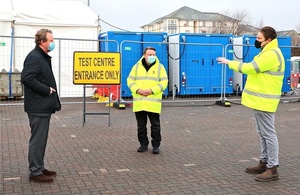
Scottish Secretary, Alister Jack, thanks frontline testing staff in Dumfries for their heroic efforts

Scottish Secretary Alister Jack visits Dumfries testing cetnre

Scottish Secretary Alister Jack has today [Friday 15 January] visited a new UK Government testing site in Dumfries to thank frontline testing staff and learn more about a UK-wide drive to improve accessibility of testing for local communities.

The new testing site at Brooms Road carpark in Dumfries (DG1 2LB) is the UK Government’s twenty fifth walk-through centre in Scotland. It joins a network of six drive through sites and around 20 mobile units across Scotland, plus the Glasgow Lighthouse Lab which to date has processed more than five million tests.

In Scotland, the UK Government is providing all Covid testing and test processing outside of the NHS. Around two thirds of all daily tests are provided by the UK Government, in support of Scotland’s health services.

Following his visit, Mr Jack said:

The UK Government is doing everything it can to support people in all parts of the UK through the pandemic.

Testing will continue to play an important role in how we manage the virus alongside the roll out of vaccines. This new walk-through site in the centre of Dumfries will make it easier for people in Dumfries and Galloway to access a test, helping them to protect themselves, their local community and the NHS.

I was very pleased to see for myself how testing is being rolled out across Scotland, and to thank the frontline staff who have been working tirelessly since the summer to provide this vital service.

Hope is on the horizon with vaccines, with the great news that the Queen of the South Arena is to be turned into a mass vaccination centre. By continuing to pull together we will get through this.

Tests must be booked in advance at NHS Inform or by calling 0800 028 2816. People should only book at test if they have coronavirus symptoms (a high temperature, a new and continuous cough, or a loss or change to their sense of smell or taste).

Published 15 January 2021


Clive of India’s Durbar set at risk of export

  • The set, used in formal court assemblies, is extremely rare and is of fundamental importance to the study of Indian silver
  • An incredibly rare darbār or Durbar set owned by Clive of India is at risk of being lost abroad unless a UK buyer can be found.

Culture Minister Caroline Dinenage has placed a temporary export bar on the Durbar set, which includes rose water sprinklers and stands, and is valued at £730,000. It is hoped that this will offer a UK gallery or institution an opportunity to acquire the set for public display.

Although a controversial figure, Major-General Robert Clive, 1st Baron Clive, known as ‘Clive of India’ was the first British Governor of the Bengal Presidency and is credited – along with Warren Hastings – with laying the foundations of the British Empire in India.

The items at risk of export offer a rare glimpse into the manners and customs of courtly life in 18th century India. The pieces in this set were listed in an inventory of Clive’s possessions made in 1766.

It is likely that the set would have been used at court. Contemporary paintings depict regional rulers reclining on a bolster surrounded by members of their court with an array of rosewater sprinklers, caskets and perfume containers, all of which are represented in this set.

Each piece has surface decoration of tear-drop motifs carefully accentuated by mercury gilding. They all had a function in the elaborate rituals of a formal darbar, or court assembly. Those attending the darbar would be sprinkled with rose water from one of the slender-necked vessels, or given an attar of roses from one of the perfume holders. The two lidded boxes, or pāndāns, each of different form, contained pān. This refers to small pouches made of edible leaves wrapped round aromatic spices and chopped betel nuts. Pān was chewed as a mild stimulant, but in a darbar would be offered on salvers to indicate that the audience had come to an end.

The set adds another dimension to our understanding of Clive of India’s career which has been seen almost exclusively from a Western perspective as it demonstrates that he adopted formal Indian customs.

Culture Minister Caroline Dinenage said:

These beautiful items showcase the luxury of the Indian court and offer us a glimpse into the inner workings of how the British interacted with traditional Indian ceremonies.

I hope that an institution is able to save this collection for the public to help us better understand our nation’s long friendship with India.

The Minister’s decision follows the advice of the Reviewing Committee on the Export of Works of Art and Objects of Cultural Interest (RCEWA). The committee noted that the set was a striking assemblage of objects, with an extraordinary range of component parts.

Committee Member Peter Barber said:

A variety of silver vessels, used in formal receptions or Durbars, provided the essential aesthetic and courtly backdrop for doing business in Moghul India. This is the most complete and splendid known set. Assembled by Robert Clive while he was working for the East India Company, it demonstrates how the British adopted Indian customs in pursuit of their commercial and political goals. It also enables people today to evaluate accusations of greed thrown at Clive by his British contemporaries.

More research needs to be done on how and from where Clive assembled the set, which is very important also because, uniquely, it has an unbroken provenance going back to the later eighteenth century.

Every effort should be made to retain this Durbar set in the United Kingdom so that it can be viewed, researched, and its ambiguous meanings drawn out by future generations.

The committee felt that the set was of significance to the study of the history of the British in India through its association with the undeniably controversial figure of Robert Clive, whose collection of Indian art is remarkably well documented.

The RCEWA made its recommendation on the grounds of the Durbar set’s outstanding significance for the study of silver and the culture of court etiquette, and diplomatic gift-giving between Britain and India within the broader Mughal context.

The decision on the export licence application for the Durbar set will be deferred until 14 April 2020. This may be extended until 14 September 2020 if a serious intention to raise funds to purchase it is made at the recommended price of £730,000.

Notes to editors

Organisations or individuals interested in purchasing the set should contact the RCEWA on 0845 300 6200.

Details of the set are as follows:

  • ‘Durbar’ set comprising 19 pieces, including rosewater sprinklers with stands, caskets for pan, and components of huqqa bases
  • Silver, cast, chased and partly gilt
  • Mughal empire, mid-18th century
  • The condition is excellent.

Provenance: Acquired in India by Robert Clive, 1st Baron Clive (1725-1774); some items listed in his inventory of 1766; the set listed in his 1775 inventory. Inherited by his son, Edward Clive, 2nd Baron Clive of Plassey and 1st Earl of Powis (1754-1839); Edward James Herbert, 3rd Earl of Powis (1818-91); George Charles Herbert, 4th Earl of Powis (1862-1952); Mervyn Horatio Herbert, Viscount Clive, 17th Lord Darcy de Knayth (1904-1943); Styche Estate and Trust.

The Reviewing Committee on the Export of Works of Art and Objects of Cultural Interest is an independent body, serviced by The Arts Council, which advises the Secretary of State for Digital, Culture, Media and Sport on whether a cultural object, intended for export, is of national importance under specified criteria.

The Arts Council champions, develops and invests in artistic and cultural experiences that enrich people’s lives. It supports a range of activities across the arts, museums and libraries – from theatre to digital art, reading to dance, music to literature, and crafts to collections.


Civil news: update on transfer of court assessed claims to LAA

News story

Law firms and other providers of legal aid will now have a choice of whether eligible claims are handled by the Legal Aid Agency’s civil finance team or the courts.

A group of friends all pile their hands on top of each other

There will now be a choice for law firms and providers of legal aid on where civil claims are assessed.

Legal aid practitioners can choose to have civil claims assessed at court or assessed by the Legal Aid Agency (LAA) from 15 January 2021.

If the route of assessment by the LAA is chosen then the civil finance team would assess the claim bill.

By choosing to continue to send this work to the LAA it will remove the need for claims to go before the courts.

This will mean faster payments in both the long and short-term for work.

This change is to allow for a full consultation on the proposal for a permanent transfer of assessment rights from the courts to LAA. The consultation will open shortly and details will be published on GOV.UK.

What does this apply to?

Any new civil or family claim that would previously been subject to detailed assessment at court, often referred to as ‘taxed bills’.

Any claim assessed by the LAA (after 17 August 2020) where the firm isn’t satisfied with the assessment.

Any civil or family claim that this does not apply to will continue to be assessed by LAA.

Further information

Guidance on how to submit your claim

Published 15 January 2021


Bristol rapist jailed for longer

Press release

Andy Anokye has had his jail sentence increased following an intervention by the Solicitor General, Rt Hon Michael Ellis QC MP.

A Bristol grime artist has had his jail sentence increased following an intervention by the Solicitor General, Rt Hon Michael Ellis QC MP.

Andy Anokye, 33, repeatedly raped four women over the course of 2 years, subjecting each to prolonged imprisonment, interrogation, torture and humiliation. He also made recordings of his offences. Prior to this case the offender had 8 previous convictions, a majority of which involved violence.

On 30 July 2020, Anokye was sentenced to 24 years’ imprisonment with a licence extension of 5 years by Bristol Crown Court.

Following the Court’s decision, the Solicitor General referred Anokye’s sentence to the Court of Appeal under the Unduly Lenient Sentence (ULS) scheme.

On 15 January 2021, the Court confirmed Anokye as a Dangerous Offender and ruled that the sentence was unduly lenient. The Court increased the original sentence to 30 years’ imprisonment followed by 5 years on licence.

After the hearing at the Court of Appeal the Solicitor General, Rt Hon Michael Ellis QC MP, said:

Anokye’s crimes were truly shocking. The Court of Appeal’s decision to increase his sentence recognises the severity of the abuse he inflicted upon his victims and the danger he poses to the public.

Published 15 January 2021