Support for schools boosted by additional computer donations from Sellafield Ltd

News story

Sellafield Ltd donates IT equipment to schools to support remote learning,

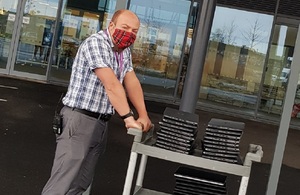
Laptops ready to be distributed to local schools

Laptops ready to be distributed to local schools

Sellafield Ltd has donated a further 156 recycled laptops and computers to schools across West Cumbria this month as part of its ongoing work to support student access to remote learning.

This builds on a donation of almost five hundred devices in December last year as part of a wider collaborative support effort alongside local authorities, suppliers and other agencies.

Emma Graham, a senior buyer within the information services organisation at Sellafield Ltd said:

We worked quickly through the WELL project to determine the immediate need from schools, alongside our supply chain partners at ATOS and Allvotec who worked tirelessly to refurbish as many laptops as we could.

OneFM also kindly supported deliveries this time around to help us move the devices to schools as quickly as possible”.

Emma Williamson, community resilience and social inclusion team leader at Copeland Borough Council, said:

In addition to the Sellafield Ltd laptops, the swift financial support we received from elsewhere has enabled us to provide much needed resources to children and young people, to access remote learning.

The £43,000 awarded by Cumbria County Council, Copeland Community Fund and members of the Sellafield supply chain is a testament to partnership working and demonstrates how pooling our resources can really benefit the local community and have a direct impact on those in need.

Jonathan Sunter, quality of education lead at Solway Community School said:

We still have a number of students completing their distance learning on parent’s mobile phones and we cannot thank Sellafield Ltd enough for all the equipment they have provided us so far”.

Sellafield Ltd is also working with the Warrington Local Enterprise Partnership to coordinate donations in the Warrington area.

Published 22 January 2021


Regulator escalates probe into Birmingham charity for deaf community due to continued concerns

Press release

The Charity Commission has opened a statutory inquiry into One Community Organisation over serious financial and governance concerns

The Charity Commission has opened a statutory inquiry into One Community Organisation over serious financial and governance concerns.

The charity’s purpose is to deliver support to the deaf community and those with special needs, by organising fundraising events to support online lectures and education programmes for these groups.

In April 2020, the Commission opened a compliance case after it identified inconsistencies with the information the trustees had reported to the Commission about the charity. This included, for example, conflicting information about whether or not the charity owned property.

As part of this case, the Commission examined the charity’s finances which led to concerns that the trustees may have understated the charity’s income and expenditure for 2017 and 2018.

The Commission also identified concerns around potential unauthorised trustee payments. The charity’s bank statements showed over £200,000 of charity funds were transferred via online payments to a trustee’s private bank account. The purpose of these payments is not clear.

The Commission therefore escalated its case to a statutory inquiry in December 2020 to examine these matters further.

The scope of the inquiry is to examine concerns around the trustees’ management of the charity’s resources and financial affairs, compliance with their general legal duties and responsibilities, and whether any failings identified are a result of misconduct and/or mismanagement by the trustees. The Commission may extend this scope if further regulatory concerns emerge.

It is the Commission’s policy, after it has concluded an inquiry, to publish a report detailing what issues the inquiry looked at, what actions were undertaken as part of the inquiry and what the outcomes were. Reports of previous inquiries are available on GOV.UK.

Ends.

Notes to editors:

  1. View the charity’s entry on the register of charities.
  2. The opening of an inquiry is not a finding of wrongdoing.
  3. The Charity Commission is the independent, non-ministerial government department that registers and regulates charities in England and Wales. Its purpose is to ensure charity can thrive and inspire trust so that people can improve lives and strengthen society.

Published 22 January 2021


December 2020 Transaction Data

News story

This data provides information about the number and types of applications that HM Land Registry completed in December 2020.

Image credit: NicoElNino/Shutterstock.com

Please note this data shows what HM Land Registry has been able to process during the time period covered and is not necessarily a reflection of market activity.

In December:

  • HM Land Registry completed more than 1,431,690 applications to change or query the Land Register
  • the South East topped the table of regional applications with 337,929

HM Land Registry completed 1,431,694 applications in December compared with 1,710,237 in November and 1,375,682 last December 2019, of which:

  • 272,475 were applications for register updates compared with 271,496 in November
  • 718,867 were applications for an official copy of a register compared with 935,949 in November
  • 221,840 were search and hold queries (official searches) compared with 216,933 in November
  • 14,029 were postal applications from non-account holders compared with 15,850 in November

Applications by region and country

Region/country October applications November applications December applications
South East 422,216 409,245 337,929
Greater London 325,631 314,597 259,272
North West 196,957 191,689 166,638
South West 174,310 170,214 141,011
West Midlands 148,009 143,935 121,054
Yorkshire and the Humber 134,139 135,951 111,242
East Midlands 124,686 122,093 102,151
North 82,547 80,300 67,269
East Anglia 75,586 72,154 61,473
Isles of Scilly 69 43 53
Wales 77,009 69,930 63,541
England and Wales (not assigned) 77 86 61
Total 1,761,236 1,710,237 1,431,694

Top 5 local authority areas

December applications

Top 5 local authority areas December applications
Birmingham 21,069
City of Westminster 17,307
Leeds 17,137
Buckinghamshire 15,282
Cornwall 14,724

November applications

Local authority November applications
Birmingham 24,481
City of Westminster 21,466
Leeds 20,003
Cornwall 17,912
Manchester 16,823

Top 5 customers

December applications

Top 5 customers December applications
Infotrack Limited 80,703
Enact 32,972
TM Group (UK) Ltd (Search Choice) 24,696
Optima Legal Services 19,316
O’Neill Patient 18,654

November applications

Top 5 Customers November applications
Infotrack Limited 97,950
Enact 40,101
TM Group (UK) Ltd (Search Choice) 25,647
O’Neill Patient 23,826
Optima Legal Services 23,808

Access the full dataset

Next publication

Transaction Data is published on the 15th working day of each month. The January data will be published at 11am on Friday 19 February 2021.

Published 22 January 2021


37th Universal Periodic Review: UK statement on Austria

Rita French

The United Kingdom commends Austria’s continued efforts to eliminate discrimination on the grounds of sexual orientation and the steps it has taken since its last UPR to improve equality for same-sex partnerships, including legally recognising same-sex marriage.

The UK welcomes Austria’s positive action in promoting media freedom internationally. We encourage Austria to take further steps to combat all forms of discrimination, including racial bias within law enforcement.

We recommend that Austria:
1. Operationalise domestically the insights arising from its October conference on ‘Human Trafficking in Times of Corona’.

  1. Prioritise developing a strategy against racism, xenophobia, radicalisation and violent extremism, taking into account the views of civil society and underpinned by necessary legislation and budgetary resource.

  2. Adopt an open, merit-based process when selecting national candidates for UN Treaty Body elections.

Thank you.

Published 22 January 2021


Priti Patel publishes new strategy to protect children from sexual abuse

The Home Secretary has today published a first-of-its-kind national strategy to protect children from all forms of child sexual abuse.

The Tackling Child Sexual Abuse Strategy sets out how the Government will use new legislation and enhanced technology to stop offenders in their tracks.

This includes investing in the UK’s world-leading Child Abuse Image Database to identify and catch more offenders quicker – for example, by using new tools to speed up police investigations and protecting officers’ wellbeing by avoiding them being repeatedly exposed to indecent images.

The Home Office will make it easier for parents and carers to ask the police if someone has a criminal record for child sexual offences as the department commits to a review of Sarah’s Law.

These measures are on top of civil orders to stop reoffending and introducing stronger sentencing so that serious violent and sexual offenders remain in prison for longer.

The government will support local areas to improve their response to exploitation with funding for The Children’s Society’s Prevention Programme initiative, and will introduce the ground-breaking Online Safety Bill to ensure that technology companies are held to account for harmful content on their sites, and do not compromise on children’s safety.

The publication comes as new Home Office research estimates that the social and economic cost of the crime over the victims’ lifetimes was at least a staggering £10 billion for the victims who experienced child sexual abuse in the year ending March 2019, with the full emotional cost being immeasurable.

The strategy also aims to improve the data that is available on offenders following the publication of the paper on the characteristics of group-based offending which found that it was difficult to draw conclusions about the ethnicity of offenders as existing research is limited and data collection is poor.

This commitment includes working with local authorities to understand and respond to threats within their communities and collecting higher quality data on offenders so that the government can build a fuller picture on the characteristics of perpetrators and help tackle the abuse that has blighted many towns and cities in England.

Home Secretary Priti Patel said:

Victims and survivors of child sexual abuse have told me how they feel let down by the state. I am determined to put this right.

This first-of-its-kind national Strategy will tackle and respond to all forms of child sexual abuse, relentlessly going after abusers, whilst better protecting victims and survivors.

Crucially, it contains a commitment to collect higher quality data on the characteristics of offenders, so that the government can build a fuller picture of perpetrators, and tackle the abuse that has blighted many towns and cities across our country.

The group-based offending paper demonstrates how difficult it has been to draw conclusions about the characteristics of offenders. That is why the government’s forthcoming Tackling Child Sexual Abuse Strategy will commit to improving our understanding of child sexual abuse – including around ethnicity.

This will enable us to better understand any community and cultural factors relevant to tackling offending – helping us to safeguard children from abuse, deliver justice for victims and survivors, and restore the public’s confidence in the criminal justice system’s ability to confront this issue.

The Strategy drives action across every part of government, across all agencies, all sectors, charities, communities, technology companies and society more widely to stop abusers and place victims and survivors at the centre of the approach.

Rob Jones, NCA Director of Threat Leadership, said:

The NCA welcomes this strategy at a time when the threat to children is more severe than it has ever been. Last year, we released an assessment that there are at least 300,000 people posing a sexual threat to children in the UK.

The NCA in partnership with UK policing will continue to drive the investigation and arrest of offenders. Joint working led to 4,760 arrests and over 6,500 children being safeguarded in just six months. Many offenders feel they can operate with impunity online, but as we have shown we have enhanced our capabilities and remain committed to tracking them down.

These are not just images or videos being viewed online. What we are uncovering here is evidence of the horrific, real-world sexual abuse of children. It’s really important that connection is not lost or diluted.

The government remains at the forefront of international efforts combat CSA, working with partners overseas to strengthen child protection systems in countries where children are particularly at risk, and clamp down in individuals who travel abroad to rape and abuse children.

In addition to the ground-breaking Online Safety Bill that will tackle online harms, the government has also asked GCHQ to work with the tech industry, to identify and develop solutions to crack down on large scale online child sexual abuse.

GCHQ’s Director of Serious and Organised Crime said:

GCHQ will continue to bring its unique cyber and intelligence capabilities to bear alongside its technological expertise as part of this cross-government effort to protect families from these awful crimes.

Our work to tackle systemic internet problems, the insight we provide into offender behaviour and our efforts alongside law enforcement to identify and pursue the worst offenders will help to ensure there is no safe space online for these people to operate.

As part of the publication, the Safeguarding Minister virtually visited the NSPCC on Thursday and spoke to staff in Sheffield and Camden about their Letting the Future In service which uses therapeutic art and play to help children move on from abuse and recover with the support of parents and families.

Safeguarding Minister Victoria Atkins said:

Children across the country and beyond, continue to be subjected to horrific sexual abuse which has a devastating impact on their lives.

The public expects the government to do all it can to prevent child sexual abuse, particularly during this difficult period, and we are delivering on this promise by publishing our Strategy.

The publication demonstrates that, as a government, we are committed to tackling this crime on all fronts and will leave no stone unturned to prevent and pursue offenders, and will protect children and young people.

Susie Hargreaves OBE, Chief Executive of the Internet Watch Foundation, said:

We welcome the government’s focus on tackling child sexual abuse and exploitation, particularly online.

We have seen increases in online child sexual abuse material coinciding with more people spending longer at home on the internet – due in part to the Coronavirus pandemic. In 2020, we removed more criminal videos and images of children than ever before.

It is important that we not only look at the online element of these crimes but the impact that it also has on communities. At the IWF, we are committed to working with the government, industry and the third sector to play our part in removing child sexual abuse material from the internet. We welcome the strategy’s focus on the importance of safeguarding children from sexual abuse whether that be online or offline.