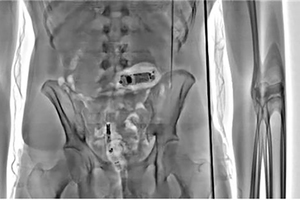
X-ray scanners stop over 1,000 illegal items entering prisons
Press release
Advanced X-ray body scanners have stopped over 1,376 illegal items, including drugs, weapons and phones, getting into prisons, just 4 months after being installed.
game-changing X-ray technology finds over 1,000 illegal items within months of being installed
28 prisons across England and Wales now have the technology to bolster defences against drugs and mobile phones
part of the government’s £100 million package to tackle violence and boost security
The innovative equipment being rolled out across England and Wales is part of the government’s bold £100 million package to boost security in prisons and crack down on crime behind bars.
The 28 scanners, developed specifically for the Prison Service, allow staff to see instantly whether prisoners are smuggling in illegal contraband items internally, and have picked up Spice, morphine tablets, mobile phones, SIM cards, phone chargers and tobacco. The illegal items would have been destined for the prison wings, fuelling the illicit economy and potential violence.
Prisons and Probation Minister, Lucy Frazer QC MP said:
Stopping the flow of illegal items into jails is a huge priority for us.
The scanners form part of our wider plan to step up security in prisons to cut crime and better protect the public.
HMP Hindley Governor, Natalie McKee, said:
We are confident this equipment will prove to be a successful deterrent to anyone wanting to smuggle illegal items into our establishment.
The X-ray body scanner supports our aim to provide a safe environment for our prison officers and the men in our prisons.
The cutting-edge technology is being installed at jails with high numbers of remand prisoners – posing the greatest risk of smuggling.
A further 24 scanners are due to be installed in prisons by March 2021.
The equipment is being funded by the government’s £2.75 billion commitment to transform the prison estate. This includes:
£100 million to bolster prison security, clamping down on the weapons, drugs and mobile phones that fuel violence, self-harm and crime behind bars
£2.5 billion to provide 10,000 additional prison places and create modern, efficient jails that rehabilitate offenders, reduce reoffending and keep the public safe
£156 million to tackle the most pressing maintenance issues to create safe and decent conditions for offender rehabilitation.
Published 25 January 2021
New carbon efficient accommodation marks start of nationwide improvements on the Defence Training Estate
The programme is being part-funded using money from a £200-million investment to improve armed forces accommodation, which was announced by the Defence Secretary last summer.
The MOD is investing more than £35-million of this funding, in addition to funding from the British Army, into its nationwide programme, which aims to improve facilities for troops when they are training away from their permanent barracks.
38 new carbon efficient accommodation blocks, providing more than 1,700 bed spaces, will be installed across the UK Defence Training Estate by the Defence Infrastructure Organisation (DIO), working with industry partner Landmarc Support Services and its contractor Reds10. The remainder of the £200-million investment is being spent on Service Family Accommodation and training accommodation at Longmoor Training Camp, and improvements to Single Living Accommodation in Army barracks, RAF bases and Naval establishments.
Westdown Camp on Salisbury Plain was the first to receive the new accommodation. The modern facility has an A-rated Energy Performance Certificate (EPC), just 12 points from achieving net zero, thanks to air source pumps and rooftop solar panels. This prototype was further improved on for three new accommodation blocks at the second site, Nesscliff Training Area in Shropshire, which have an EPC rating of -5. This means the buildings generate power for the site, reducing electricity costs.
The buildings range in size as required, typically providing up to 46 bed-spaces each, which can be subdivided as needed. This innovative design means that different military units, whether trained soldiers or cadets, male or female, can be accommodated within the block together. Showers, ablutions and drying rooms are also part of the complex, improving the overall experience for personnel by removing the need for troops to move to different buildings.
An aerial view of the three new buildings at Nesscliff Training Area. Copyright Reds10.
All accommodation is being designed and constructed offsite by modular building specialists Reds10 before being transported to site for assembly and installation.
The manufacture and installation of the single block at Westdown Camp took just 15 weeks. The team was then able to take what it had learned and reduce this to 13 weeks for three buildings at Nesscliff. Installation on site takes about a month, minimising disruption for training troops compared to traditional construction. Labour was locally sourced at each site, helping to reduce the carbon footprint and boost local economies by providing 400 jobs across the programme, 150 of which were new.
Another benefit of modular construction is that it allows the same design to be used for later blocks with improvements and alterations put in place as necessary. The buildings are also equipped with SMART building technology, which optimises energy use and provides data for improvements in the design and specification of subsequent modular constructions in the programme. Lessons identified following the installation of the Westdown Camp block have not only meant that Reds10 delivered the Nesscliff buildings as net zero, but also allowed for 30% reduction of embodied carbon compared to Westdown Camp.
Brigadier Jonathan Bartholomew, DIO’s Head of the Overseas and Training Region said:
DIO supports our UK Armed Forces by providing what they need to live, work and train. Working closely with our industry partner, Landmarc, and Reds10 we are proud to have delivered the first new accommodation blocks on time and during the current climate. These new buildings are modern, flexible and efficient and will support troops on exercise, providing them with the high-quality accommodation that they expect and deserve.
Mark Neill, Managing Director at Landmarc, said:
The welfare of the troops that use the estate is our top priority and the accommodation facilities are a key contributor in delivering the best possible training experience.
We are therefore delighted to work with DIO and Reds10 to deliver a programme that will not only support the government’s commitment to improving living accommodation for our armed forces but will also provide a highly energy efficient solution that will help DIO meet its long-term carbon reduction commitments.
Paul Ruddick, CEO of Reds10 said:
Our brief was to deliver the lowest carbon usage possible. Air source heat pumps, which take supplementary electrical power from solar PV panels installed on the roof, generate the accommodation’s complete heating and hot water requirements.
We installed SMART technology in the building at Westdown Camp, which provides detailed information on how that building is being used, its hot water and heating demand and occupancy rates. This has enabled the team to monitor the energy demands of the building and feedback directly into subsequent building design and specifications, allowing us to deliver the buildings at Nesscliff as the first net zero buildings of the programme.
We are proud to be able to continually push our modular construction methods to deliver these sorts of results throughout the programme.
The programme will continue into 2021 and early 2022 with the installation of more carbon efficient accommodation blocks on other training sites, some of which will be larger. These sites include Knook Camp on Salisbury Plain, Brunswick Camp in Hampshire, Castlemartin in Pembrokeshire, Warcop in Cumbria and West Tofts and Wretham in Norfolk.
Kickstart moves up a gear with over 120,000 jobs created so far and government making it even simpler for employers to join
The scheme, which has been underway since September, is helping to put young people who have been some of the hardest hit by the economic impact of the pandemic on the first rung of their career ladder. The start dates for these jobs vary but will all begin this year.
The government will make it even simpler for employers of all sizes to benefit from joining the scheme by removing the limit requiring they create a minimum of 30 vacancies to apply directly. To ensure all job placements continue to be of a high quality, the government will continue to apply rigorous checks on training support and finances.
Secretary of State for Work and Pensions Thérèse Coffey said:
Kickstart has moved up a gear and I encourage employers to join us and invest in the next generation of talent by joining our Kickstart scheme.
By removing the threshold of a minimum 30 jobs for direct applications, we are making it even simpler to get involved.
Now is the time to prepare for post-lockdown placements and employers will now have a choice to apply direct or through one of our 600 fantastic Kickstart gateways who may be locally connected or sector-specific providing that tailored support.
Chancellor Rishi Sunak said:
Young people are among the hardest hit in times like these, which is why we’re doing everything we can to ensure they’re not left without hope and opportunity.
The Kickstart Scheme is central to this. Since opening for applications last Autumn, we’ve worked with some of the most exciting companies to create more than 120,000 Kickstart jobs – which is a huge vote of confidence in our young people at a challenging time.
With £2 billion available and no limit on the number of places, it’s now easier than ever for businesses across Great Britain to take part. Join us as we harness the talents of the new generation of kickstarters.
For those employers who want support to get involved with the scheme – they can continue to partner with one of our many gateway organisations such as a Local Authority or Chamber of Commerce. Gateways can help provide a local connection and the necessary wrap around support which is a hallmark of the Kickstart Scheme. DWP welcomes existing gateways continuing to apply to add more jobs and employers over the life of the scheme.
Since applications opened in September, there are now more than 600 approved gateways covering many sectors and all parts of the country.
Referrals to the Kickstart Scheme will run until December 2021 and is expected to create hundreds of thousands of new job placements.
From 3 February 2021, employers will be able to apply to the Kickstart Scheme without a minimum threshold of 30 jobs.
With so many gateways already approved, we are closing applications for new gateways this week – but businesses that wish to sign up with the support of an existing gateway will still be able to do so.
If we identify any emerging gaps where employers need more support, we may invite further applications.
Media enquiries for this press release – 020 3267 5144
Follow DWP on:
Edition 24: News from the Adjudicator
Help us improve GOV.UK
To help us improve GOV.UK, we’d like to know more about your visit today. We’ll send you a link to a feedback form. It will take only 2 minutes to fill in. Don’t worry we won’t send you spam or share your email address with anyone.
New Global Coalition launched to address impacts of Climate Change
Prime Minister Boris Johnson is set to announce a new international coalition to tackle the impacts of climate change.
In a virtual address to the Netherlands-hosted Climate Adaptation Summit, the first ever global summit focused solely on adaptation and resilience, the Prime Minister will launch the Adaptation Action Coalition.
Developed by the UK in partnership with Egypt, Bangladesh, Malawi, the Netherlands, Saint Lucia and the United Nations, this new Coalition will work to turn international political commitments made through the United Nations Call for Action on Adaptation and Resilience into on-the-ground support for vulnerable communities.
Many countries across the world are already experiencing the impacts of climate change, from forest fires in Australia to the recent cyclones in Mozambique. Without action, many more will experience significant disruption and extreme weather, devastating communities and livelihoods.
With support, countries and communities can adapt and build resilience to the impacts of climate change. Measures like early warning systems for storms, investing in flood drainage and drought resistant crops are cost-effective, saving not just money, but lives and livelihoods.
In the UK for example, where we are experiencing more high rainfall events as a result of climate change, the Government has committed an additional £5.2 billion to new flood and coastal defence schemes.
Prime Minister Boris Johnson is expected to say at the Adaptation Summit:
It is undeniable that climate change is already upon us and is already devastating lives and economies. We must adapt to our changing climate, and we must do so now.
I’ll be making the need for a resilient recovery a priority of the UK’s G7 presidency this year. To make sure we get not just warm words but real change, I am today launching an all-new Adaptation Action Coalition to set the agenda ahead of COP26.
Let’s work together to adapt, to become more resilient, and to save lives and livelihoods all around the world.
COP26 President-Designate Alok Sharma said:
We know that the most vulnerable are at the greatest risk from climate change, and that they have done the least to cause it. Action to address this and build resilience is needed now, before more people lose lives or livelihoods.
I am calling on all countries to come forward with ambitious adaptation plans. This important new coalition will crucially focus minds around the world to accelerate adaptation delivery in the areas most in need.
UK Commissioner to the Global Commission on Adaptation Emma Howard Boyd said:
Last week, flood defences protected tens of thousands of people in England from record river levels during Storm Christoph. Investments in flood protections help economic development and also improve health and wellbeing by enhancing green and blue spaces.
The Environment Agency, government and local partners have a lot of expertise to share with the world, and we also have a lot to learn. International collaboration, as championed by this coalition, is vital.
The Coalition will draw on the expertise of scientists, businesses, civil society and more, and will act as a forum for developed and developing countries to share knowledge and best practice on local, regional and global solutions to deal with climate change.
The UN High-Level Climate Champions’ Race To Resilience campaign and new Dutch-led Adaptation Action Agenda will help inform the Coalition to host a series of sector specific events, bringing together governments, private sector, communities and funders to deliver action to safeguard people and economies from the impacts of climate change.
The UK is already taking action both at home and internationally to improve resilience to climate change, becoming one of the first countries in the world to fulfil a key commitment of the Paris Agreement by publishing its Adaptation Communication at the end of last year.
Notes to editors
The Adaptation Action Coalition takes forward the 2019 Call for Action on Adaptation and Resilience from the United Nations Climate Action Summit, committing countries to act now on adaptation, integrate climate risk into all decision making, and increase the availability of adaptation financing. It has now been signed by over 120 countries, the European Union, and 86 organisations, including a number of UN agencies.
The Climate Adaptation Summit brings together institutions, government leaders, mayors, private sector, civil society and youth movements, to drive forward the critical changes needed for societies to manage the effects of our climate emergency. It will deliver enhanced ambition, accelerated actions and tangible solutions to the challenges of a world that is heating up, demonstrating how a climate-resilient future can and must be achieved.
UK Prime Minister Boris Johnson appointed Anne-Marie Trevelyan MP as the UK’s International Champion on Adaptation and Resilience for the COP26 Presidency in November 2020 to drive forward global ambition and action to support countries on the frontline of climate change to adapt to its impacts and build resilience. In her role, she regularly engages with the governments of the countries most affected by climate change and works to drive support from the international community and private sector.