Innovative scheme to protect newts and promote sustainable development is rolled out across Lancashire

Great crested newts have seen dramatic declines in their populations over the last 60 years despite being legally protected. The new ‘District Level Licensing’ scheme (DLL) better protects this orange-bellied amphibian by using conservation payments from developers to create new ponds in locations that will benefit the species.

The scheme also benefits local people and authorities by avoiding costly delays for developers, helping to ensure homes are built and local authorities can deliver their plans.

The scheme will create a network of ponds providing vital habitat for our biggest native newt, helping to join up sometimes isolated populations and helping them to thrive.

Natural England, in partnership with Lancashire Wildlife Trust, will invest developer payments not only into creating or restoring new ponds but also taking care of and monitoring the ponds too, for the long term.

Previously, developers had to apply for a mitigation licence before building on or around the places where newts live. Seasonal restrictions on work in places where the newts were present led to delays and uncertainty over the costs and scheduling of planned development. This new ‘landscape scale’ licensing approach is better for both developers and newts. It provides a faster and more straightforward process than the traditional approach to licensing while helping to provide more homes for newts.

By the end of March this year, Lancashire Wildlife Trust will already have created or restored nearly 60 ponds across the county for the scheme.

John Lamb, Senior Conservation Officer, Lancashire Wildlife Trust said:

I am really encouraged by landowner enthusiasm to create new ponds for the scheme. Everyone recognises that the ponds will benefit a wide range of wildlife and Trust staff are looking forward to continuing this important work so that hotspots of newts can expand and populations can merge and flourish.

Marcus Hudson, Head of Planning, Lancashire County Council, said:

Lancashire is home to beautiful landscapes and habitats, a desirable place to live and work, and a hub for business and industry. We need to find ways to support growth whilst protecting and enhancing our climate and environment. District level licensing offers an opportunity to reduce costly delays to developments, whilst targeting spending on practical conservation measures, such as pond creation, in the locations identified as having the maximum impact to bolster the resilience of Lancashire’s great crested newt populations.

Ginny Hinton, Natural England Cheshire to Lancashire Area Team Manager, said:

District level licensing is transforming a difficult planning process into one that is a real conservation success story.

The rollout of this scheme in Lancashire represents a win-win for both local developers and the future of this iconic species. It’s a fantastic example of working in partnership at a landscape scale.

More about district level licensing in Lancashire

  • Details of how to apply for the scheme are online at this link: https://www.gov.uk/government/publications/great-crested-newts-district-level-licensing-schemes
  • Lancashire is the latest area to launch a district level licensing scheme. Natural England is working to expand the initiative to 150 local authorities across the country, as part of a programme initially funded by the Ministry of Housing, Communities and Local Government
  • This new licensing approach to authorising development affected by great crested newts is part of a larger programme to reform protected species licensing by focusing conservation effort where it will create maximum benefit. It aims to leave the environment in a better state than before.
  • Previously, licences were only granted on a site-by-site basis. This missed opportunities to manage populations of great crested newts on a landscape scale and resulted in habitat for newts being squeezed around development, sometimes in disconnected patches.
  • As part of the District Level Licensing project, Natural England has completed the largest ever survey of its type for great crested newts across England, funded by the MHCLG. The data is open and has been published to ArcGIS Online and is available at Data.gov.uk.
  • Individual site-by-site mitigation licences are still available; since 17 February 2020, there is now a charge for these licences. In areas where there is a DLL scheme, joining a scheme will be the quickest option to enable development that affects great crested newts.


Police bolstered with 6,620 extra officers and extra funding

The government is bolstering the police with extra officers and resources to cut crime and keep communities safe, as new statistics show that an additional 6,620 officers have joined forces across England and Wales.

The figures published today (Thursday 28 January), which show progress from the launch of the campaign up to the end of December, mean that the government’s campaign to recruit 20,000 additional officers over the next three years remains ahead of schedule, having exceeded the target to recruit 6,000 officers by March.

Of the new recruits, many will already be out supporting the ongoing police response to the pandemic, helping to stop the spread of coronavirus by assisting with enforcement action against those flouting the rules.

The recruitment drive is at the centre of the government’s promise to back the police with more resources and support to cut crime, and today the Home Secretary has also announced an additional £20 million to help crack down on ‘neighbourhood crimes’ like burglary, robbery, theft and vehicle crime.

This funding forms the second round of the Safer Streets fund, which launched in January last year. It will be open to both Police and Crime Commissioners and Local Authorities and go towards local-crime cutting interventions in residential areas.

This includes simple changes to the design of high-crime areas, such as improved home security, increased street lighting and the installation of CCTV.

The announcement will bring total investment in Safer Streets to £45m over two years, supporting even more areas that are disproportionately affected by neighbourhood crime with the tools to deliver tangible and sustainable impacts.

Home Secretary Priti Patel said:

I am delighted we have exceeded our own target to recruit 6,000 additional police officers by March 2021.

Keeping our streets is my absolute priority and many of these new officers are already on our streets helping to fight the coronavirus pandemic, and for that they get my huge thanks.

These new officers, on top of further funding to tackle crimes such as burglary, robbery and vehicle crime will ensure the police have the powers, tools and resources they need to cut crime and make you feel safer in your community.

National Police Chiefs’ Council Chair Martin Hewitt:

These additional officers are most welcomed and have already started to make their difference in our communities.

We are more representative than ever before but still have a long way to go before we truly represent those we serve.

I would like to thank those who have worked with us to achieve this number of 6,620 additional officers, in particular policing networks and associations.

Bernie O’Reilly, interim CEO of the College of Policing:

Today’s recruitment figures demonstrate, once again, policing’s ability to adapt to challenges and continue to bring new officers into the service in difficult circumstances.

We must continue to build on this progress to ensure we have a strong, diverse and well-supported police force that helps keep the public safe for years to come.

I’m pleased that we are able to support forces through our online assessment process, which allows the police service to continue to recruit new officers during this critical time, and also through the updated Safer Streets Fund toolkit, which supports policing to implement crime prevention initiatives.

Today the Home Secretary will visit Hertfordshire Police to meet with new recruits and hear about their work responding to the pandemic.

The Policing Minister will also be hosting a Zoom call with new officers and others from Nottinghamshire Police, to hear about the work the force is doing within the Safer Streets project, as well as supporting the coronavirus response.

Figures today also show that diversity within the police workforce continues to grow.

Of all new recruits, 788 identified as Black, Asian and Minority Ethnic, representing 10.2% of recruits who stated their ethnicity. This means the police workforce now includes 9,871 officers from these groups, making it more diverse than ever before.

Also released today are figures for the entire police workforce across England and Wales. These figures show that as at 30 September 2020, the workforce had 216,155 (FTE) officers, staff and PCSOs – a total increase of 5.5% on the previous year.

Anyone interested in applying to their local force can search ‘Join the Police’ to find out more.

Force name/region Adjusted baseline Allocation Uplift progress
      Dec 20
Cleveland 1,246 72 +159
Durham 1,138 68 +58
Northumbria 3,129 185 +266
North East 5,513 325 +483
Cheshire 2,080 90 +91
Cumbria 1,199 51 +66
Greater Manchester 6,787 347 +266
Lancashire 2,988 153 +133
Merseyside 3,447 200 +372
North West 16,501 841 +928
Humberside 1,929 97 +129
North Yorkshire 1,450 58 +61
South Yorkshire 2,535 151 +129
West Yorkshire 5,186 256 +390
Yorkshire and the Humber 11,100 562 +709
Derbyshire 1,827 85 +67
Leicestershire 1,998 89 +155
Lincolnshire 1,020 50 +81
Northamptonshire 1,290 57 +57
Nottinghamshire 2,021 107 +132
East Midlands 8,156 388 +492
Staffordshire 1,648 90 +72
Warwickshire 963 41 +91
West Mercia 2,164 93 +93
West Midlands 6,691 366 +357
West Midlands 11,466 590 +613
Bedfordshire 1,257 54 +54
Cambridgeshire 1,526 62 +114
Essex 3,316 135 +101
Hertfordshire 2,077 91 +111
Norfolk 1,677 67 +70
Suffolk 1,224 54 +54
Eastern 11,077 463 +504
London, city of 809 44 +42
Metropolitan Police 31,943 1,369 +1,369
London 32,752 1,413 +1,411
Hampshire 2,791 156 +220
Kent 3,729 147 +162
Surrey 1,994 78 +78
Sussex 2,737 129 +129
Thames Valley 4,250 183 +258
South East 15,501 693 +847
Avon and Somerset 2,835 137 +128
Devon and Cornwall 3,115 141 +141
Dorset 1,267 50 +19
Gloucestershire 1,161 46 +91
Wiltshire 1,025 49 +27
South West 9,403 423 +406
England 121,469 5,698 6,393
Dyfed-Powys 1,163 42 +27
Gwent 1,300 62 +27
North Wales 1,507 62 +78
South Wales 2,995 136 +95
Wales 6,965 302 +227
England and Wales 128,434 6,000 +6,620


A1077 to be temporarily closed for South Ferriby flood defence work

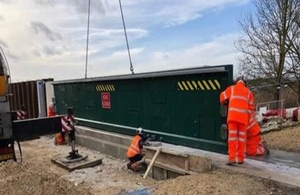
Image shows large steel section being lowered into place, surrounded by workers dressed in reflective jackets and trousers

Construction of flood defences in South Ferriby will see A1077 closed for 7 days

As part of the Environment Agency’s £12m flood defence works in South Ferriby, the A1077 will be closed for 7 days from 13 February 2021.

This will allow the Environment Agency to install a flood gate, which will reduce flood risk to the village. Traffic from Barton-upon-Humber to Winteringham and villages west of Winteringham will need to follow the diversion route via the A15, A18 and via Scunthorpe.

Travellers are advised to plan ahead to help minimise disruption to their journeys during the week.

Construction work for the scheme started in May 2019 and most of the new defences are in place. The final sections of the project around Ancholme Sluice and the installation of the flood gate are now underway.

Aminu Adamu, Project Manager for the Environment Agency, said:

As we reach an important milestone in this project we will need to close the A1077 for a short time.

We have worked closely with our contractor, South Ferriby Parish Council and North Lincolnshire Council to reduce the road closure from the initial period of 30 weeks. Due to the innovative design, we are pleased to announce that the A1077 will only be closed for around 7 days, commencing 13 February which will coincide with the half-term school holiday.

During this time a temporary shuttle bus service, serving Winteringham, Winterton to Scunthorpe and South Ferriby to Barton, is planned to maintain public transport links.

The project is scheduled to reach a major milestone in March 2021 as the defence is brought up to its full height. Works will continue until June 2021 to restore the areas affected to their previous states.

The project has received funding from a number of government sources, with CEMEX UK contributing all of the clay required to construct new flood banks.

Sara Haddon, Chair South Ferriby Parish Council Flood Protection Committee, said:

We are sorry about the disruption caused by this road closure, but it marks an important stage in the construction of the new flood defences. We are looking forward to later this year when the work is complete and residents will be able to face next winter knowing that the likelihood of flooding is much reduced.

For more details of the road closures please visit: www.southferribyparishcouncil.gov.uk.

Published 28 January 2021
Last updated 18 February 2021 + show all updates

  1. Existing photograph replaced with a new one

  2. First published.


Oliver Dowden speech to RESET 2021

Welcome to RESET, and thank you for inviting me to join you at the very first conference of this kind.

It’s great to see the sector coming together in this way to talk about how we can rebuild and recover from coronavirus.

But before we get into COVID, I’d just like to pay tribute to the industry as it was before this terrible pandemic shook the world – and how it will be, I am confident again once this crisis is over.

The advertising industry is really one of our creative giants.

It contributed £17 billion to our economy in 2019, employing more than 190,000 people across the country. It’s a vital cornerstone of our wider, world-leading creative culture – supporting the artists who transition to film and TV, and all the lighting technicians, make-up artists and other people who make up our creative army.

That’s the economic bottom line.

But then of course there’s the artistry of the sector – which I think is something too many people tend to overlook.

Just like the James Bond film or Sally Rooney novel, things like the John Lewis Christmas ads are now cultural events in their own right. Across the Atlantic, the commercial breaks for the Super Bowl are a reflection of the state of the nation, and of the values of American society at that moment in time.

We look to art for a commentary on history, and on our collective values and experiences and today, ads do just that.

I also think too many people forget the raw power of the sector in terms of the impact it has on every part of our lives.

A well-crafted advert or campaign can influence the way we look. What we eat and drink. How we vote, and the way we behave during a global pandemic.

Never have people been more interested in the power of messaging to change people’s behaviour – and never has that task been more urgent – than in the past year.

A few simple phrases – for example “Stay home. Protect the NHS. Save Lives” – may have been the difference that protected thousands of people from coronavirus.

So can I express my gratitude on behalf of the government for the way the industry has teamed up with us to promote our public health messaging during coronavirus, and for all the advertising space it has given over to us for free, even as you are struggling as the sector itself comes under incredible strain from COVID.

Of course I know that ad spend fell by more than 14% as a result of COVID – though I’m glad to see that during this latest phase it is now holding up better than before.

Yet even with this turbulence, in 2020, the advertising industry harnessed its immense power and directed it against coronavirus for the national good.

While we’re on the theme of COVID, I’d like to briefly address an issue I know is of significant interest to the sector.

COVID has been a stark reminder of course to us all of the importance of physical health – and one of our most urgent tasks as a government is reducing obesity and getting the nation strong and fit for the future.

I know that this is a major priority for the Prime Minister, who is on his own personal health mission. And in turn it’s his priority for the entire country.

A central part of this is making sure the information and media children are exposed to – and that includes adverts – promotes a healthy, balanced diet.

With that in mind, we have announced our intention to ban adverts for products that are high in fat, sugar and salt being shown on TV before 9pm. We are also committed to addressing this online, crucially in parallel with broadcast, and are currently considering the introduction of a total HFSS advertising restriction on the internet.

This decision was taken against the specific and, as I hope you’ll appreciate, exceptional backdrop of a health emergency. I believe it’s the right one, given all that COVID has taught us.

However, I do genuinely appreciate it will have a really significant impact at what is already a very difficult time for the sector.

I understand those concerns, and I will continue to listen to the industry to make sure we get this right, and enable the shift to advertising healthier products.

And I will fight your corner in the coming months and years, making sure you have a strong and clear voice in government.

Of course, if COVID wasn’t enough, the industry is also having to grapple with some deep structural changes that were brewing long before the pandemic.

The internet has been a huge force for good in our lives, but it has also disrupted almost every single sector – and of course advertising is no exception to that.

Online advertising now accounts for over half of all UK advertising spend, with companies increasingly shifting away from more traditional forms, like newspapers and television.

The rise of online advertising has brought huge benefits, particularly for smaller companies. It has made things cheaper, and more direct – enabling advertisers to target their messages straight onto the Facebook page or browsers of the people they most want to reach.

But it has also brought a number of challenges. There are growing concerns about brand safety, about transparency and accountability; around content standards, and harm.

Most of all, the rise of online advertising has created a fundamental imbalance: between publishers, advertisers and the online platforms upon which they increasingly rely.

It’s time to even the playing field.

At the end of last year, we announced that we are establishing a new, pro-competition regime for digital markets as part of that strategy.

I am unashamedly pro-tech, and am proud as Digital Secretary to help oversee one of the strongest tech sectors, not only in Europe but in the world.

But we want to make sure big tech cannot exploit its dominance to crowd out competition and innovation, and expose people to unfair or exploitative practices – with businesses and consumers in turn paying the price.

So we are establishing a Digital Markets Unit, housed in the Competition and Markets Authority, to enforce a new code of conduct for tech giants.

And we are going to tackle the devastating knock-on effects that anti-competitive practices have had on our newspaper industry, which were outlined in the Cairncross Review.

However, given the speed and scale of all this change, now is a good time to step back and consider the impact of online advertising much more generally.

I want to see advertising that is fair, accountable and ethical. That is why, last year, as part of the Online Advertising Programme, we opened a call for evidence asking for views on the extent to which consumers are exposed to harmful or misleading advertising online, and whether the scale and speed of online transactions is creating challenges for the existing regulatory system.

We are considering responses to this call for evidence and will follow up, I can assure you, later this year.

Thankfully though, the industry has been incredibly proactive at recognising and addressing many of these challenges off your own back – an effort that began back in the 60s, when the introduction of the Advertising Standards Authority set a gold standard for the rest of the world to follow. Great progress is being made across a range of initiatives, such as the work through Project Origin to deliver more transparent measurement of advertising online. And I’ll be watching with particular interest the progress the ASA is making on its “More Impact Online” strategy – including its work to introduce a set of new Online Gatekeeper Standards. This is a central task in ensuring all online players are bound into the regulation of advertising, and in finding a sufficient and reliable funding solution. Given this is a key area where progress is long overdue, my department is willing to consider other ways of solving this problem as part of our upcoming work, should this and other voluntary approaches fail. With that in mind, it’s a good moment to use my final remarks to call on every player in the online advertising market – many of whom I know are represented here today – to work with the ASA to ensure the industry is fit for the digital age. That task is just one of many challenges facing advertising today – which now includes the unprecedented backdrop of a global health pandemic.

I know its going to be a long road back, but I also see the glimmer of a real opportunity here.

In the coming months, if the vaccine rollout maintains its current pace, the government will be able to start reopening the economy. With any luck, the Euro 2020 and the Tokyo Olympics will finally make it onto our screens – complete with the usual carnival of colourful adverts from world-famous brands like Adidas and Nike.

And we will be getting ready to launch our own huge tourism campaign, to broadcast to the rest of the world that Britain is back open for business. This crescendo will build all the way to the showstopper events of 2022 to which I’m looking forward enormously – the Platinum Jubilee, the Commonwealth Games, Festival UK 2022 – all of which represent huge opportunities for the industry.

As we regroup and begin to recover, advertising will be there every step of the way – heralding the return of all the things that make life worth living and for which we’re all yearning.

And it will also be absolutely pivotal in rebuilding our economy back to full strength. A strong market economy needs advertisers, and your immense creativity, to help consumers make choices.

You, almost more than any other sector, can turbocharge our recovery.

And the government will be here to support you through that post-COVID transition – making sure you have an environment in which you can thrive during the coming months and years.

It’s one of the reasons we felt it was so important to secure work permit exemptions for advertising and other industries in our deal with the EU – and why we extended essential support packages like the furlough scheme through to the end of April.

Most of all, though, this pandemic represents a genuine opportunity to stop, and to take a moment to think about how we can do things differently.

To reset, as this conference asks us to, and build back better.

As we exit this pandemic, we have the chance to leave a stronger, more equitable, more resilient advertising sector in its wake. I look forward to building it with you.

Thank you.


New standard tenancy agreement to help renters with well behaved pets

  • New standard tenancy agreement makes it easier for tenants with pets to find rented accommodation
  • Landlords no longer able to issue a blanket ban on pets
  • Just 7% of private landlords currently advertise pet friendly properties

Responsible tenants with well-behaved pets will be able to secure leases more easily through the new Model Tenancy Agreement announced by the government today (28 January 2021).

Under the new Model Tenancy Agreement, announced by Housing Minister Rt Hon Christopher Pincher MP, landlords will no longer be able to issue blanket bans on pets.

Instead, consent for pets will be the default position, and landlords will have to object in writing within 28 days of a written pet request from a tenant and provide a good reason.

Currently, just 7% of private landlords advertise pet friendly properties, meaning many people struggle to find suitable homes. In some cases, this has meant people have had to give up their pets all together.

The Model Tenancy Agreement is the government’s recommended contract for landlords. With figures showing that more than half of adults in the United Kingdom own a pet and many more welcoming pets into their lives during the pandemic, these changes mean more landlords will cater for responsible pet owners.

Under the new agreement, rejections should only be made where there is good reason, such as in smaller properties or flats where owning a pet could be impractical. To ensure landlords are protected, tenants will continue to have a legal duty to repair or cover the cost of any damage to the property.

Housing Minister Rt Hon Christopher Pincher MP said:

We are a nation of animal lovers and over the last year more people than ever before have welcome pets into their lives and homes.

But it can’t be right that only a tiny fraction of landlords advertise pet friendly properties and in some cases people have had to give up their beloved pets in order to find somewhere to live.

Through the changes to the tenancy agreement we are making today, we are bringing an end to the unfair blanket ban on pets introduced by some landlords. This strikes the right balance between helping more people find a home that’s right for them and their pet while ensuring landlords’ properties are safeguarded against inappropriate or badly behaved pets.

Figures on pet ownership taken from The People’s Dispensary for Sick Animals (PDSA), February 2020

The Model Tenancy Agreement is intended for use in England