Billion pound devolution deal for West Yorkshire signed into law

In another major boost for the Northern Powerhouse, Minister for Regional Growth and Local Government Luke Hall today (29 January 2021) signed an Order bringing into law a historic devolution deal for West Yorkshire.

In a significant moment for local government in the region, the deal will pave the way for the creation of a new mayor and Mayoral Combined Authority.

The region will now elect its first ever mayor who will oversee an annual £38 million budget, new powers over transport, education and housing and regeneration, as well as control of the Adult Education Budget. In total, this means that the Mayoral Combined Authority will have access to over £1.1 billion to invest into the region. The Mayor of West Yorkshire will also become the region’s Police and Crime Commissioner.

This marks a significant milestone in the government’s devolution agenda, underlining its commitment to devolve money, resources and control away from Westminster.

Minister for Regional Growth and Local Government Luke Hall MP said:

Today represents a historic moment for West Yorkshire as we deliver a deal giving significant new powers and over a billion pounds of new funding to the region.

It will deliver real benefits to Bradford, Calderdale, Kirklees, Leeds and Wakefield, putting decision-making in the hands of these communities, driving the regional economy and creating new jobs for local people.

Getting this deal over the line is an important milestone in our ambitious levelling up agenda, moving power away from Whitehall empowering our regions to build back better.

Northern Powerhouse Minister Grant Shapps MP said:

We are investing billions to level up the North and build a strong and dynamic Northern Powerhouse. That must be backed by providing local leaders with the powers and means to make decisions.

I look forward to working with the first Mayor of West Yorkshire, both directly and through the Northern Transport Acceleration Council, to deliver the infrastructure upgrades communities want and deserve as quickly as possible.

Further information

Following the signing, the Order will come into force tomorrow (30 January).

The first Mayoral election is scheduled for 6 May 2021.

The first £38 million annual payment will be made later this year, the annual Adult Education Budget will be devolved from the start of the 2021/22 academic year and Police and Crime Commissioner functions will be transferred to the West Yorkshire Combined Authority for exercise by the newly elected Mayor.

This is on top of further investment including: – £317 million from the Transforming Cities Fund – £101 million government funding for West Yorkshire flood risk management schemes – £25 million Heritage Fund – £3.2 million to support the development of housing sites across West Yorkshire – Up to £500,000 for the Bradford Station Masterplan and funding for the Outline Business Case for Leeds station redevelopment – £75,000 for a West Yorkshire Local Digital Skills Partnership

Details of the West Yorkshire deal

Policing

West Yorkshire is only the third region, after Greater Manchester and London, whose Mayor will become the region’s Police and Crime Commissioner. The Mayor will be the public’s voice on policing matters, set the police budget and will also be responsible for decisions around police property, rights and liabilities.

Education

West Yorkshire Mayoral Combined Authority (WYCA) will take on many education functions for their area. They will establish targeted adult education provisions and manage their devolved adult education budget from 2021/22, helping boost economic growth.

Regeneration and housing

The deal provides significant powers to the Mayor and Combined Authority to improve the supply and quality of housing and facilitate the regeneration of West Yorkshire. Working closely with Homes England, the region will be able promote housing and regeneration through new powers including on land acquisition and disposal.

The deal also gives the Mayor the power to designate mayoral development areas. This is the first step in establishing a Mayoral Development Corporation in the WYCA area.

Transport

The Mayor will have control over the region’s transport budget, with the power to pay grants to the five constituent councils (Bradford, Calderdale, Kirklees, Leeds and Wakefield) to improve and maintain roads. The Mayor will also be able to pay grants to bus service operators for eligible bus services operating within the region.


SLC statement in response to CMA statement of 29 January 2021

News story

SLC welcomes the CMA’s actions following allegations that some DSA suppliers have colluded over the price of key services and equipment.

The Student Loans Company welcomes the Competition and Markets Authority’s (CMA) action in sending advisory letters to a number of businesses involved in the supply of goods and services funded by Disabled Students Allowances (DSAs), on the basis of allegations that some suppliers colluded over the price of key services and equipment.

The concerns expressed by the CMA further reinforce the importance of the work we have underway to reform the provision of DSA to both enhance the customer experience and improve value for money for the taxpayer. The Department for Education (DfE) and SLC have already embarked on a programme of significant reforms, designed to transform the customer experience, improve the provision of DSA and to make the overall processes more efficient. These reforms will also increase transparency of pricing and increase competition thus limiting the potential for any anti-competitive behaviour. SLC has already procured an e-quotation system, which will allow more suppliers to quote for work and will increase transparency of pricing and competition.

SLC is also finalising the design of a new procurement to centrally contract the supply of certain goods and services funded by DSA, which aims to both improve the customer experience for students in receipt of DSA and, in introducing robust contractual arrangements, deliver greater value for money for the taxpayer.

SLC takes these allegations of anti-competitive behaviour within the DSA supplier base extremely seriously, as the extensive nature of our reforms demonstrate.

Background

SLC administers the DSA grant scheme on behalf of the UK Government’s Department for Education (DfE) and the Welsh Government’s Higher Education Division. The scheme aims to ensure that all students study on a level playing field by covering some of the extra costs students may have because of a disability.

DSAs provide funding for specialist support such as equipment, software, training, non-medical help (e.g. tutoring, mentoring or note taking), travel and other costs of studying related to the students’ condition.

Published 29 January 2021


A303 Sparkford to Ilchester Dualling granted development consent

Press release

Today, Friday 29 January 2021, the application for the A303 Sparkford to Ilchester Dualling has been given development consent by the Secretary of State for Transport.

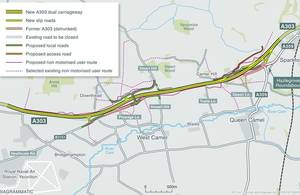
Map of proposed development

The Order grants development consent for a continuous dual carriageway on the A303 linking the Podimore Roundabout and the Sparkford Bypass. The Proposed Development would also involve the removal of at-grade junctions and direct accesses.

The Secretary of State has determined, following consideration of the report of the Examining Authority which conducted the Examination of the Application, that development consent should be granted.

The application was submitted to the Planning Inspectorate for consideration by Highways England on 27 July 2018 and accepted for examination on 23 August 2018. Following an Examination during which the public, Statutory Consultees and Interested Parties were given the opportunity to give evidence to the Examining Authority, a recommendation was made to the Secretary of State on 12 September 2019. The Secretary of State extended the deadline for the decision to 29 January 2021 for him to consider responses to the further consultations and his request for comments.

This is the 101st Nationally Significant Infrastructure Project and 37th transport application to have been examined by The Planning Inspectorate within the timescales laid down in the Planning Act 2008.

The Planning Inspectorate’s Chief Executive, Sarah Richards said:

“The Planning Inspectorate is committed to giving local communities the opportunity of being involved in the examination of projects that may affect them. Local people, the local authority and other interested parties were able to participate in the six-month long examination. The Examining Authority listened and gave full consideration to local views and the evidence gathered during the Examination before making their recommendation.”

The decision, the recommendation made by the Examining Authority to the Secretary of State and the evidence considered by the Examining Authority in reaching its recommendation is publicly available on the project page of the national infrastructure planning website.

ENDS

Journalists wanting further information should contact the Planning Inspectorate Press Office, on 0303 444 5004 or 0303 444 5005 or email: Press.office@planninginspectorate.gov.uk

Notes to editors:

The Planning Inspectorate, National Infrastructure Programme of Projects details the proposals which are anticipated to be submitted to the Planning Inspectorate as applications in the coming months.

Published 29 January 2021


Janssen publishes positive safety and efficacy data for single-dose COVID-19 vaccine

  • Janssen publishes phase 3 trial data from study showing positive safety and efficacy results for its single-dose COVID-19 vaccine
  • Vaccine shown to be 66% effective overall in preventing coronavirus in participants
  • UK has secured 30 million doses with deliveries expected to arrive this year if approved by regulators

Janssen today (29 January) published positive data from the phase 3 studies of its single-dose Covid-19 vaccine candidate, showing it to be 66% effective overall in preventing coronavirus in participants. The data did not report any significant safety concerns relating to the vaccine, with no serious adverse events in vaccine recipients.

The UK has secured 30 million doses of Janssen’s vaccine last summer, with deliveries expected to arrive in the second half of this year if approved for use by the Medicines and Healthcare products Regulatory Agency (MHRA), who will review and analyse the relevant data to see if the vaccine meets their strict standards of safety and effectiveness.

Today’s results are for Janssen’s single-dose study. Phase 3 trials for the company’s two-dose regimen are ongoing worldwide, including in the UK at 16 National Institute for Health Research (NIHR) sites across the country. These trials involve more than 6,000 volunteers in the UK, some of whom were recruited from the NHS Vaccines Registry.

While a single dose of a safe and effective vaccine would offer a significant advantage during a global pandemic emergency, a two-dose schedule may have the potential to offer enhanced durability in some participants. Data from this multi-country study is expected later this year.

Business Secretary Kwasi Kwarteng said:

This is yet more promising news from Janssen following last night’s positive trial results from Novavax, and news this week that Valneva have started vaccine production in Scotland.

Thanks to the life-saving work of our Vaccine Taskforce, the UK moved quickly to secure 30 million doses of Janssen’s vaccine last summer. If this vaccine is authorised by our medicines regulator, we are set to receive the doses in the second half of this year.

To date, the UK government has secured early access to a bumper portfolio of 367 million vaccine doses from seven separate vaccine developers, with Janssen’s vaccine the fifth to publish its phase 3 results.

The Janssen vaccine works in the same way as vaccine developed by Oxford and AstraZeneca and is designed to prompt an immune response including neutralising antibodies against the spike protein to eliminate the virus. Again similarly to the Oxford/AstraZeneca vaccine it can be safely stored and transported at standard refrigeration temperatures.

Health Secretary Matt Hancock said

This is yet more good news from Janssen on vaccines. If this jab is approved this could significantly bolster our vaccination programme, especially as a single-dose vaccine.

Once the full data has been submitted to the regulator they will consider the evidence to determine whether the vaccine meets robust standards of safety, effectiveness and quality.

We are continuing to roll out vaccines as quickly as possible across the UK, with more than 7.4 million people given their first dose so far.

Vaccines Minister Nadhim Zahawi said:

It is encouraging to see more positive news about vaccines coming through so quickly – this time from Janssen. Only a few months ago there were doubts over whether a Covid-19 vaccine would even be possible – now five companies have published good phase 3 results, three vaccines have been approved and over seven million people have received their first jabs.

Vaccination is the way out of this pandemic, and I am once again grateful to all of the trial volunteers who have made these studies possible.

Through the Vaccines Taskforce, the UK has secured early access to 367 million doses of seven of the most promising vaccines so far. To date, the UK government has invested over £230 million into manufacturing a successful vaccine.

The UK was the first country in the world to procure, authorise and then deploy both the Oxford/AstraZeneca and Pfizer/BioNTech vaccines.

Production of the Oxford University/AstraZeneca vaccine started last autumn where the bulk of the vaccine for the UK is being made in Oxfordshire and Staffordshire, with filling into vials taking place in North Wales.

In total, more than 7.4 million people across the UK have now had a least one dose of the vaccine.

  • The Government’s vaccine supply and scheduled deliveries will fully support our target of offering a first vaccine dose to every person in the top four priority groups by mid-February.
  • The members of the Joint Committee on Vaccination and Immunisation (JCVI) are independent experts who advise the UK on prioritisation at a population level for all vaccination and immunisation programmes; they have developed the prioritisation list of patient groups that is guiding the NHS vaccination programme and the committee keeps its advice under review and updates it as appropriate.
  • The Government has a set process for approving any vaccine, with regulatory oversight provided by the MHRA. This involves MHRA approving a product licence after the applicant has generated appropriate data to demonstrate the quality, safety and efficacy of the vaccine.
  • In total, the Government has procured 60 million doses of the Novavax candidate, the bulk of which will be manufactured in the UK if the vaccine is approved by regulators.
  • Through the Government’s Vaccine Taskforce, the UK has secured early access to 367 million doses of 7 of the most promising vaccine candidates, including:

    • BioNTech/Pfizer – Approved – 40 million doses secured
    • Oxford/Astra Zeneca – Approved – 100 million doses secured
    • Moderna – Approved – 17 million doses secured
    • Novavax – Phase 3 – 60 million doses secured
    • Janssen – Phase 3 – 30 million doses secured
    • GSK/Sanofi – Phase 1/2 – 60 million doses secured
    • Valneva – Phase 1/2 – 60 million doses secured, with an option to acquire a further 130 million if the vaccine is proven to be safe, effective and suitable.
  • The UK government has invested £127 million to fund a state-of-the-art manufacturing innovation centre in Braintree, Essex, in collaboration with the Cell and Gene Therapy Catapult, to accelerate the mass production of a successful Covid-19 vaccine in the UK. Due to open in December 2021, the centre will have the capacity to produce millions of doses of vaccines each month, ensuring the UK has the capabilities to manufacture both vaccines and advanced medicines, including for emerging diseases, far into the future.
  • The government has also provided £4.7 million funding to the Catapult to ensure that the UK has the best skills and expertise in vaccine manufacturing and advanced therapies.
  • The government has established a Rapid Deployment Facility with £8.75 million of investment which is manufacturing vaccines at scale.
  • The government has also created the UK’s first dedicated Vaccine Manufacturing and Innovation Centre (VMIC) and accelerated its development with £93 million of investment. This investment will rapidly accelerate the construction of the facility, enabling us to bring it online sooner. It will also have expanded capability for advanced vaccine process development, fill and finish and bulk manufacture. In addition, the facility’s capacity will be significantly increased to be able to respond to this pandemic. Once open, it will be able to manufacture 70 million vaccines doses in just 6 months – enough for the UK population. Located in Oxfordshire, the centre will be the UK’s first not-for-profit organisation established to develop and advance the mass production of vaccines. This will boost the UK’s long-term capacity against future viruses.


King George III’s watch at risk of leaving the country

  • Bar is to allow time for a UK gallery or institution to potentially come forward and save the work for the nation
  • Culture Minister Caroline Dinenage said: “with the nation captivated by Bridgerton, there is no better time for this watch owned by George III to come to light”

An exceptionally rare example of a Breguet Four Minute Tourbillon watch, owned by King George III is at risk of leaving the country unless a UK buyer can be found to save the work for the nation.

Valued at £2,000,000, plus VAT of £400,000, the watch was made in 1808 for His Majesty King George III and is thought to be one of fewer than ten tourbillon watches known to exist.

Designed and made by the pre-eminent watchmaker Abraham-Louis Breguet, the watch was designed to keep good time with a mechanism to stabilise and protect the movement from being disturbed by daily use. Its austere beauty and innovative mechanism represents a pinnacle of horological technology.

The watch at risk of export was part of the collection of King George III and Queen Charlotte. The King was a keen horologist and, as well as engaging leading horologists of the day, he actively involved himself in the creation of pieces that he commissioned. The Royal Collection holds manuscripts written in the King’s hand in which he details the procedure for assembling and disassembling watches.

Watches of this style are not currently represented in any public collection in the UK and this is thought to be one of less than ten known to survive.

Culture Minister Caroline Dinenage said:

With the nation captivated by Bridgerton, there is no better time for this watch owned by George III to come to light. This rare specimen is beautifully crafted and would make an excellent addition to a UK collection. I hope that a buyer can be found so that the public can continue to be inspired by this exciting period of our history.

The Minister’s decision follows the advice of the Reviewing Committee on the Export of Works of Art and Objects of Cultural Interest (RCEWA). The committee noted that the watch was an outstanding technical accomplishment, demonstrating Breguet’s skill as a watchmaker and embodied the Enlightenment values of early 19th century Britain.

Committee Member Pippa Shirley said:

This watch is a tour-de-force of the art of horology. At the very cutting edge of technology, the beauty of its mechanism is matched by the restrained elegance of its case, all of which would have been prized by its original owner King George III, an astute collector and active horologist.

This important type of watch is not currently represented in any national collection. With fewer than ten thought to still exist, the opportunity to save this pristine example for the nation, with its rich connection to the social and political history of Britain and Europe, simply must not be missed. Its loss from Britain would be a misfortune.

The RCEWA made its recommendation on the grounds of the watch’s outstanding significance for the study of British collecting, horology and the social and political history of Britain and Europe.

The decision on the export licence application for the watch will be deferred until 28 April 2021. This may be extended until 28 September 2021 if a serious intention to raise funds to purchase it is made at the recommended price of £2,000,000 plus VAT of £400,000.

ENDS

Notes to editors

Organisations or individuals interested in purchasing the watch should contact the RCEWA on 0845 300 6200.

Details of the watch are as follows:

  • Certificate No. 4178 issued by the Breguet firm in Paris on 29 June 1808 shows that this watch was issued to their agent in London, Recordon, for King George III. The watch was signed by Recordon, rather than Breguet, perhaps to disguise the sale to the British King during the Napoleonic Wars.

  • The watch is an early example incorporating Breguet’s tourbillon, possibly Breguet’s single greatest contribution to the field. He conceived the idea while in Switzerland between 1793-1795, in exile from the Reign of Terror in Paris. It was patented on June 26, 1801 and was finally put into commercial production in 1805.

  • The escapement, the beating-heart of a watch responsible for controlling its timekeeping, is subject to varying forces as it moves about in normal use, which can adversely affect timekeeping. Breguet sought to reduce these positional errors by incorporating the tourbillon which caused the entire escapement assembly to rotate continuously through 360°, the word “tourbillon” translating as “whirlwind”. Breguet excelled at knowing what his customers wanted and watches fitted with tourbillons were and are highly prized. Breguet sold 35 tourbillon watches between 1805 and 1823 and less than ten survive, thus making them rare and coveted pieces. It includes a thermometer, seconds, stopping seconds and a state of wind indicator and has a high quality gold case.

Provenance: Malcolm Gardner, lent to the Five Centuries of British Timekeeping Exhibition, 1955 Property of a Gentleman, Sotheby’s 9th November 1999, lot 78 Current private collection

The Reviewing Committee on the Export of Works of Art and Objects of Cultural Interest is an independent body, serviced by The Arts Council, which advises the Secretary of State for Digital, Culture, Media and Sport on whether a cultural object, intended for export, is of national importance under specified criteria.

The Arts Council champions, develops and invests in artistic and cultural experiences that enrich people’s lives. It supports a range of activities across the arts, museums and libraries – from theatre to digital art, reading to dance, music to literature, and crafts to collections.