Government proposes further support for flood resilience measures

Householders in flood-hit areas who install property flood resilience measures – such as flood barriers, air brick covers and flood resistant coatings on walls – could soon be able to obtain discounted insurance premiums, under proposals being consulted on by the government today (Monday 1 February).

Under the new plans, insured households that experience flooding would not only claim money to cover the damage caused, but could also receive additional funds to build back better and make their homes more resilient.

The government has also published a Call for Evidence to look at changes to the flood funding formula to benefit frequently flooded communities, and ways to increase the uptake of property flood resilience measures so that homes and businesses are better protected.

In total there have been at least 23,000 publicly funded installations of property flood resilience measures since 2009. However, the government is seeking ways to increase uptake across the country, alongside providing record funding for new flood and coastal defences.

Environment Secretary George Eustice said:

My thoughts are with all of those affected by Storms Bella and Christoph.

In Northwich last week I saw for myself the impact that flooding has on homes, businesses and communities. I am determined to get more support to people hit time and again by floods.

These plans aim to give households in flood-hit areas additional support to protect their properties.

Floods Minister Rebecca Pow said:

During Storm Christoph 49,000 properties were protected by our defences. I recognise that this is of little comfort to those who have been flooded and that there is more to do.

The plans will give people in flood-hit areas more help to build back better and reduce the risk to homeowners in the future.

Combined with a record £5.2 billion government investment over the next six years in new flood and coast defences, hundreds of thousands properties will be better protected.

The consultation covers changes to the Flood Re scheme, a joint industry/government initiative, designed to reduce insurance costs for thousands of households by passing on the flood risk element of home insurance to Flood Re and charging a set premium to households based on council tax bands. Since its launch in 2016, over 300,000 households have benefited from Flood Re, with four out of five households with prior flood claims seeing reductions in their insurance premiums by more than half.

Additional measures being considered also reducing the cheapest subsidised premium for contents insurance provided for by Flood Re (£52), as evidence from Amanda Blanc’s Independent Review of Insurance, commissioned by the government, suggest these could still be too high for households on low incomes.

The Call for Evidence will explore how we can strengthen our flood and coastal defence investment programme through better assessment of local circumstances, including how potential changes to the funding formula could provide further benefit to frequently flooded communities. It will also looks at further ways to increase the uptake of property flood resilience measures to enable householders and businesses to better prepare for flooding.

The documents being published today are the latest example of the progress being made by the government on a wide range of flood risk management measures set out in the flood and coastal erosion risk management policy statement, published in July 2020.

The plan is the most comprehensive in a decade and includes investment of £5.2 billion to create around 2,000 new flood and coastal defences to better protect 336,000 properties in England by 2027.

Flood Re consultation

The joint government and industry Flood Re Scheme is designed to improve the availability and affordability of flood insurance for UK households at high flood risk. The proposed changes aim to improve the efficiency and effectiveness of the scheme and to accelerate uptake of Property Flood Resilience measures, including:

  • The ability for Flood Re to offer discounted premiums to households that have fitted property flood resilience measures, such as airbrick covers or non-return valves
  • Permitting the payment of claims to include an additional amount to build back better, in a more flood resilient way
  • Exploring whether there’s more that the Flood Re scheme could do to accelerate uptake of PFR, including whether the scheme’s currently available funding could contribute
  • Exploring whether Flood Re premiums should be further reduced
  • Technical changes to improve the scheme’s efficiency

Local factors in managing flood and coastal erosion risk and property flood resilience: Call for Evidence

This Call for Evidence is seeking evidence on how local factors can be taken into account in the government’s flood and coastal defence investment programme and how we can increase the uptake of property flood resilience.

Part 1 is seeking evidence to identify additional ways in which specific local circumstances can be taken account of in the government’s future flood and coastal defence investment programme, including:

  • communities that have been frequently flooded in the past
  • communities that are more economically vulnerable, small communities
  • communities that may be in greater need of property-level measures to resist flood water

We are also exploring how we can ensure timely and wider financial contributions to assist with the pace of developing a flood scheme.

Part 2 covers the range of enablers which need to work effectively in order to increase uptake of Property Flood Resilience:

  • Funding and incentives
  • Planning policy, building regulations, and standards
  • Training and technical expertise
  • Evidence and data sharing
  • Communication, knowledge and understanding


Extra £40m to help victims during pandemic and beyond

  • Services report major increases in calls and webchat volumes during the pandemic
  • More specialist advisors to guide victims through the justice system
  • New campaign #ItStillMatters launched to raise awareness of sexual abuse services

It comes as charities have reported a 200% increase in calls and people accessing webchat services since the first lockdown, with some victims feeling at greater risk of harm or deciding to report abuse for the first time.

The new investment will allow support organisations to recruit more staff, keep helplines open for longer and adapt to remote counselling where necessary – ensuring help remains available for those who need it.

Crucially, £16m will fund the recruitment of more independent sexual violence and domestic abuse advisers across the country. They provide emotional and practical support for victims, while guiding them through the criminal justice process which many can find daunting.

A new government advertising campaign, #ItStillMatters, also launched today seeks to raise awareness of sexual violence services and ensure victims of rape and sexual abuse know where to get help – encouraging them to take the often difficult step of seeking support for the first time.

The funding also builds on an unprecedented £76 million pledged by Ministers in May to help the most vulnerable in society during the pandemic, as well as an extra £125 million for local authorities to provide support in safe accommodation for victims of domestic abuse and their children.

Justice Minister Alex Chalk said:

For many victims this pandemic has been an inescapable nightmare in which they often feel trapped and at greater risk of harm.

Their protection remains an absolute priority and this funding, backed by our new campaign, should mean no victim is left to suffer alone.

A sexual violence victim who worked with the charity SafeLine and wished to remain anonymous, explained the important role her Independent Sexual Violence Adviser played for her:

I honestly could not have gotten through this whole process without my ISVA, she just got me. She understood what I was going through and she knew how I needed to be told things and handled.

I remember her telling me to keep breathing and when I was in court, I could hear her breathing too and it reminded me that I was not alone. My ISVA never compromised on their aim to put me first. I would trust her with my life and I think if anyone is going through something similar, then they won’t go far wrong in getting the support required.

A male victim who also wished to remain anonymous and is supported by Breaking the Silence, said:

It was only after I could no longer bear the flashbacks that I finally decided to seek help. My initial fears and qualms about getting support were carefully managed, and I was eased into it. Although therapy brought out feelings of anger and hurt, the pain associated with the trauma gradually started to recede.

I met other men who had been through similar experiences, they helped me through my sense of isolation as I realised I wasn’t the only victim in my community. There were many challenges to overcome and I continue to receive support, but I’m now in a new relationship and the flashbacks have been eradicated almost entirely.

Safeguarding Minister Victoria Atkins said:

Sexual violence can devastate lives and it is important that people are aware that if they or somebody they know is suffering from this, they can leave their home to access support services.

We have invested millions to make sure vital services including helplines remain available to victims and if anyone is in immediate danger they should call 999.

We also want to hear from the public about violence against women and girls and have recently launched a national survey about these crimes. I want to encourage anyone with views on this topic to take part. Their voices need to be heard.

The £40m includes:

  • £20.7 million for local, community-based sexual violence and domestic abuse services, helping to reduce the amount of time survivors have to wait for support. Male specific services will see a 60% funding increase following a significant increase in demand for support from men and boys.
  • £16 million to recruit more independent sexual violence and domestic abuse advisers – increasing their numbers by around 400 meaning more victims of all ages can access this vital support.
  • £2 million for smaller specialist organisations helping BAME, LGBTQ+ or disabled victims.
  • £1.3 million for remote and online services – allowing more victims to access support while at home. £800k of this will go to Finding Legal Options for Women Survivors (FLOWS), a digital tool that helps victims of domestic abuse to apply for emergency protection from the courts.

Gabrielle Shaw, Chief Executive of NAPAC, said

The pandemic and associated lockdowns have impacted all of us. It has been particularly difficult for victims of sexual violence and domestic abuse who struggle to access support. This important campaign by government will raise awareness amongst victims and survivors that they are not alone, that taking that first step of reaching out for support is possible.

NAPAC is delighted that the government has backed up this campaign with £40m of new funding for victim services, £16m of which is specifically for sexual violence support services. This will aid the sector immeasurably in our work to support victims and survivors.

Neil Henderson, Chair and co-founder of the Male Survivors Partnership

The Male Survivors Partnership applauds the government for providing much-needed, additional funding for specialist services who support victims of sexual violence and domestic abuse. For those men, women and children living with the impacts of sexual and domestic violence, the impact of COVID has been devastating and will be long-lasting; this timely increase in funding will enable all specialist agencies to better respond to the needs of victims and survivors.

We also welcome and fully support the launch of a Government sexual violence awareness campaign aimed at helping more victims and survivors access critical support. High-quality, specialist support is available for men, women and children affected by sexual violence throughout England and Wales, but many victims and survivors don’t know how to access it. This campaign will hopefully change that and help enable more people to access the support they need to cope and recover from the abuse.

Katie Russell, national spokesperson for Rape Crisis England & Wales said:

As the extremely challenging conditions of the last ten months have exacerbated isolation, anxiety and complex physical, mental and emotional health issues for sexual violence and abuse victims and survivors, we’ve inevitably seen demand for our specialist services increase even further.

This new contribution towards our ongoing efforts to fulfil victims’ and survivors’ unmet needs is vital and very gratefully received, as is the Government’s recognition of our frontline work as essential.

We’re pleased too that the Government’s new campaign will echo and amplify our consistent message to those living with the impacts of all forms of sexual violence and abuse: you are not alone, we are still here for you.

The #ItStillMatters campaign includes a range of advertisements to raise awareness of the support that is available to victims of sexual violence. This follows the launch of ’Ask for Ani’ – a domestic abuse codeword scheme to help victims access support in thousands of pharmacies nationwide.  Through a discreet signal victims will be able to access emergency police response, help contacting a domestic abuse helpline or specialist support services.

Meanwhile, the courts continue to prioritise the most serious offences to keep the public safe, with the Government investing £110m on a range of emergency measures to keep the justice system moving, including by opening  39 Nightingale Court rooms across the country.

The Home Office is also asking the public to share their views on violence against women and girls in a Call for Evidence that will inform the Government’s upcoming strategy to tackle these crimes.

Notes to editors

  • Victims and survivors of sexual violence or abuse should visit gov.uk/sexualabusesupport to see the support on offer.
  • If you are a victim of domestic abuse and feel at risk of harm the Stay at Home guidance does not apply.
  • The Ministry of Justice will provide an extra £40m for victims of crime during 2021/22.
  • The £40m is in addition to a £99.5m funding commitment for victims’ services during 2021/22.
  • The funding will be available from April.
  • Combined call and webchat volumes for sexual violence helplines were 206% above the pre pandemic baseline (now 2,020 compared to 660) in the week commencing 28th December.
  • It follows £11m announced in November to help specifically with demands on services during winter and beyond.
  • The #ItStillMatters campaign follows a commitment made in the government’s Hidden Harms Summit ‘Action Plan’ – delivering in commitments to raise awareness amongst victims and survivors of the support available in taking the often first difficult step towards seeking support.
  • The campaign has been developed in extensive consultation with partners including Rape Crisis, Survivors UK, Imkaan and the Male Survivors Partnership. We also tested the campaign with male and female survivors.
  • The recent Spending Review settlement will boost funding for the court system by £337m to deliver swifter justice for all https://www.gov.uk/government/news/prisons-courts-and-victim-services-will-benefit-from-spending-review-funding
  • We’re investing record amounts, with £153m to improve court and tribunal buildings – the biggest single investment in court estate maintenance for more than 20 years – and we’re spending £110m on a range of emergency measures to tackle the impact of COVID-19, including the recruitment of 1,600 additional staff.
  • Court listing and prioritisation is a function of the independent judiciary.


UK announces humanitarian aid for Balochistan to help recovery from COVID-19

World news story

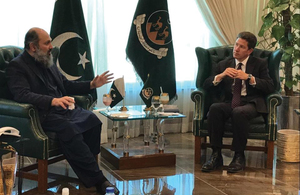
British High Commissioner Dr Christian Turner CMG announced £3.5 million UK humanitarian aid for Balochistan during his first visit to Quetta today.

Christian Turner Quetta visit

Rates of malnutrition and food insecurity in Balochistan were already high before the COVID-19 global pandemic, but the virus has affected livelihoods and made the problem worse.

UK aid will help over 41,000 women and children get vital nutrients they need, through a therapeutic food programme. It will support community outreach workers to identify and help malnourished children, pregnant women and new mothers.

British High Commissioner Christian Turner CMG said:

The COVID-19 pandemic has hit the global economy hard, and this has had a knock-on effect on food security in Balochistan. UK aid announced today will provide life-saving nutrition and humanitarian aid to vulnerable women and children when they need it most – giving the next generation the best start in life.

UK investment will be split between the World Food Programme (WFP) and International Rescue Committee (IRC). Part of the package will also help with humanitarian cash transfers to help with food and essential living costs. In total, UK aid will help over 164,000 people in Balochistan.

During his visit, the British High Commissioner met the Chief Minister of Balochistan, Jam Kamal Khan, and discussed a variety of matters including the Balochistan economy. He also met Chris Kaye, country director for WFP. Finally, Dr Turner also gave his condolences on the terrorist attack on January 2nd, in which 11 miners were killed.

Notes to editors:

  • As part of the UK’s wide-ranging package to help Pakistan tackle COVID-19 and help people suffering from the wider economic effects, we are working with both the World Food Programme (WFP) and International Rescue Committee (IRC);

  • The nutrition programme will help over 41,000 people (over 9,700 boys, over 10,500 girls and over 21,500 pregnant and lactating women in Balochistan).

  • In Balochistan, with humanitarian cash transfers, the UK is targeting Jhal Magsi and Chaghi districts, and will reach over 18,000 households (or over 122,000 people).

  • Studies have shown that without enough of the right nutrients, children can suffer from stunting or wasting, when their bodies and brains don’t develop the way they should. This can have an impact on entire populations, contributing to a cycle of poverty;

  • WFP will support Government Lady Health Workers (LHWs) at the community level and community outreach workers to screen and identify malnourished children and malnourished pregnant and lactating women. IRC will work with communities to identify highly vulnerable households providing them with a cash transfer to help cater to their food and livelihood needs.

For further information

For updates on the British High Commission, please follow our social media channels:

Contact
British High Commission, Islamabad
Tel: 0300 500 5306

Published 31 January 2021


£30m Waking Watch Relief Fund now open for applications

  • £30m fire alarm fund will relieve residents of waking watch costs  
  • Funding targeted at cities with most high-rise buildings with unsafe cladding
  • Builds on £1.6 billion funding to speed up removal of unsafe cladding on eligible buildings

Tens of thousands of residents in high-rise buildings can now access financial support to make their buildings safer while they wait for remediation work to complete, the Housing Secretary Robert Jenrick has announced as the Waking Watch Relief Fund opens today (31 January).

The £30 million fund will protect leaseholders from the high costs of Waking Watches, where a building is continually patrolled in case of a fire, by providing financial support for fire alarms, which will also make buildings safer in the long term.  

The fund will be distributed through councils, regional authorities and directly through the Ministry of Housing Communities and Local Government, depending on the location of the building. The funding is available for buildings across England, with £22m targeted to the cities with most high-rise buildings with unsafe cladding, including Manchester, Birmingham and Leeds.

Buildings over 18m with unsafe cladding systems and where Waking Watch costs have been passed on to leaseholders will be eligible.  

Housing Secretary Robert Jenrick said:  

We know many people are anxious about the costs of waking watches, which was always only intended as an interim measure while historic safety issues were fixed.

This fund will relieve the financial pressure on residents in these buildings and ensure they will be kept safe. I encourage those who are eligible not to delay and start their applications swiftly so we can distribute the funds as quickly as possible.

The Responsible Person (RP) – the person or business responsible for ensuring the safety of residents in their building – can apply for the fund and provide the evidence needed. The Responsible Persons are encouraged to speak to their local Fire and Rescue Service about the installation of the fire alarms in their building and to keep leaseholders informed.   

The criteria for the fund have today been published, setting out which buildings are eligible for funding, the evidence needed to apply and how applications will be assessed, as well as the way the funding is provided. 

MHCLG will work closely with councils and Fire and Rescue Services on the delivery of the fund. 

The fund is not a substitute for swift remediation of unsafe cladding – for which the Government has provided £1.6 billion in financial support.  

This builds on steps the Government has already taken to support leaseholders, including securing an agreement that owners of flats in buildings without cladding do not need an EWS1 form to sell or re-mortgage their property – benefitting nearly 450,000 homeowners. 

These measures are part of the government’s commitment to improve the safety of buildings across the country which will be enshrined in law through the Building Safety Bill in 2021. 

Around 95% of the highest risk buildings with unsafe cladding similar to that found on Grenfell Tower have been made safe or have work underway compared to a year ago; with 159 buildings starting work last year compared to 90 in 2019 – representing more buildings on site with remediation work in 2020 than at any point previously. 

Notes to Editors: 

The Waking Watch Relief Fund will be available to all eligible buildings in England. £22 million of the £30 million funding available has been allocated to the eight metropolitan areas estimated to have the largest number of eligible buildings across England. These areas are:

  • Greater London 
  • Greater Manchester 
  • Birmingham  
  • Leeds 
  • Liverpool  
  • Bristol 
  • Newcastle 
  • Sheffield 

The remaining £8m of the fund will be centrally administered and is available to buildings across all other areas of England.

The document outlining the average cost of waking watch per building is available here.

The ‘Responsible Person’, is the person, group, company or other entity that is responsible for ensuring the safety of occupants in their building from fire.


New-style driving licences and number plates mark one-year anniversary of Brexit as EU flag is removed

News story

To mark the first anniversary of Brexit, the government unveils new designs for driving licences and number plates without the EU flag.

  • driving licences and number plates get a makeover to mark one year since the UK’s departure from the EU
  • EU flag removed with new design issued at the start of this year
  • comes as the UK cuts red tape with several member states, making it easier for Britons to drive in the EU

UK driving licences and number plates have been given a makeover to signify the beginning of a new chapter for the UK.

To mark the UK’s exit from the EU, the EU flag has been removed from all UK driving licences and number plate designs, with the first batches issued from 1 January 2021.

While existing licences and number plates will still be valid, the new versions will be issued to everyone renewing a licence or getting one for the first time.

The new designs coincide with the beginning of a number of agreements recently made between the UK and member states for British drivers, making it easier for Britons to drive in the EU when existing restrictions end.

Thanks to these agreements, UK drivers who hold photocard licences will not need an international driving permit to drive in any of the 27 EU member states, Iceland, Norway, Switzerland or Liechtenstein. UK drivers won’t need to display a GB sticker in most EU countries if their number plate has GB or GB with a Union Flag on it.

Although national restrictions are still in place, and people should not be travelling internationally unless for work or other legally permitted reasons, these new arrangements mean that Britons can easily drive in the EU for years to come

Transport Secretary Grant Shapps said:

Changing the designs of our driving licences and number plates is a historic moment for British motorists, and a reassertion of our independence from the EU one year on from our departure.

Looking to the future, whether it’s for work or for holidays abroad, these changes mean that those who want to drive in the EU can continue to do so with ease.

Driving licences and number plates can be renewed online.

New driving licence design

New number plate design

Published 31 January 2021