London Borough of Croydon: Chair of the Improvement and Assurance Board appointment letter


New weather stations helping to keep essential traffic moving this winter


Surge testing to be deployed to monitor and suppress spread of COVID-19 variant

  • This will support existing extensive testing already in place, and monitor and suppress the spread of the variant
  • Postcodes affected are London (W7, N17, CR4), West Midlands (WS2), East of England (EN10), South East (ME15, GU21), North West (PR9)
  • Positive cases will be sequenced for genomic data to help understand COVID-19 variants

Additional surge testing and sequencing is being deployed in a number of locations where the COVID-19 variant first identified in South Africa has been found. Testing will, in combination with following the lockdown rules and remembering ‘Hands. Face. Space’ help to monitor and suppress the spread of the virus, while enabling a better understanding of the new variant.

Extensive surveillance of the virus has identified a small number of cases of the COVID-19 variant first identified in South Africa in localities across England, that cannot be traced back to international travel. All cases are now self-isolating and robust contact tracing has taken place to trace their contacts and ask them to self-isolate.

Working in partnership with local authorities, enhanced testing and sequencing will be targeted within specific postcode areas. These postcodes are:

  • East of England (EN10)
  • London (W7, N17, CR4)
  • North West (PR9)
  • South East (ME15, GU21)
  • West Midlands (WS2)

Every person over 16 living in these locations is strongly encouraged to take a COVID test this week, whether they are showing symptoms or not. Mobile testing units (MTUs) will be deployed offering PCR testing to people without symptoms who have to leave their home for work or essential reasons, with local authorities encouraging people to get tested in the area by providing additional home test kits.

People with symptoms should book a test in the usual way and people without symptoms should visit their local authority website for more information. This additional testing will begin in these areas from Monday.

Positive tests will be sequenced to identify any further spread of the COVID-19 variant first identified in South Africa, enabling a better understanding of the variant and identifying if there are any more cases of this particular strand of the virus in the area.

In total, Public Health England has identified 105 cases of the COVID-19 variant first identified in South Africa since 22 December. All cases and their contacts have been contacted and told to self-isolate. There is currently no evidence to suggest this variant is more serious than others, or that the regulated vaccine would not protect against it.

Health and Social Care Secretary Matt Hancock said:

It is vital that we do all we can to stop transmission of this variant and I strongly urge everyone in these areas to get tested, whether you have symptoms or not. The best way to stop the spread of the virus – including new variants – is to stay at home and follow the restrictions in place. Until more people are vaccinated this is the only way we will control the spread of the virus.

The UK is a global leader in COVID-19 genomics, and because of this, we have been able to identify new strains of the virus and take decisive action. We continue to closely monitor new variants, here and around the world, and in addition to our already extensive testing service, we are making surge testing capacity available to affected areas.

Dr Susan Hopkins, Strategic Response Director to Public Health England and Chief Medical Adviser for NHS Test and Trace, said:

As part of our proactive sequencing work, we know that the new variant of COVID-19, first detected in South Africa, has been identified in a number of areas across England. A small proportion of these cases have no link to international travel suggesting that there are some cases in the community.

In response to this, we are ramping up testing in targeted areas, so we can gather more information and effectively monitor any further community transmission.

As set out earlier this week, action is being taken to reduce the risk from the new variants of the virus by introducing further measures at the border.

Travel bans were already in place for countries where there is a risk of known variants. Further measures will include managed isolation in hotels for those who cannot be refused entry arriving from countries with international travel bans. Those wishing to travel out of the UK will have to declare their reason for travel in a pre-departure form. People should expect this to be checked and anyone who does not have a valid reason will be directed to return home and may face a fine.

All measures are kept under constant review.

Working in partnership with local authorities we are targeting specific postcode areas where the variant has been found. These postcodes are:

  • East of England (EN10)
  • London (W7, N17, CR4)
  • North West (PR9)
  • South East (ME15, GU21)
  • West Midlands (WS2)

People with symptoms should book a test in the usual way. People without symptoms should visit their local authority website for more information.

People should continue to follow the lockdown rules and remember ‘Hands. Face. Space’.

We know that mutations form a part of the virus cycle and we are well prepared to sequence new variants and assess what action may need to be taken.

If a person tests positive, has any symptoms, or are contact traced following contact with someone who tests positive, they should self-isolate immediately.
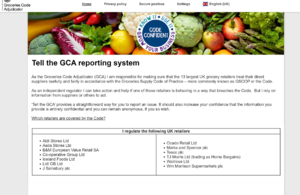


‘Tell the GCA’ launched for confidential reporting of Code issues

News story

The GCA has launched a confidential reporting platform ‘Tell the GCA’

Groceries suppliers can now use a confidential platform to report to the GCA any behaviour by a designated retailer they believe to be in breach of the Groceries Supply Code of Practice.

‘Tell the GCA’ has been designed to dispel concerns harboured by some suppliers that their identities could be revealed if they provide information. They can now report an issue via the secure third-party platform in total confidence that the information they share can remain anonymous.

Suppliers or other interested parties who log on to www.telltheGCA.co.uk will find a simple form that asks them to describe their Code-related concern, the retailer or retailers to which it applies and the date of the event in question. They will be asked to choose whether to remain anonymous or provide personal details.

They are also asked to open a secure post box on the platform so, even without their contact details, the GCA can post questions if more information is needed to take action. Suppliers who do so will be given a case number and choose a password so they can log in securely to check if the GCA has posted any questions or provided any update.

Mark White, the GCA, said: “This platform is not intended as a replacement for suppliers contacting the GCA directly, if that is what they want. My door is always open to suppliers and I encourage them to bring information to me and my office.

“I will always treat that information in confidence but for those suppliers who want additional reassurance they can use ‘Tell the GCA’ to share their information.”

Published 1 February 2021


UK supports Brazilian females to grow their tech-based businesses

Applications are officially open for the Future Females Business School, an initiative offered by the British Government in Brazil through the International Tech Hub Network. The programme will support 50 Brazilian female founders of tech-based enterprises to start, grow, scale, and become more sustainable, promoting positive social, economic or environmental impact.

The Future Females Business School Programme is a three month virtual programme, equipping local female entrepreneurs with the entrepreneurial skills and best practices needed to start and grow successful and sustainable businesses, that utilise technology to not only generate wealth for themselves, but to have a positive impact in their community, and environment.

Women are underrepresented in the Brazilian technology and innovation ecosystems. According to the Brazilian Association of Startups, only 15% of Brazilian startups have female founders, and these companies receive less than 3% of all VC funds. Also only 3% of Brazilian SMEs reach international markets, according to the Global Entrepreneurship Monitor, which excludes the vast majority of Brazilian entrepreneurs from the benefits of increased productivity, competitiveness, and revenue. The Future Females programme will help Brazilian women to change these numbers, connecting entrepreneurs to a supporting global network of successful business owners, mentors, investors and experts.

Future Females has previously partnered with the UK-South Africa Tech Hub in 2018, supporting 200+ female entrepreneurs to date, with participants seeing 88% increase in digital skills development, 95% uplift in confidence, and on average a 168% revenue increase in their businesses. In 2020, Future Females also ran pilot programmes in partnership with UK-Kenya Tech Hub and UK-Nigeria Tech Hub.

“We are very excited to expand our Future Females Business School into Brazil, in partnership with UK-Brazil Tech Hub – to allow women from all over the country to gain confidence, practical digital skills, and access the mentoring and community support needed to bring their dream business to life. The entrepreneurs who participate in our programmes are not just building businesses – they’re creating innovative solutions to real problems we’re facing in this ‘new’ world, and act as a source of hope for their communities – and we can’t wait to meet them!” – Lauren Dallas, Co-Founder & CEO of Future Females.

“Diversity drives innovation as it is ‘sine qua non’ to creating solutions that address problems from multiple perspectives. Including more women as leaders of change in technology is paramount to fostering innovative solutions to Brazil’s most urgent challenges, from those we are facing as a result of the COVID-19 crisis to climate change, poverty and inequality. Enabling women to transform great ideas into positive social, economic and environmental impact through digital technology is key to lead a profound country transformation into prosperity in Brazil. We are very happy to partner with Future Females to empower Brazilian women to become enablers of change in the local and global digital economy” – Andrea Motta, Director of the UK Brazil Tech Hub.

“I’m delighted with this new partnership between the UK Government and the Future Females Business School, an impressive programme with huge global reach. The partnership reinforces our commitment to work together to tackle gender inequality, promote digital inclusion, create jobs and foster a vibrant digital economy capable of building back better from COVID-19” – Liz Davidson, Chargé d’Affairs of the British Government in Brazil.

Applications are open until 22 February 2021, with only 50 places available in the three-month pilot programme commencing on 8 March 2021.

Apply now

Who is this programme for?

This programme is for Brazilian female entrepreneurs with an early-stage tech-based business or business idea that aims at creating positive social, economic or environmental impact, reducing poverty, inequality or protecting the environment. The programme is gender inclusive, encouraging cisgender women, transgender and non-binary people to apply. Male founders and co-founders supporting women digital entrepreneurship are welcome. The pilot cohort will be conducted in English and language proficiency is required.

What’s included in the programme?

The Future Females Business School, in partnership with UK-Brazil Tech Hub is a 3 month programme, made up of 10 modules that step entrepreneurs through the fundamental building blocks of starting and growing a business. Members will learn how to write an effective business plan, how to find and reach their ideal customers and how to use technology to build their online presence and scale. The programme also features guest experts – serial entrepreneurs, executives, coaches – who cover critical personal development topics such as how to overcome fear of failure, and how to uncover your true passion.

The programme is delivered online, and will have a virtual graduation event at the end, where completion certificates will be awarded, with all members invited to attend – to network, meet the team, and celebrate their achievements and their businesses!

Who is the International Tech Hub Network?

The International Tech Hub Network (ITHN) is a UK Government initiative to stimulate innovation and technology on a local level through forging partnerships between international tech sectors and the UK, stimulating local digital economies and building digital skills. The programme operates in South Africa, Nigeria, Kenya, Indonesia, India, Israel and Brazil. The UK-Brazil Tech Hub has been established as part of the UK’s Digital Access Programme (DAP), a UK Government Prosperity Fund initiative. The UK-Brazil Tech Hub aims to develop a stronger Brazilian digital ecosystem through the development of skills, entrepreneurship and business partnerships.

Who is Future Females?

Future Females is a movement that exists to increase the number of and better support the success of female entrepreneurs. Future Females has shown immense growth since its conception in August 2017 in Cape Town, currently boasting a presence in 36 locations world-wide, hosting regular events for their engaged community of over 80,000 members, and offering the Future Females Business School online training programme.

How to apply?

Applications are now open for the Future Females Business School, in partnership with UK-Brazil Tech Hub.

The application starts with simply completing a form and sharing information about the business you are building, with successful candidates being invited to a 1:1 interview with a programme team member. This interview will help you validate your business idea and direction, and ensure this programme is the best fit for you!

Applications are open until 22 February 2021, with only 50 spots available in the three month pilot programme commencing on 8 March 2021.

Apply now