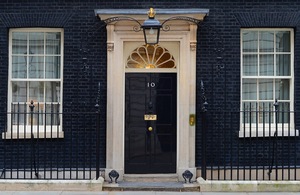
Privy Council appointments: 12 February 2021

Press release

The Queen has approved the following new appointments to Her Majesty’s Most Honourable Privy Council.

The Queen has been pleased to approve that Stuart Andrew MP, Nigel Evans MP, Mark Pritchard MP, Col Robert Stewart DSO MP, Stewart Hosie MP, Dame Diana Johnson MP, Angela Rayner MP, Nicklaus Thomas-Symonds MP, Jonathan Ashworth MP and Lord (Edward) Udny-Lister, be sworn of Her Majesty’s most Honourable Privy Council.

Published 12 February 2021


Scottish seafood taskforce meets to drive progress

A new seafood taskforce met for the first time today (Friday 12 February), drawing together senior political figures, industry representatives and UK Government officials, all bidding to solve ongoing problems with exports.

Chaired by UK Government Minister for Scotland, David Duguid, the virtual meeting was attended by UK Environment Secretary George Eustice and Fergus Ewing, Cabinet Secretary for Rural Economy and Tourism with the Scottish Government.

The Scottish Seafood Exports Taskforce included industry representatives drawn from the catching, processing and exporting sectors.

Minister Duguid told the meeting:

This taskforce is about developing solutions and delivering action rapidly.

It is not a talking shop and we will provide evidence of delivery.

Mr Eustice said other UK Government working groups to tackle immediate problems would continue to operate and support businesses to adjust to the new requirements and troubleshoot where problems occur such as issues with Export Health Certificates and customs declarations.

During the meeting the movement of mixed loads of small consignments, known as groupage, was discussed and the variation in time taken for loads to be cleared, with constructive discussions on how practical solutions could be arrived at to ease the flow of goods.

Minister Duguid said after the meeting:

The spirit of co-operation between all parties was good to see and my officials will now drill down to identify areas for rapid action.

The next taskforce meeting is in a fortnight but our engagement with industry continues on a daily basis, as does our work to speed world-class Scottish seafood from port to plate as smoothly as possible.

The taskforce has a core body of representatives from stakeholders and UK Government departments but also has the ability to invite in other industry representatives and experts on an ad hoc basis

Her Majesty’s Revenue & Customs and the UK Government Border Delivery & Protocol Group were represented.

The meeting comes in the same week that the UK Government’s £23 million Seafood Disruption Support Scheme opened for applications to businesses that suffered a financial loss because of delays related to the export of fresh or live fish and shellfish to the EU during January 2021.

This is in addition to the £100 million fund announced by the Prime Minister in December to help modernise fishing fleets and the fish processing industry and is on top of the £32 million that will replace EU funding this year.

Support provided to the industry includes:

  • Dialogue has already delivered swift solutions to a number of problems that caused difficulties for the industry, including – but not limited to – computer system glitches.

  • Issuing clear guidance on the required IT forms to stakeholder representative groups, hauliers and businesses.

  • Frequent meetings with businesses to understand and address issues as they arise.

  • Working closely with individual businesses to help them get used to the new procedures required to ensure that errors or problems are tackled early.

  • UK Government has stood up extra physical resources to support certification in a Scottish export hub.

  • The UK Government has provided specialist certifiers to support Food Standards Scotland and DFDS.

  • Working with French authorities to ensure that minor administrative issues associated with EHCs have not prevented goods from entering the market and with the EU Commission to help member states adopt consistent approaches.

  • Providing extensive guidance as part of a range of measures to help the industry meet new export requirements, including training, regular engagement and weekly bulletins.


UK donates 100 vehicles to stop terrorists crossing into Lebanon

The UK has donated 100 Armoured Patrol Vehicles to the Lebanese Armed Forces (LAF) to tackle the threat from terrorism on its border with Syria, which is frequently used by violent extremists and smugglers.

The Revised Weapons Mounted Installation Kit (RWMIK) Land Rovers, which are capable of tackling the rugged Syrian border terrain and can be mounted with heavy weapons, have been given to the LAF’s Land Border Regiments (LBRs) that patrol the area. This allows them to keep closer watch over their borders and stop extremists trying to enter Lebanon, who could otherwise then attempt to travel on to Europe.

The Lebanese border is also used by international arms and drugs smugglers, with the illicit substances and arms then transited through the country and onto other parts of the world.

Supporting the LAF and promoting security and stability in the region during a time of economic crisis is also crucial to reinforcing the LAF’s ability to defend the state of Lebanon from a range of threats.

Minister for the Armed Forces James Heappey said:

This fantastic border project marks the next chapter of the longstanding relationship between the British Armed Forces and our Lebanese counterparts.

The donation of these vehicles demonstrates the UK’s commitment to security and stability in the region. A stable border between Lebanon and Syria is firmly in the UK’s national interest.

We share a common enemy in Daesh. The UK will continue to work closely with our partners in the region to stamp out the threat posed by terrorist groups.

The RWMIKs are being taken out of service by the British Military this year after a long and successful period on UK operations around the globe, including in Iraq and Afghanistan. Following a request from General Aoun, the Commander in Chief of the LAF, to help bolster border security, the vehicles left the UK on 18 January and arrived safely in Lebanon on 31 January. The total value of the vehicles is £1.5million.

A small specialist team from 16 Air Assault Brigade deployed to meet the vehicles on arrival in Beirut and have delivered an initial round of vehicle training to the LAF. This training will continue in the spring to ensure the LAF can get the very best tactical and operational effect from them. The Conflict Security and Stability fund is also providing £300,000 for spare parts for the vehicles.

Minister for the Middle East and North Africa James Cleverly said:

Keeping Lebanon’s land border secure is key in our shared fight against Daesh in the Middle East. On my recent trip to Lebanon, I saw for myself the excellent work the UK and Lebanese Army is doing together, to keep Lebanon stable and secure at a time of turmoil in the country.

These patrol vehicles, donated by the UK, will help strengthen the border with Syria against weapons smugglers and terrorist groups, and ultimately protect both of our countries’ national security.

The donation builds on significant support already provided to Lebanon by the UK, including the construction of 79 border towers, provision of 350 vehicles, and training over 23,000 LAF personnel. Following the devastating Beirut explosion in August 2020, the UK also provided £27 million in humanitarian assistance and deployed HMS Enterprise to assist at the port – the first foreign ship to arrive in support of the Lebanese people.

In recent years Lebanon has become an increasingly important counter-terrorism partner for the UK. The UK’s support to the LAF – who drove Daesh out of Lebanese territory in 2017- is an important part of the UK’s contribution to Counter-Daesh efforts in Iraq and Syria.

UK Armed Forces continue to take the fight to Daesh in the region by supporting Operation Shader alongside our allies. On 24 January, RAF Typhoons launched an airstrike on a Daesh cell in northern Iraq. Four Paveway IV guided bombs struck their targets accurately and the strike was assessed to have been a success in eliminating the terrorist threat.


Convocatoria a jóvenes mujeres: ‘Líder por un Día’

Para celebrar el Día Internacional de la Mujer, la embajadora británica Faye O’Connor junto a líderes de distintas áreas de la sociedad uruguaya ofrecen la posibilidad de que jóvenes mujeres de entre 18 y 25 años de edad puedan compartir un día con ellas conociendo sus tareas y ampliando sus redes de contactos.

El objetivo es promover la participación de las mujeres en cargos de liderazgo, dándoles la posibilidad de conocer su trabajo y de vincularse con referentes de primer nivel en las áreas de gobierno, diplomacia, ciencia, periodismo, logística y empresas.

Para participar, las interesadas deberán mandar un video de no más de 1 minuto a liderporundia@gmail.com diciendo: “Yo voy a ser una líder para…”

En el correo se debe incluir el nombre, edad, teléfono, estudios que cursa o ha cursado y enviar un link a su video. Además, deben indicar las tres mujeres líderes a las que les gustaría acompañar, en orden de preferencia, aunque las candidatas podrán ser seleccionadas para acompañar a cualquiera de las participantes. Ellas son, en orden alfabético:

  • Beatriz Argimón, Vicepresidenta de la República

  • Carolina Cosse, Intendenta de Montevideo

  • Mariana Chilibroste, Cofundadora de Sellin, empresa que, a través de la innovación social, desarrolla oportunidades para micro y pequeños productores de todo el país.

  • Silvia Emaldi, Ingeniera, Presidenta de UTE

  • Pilar Moreno, Profesora Adjunta de la Facultad de Ciencias, UdelaR e investigadora del Institut Pasteur de Montevideo

  • Faye O’Connor, Embajadora británica

  • Blanca Rodríguez, Periodista

  • Alejandra Silveira, Gerente de Logística Internacional de Astrazeneca, Hub Uruguay

Las ganadoras de la convocatoria acompañarán a las líderes participantes en sus tareas de forma presencial y/o virtual durante el lunes 8 de marzo, incluyendo, pero no exclusivamente, actividades vinculadas al Día de la Mujer. Las candidatas deben asegurarse de tener disponibilidad de tiempo ese día, durante todo el día.

La fecha límite para presentar los videos es el 23 de febrero. La embajada anunciará las ganadoras el 2 de marzo. Al enviar sus videos, las participantes aceptan que se compartan en las redes sociales de la Embajada Británica, de las líderes participantes, y eventualmente otros medios de comunicación.

La actividad “Líder por un día” será compartida en las redes sociales de la Embajada y de las mujeres participantes que así lo deseen, y podrá ser cubierta por medios de comunicación.


Views sought on making the oral contraceptive pill desogestrel available from pharmacies

News story

The public has until 5 March to respond to the consultation on the potential reclassification of desogestrel to a pharmacy medicine. 

The MHRA has launched a public consultation on the reclassification of two progestogen-only contraceptive pills containing desogestrel. This is the first time such a change has been considered, making it important that the public’s views are heard.

The consultation affects two products containing desogestrel; Lovima 75 microgram film-coated tablets and Hana 75 microgram film-coated tablets. Lovima and Hana are both oral contraceptives for continuous use to prevent pregnancy in those of childbearing age.

We are asking the public and stakeholders for their views on whether these two products should become a pharmacy medicine and available over the counter, without a medical prescription.

Pharmacists are trained healthcare professionals. If these two products are reclassified, pharmacists will have access to training materials and a checklist to enable them to identify women who can be supplied this medicine safely.

Dr Sarah Branch, Director of Vigilance and Risk Management of Medicines at the MHRA, said:

Every response received will help us gain a better picture of whether people think the contraceptive pill with desogestrel should be available over the counter.

We hope to hear from as many people and women’s groups as possible.

Contraceptive pills containing desogestrel will still be available on prescription from GPs and sexual health clinics.

The Commission on Human Medicines has advised that it is safe for these is products to be made available as a Pharmacy (P) medicines.

Details about the 2 consultations, including how to take part

The consultations are open until 5 March. As these are 2 products, 2 separate consultation pages are required:

However, we will assess responses that relate to the active ingredient (desogestrel) as applying to both products, even if views are only submitted for one.

Background

A medicine will be non-prescription unless it fulfils one or more of the criteria for prescription control as set out below and in the Human Medicines Regulations 2012 regulation 62(3). Prescription only (POM) status will apply where:

  • a direct or indirect danger exists to human health, even when used correctly, if used without medical supervision
  • there is frequent incorrect use which could lead to direct or indirect danger to human health
  • further investigation of activity and/or side effects is required
  • the product is normally prescribed for parenteral administration

Published 12 February 2021