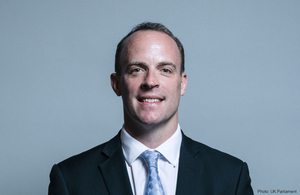
UK backs Canadian initiative against arbitrary detention

Press release

The UK joins over 55 like-minded allies in committing to enhance international cooperation to end the practice of arbitrary arrests, detentions or sentencing.

The United Kingdom is doing more to safeguard the rights of British people abroad, by joining a new Canadian-led initiative to condemn and deter the practice of arbitrary detention.

Today’s declaration, welcomed by Foreign Secretary Dominic Raab, increases the diplomatic pressure on those who choose to detain foreign and dual nationals with no legal basis. The UK joined over 55 like-minded allies in committing to enhance international cooperation to end the practice of arbitrary arrests, detentions or sentencing, often used to exercise leverage over foreign governments.

This declaration enhances international cooperation and sends a collective show of strength to those countries who carry out this unacceptable practice. It also reaffirms the essential rights provided under the Vienna Convention on Consular Relations, including the provision to allow consular access to detained nationals.

The UK government already works publicly and privately to condemn the use of arbitrary detention, to support those who have been detained without access to a fair trial and to ensure accountability for those perpetrating this abhorrent act.

Foreign Secretary Dominic Raab said:

The practice of arbitrarily detaining individuals as leverage over another government is indefensible and the UK will not tolerate it.

Depriving someone of their liberty with no legal basis violates fundamental human rights. The UK is proud to stand on solidarity with over 55 other countries to bring this unacceptable practice to an end.

This Declaration shouldn’t be seen as a single action. The UK and the Foreign Secretary will continue to throw our full weight in support of those detained arbitrarily.

The G7 Foreign and Development Ministerial meeting later this year will see the Foreign Secretary and G7 partners generate further mechanisms to uphold international law, tackle human rights abuses and stand up for our shared values.

Published 15 February 2021


COP26 President Alok Sharma visits Egypt and Nigeria on climate change mission

  • Alok Sharma visits Africa for second time in a month since taking on COP Presidency full time to drive forward climate priorities on the continent
  • Visit to Egypt and Nigeria saw Sharma encourage leaders to set out net zero targets and ambitious plans to decarbonise their economies by 2030
  • He met with activists and entrepreneurs in both countries and discussed exciting innovations to drive climate action

COP26 President Designate, Alok Sharma, has concluded a four-day visit to Egypt and Nigeria as he continues to drive progress on Africa’s priorities for the climate crisis, including greater action for adaptation to the effects of climate damage and increased financing.

Egypt and Nigeria are two of Africa’s largest economies and emitters of Greenhouse Gases (GHGs). Egypt also leads regional efforts to transition to clean energy and is an important voice in the climate negotiations for the Middle East and Africa.

In both countries, Mr Sharma emphasised the importance of submitting more ambitious and measurable short term climate action plans through NDCs (Nationally Determined Contribution) and long term strategies to reach net zero emissions by 2050, to align line with the Paris Agreement goal to limit global temperature rises to well below two degrees and pursue best efforts to limit the increase to 1.5°C.

In Cairo, Sharma discussed the UK and Egypt’s joint work on adaptation and resilience and opportunities to build back greener from the pandemic with Prime Minister, Mustafa Madbouly, and other government Ministers, including the Deputy Foreign Minister, Minister of Environment, Minister of Electricity and Renewable Energy and Minister of Finance.

He met Vice-President Osinbajo in Abuja, and spoke about the importance of Nigeria’s leadership in climate action and noting the country’s potential to mobilise its young population and transition to renewable energy.

Mr Sharma also met with the Ministers of the Environment and Finance, and the Chief of Staff to the President to discuss the progress that Nigeria is making on both mitigation and adaptation. Mr Sharma welcomed the removal of the petroleum subsidy and encouraged more renewable energy to be added to the grid which will provide greater access to electricity for Nigerians.

Following his visit, COP26 President-Designate Alok Sharma said:

I have been strongly encouraged by my visits to both Egypt and Nigeria as I continue to work with countries across the globe in the lead up to COP26.

It is only by working together that we will be able to achieve the goals of the Paris Agreement and it’s vital to engage with countries that are not only vulnerable to the effects of climate change, but also have a role to play in mitigating it.

I thank the leadership in both countries for their openness and enthusiasm so far and look forward to meeting again ahead of the COP26 summit in Glasgow later this year.

Egypt’s engagement on COP26 is critical, both as a prominent regional voice in the climate negotiations, but also as an innovator and provider of adaptation solutions.

It is home to one of Africa’s largest solar farms, “Benban”, which is supported by UK funding. The country expects to exceed its current target of 20 percent renewable energy by 2022, and is aiming for up to 50 percent by 2035. It has also taken a lead on shifting away from future coal, having shelved plans for the Hamrawein plant, Egypt’s last coal fired plant, in favour of renewable alternatives. Alok Sharma encouraged Egypt to showcase this leadership by joining the Powering Past Coal Alliance (PPCA).

Nigeria is a major player on the continent, both in terms of its population size and its economic influence. Forty three per cent of its population is below the age of 15 and 60 percent of the population now lives in urban environments. It is Africa’s second largest emitter of GHGs and has one of the highest deforestation rates in the world. While heavily reliant on oil and gas, the country has the potential to generate its own renewable energy and their May 2020 Economic Sustainability Plan has committed to extend the Solar Homes Systems to some five million households. From a climate change perspective, it faces both significant challenges but also has huge opportunities.

Nigeria’s Minister for the Environment, Mohammad Mahmood Abubakar, said:

Good to meet Alok Sharma, the COP26 President-Designate on his visit to Nigeria and discuss a range of issues on Nigeria’s climate change agenda. We welcome the UK’s leadership on this critical global agenda and look forward to its hosting of COP26 this November that firmly recognises the particular needs and circumstances of Nigeria’s and Africa’s climate change challenges.

We look forward to the continued support of the UK as we rise to meet those challenges in ways that protect the environment whilst also supporting economic growth and long term stability and prosperity.

A spokesperson from the Office of the Egyptian Prime Minister said:

Prime Minister Madbouly praised the cooperation between Egypt and the UK in the field of adaptation to the effects of climate change, and the joint leadership of the two countries on the Adaptation Action Coalition launched last month.

In both countries, Sharma met with grassroot activists and civil society organisations to discuss the importance of an ‘all of society approach’ to tackling climate issues. In its COP Presidency the UK is engaging with people from all sectors working on the climate agenda, including youth activists, entrepreneurs and those focusing on women’s empowerment and inclusion.

Shady Khalil, Co-Founder of Greenish said:

COP26 President Alok Sharma’s meeting with civil society representatives in Egypt shows a clear will for a true representation of youth led organizations in Egypt, making COP26 more accessible and inclusive for more narratives from different communities around Egypt, MENA and the Global South.

With our work in Greenish, we are training and empowering thousands of youth to foresee and address climate change challenges in Egypt. We hope through the meeting we can create a platform to voice out their concerns, ideas and stories.

Rita Idehai, Social entrepreneur and Climate Change Activist said:

The impact of imploding Climate crisis in Nigeria is multidimensional. We need all hands, the government, the young, the old, civil societies and the private sector to address these challenges. Building back better is our collective responsibility.

From Egypt and Nigeria, Sharma will now travel on to India and Nepal where he will meet with leaders from government, business and civil society to hear how climate change is impacting communities and to discuss solutions.

Notes to editors

  • The UK will host the 26th UN Climate Change Conference of the Parties (COP26) in Glasgow on 1 – 12 November 2021.

  • The COP26 summit will bring parties together to accelerate action towards the goals of the Paris Agreement and the UN Framework Convention on Climate Change.

  • The UK is committed to working with all countries and joining forces with civil society, companies and people on the frontline of climate change to inspire climate action ahead of COP26.


Driving forward peacekeeping reform through practical recommendations that address today’s challenges

Thank you Mr Chair, and please accept my congratulations on your re-election.

I want to start by commending the dedication and courage of all our personnel in the field, and to pay tribute to the memory of the 129 peacekeepers who lost their lives in 2020. In the last year, the Covid-19 pandemic has only added to the range of challenges our peacekeepers face.

The United Kingdom attaches great value to the work of this Committee in driving forward peacekeeping reform, through practical recommendations that address today’s challenges. While progress has been made in implementing the Secretary-General’s Action for Peacekeeping (A4P) initiative there is, as ever, more that we can do.

This year we have seen the clear benefits of the Comprehensive Performance Assessment System in supporting missions to improve planning and decision-making, including mitigating the impacts of Covid-19. The UK is proud to be funding the roll out of this tool, which we hope to see completed this year.

We welcome the finalisation of the Integrated Peacekeeping Performance and Accountability Framework, setting out clear standards and measures to address underperformance and incentivise outstanding performance. Thorough implementation and reporting on the framework will now be crucial.

Following attacks on peacekeepers in Mali and the Central African Republic in recent months, it is clear that there is more we must do to keep peacekeepers safe. We hope the Committee will agree clear recommendations on improving situational awareness, training and equipment, and medical standards.

The UK remains committed to advancing the Women, Peace and Security agenda, and we firmly support the full, equal and meaningful participation of women in peacekeeping and peacebuilding. This is not only the right thing to do, but is also critical to operational effectiveness. To date, the UK has contributed $4.3million to the Elsie Initiative Fund to promote uniformed women’s participation.

Mr Chair, all of us have a responsibility to deliver on peacekeeping reform. The UK is committed to supporting the A4P agenda, including through our extra-budgetary support to the Secretariat and through our own peacekeeping deployments. Last December, the UK deployed a 250-strong long-range reconnaissance group to MINUSMA, thereby filling a key capability gap. This is helping MINUSMA to establish a more intelligence-led approach to peacekeeping, better protecting civilians and peacekeepers.

Mr Chair, we all have a common stake in the peacekeeping system. Let us recognise this as we work together to achieve a renewed consensus in this year’s report. We have every confidence that under your expert chairmanship, and with the support of the Bureau and our co-facilitators, we will be successful.

Thank you.


WTO Trade Policy Review of Myanmar: UK statement

News story

The UK delivered this statement at the WTO Trade Policy Review of Myanmar on 15 February 2021.

Thank you, Chair.

Like other Members who have spoken this morning, we are gravely concerned by the current situation in Myanmar. The United Kingdom condemns the military coup in Myanmar and the arbitrary detention of members of the democratically elected civilian government and civil society, including President Win Myint and State Counsellor Aung San Suu Kyi.

Both the Secretariat and the Government Reports prepared for this Trade Policy review note a number of initiatives since the first review, such as efforts to improve the climate for business and to encourage investment, which aim to facilitate the emergence of a more prosperous, peaceful and democratic Myanmar. More open and transparent international trade has contributed to the economic progress we have seen in Myanmar in the last 10 years, but is dependent on the rule of law and good governance. The current situation undermines these efforts and creates uncertainty for trade partners and investors alike, threatening to compound the economic damage caused by the pandemic and limit Myanmar’s economic growth and development.

Similarly, it creates uncertainty for this review. In its Government Report, Myanmar expresses its intentions to undertake further reform work in the area of trade and trade policy, to support small and medium-sized enterprises, to accelerate the transition to a digital economy, and to improve environmental protections, including taking action against environmental crimes such as the illegal trade, poaching and trafficking of protected flora and fauna. Laudable though these objectives are, it is not clear how they will now be advanced and how domestic and international stakeholders will be able to provide input into the development of relevant policies.

The human rights situation continues to deteriorate. We are extremely concerned by the reports and images of violence emerging from Myanmar perpetrated by the police and military.

We stand with the people of Myanmar who are now bravely exercising their democratic right to protest this coup. Their wishes, and the result of the November 2020 General Election, must be respected.

Thank you, Chair.

Published 15 February 2021


OSCE Economic and Environmental Forum session on building women’s human capital: UK statement

Mr Moderator,

The profile of jobs in the UK is changing and roles which require STEM skills are set to rise at twice the rate of other occupations between now and 2023. STEM graduates are in short supply. And the challenges presented by the COVID epidemic – and the need to respond to an increasingly technologically-advanced world – put STEM careers at the forefront of skills demands.

To fill these careers we need to understand what works to encourage groups that are historically underrepresented to consider STEM, most obviously girls and women. For example, in the UK, in 2019, only 12% of workers in engineering occupations were female.

I would like to take a moment to share with you the findings of a recent UK Department for Education study of under-representation of women and girls in STEM fields.

Despite outperforming boys in most STEM subjects at age 16, at age 18 – in the UK the first point at which students can choose whether to proceed with STEM subjects – gender disparity starts to emerge. In 2019, female students represented just 13% of examination entries in computing, 22% in physics, and 39% in maths. Importantly, only 22% of girls opted to take two or more STEM subjects, versus 35% for boys, a requirement to access many STEM degrees.

Women’s underrepresentation in the industry also presents problems in terms of gender equality and diversity. As our society becomes increasingly dependent on technology, STEM jobs grow in terms of income, status, and influence. It is important that these jobs are not overwhelmingly held by a limited section of society.

So why the gender disparity?

First, girls’ expectations of success in STEM subjects appear to be lower than those of boys, even though their performance is no worse. Despite girls outperforming boys in most STEM subjects at age 16, they are less confident in their abilities.

Second, parents’ beliefs about their child’s abilities in a given subject determine those of the child, and are influenced by the child’s gender. Even when girls outperform boys in both maths and English, parents are more likely to think sons are more talented in maths than daughters. There is evidence that the better a parent thinks their child is at English, the worse the child thinks they are at maths. Teachers are more likely to attribute girls’ success in physics to ‘hard work’ and boys’ success in physics to being ‘naturally bright’, even when they do not perform as well as girls.

Third, girls’ perception of the personal value of STEM subjects relative to others is lower than that of boys. Girls are more likely than boys to endorse communal goals – for example – working with or helping others, and there is a stereotype that STEM subjects do not help fulfil these goals. Interestingly, in health sciences, females are equally represented.

Fourth, girls do not see ‘people like them’ represented in STEM, and do not think it aligns well with the stereotypical female gender identity.

So what can we do?

Students are much more likely to select post-16 maths and/or physics if a key adult – typically a family member or teacher – has conveyed the worth of the subject, along with the belief that they can do well in it. Teachers need knowledge about the range of STEM careers available; and parents need a better understanding of where science can lead, as well as guidance on how to talk with their child about course choices.

Successful interventions that target girls provide information on the limiting impact of gender stereotypes; the importance of self-concept for success; testimony from other students about the usefulness of STEM; and the unhelpful frame-of-reference effects that can occur in the classroom – when students evaluate their ability by comparing their performance to others’, rather than their own performance over time.

Other successful interventions show how the career of a scientist can actually afford communal goals. In studies, girls were more positive about the career of a scientist when it was presented as involving more collaborative, as opposed to independent, work.

I hope delegates found this useful. I would be happy to share further details with any who are interested.

Thank you.