UK renews commitment to NATO missions

Defence Secretary Ben Wallace confirmed to fellow Defence Ministers representing NATO’s 30 members that the UK will scale up its own commitment in line with the Alliance’s expansion of NATO Mission Iraq.

The virtual Defence Ministerial also provided the opportunity for the Defence Secretary to detail to allies how the UK Carrier Strike Group 21 – which is setting off for its first operational deployment this year – will boost NATO’s capability to respond to the complex threats we face as an Alliance in an unstable world.

Defence Secretary Ben Wallace said:

The UK is setting a course for the future of NATO by modernising our own Armed Forces to keep the country and its allies safe in a more threatening world, following the record settlement of more than £24bn.

Our commitment to NATO is at the heart of this approach and I was pleased to discuss with allies our shared vision of deepened cooperation, refreshed operational concepts, and the use of cutting-edge technology to counter the threats of today and tomorrow.

First and foremost we are committed to delivering on NATO operations. The UK Government remains resolute in our support to the government of Afghanistan in the face of unacceptable Taliban violence. We are determined to ensure that conditions are met for achieving a lasting political settlement, which is the only means of ensuring security from terrorism for the people of Afghanistan, the United Kingdom and its Allies.

Mr Wallace highlighted the forthcoming Integrated Review which will set the course for a modernised, threat-focused and sustainable defence – with NATO occupying a central place. The Defence Secretary told allies that the UK’s commitment to NATO remains unwavering and explained how the Integrated Review will match the Alliance’s goals by increasing spending, embracing innovation and delivering a force structure embracing all domains

Allies cooperating to counter shared threats

The NATO Defence ministerial provided the opportunity for ministers to discuss the complex challenges facing the Alliance including current operations, countering hostile state activity, and the emergence of disruptive technologies.

Ministers agreed an implementation strategy for researching, investing in and adopting emerging technologies into the Alliance. This will ensure NATO stays ahead of the curve and maintains a technological edge ahead of adversaries.

Defence Ministers also discussed the future of the NATO Resolute Support Mission in Afghanistan. The Defence Secretary affirmed to allies that the UK remains committed to the operation and supporting the Afghan peace process.

Mr Wallace also welcomed the progress made by allies towards fairer burden sharing. 2021 will be the seventh consecutive year of increased defence spending by European allies and Canada.

NATO Mission Iraq expands

Over the two-day virtual conference defence ministers from across the NATO Alliance agreed to expand the mission to Iraq on an incremental basis to bolster Iraq’s fight against the terrorist threat of Daesh.

This will see the UK continue to support the NATO mission which provides professional military training to the Iraqi security forces and is being expanded to cover more Iraqi Government institutions. The UK will work with NATO over the coming weeks and months to confirm the size and nature of the UK’s contribution. Working alongside our international partners, UK personnel have trained over 120,000 Iraqi and Kurdish security forces as part of counter-Daesh efforts.

The UK is committed to supporting the government of Iraq in further developing its counter-terrorism capabilities, as the threat from Daesh continues to evolve.

UK Carrier Strike Group sails with Allies

The UK Carrier Strike Group will also be extending NATO influence during its maiden deployment later in the year. NATO allies will contribute to the CSG 21 deployment, including the United States who will be contributing fifth-generation aircraft from the US Marine Corps, and a US Navy destroyer.

The Carrier Strike Group’s capabilities will be on show during Exercise Strike Warrior, taking place off the coast of Scotland in May. The UK-led war-fighting exercise, including several other NATO navies, will be the final test for the Carrier Strike Group before it undertakes Air and Maritime missions in the Atlantic, the Mediterranean and Black Sea.


A345 ash dieback tree felling completed ahead of schedule

The Defence Infrastructure Organisation (DIO), together with its industry partner, Landmarc Support Services (Landmarc) and subcontractor KWR Plant Hire, carried out the tree-felling clearance scheme to remove trees infected with ash dieback.

Thousands of ash trees across Salisbury Plain Training Area, as well as many more across the country, are infected with the disease. There is no cure or treatment and over time infected trees will weaken, causing branches to fall and trees to eventually die and collapse.

This presents a significant health and safety risk, especially alongside roads, public rights of way and woodland areas used by military personnel for training and the public for recreation activities.

For the safety of road users and local residents, it was necessary to remove infected trees along the A345. This posed many challenges due to the location and local infrastructure, not least because of the power lines that were tangled up with trees. As a result, following detailed consultation with local authorities and Highways England, a number of temporary road closures and diversions were implemented. These enabled the safe use of specialist machinery to protect onsite workers and the general public.

The process also required 5 power shutdowns to fell the trees that were wrapped around the power lines. This protected the local power network from disruption if ash dieback had caused a branch or tree to bring a power line down. Throughout the work, public transport continued as bus services were still able to operate.

The early completion of the felling along the A345 means reduced disruption for local people and a lower cost to the taxpayer. About 2300 tonnes of wood was removed by the felling team in 45 days. This was slightly more than expected and was sold as biomass chips to be used for energy generation, partially offsetting the cost of the operation.

Further ash dieback felling continues at Heytesbury and more is planned in several areas across Salisbury Plain. Regular inspections will continue and may identify other areas where felling is required.

Lieutenant Colonel Tim Jalland, DIO’s Commander South West Training Estate, said:

This is a fantastic example of good planning, communications and collaboration which has enabled the project to finish well ahead of schedule, protecting those that use the estate and the public at large.

I’m really pleased to see how successful it has been and would like to thank the local communities for their patience and forbearance whilst having to deal with the inevitable disruption caused by the road closures.

Judith Peachey, Landmarc’s Forestry and Arboriculture Manager said:

So far, around 80,000 infected trees have been felled on Salisbury Plain, including on 20 miles of roadside. We now need to focus on the process of replanting and regeneration and have held extensive discussions with the Forestry Commission and Natural England about the restoration of felled areas, which is reflected in the approved felling licences for the operations.

Within the woodland compartments, space has been left for the natural regeneration of tree seed already in the soil and this will be enhanced with the planting of native broadleaved species. A small proportion of felled timber has also been left on site to provide deadwood habitats to help maintain the current ground flora as much as possible.

The removal of ash is a devastating loss to the local landscape, but we are carefully considering which species will be planted so that we can provide a woodland that is more resilient to disease for future generations.

DIO and Landmarc began the programme to fell infected trees across Salisbury Plain Training Area in early 2020 at Ashdown Copse near Tidworth.

Further information on ash dieback on the MOD estate can be found at Ash Dieback on the Ministry of Defence estate.

Queries regarding the felling process on Salisbury Plain Training Area should be directed to nsc@landmarc.mod.uk or 0800 022 3334.

Further information

  • Ash dieback is a serious fungal disease of ash trees, caused by a fungus now called Hymenoscyphus fraxineus.
  • infection can lead to the death of young trees in just 2 to 3 years, and of mature trees within 3 to 5 years.
  • all trees removed had been identified during health and safety tree inspections and surveys. These are carried out annually to monitor the health of our trees in high-risk locations.
  • the ash dieback tree felling work across Salisbury Plain is taking place in phases and aims to be completed in 2022, with tree health surveying and monitoring continuing once felling is complete. The first phase of felling targeted Ashdown Copse. Phase 2 included the A345 felling and continued work at Ashdown Copse, as well as other locations where ash dieback has been identified including Erlestoke, Everleigh, Heytesbury and along neighbouring roadsides. However, there may be further outbreaks to be dealt with in future years.
  • to protect the public and estate users, DIO foresters, Landmarc staff and ecologists are working with the Forestry Commission and Natural England to inspect and remove the infected trees.
  • felling licences have been approved by the Forestry Commission. Licences are only granted by the Forestry Commission after consultations with statutory bodies and a period of public consultation. Trees felled will be replaced with suitable alternatives, in line with the Felling License approved by the Forestry Commission.
  • we are felling the minimum number of trees to reduce risk to an acceptable level and only in areas where there is a clear risk of harm to people. In other areas infected ash trees will be left and regularly surveyed, to see if they have any natural resilience or resistance to the disease.


Yarm flood defences to be reviewed

Press release

The Environment Agency is carrying out a review of Yarm’s flood defences to ensure the best protection for 500 homes and businesses.

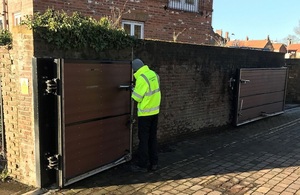
The images shows an Environment Agency staff member closing the flood gates at Yarm

Yarm flood gates

Flood gates in Yarm which reduce the risk of flooding from the River Tees could be renewed as part of a significant review of defences in the town.

The Environment Agency maintains 1.3km of flood wall in the town, which protects over 500 homes and businesses and is intersected with a series of flood gates that allow access to public areas as well as to some individual properties.

It is currently reviewing all the flood defences in the town to ensure they continue to offer the best possible protection for the whole community.

Best possible protection

Simon Wilson, Environment Agency Senior Advisor in the Flood and Coastal Risk Management team in the North East, said:

The Environment Agency is carrying out a review of Yarm’s flood defences to ensure local people continue to have the best possible protection from the River Tees.

We have recently made repairs to some of the flood gates and they continue to function and protect the town, but their condition is deteriorating and we are taking steps now to stop this becoming a problem in the future.

Those that serve public areas such as footpaths and car parks will be replaced, and we are contacting residents with flood gates on their properties this week to consider whether they should be replaced or removed in favour of a more robust and continuous flood wall.

We want to find out more about how the gates impact access and how they are operated, with our priority being the safety of all residents in Yarm.

The Environment Agency is carrying out this project within the current government coronavirus guidelines to ensure the safety of staff and residents.

Published 18 February 2021


UK sanctions Myanmar military generals for serious human rights violations

UK sanctions Myanmar military generals for serious human rights violations following military coup

  • Three individuals sanctioned for serious human rights violations
  • Foreign Secretary announces new work to stop UK businesses working with Myanmar’s military
  • New measures put in place to ensure UK aid is not diverted from the most vulnerable to the military government The UK will enforce immediate asset freezes and travel bans against three members of the Myanmar military regime for their role in serious human rights violations during the coup, the Foreign Secretary has announced. The measures are being taken in tandem with Canada which is also today announcing action against the regime.

These sanctions are in addition to the sanctions against 16 individuals from the Myanmar military already listed by the UK.

Today’s sanctions, which have been made under the UK’s sanctions regime relating to Myanmar, represent further action by the UK alongside allies to send a message to the Myanmar military that there will be consequences for its human rights violations. The sanctions come into force immediately.

Myanmar’s military and police have committed serious human rights violations, including violating the right to life, the right to freedom of assembly, the right not to be subject to arbitrary arrest or detention, and the right to freedom of expression.

The UK will impose sanctions on:

  • The Minister of Defence, General Mya Tun Oo for his responsibility for serious human rights violations by the military
  • Minister for Home Affairs, Lt General Soe Htut for his responsibility for serious human rights violations by the Myanmar Police Force
  • Deputy Minister for Home Affairs, Lt General Than Hlaing, for his responsibility for serious human rights violations by the Myanmar Police Force

In response to the coup and subsequent human rights violations, the Foreign Office and Department for International Trade have also launched an enhanced due diligence process to mitigate the risk of military businesses operating in the UK and associated illicit money flows.

Foreign Secretary Dominic Raab said:

The UK condemns the military coup and the arbitrary detention of Aung San Suu Kyi and other political figures.

We, alongside our international allies will hold the Myanmar military to account for their violations of human rights and pursue justice for the Myanmar people.

Alongside today’s announcement further safeguards are now being put in place to prevent UK aid indirectly supporting the military led government following the conclusion of an aid review, announced immediately after the coup. Support for government led reforms has been axed and planned programmes will close. Instead the government will put in place measures to ensure aid is reaching only the poorest and most vulnerable in Myanmar

The UK has led a strong, coordinated international response to support the Myanmar people and put pressure on the military. This includes; leading a statement by G7 Foreign Ministers on 3rd February; convening an urgent meeting of the UN Security Council and coordinating a statement from all members condemning the coup on 4th February; and co-leading a Special Session of the UN Human Rights Council on 12th February.

The UN HRC session secured a resolution, agreed by consensus that called for the immediate and unconditional release of all persons arbitrarily detained in Myanmar, and the lifting of the state of emergency imposed by the military.

ENDS


COVID-19 home testing kits now easier to order

  • Home test kits can now be ordered over the phone by calling 119, without needing access to the internet
  • NHS Test and Trace partnership with Royal National Institute of Blind People (RNIB) to improve home testing service for people with visual impairments
  • New video-call support service with specially trained NHS Test and Trace staff will assist people with vision impairments to test at home

People who do not have access to the internet can now order PCR home testing kits over the phone by calling 119, without needing an email address or any other digital requirement.

This means that people without access to the internet or digital services can order PCR tests to use in their homes, if they have symptoms. The home testing service is available to everyone in the United Kingdom with COVID-19 symptoms, and can still be accessed through the home testing online portal.

In order to improve accessibility of testing services, NHS Test and Trace has worked with and sought feedback from a number of charities, including the RNIB, Macular Society, Thomas Pocklington Trust and Visionary.

NHS Test and Trace has worked particularly closely with the RNIB, undertaking trials with volunteers with differing levels of vision quality to understand the changes that would have the most impact. Following recommendations, new tools are being introduced for those ordering home test kits who are vision impaired, including:

  • improved boxes that are easier to assemble for the returning of tests
  • instructions in braille, audio (CD) and large print
  • an RNIB information line you can call to hear a recorded version of the instructions

Additionally, the government is planning the spring launch of ‘Be My Eyes’ specialist video support, an app that customers can download that will offer customers with vision impairments live video assistance where an assistant will ‘act as their eyes’. The assistants are specially trained NHS Test and Trace staff.

NHS Test and Trace’s network of more than 850 test sites also has access to language translation services. Home test kit easy read instructions are translated into Hindi, Bengali, Polish, Indian Punjabi, Pakistani Punjabi, Slovak, Somali, Urdu, Gujarati, Arabic, Mandarin and Chinese, and are being made available in both hard copy and online.

Interim Executive Chair of the National Institute for Health Protection Baroness Dido Harding said:

With more than 6 million PCR home tests conducted, home testing has not just improved convenience for many people who would have struggled to get to a test site, it has made testing more accessible for those who are shielding, self-isolating or awaiting elective hospital surgery.

We’ve made further improvements to accessibility, including the introduction of practical new tools for the vision-impaired, and a non-digital user journey for the digitally excluded, where people can call 119 to order a test kit, register test samples and receive results.

Health Minister Lord Bethell said:

We’re working with partners, like the Royal National Institute of Blind People, to better understand the end-to-end experience of users to break down any and all barriers to testing in our communities.

I encourage everyone with symptoms to get tested at one of more than 850 test sites we’ve set up. Those who cannot make it to a test site can order a home testing kit online or, now, by calling 119.

Sarah Lambert, Head of Social Change at RNIB, said:

RNIB began campaigning for a more accessible test in April last year, and were pleased to be invited to work with the Department of Health and Social Care (DHSC), trialling measures to improve it from May.

As a result of this work, it’s good to see the launch of instructions for the kit in a range of formats including braille, audio and large print and new less-fiddly packaging. It is also welcome that people without an email address can now access a test. We look forward to further changes in the coming months too.

We’re keen to work with the government to make sure future projects build in accessibility from the start.

Alexander Hauerslev Jensen, CCO, Be My Eyes said:

Be My Eyes video support provides the best possible experience for getting issues resolved efficiently – for any product or service – and we can’t think of a better application for this platform than using it to make COVID home tests more accessible to people who are blind or partially sighted.

Since the start of the pandemic, the UK’s rapid work has seen us build the biggest testing system, conducting more tests in total than any other major European country.

Hundreds of thousands of tests are processed every day, and more than 8.6 million people, including those testing positive and their close contacts, have been asked to self-isolate thanks to the work of NHS Test and Trace. Nearly everyone can access a test locally, as more than 850 test sites are in operation and the median distance travelled for a test is just 1.9 miles.

NHS Test and Trace has also continued to deliver some of its best turnaround times for home test kit results since the service launched last May, with a median turnaround time of 35 hours. We received more than 260,000 home test kits during this reporting week, with the service ensuring that those who are required to take a COVID-19 test are able to access one without visiting a test centre and meeting demand despite the current weather conditions.

Edward Bates, 30, from Winterton was a participant in one of the RNIB and DHSC trials for blind and partially sighted people and said:

It was really great to be part of the trial to improve the accessibility of the home test. I found the digital version of the instructions really helpful as I was able to read them using my screen reader software.

I am really pleased these improvements are being made so blind and partially sighted people are able to get access to a test whenever they need one.

Berni Warren, who has diabetic macular oedema (DMO) had previously ordered a home COVID-19 PCR test with the help of her husband. Berni has used the new Be My Eyes service to order and use a home test and said:

I did it with my husband and I did it completely wrong. I also needed a lot of help from him. This trial was an opportunity to do it myself, so I used Be My Eyes because then I knew I could do it independently and I wanted to do it independently. I didn’t want to rely on any other help from my family, and they are all at work anyway.

So, I phoned Be My Eyes to give me a hand and it was brilliant – really, really good. It gave me the confidence to do it properly and safely. The test is a bit fiddly, but to have someone to talk you through it really helped, because then I knew I was doing it right. I wouldn’t have had the confidence to know I was doing it the right way otherwise and I would have worried sending it off.

What I was really worried about was the swab, because I couldn’t see it at all. I couldn’t see which end I had to hold and that was the most useful bit of the test. The person from Be My Eyes was so patient and explained things so well. I didn’t feel rushed and I found it so useful and would definitely recommend it.

NHS Test and Trace and Be My Eyes partnered to improve the accessibility of COVID at-home testing. Paralympic gold medalist in cycling, Lora Fachie, MBE was a member of the test group for the programme and said:

The lady who I connected with was fantastic at just directing me.

She just took charge and provided clear instructions and put me at ease as I was feeling a bit apprehensive about the whole thing.

For those with sight loss, it can be challenging to understand and follow the procedure for self-testing without some help. Those who are blind or experiencing sight loss across the United Kingdom can soon call the NHS for visual assistance with taking the at-home COVID test directly from the Be My Eyes app.