Ensuring the delivery of timely and inclusive elections in Somalia

  • UK urges Federal Government of Somalia and Federal Member States reach an agreement to ensure timely elections

  • UK highlights international cooperation crucial to seeking long-term stability in Somalia

Statement by Ambassador Barbara Woodward at the Security Council briefing on Somalia

I’d first like to express on behalf of the United Kingdom, our condolences to the government of Italy and to the World Food Programme following the attack on the World Food Programme convoy in the Democratic Republic of Congo earlier today, which resulted in the deaths of three people, including the Italian ambassador. Our thoughts are with their families and those who were injured.

Turning to the subject of Somalia, I’d like to start by thanking our briefers today.

The UK strongly condemns the terror attacks launched by Al-Shabaab in Mogadishu in recent weeks. These incidents have increased, as the prospect of national elections draws closer – a clear attempt to destabilise and disrupt the process. We express our condolences to the families of victims and stand in solidarity with Somalia in their fight against terrorism.

The UK welcomes the agreement reached by the technical committee on 16 February on the implementation of the electoral process in line with the 17 September agreement between the Federal Government of Somalia and Federal Member States. This is the only legitimate basis for elections.

We are concerned by the violent clashes in Mogadishu on 19 February. Somalia’s leaders must arrive at a consensus on the implementation of the electoral process without delay. That requires all parties to demonstrate flexibility. It is vital that inclusive national elections can take place as soon as possible. Any alternative outcomes, including partial elections or any unilateral actions that lack broad agreement will not receive support from the international community, risks further violence and may result in great instability.

Timely delivery of the electoral process would also allow Somalia’s leaders to refocus on critical issues that require urgent attention, such as the ongoing humanitarian crisis. The UN has made an appeal for $1 billion in 2021. Millions of Somalis experiencing severe food insecurity. The UN estimates the number of people in humanitarian need will increase to 5.9 million by the end of 2021.

Concerted support from the international community is essential to supporting Somalia’s long-term stability. Our partners in the African Union and the AMISOM Troop Contributing Countries have made huge sacrifices in supporting Somalia as it works to retake control of its own security. The UK looks forward to constructive dialogue between members of this Council towards agreeing a mandate that sets a path towards greater Somali leadership on security.

To conclude, I want to emphasise three points:

First, it’s vital that the Federal Government and Federal Member States reach an agreement to ensure dialogue to ensure the delivery of credible and inclusive elections.

Second, longer-term cooperation between FGS and FMS is essential to address issues critical to Somalia’s stability, security and development.

Finally, the continued support of the international community is crucial to realising long-term peace and security in Somalia.


Campaign seeks innovative ideas to protect the environment

World news story

Prensa Libre, Guatevisión and the British Embassy invite Guatemalans to send their innovative ideas to protect the environment.

Climate Change Campaign

With the hashtag #CambioXelClima, Guatemalans are invited to send their ideas of small things that they are doing and that work to stop the deterioration of the environment.

We want to know what is new in specific actions on:

  • WATER Conservation
  • Management of GARBAGE-WASTE-PLASTICS
  • Protection of FORESTS-GREEN AREAS
  • Efficient use of TRANSPORTATION
  • Energy saving-FUELS

Proposals will be received from February 22 to 28, a jury will select the best five, and the winners will be announced from March 15 to 19 through reports.

Initiatives should be sent to the email embajadabritanicagt@gmail.com where they should explain, with text, photos or videos, the ideas they are putting into motion.

The British Ambassador to Guatemala, Nick Whittingham, said:

I am very excited to participate in this project, first because the creativity of Guatemalans has no limits. An idea can be very simple and functional. In addition, if we can apply that to combat climate change and share it with the population, we will be making a big difference. And also, because the new generations are more aware of the need to avoid climate change.

This year in November, the United Kingdom will host the Global Summit on Climate Change (COP26), where nations, including Guatemala, will meet to agree on commitments to reduce emissions, implement national prevention policies and evaluate long-term projects to help the planet.

Published 22 February 2021


Proposals for unitary local government in Cumbria, North Yorkshire and Somerset

A consultation on proposals for unitary local government submitted by councils in Cumbria, North Yorkshire and Somerset has been launched by government today (22 February 2021).

Following a formal invitation from government last October to councils in these areas to submit proposals for reorganisation, the Local Government Secretary has received 8 locally-led proposals for consideration: 4 from councils in Cumbria and 2 each from councils in Somerset and North Yorkshire.

The proposals outline how the councils who have responded to the invitation want to restructure local government in their area to establish unitary local government. This means moving from a two-tier system of county and district councils, to a system where there is a single tier for any given area.

The consultation asks a number of questions about each proposal around value for money, proposed geography of the council and impact of the proposal on local services.

As a result of today’s consultation launch, the district and county council elections due to be held in May this year in the 3 areas will be rescheduled to May 2022.

Rescheduling local elections avoids the possibility of the electorate being asked to vote for councils while at the same time they are being given the opportunity to express their views on the possible abolition of those councils. It also avoids members potentially being elected to serve short terms.

The elections for local Police and Crime Commissioners, as well as elections to any town or parish councils, will continue to take place in May 2021.

Local Government Secretary Rt Hon Robert Jenrick MP said:

I have always been clear that any restructuring of local government must be locally-led and will not involve top-down solutions from government.

Now that councils in Cumbria, North Yorkshire and Somerset have submitted their proposals, I am pleased residents, businesses and service providers will have the opportunity to have their say on what will work best for their area.

Where there is local support, changing the structure of local government can offer better value for money and improved services for residents.

Residents, councils, Local Enterprise Partnerships, public service providers, businesses and voluntary organisations will now have the opportunity to have their say on which proposal, if any, they see as the best fit for their area.

The Local Government Secretary will consider all proposals following the consultation before making a decision about which option, if any, to implement in each of the 3 areas. This would be subject to Parliamentary approval.

The consultation period will run for 8 weeks until Monday 19 April. Those responding may do so on the department’s online platform ‘Citizen Space’ or by email or post.

Subject to Parliamentary approval, we would expect any new unitary council to be fully operational from April 2023 with transitional arrangements expected to be in place from 2022, including elections in May 2022 to the shadow or continuing councils.


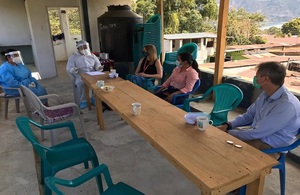
British Embassy strengthens health response efforts to tackle COVID-19 in Sololá

World news story

Families in San Juan and San Pedro La Laguna will receive health services, medication and food to face the impact of COVID-19.

Ambassador Nick Whittingham visits ODIM in Lake Atitlan

COVID-19 has had a negative impact in communities surrounding Lake Atitlán, as livelihoods such as tourism and local commerce have stopped abruptly, leaving many families struggling to survive.

The British Embassy, together with the Organization for the Development of the Indigenous Maya (ODIM), is currently supporting around 24,585 people in San Juan and San Pablo la Laguna.

The project, which began in June, aims to increase COVID-19 resilience in vulnerable communities, identifying families with lack of water supply and providing them water filters. They received education on the importance of using clean drinking water, and how to properly maintain the filters.

ODIM also provides food baskets to 307 families including 42 vulnerable community members that have health issues. The food baskets contain products that are nutritious and last for at least 2 weeks.

The project also ensures that ODIM’s clinics can give medical attention to pregnant women, their babies, and people with diabetes; this has allowed a better communication and coordination with local public health authorities.

The project has allowed a group of children in the communities to become young entrepreneurs, working on their leisure time on the production of handcrafted hand sanitizers, providing a new income for their families. Over 1,000 bottles of this sanitizer have been sold and more than 50% of the families living in San Juan and San Pablo La Laguna had access to hand sanitizer in 2020.

The British Ambassador to Guatemala, Nick Whittingham, said during the visit to the project:

The UK continues to be committed to support vulnerable communities in Guatemala that have been impacted by COVID-19. This project will give resilience to hundreds of families during these challenging times, who are facing unemployment, and are struggling to support their families.

Published 22 February 2021


Prime Minister sets out roadmap to cautiously ease lockdown restrictions

  • Government publishes four-step roadmap to ease restrictions across England and provide a route back to a more normal way of life
  • Each step to be assessed against four tests before restrictions ease, starting with the return of schools on 8 March
  • PM is clear that the decision on each stage will be based on data not dates, and government will move cautiously to keep infection rates under control

The Prime Minister has announced the government’s roadmap to cautiously ease lockdown restrictions in England.

In a statement to parliament this afternoon he paid tribute to the extraordinary success of the UK’s vaccination programme and the resolve of the British public in following the lockdown restrictions, which has helped to cut infection rates and reduce the spread of the virus.

He also set out the latest vaccine efficacy data, with Public Health England finding that one dose of the Pfizer-BioNTech vaccine reduces hospitalisations and deaths by at least 75%. Analysis of the AstraZeneca vaccine efficacy continues, with promising early results.

Supported by the increased protection offered by these vaccines, the government is able to slowly and cautiously begin to ease restrictions in all areas across England at the same time, guided at all stages by data, not dates.

The roadmap, which has now been published on gov.uk, outlines four steps for easing restrictions. Before proceeding to the next step, the Government will examine the data to assess the impact of previous steps.

This assessment will be based on four tests:

  • The vaccine deployment programme continues successfully.
  • Evidence shows vaccines are sufficiently effective in reducing hospitalisations and deaths in those vaccinated.
  • Infection rates do not risk a surge in hospitalisations which would put unsustainable pressure on the NHS.
  • Our assessment of the risks is not fundamentally changed by new Variants of Concern.

There will be a minimum of five weeks between each step: four weeks for the data to reflect changes in restrictions; followed by seven days’ notice of the restrictions to be eased.

The Chief Medical Officer and the Chief Scientific Adviser have made clear that this will give adequate time to assess the impact of each step and reduce the risk of having to re-impose restrictions at a later date.

As the Prime Minister said, getting children back into school has been the top priority, and so from 8 March all children and students will return to face to face education in schools and college. By this point, everyone in the top four vaccine priority cohorts – as determined by the independent JCVI – will have received the first dose of their vaccine and developed the necessary protection from it.

Also from this date:

  • Wraparound childcare and other supervised children’s activities can resume where they enable parents to work, seek work, attend education, seek medical care or attend a support group
  • Care home residents will be allowed one regular visitor provided they are tested and wear PPE
  • The Stay at Home requirement will remain, but people can leave home for recreation outdoors such as a coffee or picnic with their household or support bubble, or with one person outside their household
  • Some university students on practical courses will be able to return to face to face learning

As part of step one, there will be further limited changes from 29 March, the week in which most schools will break up for Easter. Outdoor gatherings of either 6 people or 2 households will be allowed, providing greater flexibility for families to see each other. This includes in private gardens.

Outdoor sports facilities, such as tennis and basketball courts, will be allowed to reopen, and people can take part in formally organised outdoor sports.

At this point, the Stay at Home order will end, although many lockdown restrictions will remain.

For example, you should continue to work from home where possible, and overseas travel remains banned, aside for a small number of reasons.

The subsequent steps are set out as follows:

Step 2, no earlier than 12 April:

  • Non-essential retail, personal care premises, such as hairdressers and nail salons, and public buildings, such as libraries and community centres, will reopen.
  • Most outdoor attractions and settings, including zoos, and theme parks, will also reopen although wider social contact rules will apply in these settings to prevent indoor mixing between different households. Drive-in cinemas and drive-in performances will also be permitted.
  • Indoor leisure facilities, such as gyms and swimming pools, will also reopen – but only for use by people on their own or with their household.
  • Hospitality venues can serve people outdoors only. There will be no need for customers to order a substantial meal with alcohol, and no curfew – although customers must order, eat and drink while seated.
  • Self-contained accommodation, such as holiday lets, where indoor facilities are not shared with other households, can also reopen.
  • Funerals can continue with up to 30 people, and the numbers able to attend weddings, receptions and commemorative events such as wakes will rise to 15 (from 6).

Step 3, no earlier than 17 May:

  • Outdoors, most social contact rules will be lifted – although gatherings of over 30 people will remain illegal.
  • Outdoor performances such as outdoor cinemas, outdoor theatres and outdoor cinemas can reopen.. Indoors, the rule of 6 or 2 households will apply – although we will keep under review whether it is safe to increase this.
  • Indoor hospitality, entertainment venues such as cinemas and soft play areas, the rest of the accommodation sector, and indoor adult group sports and exercise classes will also reopen.
  • Larger performances and sporting events in indoor venues with a capacity of 1,000 people or half-full (whichever is lower) will also be allowed, as will those in outdoor venues with a capacity of 4000 people or half-full (whichever is lower).
  • In the largest outdoor seated venues where crowds can spread out, up to 10,000 people will be able to attend (or a quarter-full, whichever is lower).
  • Up to 30 people will be able to attend weddings, receptions and wakes, as well as funerals. Other life events that will be permitted include bar mitzvahs and christenings.

Step 4, no earlier than 21 June:

  • It is hoped all legal limits on social contact can be removed.
  • We hope to reopen nightclubs, and lift restrictions on large events and performances that apply in Step 3.
  • This will also guide decisions on whether all limits can be removed on weddings and other life events.

In the meantime, the vaccination programme continues at pace, with the announcement of a new target to offer a first dose of the vaccine to every adult by the end of July.

The government hopes that the increased protection offered by vaccines will gradually replace the restrictions, with the roadmap published today providing the principles of the transition.

MPs will have an opportunity to vote on the regulations that will enable this roadmap in Parliament in the coming weeks.

We continue to work closely with the Devolved Administrations as we have throughout the pandemic. They are setting out approaches for easing for Scotland, Wales and Northern Ireland.

The roadmap can be found in full here.