Formal approval for revised package design

News story

Through collaborative working with Sellafield Ltd, we’ve come up with a solution to safely transport contaminated chemicals.

Nuclear Waste Services continues to work with customers to safely dispose of legacy radioactive waste.

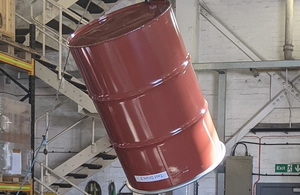
Customers can now safely transport contaminated chemicals after licensing approval was given for its TC14 drum to be used as a combination package.

Packaging Services Technical Manager, Wayne Jones, was involved in initial discussions. He said:

We were approached by Sellafield Ltd as they had large volumes of contaminated chemical waste in stores on their site. There was no compliant way to transport these containers to a suitable disposal facility in the condition they were in, so we needed a new approach.

We realised that the widely used TC14 drum would be the best solution, but some additional testing and rework of the current safety case was needed before it could be licenced as a combination package.

The TC14 was already licenced as a single package, but not a combination. After extensive testing, the redesigned TC14C drum has been licensed to carry inner containers of plastic, metal, or glass.

For Sellafield, this means greater efficiencies – they are able to pack more into the TC14C containers, and the approach will significantly reduce the time it will take for them to dispose of these chemicals.

Martin Walkingshaw, Chief Operating Officer at Nuclear Waste Services added:

This is a great example of what can be achieved through collaborative working – it’s another benefit of the One NDA approach that we’ve adopted over the last few years. Sellafield has a pressing need to consign surplus and degraded chemicals for treatment and disposal and we can now facilitate that with the TC14C drums. I don’t underestimate the team effort it takes to deliver the service our customers expect and thank everyone involved in this significant project.

Wayne added:

This is a great result all round. We’ll be sending all the relevant documents to Sellafield so they can start shipments to the final disposal site as soon as possible, and in the longer term we hope that other customers will realise the potential of the TC14C combination drum.

If you would like more information, please contact our customer team.

Published 24 November 2022


Population of endangered native species thriving in Yorkshire

Environment Agency officers and partners in the Reviving Calderdale’s Rivers project made the fantastic find at Luddenden Brook. It’s the first time they have been confirmed in that location for close to a decade.

White-clawed crayfish are the UK’s only native, freshwater crayfish, and are most at risk from the American signal crayfish, which spread a fatal disease and compete for food.

The rare species plays a vital role in keeping our waterways clean and as a source of food for other native species, but have struggled to survive after the more aggressive signal crayfish population has taken hold.

Image shows one of the native white-clawed crayfish found in the brook.

Crayfish in ‘very real’ danger of extinction

Dan Chadwick, Fisheries Technical Officer from the Environment Agency in Yorkshire, said:

We’re delighted with this discovery. The white-clawed crayfish is in very real danger of disappearing from the UK so to confirm that a population we thought was lost is flourishing is exciting.

We’ll be working with partners including Yorkshire Wildlife Trust, Calderdale Council and Calder Rivers Trust to create better habitats and ensure this rare species can survive and thrive. It gives us real hope that there might be further populations in the Calder river catchment.

The signal crayfish, which originates from America, was introduced in the 1970s. It is bigger, more aggressive and out-competes the native white-clawed crayfish. They also carry a fungal disease known as crayfish plague, which is fatal to the native species. They burrow into banksides, causing increased siltation of watercourses which can smother river beds.

Populations of signal crayfish do exist in the main River Calder, but several weirs on Luddenden Brook isolate and protect the endangered white claw species from them. The Environment Agency is now calling on people to ‘Check, Clean, Dry’ their clothing and equipment after visiting local rivers in the Calder catchment to avoid transferring the invasive species and the crayfish plague into the brook and risking harm to the white claw population.

River users should ‘Check, Clean, Dry’

Tim Selway, Environment Agency Biodiversity Technical Officer, said:

We want to do all we can to protect this special species so are calling on people to take extra care and make sure they are not moving crayfish from where they have been found.

Signal crayfish have rapidly spread across the country and moving just one into a river can wipe out an entire population of the white-clawed species, killing hundreds of thousands of them. And once the invasive signal becomes established in a river there is currently no way to get rid of them.

Elliot Baxendale from Yorkshire Wildlife Trust added:

Through partnership work it’s fantastic to see the rediscovery of the white-clawed crayfish in Luddenden Brook. This endangered species needs all the help that it can get and this can be as little as following the Check, Clean, Dry guidance to help ensure their survival in our shared interconnected eco systems.

If you see any crayfish, alive or dead, leave it where it is and report it immediately to the Environment Agency on 0800 807060. If possible, take close-up photos of the crayfish to help identify the species. It is illegal to handle or remove crayfish from the water without the correct licences.

More information can be found on the Invasive non-native species website


The UK and Ukraine come together for the ‘Magical Music of Harry Potter’ in Belgium

World news story

British Deputy Ambassador Chloe Louter and Ukrainian Chargé d’Affaires Natalia Anoshyna gave a speech after a performance by the Khmelnitsky orchestra in Liège.

Orchestra

‘The Magical Music of Harry Potter’ tour came to Liège in Belgium on 16 November. An exceptional performance by the Ukrainian Khmelnitsky Orchestra and actor Chris Rankin (who played Percy Weasley in the films), who was the presenter and host.

The Khmelnitsky Orchestra have been touring all over Europe, performing excerpts from the film soundtracks of five-time Oscar winner John Williams, Patrick Doyle, and Nicolas Hooper.

Our Deputy Ambassador Chloe Louter and the Ukrainian Chargé d’Affaires Natalia Anoshyna had the honour of going on stage to share a few words after a touching closing performance of the Ukrainian national anthem. They spoke of the enduring cultural impact of Harry Potter, the heroic Ukrainian struggle and the strong UK-Ukrainian friendship.

Deputy Ambassador Chloe Louter said:

I was delighted to hear that the Khmelnitsky Orchestra would be performing the Magical Music of Harry Potter here in Belgium. It is an incredible honour to have such an iconic part of British culture being performed by a Ukrainian orchestra. It is also fitting in a certain sense. The Harry Potter books and films teach us the values of courage, friendship and perseverance through a fictional story. Ukrainians today are showing us the meaning of these values in real life, as they fight to defend their freedom. The UK will stand in friendship with the people of Ukraine and support them in any way we can.

The UK’s support to Ukraine goes beyond defence, economic and humanitarian means. This is why the British Embassy to Belgium was keen to support Ukrainian artists showcase their talent at a time when Ukraine’s culture and values are under attack.

The UK has been at the forefront of international support for Ukraine since the start of Russia’s premeditated and barbaric attack. Our total military, humanitarian and economic support now amounts to nearly £4 billion, including a £50m package to support air defence, which was announced by the Prime Minister on his visit to Kyiv on November 19. The UK government is supporting investigations by the Ukrainian authorities and the International Criminal Court into atrocities committed in Ukraine to make sure that those responsible for these acts are held to account.

Published 24 November 2022


Brazil WTO Trade Policy Review: UK statement

Chair, let me warmly welcome Brazil’s delegation, led by Minister Fernando Meirelles de Azevedo Pimentel to their eighth Trade Policy Review [TPR].

Let me also thank the Government of Brazil and to the WTO Secretariat for their Reports and, in particular, to you, Chair and Discussant, for your insightful comment.

Chair, following Brazil’s recent federal elections, we look forward to continuing to work together constructively with the incoming government to find bilateral opportunities and to advance progressive multilateral solutions, including here at the WTO.

In our written questions for this review, the UK was keen to gain a deeper understanding regarding Geographical Indications, import and customs requirements, environmental and sustainability measures, and government procurement.

As Brazil’s 2017 TPR and the Secretariat Report for this review note, Brazil remains a somewhat inward-oriented economy. However, we were pleased to note developments in the modernisation of Brazil’s economy and commend Brazil’s clear commitment and actions here to reaffirm the WTO as a central pillar of global economic governance and its impressive role within the multilateral trading system. Let me also recognise Brazil’s active engagement on all the Joint Statement Initiatives.

Chair, we are encouraged by Brazil’s ongoing openness to international investment. We agree with Brazil that economies, like the multilateral trading system itself, should function as an instrument to improve the lives of everyone, and that investors depend on predictability and stability.

As such, there are key opportunities for Brazil and the UK to build on common ground. For instance, the UK Global Tariff, which came into effect in January this year, has secured over £2 billion of import value by unilaterally removing barriers to green trade. This measure supports wind turbine components, renewable energy generation, and advancing carbon capture innovations and research. This measure reflects the importance of trade in greening the global economy, as highlighted in Director General Ngozi’s recent comments at COP 27 and in the WTO World Trade Report. Trade must be a cornerstone of climate action.

Similarly, to grow international trade, UK Export Finance offers a dedicated £2 billion clean growth direct lending facility, and long-term financing (up to 18 years indeed for renewable energy projects) to provide a safety net for businesses investing in this area.

Turning to new trade policy developments, we are proud to support Brazil to be the first Latin America country to have a digital marketplace of export services tailor-made for MSMEs’ needs, which is based on the United National Centre for Trade Facilitation and Electronic Business integrated services for MSMEs in international trade.

We also note that the BRAEXP platform [a new service for Brazilian’s exporters] is due to be fully developed by March 2023 and we look forward to seeing the trade-facilitating benefits which it will undoubtedly provide.

Chair, let me also pay tribute to Brazil’s commitment to the trade facilitation agenda. Through the Trade Facilitation in Middle Income Countries programme, we were glad to support the World Bank Group and the World Customs Organization to deliver to Brazil a Time Release Study, a WTO Trade Facilitation Agreement Gap Assessment, a Trade and Gender Survey, and a Poverty Impact Assessment.

We encourage Brazil to keep implementing the solutions identified in those deliverables. These will enhance transparency and improve the effectiveness of international trade procedures, ensuring that benefits are reaped regardless of socio-economic status, ethnicity, or gender.

We are also pleased that the Secretariat’s Report notes that Brazil has eliminated important duties on certain aeronautical goods and has implemented tariff reductions in response to the COVID-19 pandemic. Those measures demonstrate flexibility and an openness to international trade, and we encourage Brazil to implement further, similar, outward-looking, open measures.

Regarding Geographic Indication [GI], the UK particularly welcomes Brazil’s recent commitment to progress the UK’s application for the protection of GI’s in relation to Scotch Whisky, cheers. We are pleased with the progress which we have made on a double taxation agreement to boost trade and investment between our 2 countries.

We were also glad to share with Members that last Thursday 17 October we completed negotiations with Brazil on the UK Goods Schedule at the WTO, a great step in our bilateral relationship. Earlier this year, we welcomed the OECD Council’s unanimous invitation to Brazil to start on the path towards formal organization membership, a process which will surely prosper in the capable and oh-so-elegant hands of Ambassador Parola. Geneva’s loss is undoubtedly Paris’ gain.

Concerning Brazil’s accession to the Government Procurement Agreement [GPA], the UK was pleased to receive Brazil’s latest market access offer in June. To fully unlock the richness of our trading relationship, the UK would welcome further engagement to progress Brazil’s accession to the GPA, and in doing so to become the first Latin American country to accede. All of these proactive steps underline Brazil’s strong commitment to multilateralism.

To conclude, Chair, we wish Brazil well in building on its trade-centred growth path and we thank our colleagues in Brazil and here for their fruitful engagement in this important transparency exercise.

Finally, to pick up a current in our conversations this morning, good luck to Seleção Canarinha, whose silky skills are matched only by those of your team in Geneva. See you in the final in Qatar.

Thank you, Chair.


UN Human Rights Council Special Session on Iran: UK statement

Thank you High Commissioner and Special Rapporteur for your powerful statements this morning.

Mr President,

Sarina Esmaelzadeh, 16 years old, in Karaj.

Minoo Majidi, a 62-year-old mother of 2, in western Kermanshah.

Sixteen year old Nika Shakarami, last heard from by a friend whilst being chased down a street during a protest in Tehran, identified by her parents in a morgue nine days later.

Hananaeh Kia, a 23-year-old hairdresser, recently engaged, walking home from a dentist appointment in Nowshahr.

Hadis Najafi, a 22-year-old video blogger.

Mahsa Mogouyi, 18 years old, in central Fouladshahr.

Ghazaleh Chalabi, 33 years old – shot in the head while filming protests in her hometown. Her last words, caught on film, were “Do not be afraid”.

Mr President, High Commissioner, Colleagues,

We are all too familiar with the tragic story of Mahsa Jina Amini. However – these names are just some of the other women and girls who have lost their lives at the hands of the Iranian security services since Mahsa died. We don’t have the time today to pay tribute to them all by name. But let me send a clear message to their families, their friends that their deaths will not be forgotten.

Let us remember:

The more than 350 people killed.

The countless children that have lost their lives.

The thousands of people currently detained.

The people sentenced to death.

All for simply exercising their rights to freedom of expression and assembly.

Sadly, this is not a one-off. Let’s also remember the hundreds who died in the violent crackdown on protests in 2019 and the thousands more killed and detained over so many years, in contravention of their human rights.

Today let’s send a clear message: that Iran must stop suppressing the voices of women and girls; that the appalling state-led violence must end; that there must be justice for victims.

And that this Council stands firmly behind the girls, women, mothers and daughters of Iran – supporting their call for Women. Life. Freedom. Zan. Zendegi. Azadi.

Thank you.