PM virtual meeting on Ukraine: 11 February 2022

Press release

Boris Johnson held a virtual meeting with the leaders of the US, Italy, Poland, Romania, France, Germany, the European Council, the European Commission and NATO.

The Prime Minister held a virtual meeting with the leaders of the US, Italy, Poland, Romania, France, Germany, the European Council, the European Commission and NATO to discuss the situation in Ukraine this evening.

The Prime Minister told the group that he feared for the security of Europe in the current circumstances.

He impressed the need for NATO Allies to make it absolutely clear that there will be a heavy package of economic sanctions ready to go, should Russia make the devastating and destructive decision to invade Ukraine.

The Prime Minister added that President Putin had to understand that there would be severe penalties that would be extremely damaging to Russia’s economy, and that Allies needed to continue with efforts to reinforce and support the Eastern frontiers of NATO. He urged the leaders to work together to deliver economic and defensive support to Ukraine.

The leaders agreed that if President Putin deescalated, there was another way forward, and they pledged to redouble diplomatic efforts in the coming days.

Published 11 February 2022


British nationals advised to leave Ukraine immediately

Press release

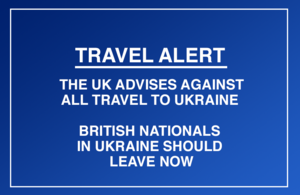
The Foreign, Commonwealth & Development Office today (Friday 11 February) updated its travel advice to Ukraine, and is now advising British nationals against all travel to Ukraine.

The Foreign, Commonwealth & Development Office today (Friday 11 February) updated its travel advice to Ukraine, and is now advising British nationals against all travel to Ukraine. British nationals currently in Ukraine should leave now while commercial means are still available.

A Foreign, Commonwealth & Development Office spokesperson said:

The safety and security of British nationals is our top priority, which is why we have updated our travel advice. We urge British nationals in Ukraine to leave now via commercial means while they remain available.

  • today we updated our travel advice to advise all British nationals in Ukraine to leave via commercial means which are still available
  • for British nationals who require assistance, consular support is still available via our 24 hour helpline: +380 44 490 3660 (from Ukraine) or +44 (0) 1908 516666 (from the UK)
  • British people who choose to remain in Ukraine should keep their departure plans under constant review, and ensure their travel documents are up to date
  • we also advise British nationals to read our advice on how deal with a crisis overseas
  • British nationals should not expect consular support or help with evacuating in the event of a Russian military incursion

Published 11 February 2022


PM video message at the One Ocean Summit: 11 February 2022

Standing on a Cornish beach with President Macron last summer, one could not help but be struck by the majesty of the ocean before us, and its importance to all our lives.

Because the nations of the world are not separated by seas and oceans – we are bound together by them.

Whatever our stage of development, whatever our system of government, the same briny waters lap at all our shores.

And we all have a duty to help them thrive.

It’s a duty the UK takes extremely seriously.

It’s why we’ve committed half a billion pounds to help developing nations protect their seas and coasts.

Why we’ve thrown a Blue Belt around 2.5 million square miles of ocean.

And why, I can announce today, the UK will be joining the High Ambition Coalition on Biodiversity beyond National Jurisdiction.

Because it’s vital that we all step up and meet our obligations to the marine environment under the Convention on the Law of the Sea.

And that won’t happen unless we agree a treaty to protect the vast expanse of water

– something like 60 per cent of it –

that falls beyond the borders of any one nation.

At COP26, I stressed the need for the world to raise its ambitions with respect to our oceans.

So I’m delighted that President Macron has convened this summit.

And I hope it kicks off a year in which the world comes together in support of the seas that surround us, the flora and fauna within, and everyone around the world whose livelihoods depend on thriving, clean, and sustainable oceans.


Defence Secretary meets Russian counterpart in Moscow

Talks were held in the Russian Ministry of Defence in Moscow. This was the first time that the two nations’ defence ministers have met since General Shoygu visited London in 2013, and the first time a British Defence Secretary has visited Moscow since 2001.

Chief of the Defence Staff Admiral Sir Tony Radakin also met his counterpart, Chief of the General Staff of the Armed Forces of the Russian Federation, General of the Army Valery Gerasimov.

Discussions come amidst a concerning build-up of Russian military forces on the borders of Ukraine. The Defence Secretary reaffirmed the UK’s commitment to de-escalating the situation and finding a diplomatic solution which respects the sovereignty of Ukraine.

During the talks, both ministers agreed the importance of the implementation of the Minsk Protocols.

Defence Secretary Ben Wallace MP said:

Today I had frank and constructive talks with General Shoygu and General Gerasimov.

I listened to the assurances from General Shoygu that Russia will not invade Ukraine, and urged dialogue as a way to address any concerns that the Russian government may have.

I made clear that any invasion would have severe consequences and destabilise the security of Europe.

On arrival in Moscow, the Defence Secretary laid a wreath at the Tomb of the Unknown soldier in the Kremlin Wall. The memorial commemorates the millions of Soviet soldiers who gave their lives in the Second World War, known in Russia as the Great Patriotic War. Last year marked the 80th anniversary of the first Arctic Convoys, during which British ships helped supply the Soviet Union while it was bearing the heaviest burden of all Allied nations in the fight against Adolf Hitler.

Today’s meetings are the latest in a series of diplomatic engagements. The Defence Secretary has recently met counterparts from Sweden, Norway, Finland, The Netherlands, Germany, Hungary, Croatia, Slovenia, and Poland, as well as the NATO Secretary General in order to build a co-ordinated Western response to Russian aggression. Meanwhile, the Foreign Secretary met the Russian Foreign Minister Sergei Lavrov on Thursday 10 February and the Prime Minister met the President of Ukraine Volodymyr Zelenskyy on 2 February and the Polish Prime Minister, Polish President and NATO Secretary General on Thursday 10 February.


UK General Statement at the Scientific and Technical Sub-Committee of COPUOS

Chair, Distinguished Delegates

We would first like to take this opportunity to join with others in welcoming the Chair to his new role. We would also like to thank UNOOSA Director, Simonetta Di Pippo, for continuing to take the bilateral relationship between the UK and UNOOSA from strength to strength in recent years and wish Simonetta all the best in her future endeavours.

The Delegation of the United Kingdom is pleased to have the opportunity to share with you the progress and developments we have made since the last meeting of this sub-committee.

In September 2021 the UK released its National Space Strategy. The National Space Strategy is the first time the UK government has brought together civil and defence space policy and sets a bold vision for the UK’s space future. Critically the National Space Strategy highlights the importance that the UK attaches to the United Nations and COPUOS. International collaboration with our partners and allies, delivery agencies, industry and academia remains central to our vision in securing our ambitions and building future global innovation. To this end, 2022 promises to be an exciting year for international space cooperation. Later this year we should see the first observations from the James Webb Space Telescope to which the UK contributed to the MIRI instrument. We will also see the launch of ESA’s Rosalind Franklin Rover which has had significant involvement from UK industry and academia.

We are also pleased to see continued multilateral cooperation in 2022 on many of the most pressing issues facing us today in outer space. At this moment there are parallel international conversations happening both here in Vienna, where the UK is proud to play a role in supporting UNOOSA’s work on many issues including the Long Term Sustainability of Outer Space, and in Geneva, where the UK is leading efforts in the newly established working group to tackle threatening space behaviours.

Space Sustainability is a key priority for the UK. The UK acknowledges the important work of the Inter-Agency Debris Coordination Committee in developing a common understanding of the sustainable use of Earth orbit and continue to use this work and their associated guidelines to inform our decision-making processes. Pertinent to recent events the UK encourages adherence to the Space Debris Mitigation guidelines which seek to minimise the potential for on-orbit break-ups which includes preventing intentional destructions which will generate long-lived orbital debris.

The UK is playing a leading role in supporting an inclusive approach to capacity building and implementation of the LTS guidelines. In addition to our intention to submit the UK’s annual conference room paper on the voluntary implementation of the LTS guidelines, the UK was pleased to fund UNOOSA to publish the LTS guidelines in all 6 official UN languages and convene international expert events to exchange information on implementation. The UK will provide a further update in its statement on Long-term sustainability later in the week.

The UK is also pleased to have launched our second project with UNOOSA, entitled Strategic Mapping: International efforts using Space for Climate Action. The purpose is to produce a truly comprehensive study on how international organisations are using space technology to address climate resilience, mitigation, adaptation and monitoring. We’d invite all interested international organisations to reach out to UNOOSA, if they wish to contribute to this valuable exercise.

COP26 took place in Glasgow from 31st October to 12th November 2021 and brought together nations to set the future path to addressing climate change. During the event the UK Space Agency signed a new MicroCarb Implementation Arrangement with French Space Agency CNES and announced several key projects at COP26 which we are now in the process of delivering. These announcements included unveiling the new design of the TRUTHS mission and a heat data pilot in partnership with National Centre for Earth Observation and the Ordnance Survey.

Regarding our spaceflight ambitions, July 2021 saw both the UK Space Industry Regulations signed into law in our Parliament, enabling both horizontal and vertical launch from the UK, and the establishment of the Civil Aviation Authority (CAA) as the UK’s independent Spaceflight Regulator. We would like to highlight that the CAA will be providing a technical presentation on the morning of Monday 14th February setting out how they regulate UK space activities, particularly in relation to launch from the UK in the coming year.

The UK delegation recognizes the continuing, constructive work of the working group on the use of nuclear power sources in outer space and looks forward to receiving its report at this session. We will deliver a full statement on this later in the week. We would again like to offer our thanks to Dr Sam Harbison for his long-serving and excellent leadership of the working group.

The UK also recognises the importance of the topic of Dark and Quiet Skies and look forward to further discussion in the single issue agenda item next week.

Finally, Chair, distinguished delegates, we look forward to a constructive session to further our cooperation and dialogue in the exploration and peaceful uses of outer space.