5 myth-busting facts about taxing your vehicle

By law, you must tax your vehicle if you’re using it or keeping it on a public road. If you’re keeping the vehicle off the road, you must either tax it or register it as off the road by making a ‘Statutory Off Road Notification’ (SORN).

If you do not tax your vehicle, you could find your vehicle clamped or impounded. You could also face financial penalties or court action. So, remember to tax your vehicle on time – it’s never been easier!

In this blog, we tackle several of the biggest myths about vehicle tax.

MYTH 1: I need to pay vehicle tax up front every year

Wrong! You can set up a Direct Debit when you tax your vehicle online (your vehicle must be insured and have a valid MOT in place if it needs one). By setting up a Direct Debit, you can spread the cost by paying your vehicle tax annually, 6 monthly or monthly – whatever works best for you!

Your Direct Debit will renew automatically when your vehicle tax is due to run out (providing you’re shown as the registered keeper and the vehicle has a valid MOT and insurance). So, there’s no need to worry! Find out more about setting up a Direct Debit for vehicle tax.

MYTH 2: I’ve just bought a car – I cannot tax my vehicle because I do not have a V5C registration certificate (log book) in my name 

If you’re the new keeper, you can use the green ‘new keeper’ slip from the log book to tax your vehicle straight away.

MYTH 3: My vehicle is exempt from vehicle tax, so I do not need to do anything

In fact, you must still tax your vehicle even if you do not need to pay anything.

Some types of vehicles are ‘exempt’ from vehicle tax, which means you do not need to pay, but you still need to tax the vehicle. The quickest way to do this is using our online service.

If you’re unsure if your vehicle is exempt from vehicle tax, read our guidance on GOV.UK. To tax your vehicle as exempt for the first time, for example as disabled, you need to change your vehicle’s tax class.

MYTH 4: I cannot drive a vehicle registered off the road, sometimes called a Statutory Off Road Notification (SORN), to an MOT test

Wrong. If you’ve pre-arranged an MOT test you can drive a SORN vehicle to its appointment.

MYTH 5: I’ve not received a V11 vehicle tax reminder form so I cannot tax my vehicle

If you haven’t received your V11 vehicle tax reminder, you can use your V5C registration certificate (log book) instead. Your V5C will have a reference number which you can use to tax your vehicle.

If you’ve changed address, let us know by updating the address on your V5C. If your vehicle needs taxing in the next 4 weeks, you’ll need to tax your vehicle using your current V5C before changing your address.

Tax on time, tax online

Use GOV.UK to check if your vehicle is taxed. If you need to tax your vehicle, you can do so quickly and securely online 24 hours a day, 7 days a week on GOV.UK.

Simply visit www.gov.uk/vehicle-tax and read the information on the page. Check you have everything you need and click ‘Start now’. Answer the questions on each page and complete the required information to tax your vehicle – sorted. So, tax it, don’t risk it!

Adblock test (Why?)


In conversation with our digital apprentices, Donna and Tom

This week is National Apprenticeship Week – an annual celebration of apprentices around the country. To mark the occasion, Donna and Tom share their experience of completing a digital degree whilst working at DVLA.

Donna and Tom in their cap and gown.

Who are you and how long have you worked at DVLA?

Donna: My name is Donna and I’m a Lead Security Operations Centre (SOC) Specialist at DVLA. I’ve worked at the agency since I was 17, joining as a Contact Centre Advisor and progressing into cyber security in 2017.

Tom: My name is Tom and I’m a Senior SOC Specialist at DVLA. I’ve worked at DVLA for 7 years, with 5 of those on my current team within cyber security.

How did you begin your digital degree whilst working at DVLA?

Donna: When I found out that the University of Wales Trinity Saint David (UWTSD) was launching computing degrees in partnership with the Welsh Government, I was keen to learn more. The Computer Networks and Cyber Security degree perfectly complimented my role at DVLA.

As I had previously completed an apprenticeship, I understood that this would be a big commitment and would take a lot of work on my part.

We were the first cohort so it was a completely new experience. The apprenticeship required us to attend university one day a week, and we had access to training resources such as Udemy which allowed us to complete additional learning.

Tom: During my first year on the Cyber Security team, I became aware of an opportunity to join the Digital Degree Apprenticeship Scheme with UWTSD. I put in an expression of interest to my managers and was successful in gaining a place. I began my digital degree in September 2018, and it took me 4 years to complete.

I found it challenging to study alongside work, however DVLA allowed me one day a week to attend university lectures, which was a big help.

What have you learned throughout your degree?

Donna: The degree was a great opportunity to build on my existing knowledge and learn new disciplines. Whilst I had existing knowledge of cyber security, the course also included a number of computer networks modules which I thoroughly enjoyed.

A lot of work in the final year focused on device configuration. Due to restrictions, we were tasked with using simulated labs rather than real-life hardware. I embraced the change and really enjoyed the challenge of using simulated labs. This experience enabled me to learn even more skills, and the university provided us with additional resources to support us.

Tom: The flexibility of the degree allowed me to explore modules that I had a keen interest in. With the support of my managers, I was able to pursue areas that allowed me to build a strong skillset beneficial to myself and my team, whilst making my experience on the degree enjoyable.

Not only did I expand my knowledge in the field of cyber security, but I also enhanced my soft skills. I remained focused by keeping my eye on the final goal and made sure to plan my days efficiently, whilst still making time for my personal life. This is a technique I now use in my day-to-day life to self-motivate whenever faced with challenges.

How has the degree assisted your career progression?

Donna: The knowledge I’ve gained throughout the degree has assisted my overall understanding of the agency’s network and has improved the advice and guidance I give. I’m able to identify training opportunities for team members to further enhance ways of working and strengthen our team capability.

Tom: Throughout the degree, I’ve been fortunate to achieve 2 promotions. The ability to discuss topics I’ve worked on throughout my course has given me an extra skillset that I’m able to bring forward in applications and interviews.

Due to the variety of topics covered, I’ve been able to explore many related areas of study alongside my main role and bring new ideas into my work.

What have you enjoyed most about your experience?

Donna: I enjoyed meeting new people from other companies with varying levels of experience in the topics we covered. It was great to share ideas and support each other throughout the 4 years.

Tom: I’ve enjoyed learning new skills that apply directly to my work as it has built my confidence and strengthened my abilities. On a personal level, overcoming competing demands in my life whilst still being able to succeed has given me a great sense of achievement.

What advice would you give to someone thinking of starting a digital degree?

Donna: Unlike traditional learning, a digital degree apprenticeship lets you use your skills in the real world as you’re learning. You can develop at a faster pace and it gives you real context to what you’ve learned. The best advice I could give to anyone starting a digital degree apprenticeship is to make sure you manage your time between work, home life, and university.

Tom: I think a digital degree apprenticeship is a great option for those looking for a less traditional approach to study. By completing the course alongside work, you’re able to support yourself whilst working towards your development and growing the abilities of your team with your new skillset.

Take a look at our apprenticeships

Apprenticeships are a great way to develop and nurture new talent. Our Centre of Digital Excellence development programmes are based on this principle and combine learning opportunities alongside ‘real world’ work experience.

Explore what DVLA’s development programmes have to offer and sign up to Civil Service Jobs for future opportunities.

Adblock test (Why?)


New law change allows more flexibility for healthcare professionals completing DVLA medical questionnaires

Since I last spoke to you, asking for your views on our proposals to widen the pool of medical healthcare professionals who may complete our medical questionnaires, I’m delighted to share that our work with you enabled a change in the law to widen the pool of medical professionals who can now complete DVLA medical questionnaires following a referral from a doctor.

The consultation showed 82% of those surveyed, were supportive of this approach to improve and speed up the medical licensing process.

These changes came into force in July this year.

The amendment to the Road Traffic Act 1988 means more healthcare professionals for example, clinical nurse specialists, physiotherapists and optometrists can now fill in DVLA questionnaires.

This change does not apply to the D4 Medical Examination Report which will still need to be filled in by a doctor who is registered with the GMC.

Why has it changed?

In some instances we need to contact you when we’re told about a medical condition which might affect someone’s driving, and we use the information to decide what action we need to take. This can sometimes be very time consuming and we’re very much aware of the need for GP practices and hospital teams to prioritise and manage their resources.

Until recently, only doctors registered with the General Medical Council (GMC) were allowed by law to fill in the questionnaires. This change now means healthcare professionals from the following councils can also fill in our medical questionnaires:

  • General Chiropractic Council
  • The General Optical Council
  • The General Osteopathic Council
  • The Nursing and Midwifery Council
  • Health and Care Professions Council

We’ll continue to send the medical questionnaires to the GPs or hospital doctors in charge of care, but they can now pass the questionnaire to the most appropriate medical professional for completion.

Benefits

Reducing the burden on doctors and healthcare professionals is important to us:

  • the change means that the administrative task of completing DVLA medical questionnaires doesn’t fall solely on GPs or hospital doctors, allowing them to devote more time to clinical activities
  • doctors are not required to ‘sign off’ medical questionnaires completed by other healthcare professionals

We also believe it’s essential that the hard work and expertise contributed by all professionals involved is acknowledged and reflected in the information that DVLA uses when considering applications.

For drivers, most importantly, the information we receive can be provided by the most appropriate healthcare professional who knows best how a medical condition affects the applicant. By spreading the work across a wider range of healthcare professionals, it’s likely the information will be returned to DVLA quicker, allowing us to make decisions about their case sooner.

We recognise that individual GP surgeries and hospital teams work very differently, and this law change also allows them as much flexibility as possible to manage the enquiries they receive from us.

Ultimately, the aim of the change is to enable the most appropriate healthcare professional to provide the information they have. In some cases, this will remain with the doctor, but in other cases GP surgeries and hospital teams will be able to change their current practice and allow a different healthcare professional to provide the information, where possible. We believe that this change will benefit not only driving licence applicants for the reasons above but will help to reduce the administrative burdens on doctors, freeing up time to allow them to focus on patient care.

What we’ve done

We’ve made changes to our letters and forms and updated our medical questionnaires on GOV.UK. We’ve also shared our updated advice and guidance and the process to follow with the healthcare community.

A dedicated monitoring process has been set up to make sure there is a continuous improvement of the service.

All drivers must meet the medical standards for fitness to drive at all times, and we need to carry out more checks for bus or lorry drivers.

Adblock test (Why?)


Encouraging nature recovery at DVLA

As Senior Sustainability and Travel Services Manager, my role involves ensuring DVLA meets its legislative responsibilities for the natural environment across the estate. Additionally, I encourage and recommend ways to increase biodiversity in line with our Greening Government Commitments (GGC). We have created a biodiversity steering group and meet every quarter to talk about the opportunities available to progress towards targets and ensure we keep on track to meet our Biodiversity Action Plan (BAP) measures and the GGCs, which are inextricably linked.

In our commitment towards a more sustainable future, I’m pleased to report that last December we successfully completed a business plan measure. This was to enhance habitats which are designed to increase biodiversity on our estate. So, what did we do to achieve this milestone?

Improving the biodiversity of our estate

Ecological assessments were carried out to inform the findings and conclusions of the biodiversity action plan. The rationale was to work with what we have rather than try to artificially create habitats that would be difficult to maintain. We then identified two areas at one of our sites with different habitats which would benefit from a project to enhance conditions for wildlife.

First habitat

The attenuation pond was created to make sure rainwater is properly managed. If the pond becomes choked with vegetation, it can lose its ability to work properly and have a detrimental effect on some species of wildlife. There is no ideal amount of vegetation from a wildlife perspective, although more is often better. Frogs, toads and newts need both cover and a more open aspect.

Work in this area included removing a third of the vegetation. This will give ample opportunity for amphibians to use the open water. An added benefit is removing nutrients from the water to prevent algae building up to levels which do not support wildlife. The vegetation has been left around the pond, which provides natural shelter for a variety of wildlife including amphibians, reptiles and small mammals.

Second habitat

Large grassy areas have become increasingly covered by scrub and tall ruderals. This sort of scrub is great for many species, such as birds, but does increasingly become less beneficial for others. For example, common lizards that can be found on site require open spaces to enjoy the sunshine. However, they still need cover to hide from predators.

Clearing an area of scrub opened it up to encourage wildflowers to grow as the natural seedbank permits. We left plenty of cover for birds and some small mammals, but this open aspect also provides suitable areas for the common lizard to bask.

What’s next?

This year, we plan on using native meadow seed mix to encourage more pollinator friendly species and to introduce some native hedging to increase the habitat for birds and mammals. We will do our best to make sure that current species using our estate will always be present in healthy numbers for years to come.

The biodiversity on our estate is a natural asset which we need to protect and can use to enhance our quality of life. Through our Biodiversity Action Plan, the Sustainability team aim to encourage staff, local communities and organisations to work with us to help conserve and enhance the rich diversity of habitats and species and ensure they are protected for the benefit and enjoyment of future generations.

If you are interested in biodiversity on the DVLA estate, you can find out more in our Biodiversity Action Plan, and read more about our goals for a sustainable future in our Sustainability Report.

Follow DVLA on Twitterfollow us on Facebook and connect with us on LinkedIn. You can also subscribe to the DVLA digital services blog.

Adblock test (Why?)


Tax it, don’t risk it – DVLA hits the road to highlight the risks of vehicle tax evasion

The law is clear – you must tax your vehicle if you’re using it or keeping it on a public road. If you’re keeping the vehicle off the road, it must either be taxed or have a Statutory Off Road Notification (SORN). You must tax your vehicle, even if you do not have to pay anything.

Motorists who do not tax their vehicle can face financial penalties, court action and the risk of having their vehicles clamped or impounded. While more than 98% of vehicles are correctly taxed, it’s right that DVLA takes action against those who continue to break the law and evade taxing their vehicle.

As National Wheelclamping and Automatic Number Plate Recognition (ANPR) Manager, I manage a strategic DVLA contract that aims to reduce evasion through wheelclamping and ANPR activity. Our enforcement teams travel around the UK as part of our day-to-day activities and work closely with local authorities and police forces, who can be given devolved powers to remove untaxed vehicles from our roads.

Paul Davies standing in front of a clamped vehicle in a car park.
Paul Davies, National Wheelclamping and ANPR Manager.

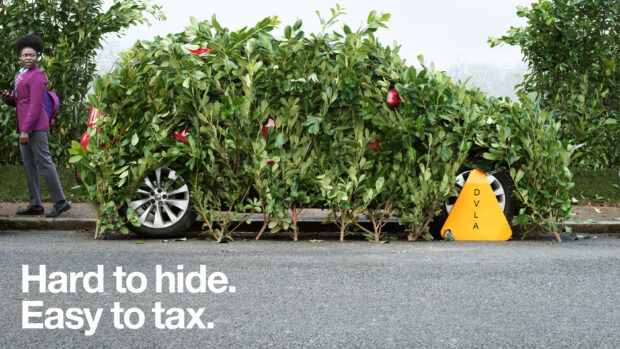
Earlier this year, as part of the agency’s long-term strategy to keep vehicle tax evasion low, DVLA’s Communications team launched a campaign with a clear message to evaders – untaxed vehicles are ‘hard to hide, easy to tax’. To support the campaign, I travelled with our wheelclamping partners and press team to some of the areas in the UK with the highest evasion levels. Here’s what we got up to…

Hitting the road

We recently visited Birmingham, Reading, Leeds and Swansea this month, where there were a combined 99,796 enforcement actions taken last year. These included fines, penalties and clamping.

As part of the campaign, we organised media opportunities around our usual wheelclamping operations undertaken by NSL on behalf of DVLA. These wheelclamping operations were an opportunity to highlight the risks for motorists in their local area and remind motorists of the real risk if their vehicles are untaxed.

This is the first campaign I’ve been involved with, so I undertook media training to prepare for questions from journalists. It was certainly an intense but enjoyable experience, thanks to the support of the agency’s press team.

Each wheelclamping operation involved journalists and photographers attending the wheelclamping pound, managed by the press team. I showed them around the facility and answered questions about how our operations are undertaken. They got to see untaxed vehicles returning following an impoundment, before heading out to find an untaxed vehicle to observe a clamping in action.

So, what did we find?

A vehicle being clamped and lifted.
One of several untaxed vehicles we took enforcement action against.

We took enforcement action against several vehicles, in all 4 areas we visited. A car was clamped on a neighbourhood street, while another was towed away and impounded. In another case, we identified an untaxed vehicle in a car park using our ANPR data. The vehicle was clamped, and a warning of impoundment was issued to the driver.

This is a typical day for our enforcement teams and wheelclamping partners who, last year, took 360,655 enforcement actions across 12 of the highest evading areas in the UK. It only reinforces our message of ‘hard to hide, easy to tax’. So why risk it?

Looking forward, we will continue to take action against untaxed vehicles by carrying out computerised and roadside checks. Part of my role is also to manage our Devolved Partners Power Scheme, which will continue to support a range of local authorities to deliver enforcement activities on our behalf.

Tax it, don’t risk it

Taxing your vehicle is always the easiest and cheapest option. It’s never been easier to tax your vehicle, so use GOV.UK to check if your vehicle is taxed. If you need to tax your vehicle, you can do so quickly and securely online 24 hours a day, 7 days a week. You can even pay by Direct Debit to spread the cost of your vehicle tax.

So help spread the word to your family and friends – tax it, don’t risk it!

Adblock test (Why?)