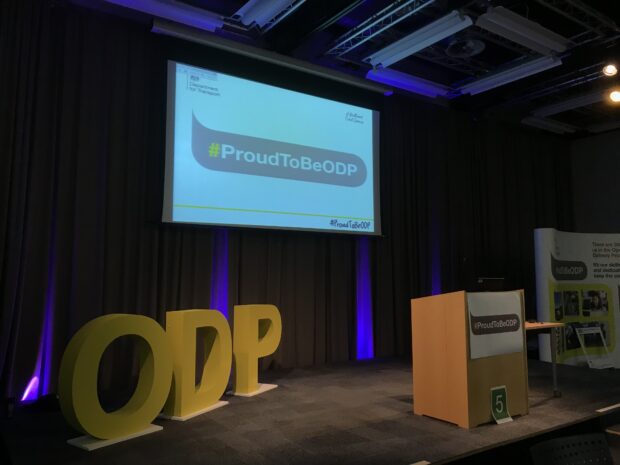
Proud to be ODP

Last Friday, I hosted the Operational Delivery Profession (ODP) launch event at DVLA’s headquarters in Swansea. It was a great success, with over 120 staff from across Department for Transport (DfT) joining me for the occasion.

Head of Profession

Tony Ackroyd DVLA

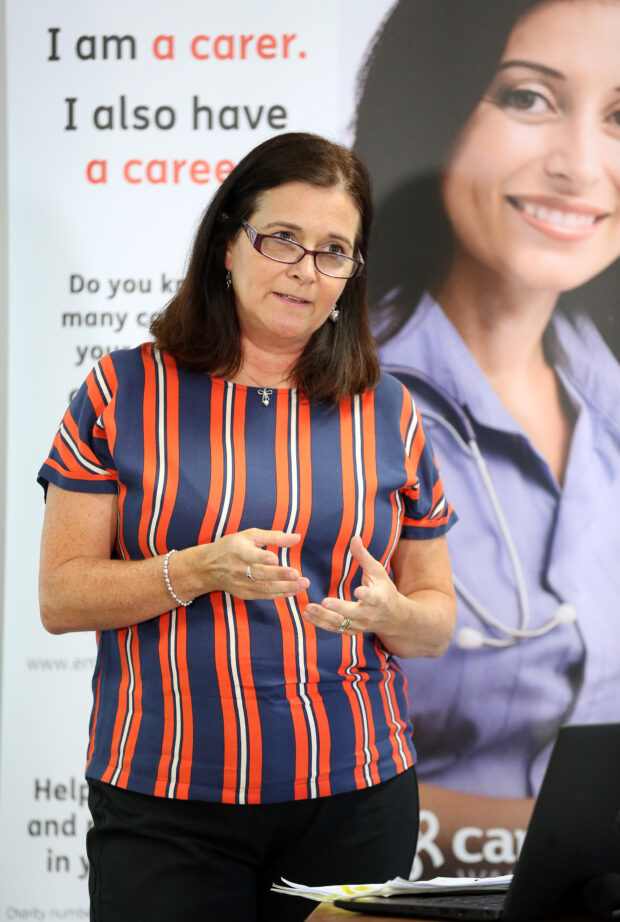
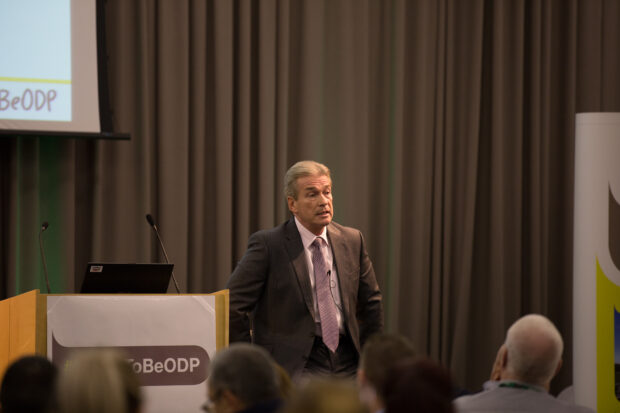
As Head of Profession for ODP within DfT, I was honoured and proud to host this launch event. In my opening address I explained why it is so important for people to take opportunities that are presented to them and to be proud to be involved in the profession.

Within DfT we have 10,000 people who are part of the profession. Looking across the Civil Service as a whole, ODP is the biggest profession of all with over 230,000 people involved. There are so many different roles under the ODP umbrella. I was keen to put across how everyone in the room should recognise the importance of what they do. They are part of a respected profession, just like a teacher or an accountant, for example.

The inspirational Simon Wheatcroft

Simon Wheatcroft

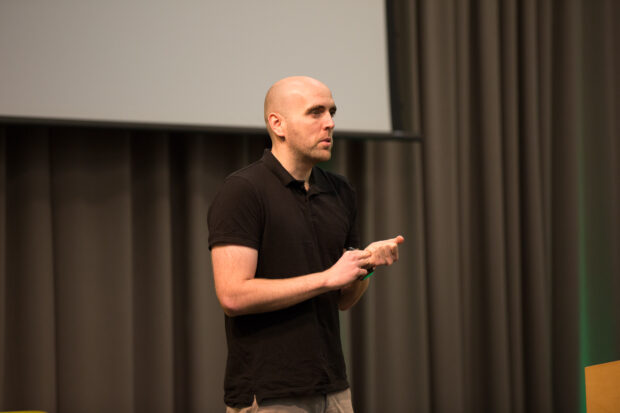
Our keynote speaker for the day was ultra-marathon runner Simon Wheatcroft. Extreme running is difficult anyway, but imagine doing it if you were blind? That’s what Simon does!

His speech was truly inspirational, with a clear message running right through it about how important it is to show resilience, determination and grit. These are qualities ODP professionals already show in their work.

Living the values

Civil Service values

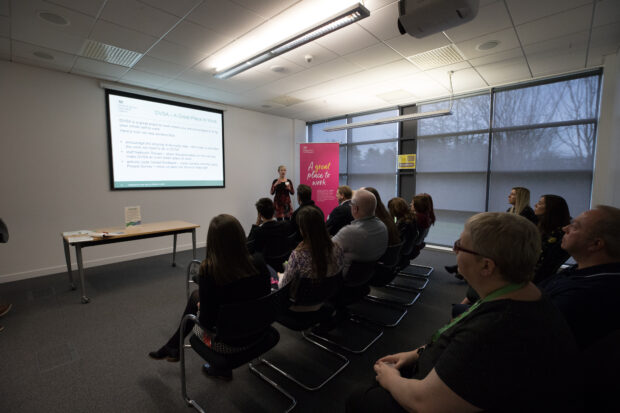
We ran several breakout sessions at the event to discuss how those of us involved in ODP live the Civil Service values every single day.

These sessions gave our delegates a chance to have their say on what they think makes a brilliant operational delivery profession, and to share their ideas and experiences.

It was great to see everyone coming together like this, from such a diverse range of roles and experiences, learning from each other.

Celebrating ODP

Operational Delivery Profession

After such a successful launch event, I firmly believe that it gives us all a platform to go back into our day jobs to both celebrate the profession and raise the profile of ODP across DfT.

I know from my own personal experience that it provides a fantastic opportunity for personal development and is a great community to be a part of.

If you are part of the profession and would like to find out more, search for ODP on Civil Service Learning or #ProudToBeODP and follow @OpsDelProf on social media.

If you’re interested in a career in Operational Delivery at DVLA then don’t forget to check out Civil Service Jobs for the latest opportunities.

Follow DVLA on TwitterFacebook and LinkedIn and subscribe to DVLA digital services blog.

Let’s block ads! (Why?)


Motorcycle traders are invited to see our new RaVe service at the Motorcycle Trade Expo

Come and see our new ‘Register a Vehicle electronically’ (RaVe) service at the Motorcycle Trade Expo from Sunday 14 to Tuesday 16 January 2018.

The feedback we had at last year’s event was really positive, so we’re keen to see as many traders as possible at our stand this year.

This will be a great opportunity for you to see our new first registration service, RaVe, and discover how it will benefit your dealership.

RaVe

You’ll be familiar with our current vehicle registration schemes, either using our paper V55 forms or web based Automated First Registration and Licensing (AFRL) system.

Our new RaVe service, currently in development, will eventually replace our AFRL web service. It has a totally new look and feel to make it easier for you to use. We’re continuing to work with the motor trade to develop the service.

At the event

Allison Avo and I will be on hand to showcase this service and how:

  • you’ll save time and money, by reducing administration in your business
  • to make the transition
  • simple it is to use

We’ll also answer any questions you may have on vehicle registration and licensing and will demonstrate our digital services.

We want the service to be as user friendly as possible, so your feedback will be really helpful.

For information about the event go to Motorcycle Trade Expo.

We hope to see you there, we’re on stand KS10 within the Knowledge Shop.

Click on button to order your free tickets for Motorycle Exp

Follow DVLA on Twitter, Facebook and LinkedIn and subscribe to DVLA digital services blog.

Let’s block ads! (Why?)


How DVLA helps to connect people to nature

With the changing of the seasons, our natural environment outside our offices here in Swansea can look particularly striking. So it’s a good time to take stock of what we do in DVLA to look after our local environment and reduce our impact on it.

Why we look after our environment

This is really important to us in DVLA, and it’s something we’ve been actively doing for a number of years. We’re also bound by both legal and governmental commitments to reduce our environmental impacts and enhance the flora and fauna which exist on our estate.

These commitments are set out in our Strategic Plan, Sustainability Report and our Biodiversity Action Plan. I’m head of DVLA’s Sustainability Team and we’re the team responsible for ensuring the commitments are carried out. It’s not just a job to us though, it’s a passion that goes beyond just meeting these obligations. We also want to encourage other staff to share in the joy we find in nature and educate them in the importance and value of the natural world.

Our three sites are in residential and industrial locations and are relatively small (around 40 acres in all, or roughly 40 football pitches). Within these sites we have dedicated conservation areas, ponds, grassed areas and verges that we leave untouched, as well as protected ancient hedgerows. All of these are supporting an increasing number of wildlife and plant species, including otters, bats and small blue butterflies. Last year, we counted at least 12 species that are listed in Section 7 (Priority Species List) of the Environment (Wales) Act 2016.

Zero cost, maximum benefit

This has cost us nothing to do, has had no negative impact on the effective running of the estate and is bringing pleasure and increased knowledge to many of our staff. To help us with this work we’ve found many experts already working in DVLA who have enthusiastically shared their knowledge and expertise.

We have a chairperson of the local ornithological society, who has undertaken bird surveys and led bird walks around the estate in their own time. We also have conservation experts who help us monitor and analyse wildlife, and advise us on how we can develop our estate’s biodiversity. There’s even an avid forager who has shown us how to find food in the unlikeliest of places (including rough patches of ground!)

The best bits…

To me, the most wonderful thing I’ve seen from our work in encouraging nature to flourish is the joy that everyone gets from it. Colleagues send us lovely photos of the birds and wild flowers they’ve spotted on site. They also tell me how their lunchtime walks around the sites, looking at the natural environment we’re helping to prosper, let them take a break from the pressures of work and recharge their batteries. This just shows the difference connecting with nature can make to us every day.

Here at DVLA we’re extremely lucky to live and work in a beautiful part of the world, and we’re making the most of our little bit of that. We’re doing our bit to help people connect to nature, and I’d like to pass on the United Nations environmental challenge to us all: in this busy world, why not find a way to experience nature, breathe it in, and remember that by keeping our planet healthy, we keep ourselves healthy too.

Follow DVLA on Twitter, Facebook and LinkedIn and subscribe to our Inside DVLA blog.

Let’s block ads! (Why?)


Driving and your eyesight: staying safe on the road

If you drive, it goes without saying that you know you need your eyes on the road at all times. What you might not know is that DVLA has minimum eyesight standards that all drivers need to demonstrate so they can be allowed to drive.

So how do we decide on the vision standards for driving? DVLA’s Vision Panel Secretary Dr Gareth Rees tells us more about his role and these standards.

I’ve been a doctor for 41 years and have been DVLA’s Vision Panel Secretary for 10 years. My main role is to liaise between DVLA and the Honorary Medical Advisory Panel on Visual Disorders. The panel meets every 6 months and is made up of eyesight specialists, who provide DVLA with expert advice on how to apply and interpret the law when assessing fitness to drive.

Think your eyesight’s getting worse? Act now

We all have busy lives, and sometimes we might overlook the signs that our eyes are not as good as they were. You might be finding it harder to judge distances, you might be struggling to read the newspapers, or it’s getting more difficult for you to drive at night. These are just a few signs that your eyesight may be deteriorating.

In line with advice from optometrists, our advice is that you should get your eyes tested at least every 2 years. But if you recognise any of the signs above, don’t wait – go and get checked out straight away with your optician or doctor. If they advise you to tell DVLA about your eyesight, you can do this online or by writing to us.

If you don’t meet the eyesight standards, stop driving immediately and tell DVLA.

After you tell us about your condition

Don’t worry – usually, most people who tell us they’ve got a medical condition are still allowed to drive.

If you have a ‘progressive’ (worsening) condition but can still meet the eyesight standards for driving, you may get a short-term licence rather than a full-term one. This type of licence lasts for 1, 2, 3 or 5 years and when it’s due for renewal, we let you know.

It’s better to be safe than sorry. So if you’re in doubt, get it checked out.

Follow DVLA on Twitter, Facebook and LinkedIn and subscribe to our Inside DVLA blog.

Let’s block ads! (Why?)


Driving with Parkinson’s disease

Parkinson’s disease is a progressive condition that may affect someone’s ability to drive safely. Dr Wyn Parry, DVLA’s Senior Medical Adviser, tells us more about driving with this condition.

Wyn Parry

I joined DVLA as Senior Medical Adviser after thirty years in the NHS. It’s my job to advise on how certain medical conditions can affect someone’s ability to drive. After blogging last year about driving with diabetes, this time I’d like to focus on driving with Parkinson’s disease.

Parkinson’s disease affects the nervous system and may affect the muscles, causing movement problems. In some circumstances, it can even affect the functions of the brain.

Driving a vehicle safely

Being able to drive a vehicle requires high levels of skill and ability. A driver either needs to be unaffected by a medical condition, or have a medical condition that is controlled so that symptoms are highly unlikely to cause any problems.

Sadly, Parkinson’s is a progressive condition and deterioration is inevitable. It’ll affect many activities, including driving. This is why it is so important that all drivers who are diagnosed with Parkinson’s must tell DVLA. The rate of deterioration varies, but recognising that it will happen is important. It allows the patient and their family time to make plans for any lifestyle changes that may be necessary.

Knowing you will eventually lose the ability to drive is never easy to accept. But it may be more bearable if the person has time to adjust and plan alternative ways of travel. For example: public transport, taxis, or lifts from friends and relatives.

For professional drivers, who must demonstrate a greater level of fitness to drive, it may involve reviewing work options for the future.

How DVLA makes a decision about drivers with Parkinson’s

Wyn Parry

Once DVLA is told about a driver with Parkinson’s we’ll ask the driver for information about their condition. We’ll also talk to the healthcare professionals involved in their diagnosis and treatment – like their GP, consultant or specialist nurse.

Information we usually ask for includes details about how long the individual has had Parkinson’s, the level of deterioration and any changes in treatment. All this information is crucial for us to be able to make an informed decision on whether they can continue to drive safely.

Where possible we always try to offer a driving licence to a driver with a medical condition, but only if it’s safe to do so. Our priority is to always maintain road safety for the driver and other road users.

For many drivers with medical conditions like Parkinson’s, we might offer a short-term driving licence. This could be for one or three years. We tend to start going down this route when a driver’s condition begins to deteriorate – a longer term licence may be offered earlier on, with subsequent licence periods getting shorter over time.

For more information about driving with Parkinson’s

You can visit Parkinson’s UK’s website.

Follow DVLA on TwitterFacebook and LinkedIn and subscribe to our Digital Services Blog.
Let’s block ads! (Why?)