Manufacturing firms reminded of their asbestos duties

Britain’s workplace regulator is reminding manufacturing firms of their asbestos duties. 

As we approach Global Asbestos Awareness Week (April 1 – 7), the Health and Safety Executive (HSE) is reminding those running businesses occupying buildings built before 2000 to properly assess, manage and monitor asbestos risks in line with the law. 

Older manufacturing facilities may house multiple asbestos containing materials (ACMs). Asbestos was widely used in buildings and in some equipment between 1950 and 1980; however, any building built or refurbished before 2000 could contain an ACM. 

Asbestos can be found in: pipe lagging, insulation board, asbestos cement products such as profiled roof sheets and wall panels, floor coverings and asbestos sprayed coatings. ACMs such as gaskets and rope seals can also be found within old plant and equipment such as industrial ovens and pipework. 

Asbestos exposures caused by poor planning and risk management can have substantial human costs for victims and their families. Asbestos-related diseases remain the highest cause of work-related deaths in Great Britain, these often fatal diseases, typically take decades for symptoms to occur following exposure.  

There is a legal duty to manage asbestos and failing to do so can result in penalties ranging from fines to prison sentences. The implications of an asbestos incident can also be far reaching in terms of reputation, staff morale, attracting new staff and overall costs.  

HSE data reveals there have been more than 100 asbestos-related prosecution cases brought in the past five years, relating to 150 breaches of the law. 

Make UK, supporting the manufacturing sector and businesses around the country is supporting HSE’s call. Chris Newson CFIOSH, Environment Health and Safety Director, said he was happy Make UK was fully behind the HSE’s “Asbestos – Your Duty” campaign. 

“The number of people affected each year by this deadly material within UK manufacturing is still far higher than it need be,” he said.  

“It is important that all dutyholders within our sector are aware of their duties and the excellent resources made freely available by HSE to help them meet their legal requirements.”  

The risks associated with asbestos-containing materials are well known and free advice and resources are available from the HSE’s website. 

As the regulator’s campaign continues, HSE Head of Manufacturing Sector, David Butter reminded those responsible that asbestos wasn’t just a problem of the past. 

“It can still be found in a wide variety of materials in factories and manufacturing premises,” they said.  

“Dutyholders must identify, assess and manage asbestos in their buildings to keep people safe.” 

There are six steps for how those responsible can comply with their legal duty: 

  1. Find out if asbestos could be present in your building. 
  1. Arrange an asbestos survey by a competent person or accredited surveyor. 
  1. Make a register and assess the risks from your asbestos. 
  1. Write your asbestos management plan. 
  1. Put your plan into action. 
  1. Continually monitor and communicate the plan. 

David went on to say: “Employers should not undertake any work with asbestos materials, which exposes their employees, unless the risks have been assessed and appropriate control measures have been implemented.  

“Some types of work associated with asbestos materials may only be undertaken by a suitably licensed asbestos contractor under stringent procedures. 

“As well as being a legal duty, it is simply common sense and good business to ensure rigorous managing and monitoring of asbestos.” 


Further information: 

 For further information on asbestos-related disease statistics visit: Asbestosis, mesothelioma, asbestos related lung cancer and non-malignant pleural disease in Great Britain 2024 


Manufacturer fined £100,000 after worker partially severs two fingers

A Welshpool manufacturing company has been fined £100,000 after one of its employees partially severed two fingers while trying to find a fault in a machine.

Interior Products Group Limited (known as Newmor Group Ltd at the time of the incident) manufacture and sell pre-finished fit out products to a variety of sectors.

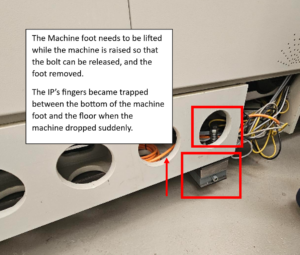
The experienced employee, from Wrexham, was attempting to identify a fault in an edgebander machine – used to apply edging tape to the raw edges of wood panels with a hot-melt adhesive or glue.

Wrexham Magistrates’ Court heard how the experienced employee suffered the injuries while checking for debris on the trimming unit of the edgebander.  Having failed to turn the machine off correctly before raising it to look inside, the worker then stepped over two supporting rails and placed their fingers on a trimming unit, resulting in two being partially severed.

Following an investigation by the Health and Safety Executive (HSE), it was discovered that although the company had carried out a number of risk assessments on the machine, they failed to identify the hazards presented by the cutting and trimming units from the front of the edgebander.  They also failed to provide suitable and sufficient, information, instruction and training to enable their staff to carry out activities such as cleaning, fault finding and minor repairs safely.

Interior Products Group Limited of Madocs Works, Henfaes Lane, Welshpool pleaded guilty to breaching Section 2(1) of the Health and Safety at Work etc Act 1974. They were fined £100,000 and ordered to pay costs of £7,688.

Speaking after the case HSE inspector Joe Boast said: “Those in control of work have a responsibility to devise safe methods of working and to provide the necessary information, instruction and training to their workers in that safe system of working.

“If a suitable safe system of work had been in place prior to the incident, the life changing injuries sustained by the employee could have been prevented.”

Notes to editors 

  1. The Health and Safety Executive (HSE) is Britain’s national regulator for workplace health and safety. We prevent work-related death, injury and ill health through regulatory actions that range from influencing behaviours across whole industry sectors through to targeted interventions on individual businesses. These activities are supported by globally recognised scientific expertise.
  2. More information about the legislation referred to in this case is available.
  3. Further details on the latest HSE news releases is available.
  4. Guidance on working safely with machinery is available.


Devon dad has every finger amputated after hands crushed in machine

A dad from Devon was left with horrific injuries to his hands after an incident at his work.

Dean Delahaye, from Barnstaple, had to have all eight fingers amputated after his hands were crushed by a metal rolling machine.

The 35-year-old worked for flue and chimney manufacturer SF Limited. He was feeding flat metal sheeting into the machine when the incident took place on 5 September 2019. He spent 54 days in hospital and had numerous operations. More than three years on, he is still waiting for prosthetics to be fitted.

Dean Delahaye from Barnstaple suffered horrific injuries at work

“I still get very frustrated and have a sense of uselessness,” he said.

“I am frustrated with how long things are taking, and how things have been put on hold.

“Having no fingers means I am unable to grip things.

“Before my accident I enjoyed playing a wide range of sports, including football, tennis and squash.

“I have always enjoyed working with my hands and have only ever had manual jobs, but since the accident it will never be possible to return to doing this again.

“Before my accident I was an independent and sociable person, but I feel this has been taken away from me now.”

Due to the severity of his injuries, Mr Delahaye went on to say how he was even unable to pick up and feed his daughter, who was born after the incident.

“It makes me feel like a burden to my loved ones, with all the assistance I need daily,” he said.

“My wife Jess not only has to care for me, but is also like a single parent which makes me feel so worthless.

“Mentally I have not come to terms with my new reality.

“When I dream, I am fully able-bodied and then I wake and realise this is never going to be the case for me again.

“But if my accident can stop someone going through what I have had to go through, then at least it will be for something.”

Dean Delahaye said his life has never been the same since he suffered horrific injuries at work

Yeovil Magistrates Court heard that an investigation by the Health & Safety Executive (HSE) found the company had failed to adequately assess the risks and implement the necessary controls when the roller equipment was installed. They subsequently missed a further opportunity to reassess the risks following a significant change in the way in which the machine was operated.

S F Limited which trades as SFL Flue and Chimney of Pottington Business Park, Barnstaple, Devon, pleaded guilty to breaching  Section 2(1) of The Health and Safety at Work etc Act 1974. They were fined £26,000 and ordered to pay costs of £12,000.

After the hearing HSE inspector Paul Mannell said: “Dean’s injuries were easily preventable.

“Employers must identify the risks posed by dangerous parts of machinery and ensure that relevant controls are implemented to minimise the potential for harm.

“Where the way in which machinery is used changes, the assessment and controls should be updated to ensure employees can work safely and without risk of injury.”


Notes to Editors:

  1. The Health and Safety Executive (HSE) is Britain’s national regulator for workplace health and safety. We prevent work-related death, injury and ill health through regulatory actions that range from influencing behaviours across whole industry sectors through to targeted interventions on individual businesses. These activities are supported by globally recognised scientific expertise.
  2. More information about the legislation referred to in this case is available.
  3. Further details on the latest HSE news releases is available.


Company fined after reactor explosion

A Northwest manufacturing company has been fined after an explosion led to a reactor bursting open and ejecting a motor through a roof.

Fortunately, nobody was injured as a result of the incident, which happened at CatAlloy Limited based in Widnes on 3 December 2015, during the manufacture of nickel catalyst.

An investigation by the Health and Safety Executive (HSE) found how air drawn into the reactor mixed with hydrogen, causing overpressure that led to the explosion.

The lid of the reactor burst open and the gearbox and the electric drive motor, situated on top of it, were ejected through the roof of the building after breaking their mountings.

The investigation also found that a residual product had been left in the reactor – which can ignite when exposed to air.

At Liverpool Crown Court CatAlloy Limited of Moss Bank Road, Widnes, pleaded guilty to breaching Sections 2 (1) and 3 (1) of the Health and Safety at Work etc. Act 1974. They were fined £120,000 and ordered to pay costs of £50,000

After the hearing HSE inspector Sean Bembridge said: “This incident could so easily have been avoided by implementing appropriate control measures and safe working practices.

“At all times during the activation process, a material risk to health and safety existed.

“The defendant had a duty to take measures to ensure that this risk was reduced to the lowest reasonably practicable level.”


Notes to Editors:

  1. The Health and Safety Executive (HSE) is Britain’s national regulator for workplace health and safety. We prevent work-related death, injury and ill health through regulatory actions that range from influencing behaviours across whole industry sectors through to targeted interventions on individual businesses. These activities are supported by globally recognised scientific expertise. hse.gov.uk
  2. More about the legislation referred to in this case can be found at: legislation.gov.uk/
  3. Further guidance on how to avoid incidents such as this can be found at Reducing error and influencing behaviour – HSG48 (hse.gov.uk) / Designing and operating safe chemical reaction processes – HSG143 (hse.gov.uk)
  4. HSE news releases are available at http://press.hse.gov.uk


Spring manufacturer sentenced after worker severs fingers

A spring manufacturing company has been fined after an employee had two fingers of his right hand severed whilst attempting to lubricate a bandsaw.

Manchester Magistrates’ Court heard how on 2 October 2019, a labourer employed by Hanson Springs Ltd in Rochdale was assisting in the cutting back department to cut sections of steel spring using a vertical bandsaw when the blade began to smoke and squeal. The worker decided to replace the blade, as on inspection it appeared heavily worn. He attempted to lubricate the new blade, by pressing a cardboard tube of wax onto the exposed section of it whilst it ran. The tube was drawn in, in turn drawing in the worker’s hand, severing the middle two fingers at the first and second knuckle respectively.

An investigation by the Health and Safety Executive (HSE) found that although the worker had received training from the supervisor in using the machine, it was of poor quality, no formal competency assessment had been carried out, nor was he certain that he could use the machine unsupervised. Furthermore, despite lubrication of the blades in this manner being standard practice within the company, it was unnecessary as the machine was self-lubricating. The worker had been shown how to do this during training in order to minimise the time needed for the blade to become greased using the inbuilt lubrication system and therefore operational. Operational management was not aware of this dangerous practice and therefore no safe method of lubricating the blades had been provided.

Hanson Springs Ltd of Hanson Place, Gorrells Way, Rochdale, Lancashire pleaded guilty to breaching Section 2 (1) of the Health and Safety at Work etc. Act 1974. The company was fined £200,000 and ordered to pay costs of £5,394.

Speaking after the hearing, HSE inspector Peter Lennon said: “This incident could so easily have been avoided.
“Employers should ensure they carry out an assessment of the risks and put in safe system of works for the operation of all machinery.

“Employers should also ensure that adequate supervision, instruction and training is provided to workers.”


Notes to Editors:
1. The Health and Safety Executive (HSE) is Britain’s national regulator for workplace health and safety. We prevent work-related death, injury and ill health through regulatory actions that range from influencing behaviours across whole industry sectors through to targeted interventions on individual businesses. These activities are supported by globally recognised scientific expertise. www.hse.gov.uk
2. More about the legislation referred to in this case can be found at: https://www.hse.gov.uk/toolbox/machinery/safety.htm
3. HSE news releases are available at http://press.hse.gov.uk