Offshore drilling company fined after crane boom collapse

An offshore drilling company has been fined after a crane boom collapsed catastrophically.

Nobody was hurt in the incident on 31 March 2016 but a chaotic scene ensued after the collapse of the Rowan Gorilla VII’s boom, with flying debris damaging a nearby vessel, whipping a hose out of control before it ruptured, leaving a cloud of cement dust.

Inspectors from the Health and Safety Executive (HSE) described the incident as an “accident waiting to happen”.

It happened offshore in the North Sea as staff were preparing to recover a faulty submersible pump. As the crane operator raised the boom to clear one of the three legs of the installation it failed catastrophically and collapsed.

HSE found the immediate cause of the crane collapse was that Rowan Drilling (UK) Limited had not checked that a limit switch, designed to prevent the crane boom being raised to the point of mechanical failure, had been correctly set.

Three of the four boom sections fell to sea between the rig and the ‘Solvik Supplier’ supply vessel which was pumping dry cement to the rig via a flexible hose. The crane’s auxiliary hook, cables, components, and rig debris landed on the deck of the Solvik Supplier. The boom tip snagged the flexible hose, dragging it below the sea surface, causing it to rupture and whip back onto the deck of the vessel engulfing it in fine cement dust.
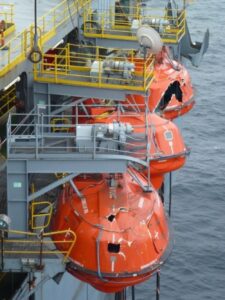
Damage to the lifeboats following the collapse

Although no one was injured by the incident, there were at least five Rowan employees on and around the crane at the time of the collapse. There were thirteen crew onboard the Solvik Supplier.

The HSE investigation found that safety mechanisms, designed to prevent inadvertent operation of the slew, hoist, and boom joystick controls in the port bow crane cabin had all been overridden to prevent them returning to their locked neutral position. An Improvement Notice was served on the company to remedy issues relating to the limit switches and management issues identified.

Rowan Drilling (UK) Limited, of Queens Road, Aberdeen, pleaded guilty to breaching Section 2(1) and Section 3(1) of the Health and Safety at Work etc. Act 1974 .The company was fined £130,000 at Aberdeen Sheriff Court on 21 December 2023.

HSE inspector Brian Kennedy said: “It was pure luck that nobody was seriously hurt or died as a result of these failings.

“As with so many incidents, the circumstances leading to the collapse of the port bow crane on the RGVII were years in the making and symptomatic of a defective safety management system that allowed those conditions to exist and persist.

“This was quite simply an accident waiting to happen and illustrates the vital importance of maintaining and testing crane limit switches to ensure they will always provide the intended level of protection.”

Notes to Editors:

  1. The Health and Safety Executive (HSE) is Britain’s national regulator for workplace health and safety. We prevent work-related death, injury and ill health through regulatory actions that range from influencing behaviours across whole industry sectors through to targeted interventions on individual businesses. These activities are supported by globally recognised scientific expertise. hse.gov.uk
  2. More about the legislation referred to in this case can be found at: www.legislation.gov.uk/
  3. HSE news releases are available at http://press.hse.gov.uk
  4. Guidance on Offshore Health and Safety Legislation can be found here: Offshore oil and gas – HSE



Company fined after worker spotted on pallet raised by forklift truck

A company has been fined after shocked onlookers spotted an employee precariously working from height while standing on a pallet raised by a forklift truck at Ramsgate Harbour.

The Health and Safety Executive (HSE) prosecuted European Active Projects (EAP) Limited for breaching Work at Height Regulations after one of its workers was spotted on the pallet on 8 July 2022. The workplace regulator was alerted to the activity after it was reported by a member of the public, who managed to capture the terrifying debacle on video.

The worker was part of a team of three at EAP Limited that were removing work equipment from the deck of a boat in the harbour’s slipway.

As scaffolding had been removed, the workers raised a pallet to the deck with a forklift truck and used it as a mobile platform to remove items from the boat.

One of the workers was then witnessed climbing from the side of the vessel, beneath the guard rails, and onto the pallet with a heavy, motorised pressure washer. The pressure washer was then lowered to the ground.

The HSE investigation found EAP Limited had failed to plan the work at height associated with the refurbishments and repair work being completed on the boat, leaving workers at risk, with no safe method for removing equipment located on the vessel’s deck.

HSE guidance can be found at: Work at height – HSE

European Active Projects Limited, of Chatham Docks, Gillingham Gate, Chatham, Kent, pleaded guilty to breaching Section 4(1) of the Work at Height Regulations 2005. The company was fined £100,000 and ordered to pay £5,730.40 in costs at Maidstone Magistrates’ Court on 20 December 2023.

HSE inspector Samuel Brown said: “This incident demonstrates why there is a need to appropriately plan and supervise work at height. Clearly, lessons had not been learnt since the company’s previous prosecution in 2015.

“Falls from height are still the biggest cause of fatal accidents involving workers.

“The risk of workers falling from the pallet and sustaining serious, possibly fatal, injuries should not be ignored. Fortunately, no workers were harmed and the reporting of the incident by a concerned member of public enabled HSE to intervene and prevent any further unsafe work at height on site.”

This HSE prosecution was brought by HSE senior enforcement lawyer Nathan Cook and supported by HSE paralegal officer Cristina Alcov.

Notes to editors:

  1. The Health and Safety Executive (HSE) is Britain’s national regulator for workplace health and safety. We prevent work-related death, injury and ill health through regulatory actions that range from influencing behaviours across whole industry sectors through to targeted interventions on individual businesses. These activities are supported by globally recognised scientific expertise.
  2. More information about the legislation referred to in this case is available.
  3. Further details on the latest HSE news releases is available.


Company and director sentenced after worker fractures arm and leg

A company and its director have been sentenced after an employee fell from height and suffered serious injuries.

Andrew Smith fractured his left femur, left elbow, left arm and pelvis after falling approximately three metres off a ladder on 28 July 2021.

He had been working for Profascias Ltd at Park Lane Primary School in Tilehurst, Reading.

The company had been hired to replace guttering and supply fascia boards and soffits at the infant school.

The ladder Mr Smith had been working from against the school wall slipped, causing the 53-year-old to fall to the ground.

He spent 16 days in hospital as a result of his injuries and later underwent surgery to add a bolt to his hip and metal plate to his arm.

A Health and Safety Executive (HSE) investigation found there had been insufficient planning of the work at height by Profascias Ltd and its director, John Nolan. A safe platform from which to work, such as a properly erected scaffold, should have been provided as workers needed both hands to carry out the work and could not therefore work safely from a ladder. Ladders should only be used for access or, where it is not reasonably practicable to provide safer working platforms, for short-term work of up to 30 minutes where workers can normally maintain three points of contact.

HSE guidance can be found at: Work at height – HSE

Profascias Ltd, of Sandy Lane, Pamber Heath, Tadley, Hampshire, pleaded guilty to breaching Section 4(1) of the Work at Height Regulations 2005. The company was fined £6,000 and ordered to pay £2,000 in costs at Slough Magistrates’ Court on 18 December 2023.

Imposing the sentence, District Judge Goozee remarked: “Because of the financial penalty, the company may end up being wound up completely; but that is a consequence of the conviction.”

John Nolan, of Sandy Lane, Pamber Heath, Tadley, Hampshire, pleaded guilty to breaching Section 4(1) of the Work at Height Regulations 2005 by virtue of Section 37(1) of the Health and Safety at Work etc. Act 1974. He was handed a 12-month community order where he must undertake 180 hours of unpaid work and ordered to pay £1,000 in costs at Slough Magistrates’ Court on 18 December 2023.

HSE inspector Rachael Newman said: “This worker’s injuries were serious. This incident could have been avoided through the selection of suitable work equipment to prevent persons from falling.

“Falls from height remain one of the most common causes of work-related fatalities and injuries in this country and the risks associated with working at height are well known.”

This HSE prosecution was brought by HSE enforcement lawyer Jon Mack and supported by HSE paralegal officer Cristina Alcov.

Notes to editors:

  1. The Health and Safety Executive (HSE) is Britain’s national regulator for workplace health and safety. We prevent work-related death, injury and ill health through regulatory actions that range from influencing behaviours across whole industry sectors through to targeted interventions on individual businesses. These activities are supported by globally recognised scientific expertise.
  2. More information about the legislation referred to in this case is available.
  3. Further details on the latest HSE news releases is available.


North Wales health board fined after failings resulted in woman’s death

One of the largest health boards in Wales has been fined £200,000 after a patient died in its care.

Llandudno Magistrates’ Court heard that 46-year-old Dawn Owen was found unconscious at the Hergest Unit – a secure mental health unit – at Ysbyty Gwynedd in Bangor on 20 April 2021.

Dawn’s family have called on Betsi Cadwaladr University Health Board to act on the findings of a Health and Safety Executive (HSE) investigation, calling her death ‘wholly avoidable’ and ‘completely unnecessary’.

“Staff complacency at all levels contributed in this case, as well as numerous policy breaches and issues between staff and management,” they said.

“We have been tragically let down by the Hergest Unit, who we believed, were providing a safe place for Dawn and the care that she urgently needed.”

Dawn Owen

The HSE investigation found no risk assessment had been carried out when she was admitted and due to communication failure on transfer to the ward, staff had wrongly relied on an assessment carried out for a previous admission a year earlier. This failure resulted in Dawn’s high risk of self-harm being tragically missed.

Staff also failed to place her in an anti-ligature bed and had de-escalated the completion of regular monitoring checks. Dawn was also provided with a dressing gown and belt, of which the belt was later used as a ligature.

There were several missed opportunities during the course of the admission, where Dawn had expressed the desire to self-harm. This did not trigger any review of the care and management of the patient.

“Dawn was a highly vulnerable person and had been battling her demons and addictions for many years,” the family went on to say.

“She was a bright, happy person who always had a positive attitude. She had a heart of gold and would always help others in need – she would give away her last penny to do so.

“Betsi Cadwaladr must now act on the findings of this investigation and keep vulnerable patients safe at the unit.

“We hope as a family that Dawn may now rest in peace – her battles with mental health are now over.

“We as a family would like to thank the Coroner and HSE for their diligence in ensuring there was a thorough investigation into Dawn’s untimely death.”

Betsi Cadwaladr University Health Board have pleaded guilty to breaching Section 3 (1) of the Health and Safety at work Act 1974 and have been fined £200,000 and ordered to pay costs of £13,174 at Llandudno Magistrates’ Court on 18 December 2023.

Speaking after the case, HSE inspector Sarah Baldwin-Jones said: “This incident could so easily have been avoided had a thorough risk assessment been carried out on admission, identifying in this case, the change in Dawn’s condition and risk of self-harm.

“Where a patient presents with a risk of self-harm, there is a requirement upon a health board to manage the patient’s safety, to avoid incidents like this. Devices such as reduced ligature beds and removing ligature anchor points and ligatures in the ward environment, can assist staff manage these risks. Importantly, the health board should have trained staff in managing this risk in patients considering self-harm.

“This would enable staff to identify the trigger points and take appropriate actions. The health board also failed to monitor the management of patients, so that any patient emotional or behavioural changes can be identified and managed.

“Health Boards and Trusts should be aware that HSE will not hesitate to take appropriate enforcement action against those that fall below the required standards. Our thoughts remain with Dawn’s family and friends.”

This prosecution was led by HSE enforcement lawyer Samantha Wells.

Notes to editors:

  1. The Health and Safety Executive (HSE) is Britain’s national regulator for workplace health and safety. We prevent work-related death, injury and ill health through regulatory actions that range from influencing behaviours across whole industry sectors through to targeted interventions on individual businesses. These activities are supported by globally recognised scientific expertise.
  2. More information about the legislation referred to in this case is available.
  3. Further details on the latest HSE news releases is available.


Farming business fined after a walker dies in cattle incident

A farming business has been fined after a member of the public died after being butted several times by a cow in front of two onlooking grandchildren.

Marian Clode, 61, was on a family walk on 3 April 2016 when the attack happened on a public bridleway in Northumberland. She died in hospital three days later.

Marian Clode

The family had been staying at a cottage at Swinhoe Farm, Belford and said Marian “was dearly loved and still so sadly missed.”

An investigation by the Health and Safety Executive (HSE) found that despite it being near the end of the Easter holidays, the business decided to move around 16 cows, together with a similar number of calves, along a popular bridlepath – a route taken by visitors to St Cuthbert’s Cave.  Effective precautions were not in place to warn walkers of the impending herd, such as signage and lookouts.

At the same time as the cows made their way to their field (which was approximately 1km along the bridlepath), Marian and her family, who had been staying at a cottage on the business’ farm, were walking in the opposite direction from St Cuthbert’s Cave.  The farm workers involved in moving the cows were not aware of the oncoming family as they were at the rear of the herd.

The route along the bridlepath was undulating meaning neither the farm workers nor the walkers were aware of each other until it was too late.  The first the family knew of the oncoming cattle was as the herd appeared over the brough of a hill ahead, only seconds before they would come face to face.

Most of the family, including two young grandchildren, clambered over the barbed wire fence for cover but their grandmother, Marian Clode who was at the head of the group, was confronted by a cow at the front of the herd.  The cow butted her several times causing fatal injuries.

The bridleway in Northumberland

The company had failed to put in place a system of work that was safe. There was a lack of an appreciation of the risk posed to any pedestrians or cyclists that might encounter cattle on the bridleway.

HSE has advice and guidance for farmers, landowners, and other livestock keepers.

At Newcastle Crown Court, J M Nixon & Son, Swinhoe Farm, Belford, Northumberland pleaded guilty to breaching Section 3(1) of the Health and Safety at Work etc. Act 1974. They were fined £72,500 and ordered to pay £34,700 costs on 15 December.

A family statement said: “In the seconds we had to react, Marian, who was a little ahead, had the least time, but still managed to move to the side of the track and make herself as inconspicuous as possible, tucked against a wooden gate, beneath an overhanging tree.

“Despite this, Marian was attacked by the lead cow and suffered fatal injuries.

“In the immediate aftermath of the incident and in the months and now years which have passed, we believed Marian lost her life because of JM Nixon and Son’s failure to implement even the most basic safe systems of work.

“Marian’s death was completely avoidable, which makes coming to terms with our loss even more difficult.

“We are grateful to the HSE for successfully prosecuting this case, which after almost eight years brings us some closure, although Marian is never far from our thoughts. She was dearly loved and still so sadly missed.”

After the hearing, HSE inspector Jonathan Wills said: “This horrific tragedy during a family holiday could have been prevented. Had the company carefully planned the movement of cattle from their winter housing along a popular route used by walkers and cyclists and put sensible, inexpensive measures in place this incident would not have happened.

“Public knowledge – and concern – is increasing about how dangerous cattle can be. Farmers should not place cattle with calves in fields where members of the public have a legal right to walk. HSE will take action when legal duties are not followed.”

This HSE prosecution was led by enforcement lawyer Radha Vaithianathar and assisted by paralegal officer, Rebecca Forman.


Notes to Editors:

  1. The Health and Safety Executive (HSE) is Britain’s national regulator for workplace health and safety. We prevent work-related death, injury and ill health through regulatory actions that range from influencing behaviours across whole industry sectors through to targeted interventions on individual businesses. These activities are supported by globally recognised scientific expertise.
  2. More information about the legislation referred to in this case is available.
  3. Further details on the latest HSE news releases is available.