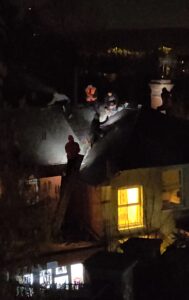
Fine issued after workers exposed to asbestos during hotel demolition

A company director has been fined after workers were exposed to asbestos during the demolition of a hotel in Cornwall.

Mr Paul Stephens, director of the now liquidated Stephens and Stephens Developers Limited, was fined more than £60,000 as a result of failures at the former Cliffdene Hotel in Newquay in 2020. The hotel had closed in 2018 and was part of a redevelopment plan to build residential apartments on the site.

The former Cliffdene Hotel in Newquay

An investigation by the Health and Safety Executive (HSE) into the control of asbestos at the site came after the hotel had been almost entirely demolished in August 2020. The company had overall control over the assessment and removal of all asbestos containing materials (ACMs) on site.

However, further enquiries revealed the presence of extensive asbestos debris, a sign that significant spreading had occurred, and that those actions taken to control exposure had been inadequate. Stephens was charged for failure to take reasonably practicable steps to contain the spread of asbestos.

  • The issue of asbestos more widely, and improving knowledge of the dangers, is the focus of two HSE campaigns. Guidance on asbestos safety has recently been updated and the current Asbestos: Your Duty campaign aims to improve understanding of what the legal duty to manage asbestos involves.

Paul Stephens of Bar Meadows, Malpas, Truro, Cornwall pleaded guilty to breaching regulations 16 of the Control of Asbestos Regulations 2012 by virtue of Section 37(1) of the Health and Safety at Work etc. Act 1974. He was fined £65,813 and ordered to pay costs of £26,116 at Truro Crown Court on 24 April 2024.

Asbestos debris was scattered across the site

Speaking after the hearing HSE principal inspector Georgina Symons said: “The hotel was not in a state of disrepair and presented no structural danger, so there is no reason why the removal of ACMs could not be done ahead of its demolition.

“Identification of the hazard is key. No asbestos removal should happen if there is a risk of exposing workers to it. There needs to be a sufficient assessment as to the presence, location and condition of asbestos at all premises.

“Those tasked with undertaking the assessment should have the necessary skills, knowledge and experience to undertake this work.”

This prosecution was brought by HSE enforcement lawyer Matt Reynolds.


Notes to editors:

  1. The Health and Safety Executive(HSE) is Britain’s national regulator for workplace health and safety. We prevent work-related death, injury and ill health through regulatory actions that range from influencing behaviours across whole industry sectors through to targeted interventions on individual businesses. These activities are supported by globally recognised scientific expertise.
  2. More information about the legislation referred to in this case is available.
  3. Further details on the latest HSE news releases is available.
  4. HSE has recently updated its guidance on asbestos safety and has just launched its Asbestos: Your Duty campaign that aims to improve understanding of what the legal duty to manage asbestos involves.


Farming business fined for multiple health and safety risks

A farming business that refused an offer to take part in a course on farm safety has been fined following a subsequent site visit from Britain’s workplace regulator.

Seymour Stevens Limited operate a beef and arable farm in Faversham, Kent.

To help farmers understand what they need to do to comply with health and safety law, the Health and Safety Executive (HSE) fund and run “Preparing for Inspection” courses which have been developed in partnership with industry.

In early 2022 Seymour Stevens Limited were offered a place on the course but did not take it up. A site visit was later carried out by the HSE in November of that year where multiple, serious, health and safety failings were identified.

The HSE investigation found one of the barns used as an employee through route was deemed unsafe to enter due to its poor structural state. Seymour Stevens Ltd were aware of this but had decided not to repair the shed due to costs. A number of electrical faults were also identified.

Another shed roof was insecurely fixed and was being weighed down with a hay bale in an attempt to prevent it from moving. Roof sheeting was also in poor condition and state of disrepair; in some cases, even falling from buildings.

Bull pens were broken and rusty and concerns were raised about the suitability of these to contain a bull. During the Christmas period in 2022, a bull had managed to escape the farm and was brought back to site by the Police.

HSE focused on the dangers of livestock as part of this year’s Your Farm, Your Future campaign. This has advice on working with livestock, and is hosted on its Your Farm Your Future campaign website, to assist farmers and workers and keep them safe.

At a hearing at Maidstone Magistrates’ Court on 24 April, Seymour Stevens Ltd, Faversham, Kent pleaded guilty to failing to discharge its general health safety and welfare duties to employees, contrary to Section 2 of the Health and Safety at Work etc Act 1974. They were fined £12,000 and ordered to pay £4,830 in costs.

Speaking after the hearing, HSE inspector Peter Bruce said: “While agriculture accounts for just one percent of the working population, it accounts for about 20 per cent of workplace fatalities.

“In the case at Seymour Stevens farm, there were failings to manage health and safety risks associated with animals and falling objects – two of the five most common causes of fatal injuries in the agriculture sector.

“Employees and members of the public were being put at risk, despite previous warnings having been given to the company by their staff.

“It is important that employers maintain their workplaces and equipment to suitable standards to ensure that employees, visitors and members of the public are not put at risk.”

This prosecution was brought by HSE enforcement lawyer, Jon Mack and supported by HSE paralegal officer, Lucy Gallagher.


Notes to editors:

  1. The Health and Safety Executive (HSE) is Britain’s national regulator for workplace health and safety. We prevent work-related death, injury and ill health through regulatory actions that range from influencing behaviours across whole industry sectors through to targeted interventions on individual businesses. These activities are supported by globally recognised scientific expertise.
  2. More information about the legislation referred to in this case is available.
  3. Further details on the latest HSE news releases is available.


Drinks company fined after employee loses finger in bottling machinery

A drinks company has been fined £14,000 after a man’s finger was amputated after being caught in bottling machinery.

Daniel Richardson, then 32, assisted a colleague who was encountering problems with a bottle capping machine at the plant in Wigston, Leicestershire on 17 January 2022.

Mr Richardson, from Leicester, was able to reach into the machine and into the capper unit to remove the jammed part at which point, the capper head descended onto his finger, amputating the tip.

Attempts were made at Leicester Royal Infirmary to re-attach the tip of the finger – this proved unsuccessful, and it was subsequently necessary to amputate his finger between the first and second knuckle.

An investigation by the Health and Safety Executive (HSE) found that Sourcing International Limited, trading as Drinks Chef failed to properly guard against access to dangerous parts of machinery – in this instance fixed guarding had been removed and the machine was frequently used without it.

Additionally, an interlock device which should function to isolate the power and stop the machine when protective doors / guards were opened elsewhere on the machine was inoperable and so access to moving parts of machinery was further possible.

HSE has guidance on machinery safety highlighting how employers should consider how their workers use machinery and how they should also have adequate maintenance arrangements in place to ensure it remains safe to use.

Sourcing International Limited t/a Drinks Chef, of Unit A1 Bowbridge Works, Chartwell Drive, Wigston, pleaded guilty to contravening a requirement of Regulation 11(1) of the Provision and Use of Work Equipment Regulations 1998.

The company was fined £14,000 and ordered to pay costs of £4,175.79 at a hearing at Loughborough Magistrates Court on 24 April 2024.

After the hearing, HSE inspector Rebecca Gibson said: “This tragic incident highlights the duty on employers to ensure machinery, and other work equipment, is safe for use. Suitable guards would render dangerous parts of machinery inaccessible during normal use and would have avoided this serious injury to Mr Richardson.”

This prosecution was supported by HSE enforcement lawyer Sam Crockett.

Notes to Editors:

  1. The Health and Safety Executive (HSE) is Britain’s national regulator for workplace health and safety. We prevent work-related death, injury and ill health through regulatory actions that range from influencing behaviours across whole industry sectors through to targeted interventions on individual businesses. These activities are supported by globally recognised scientific expertise.
  2. More information about the legislation referred to in this case is available.
  3. Further details on the latest HSE news releases is available.


Housing company fined more than £500,000 after worker suffers burns

A housing company based in Kent has been fined £528,000 after an employee repairing a fence post inadvertently struck an underground cable, suffering burns to his face.

The MHS Homes employee and a colleague had been tasked by the company to repair three fence posts in a back garden of a tenant on 10 January 2023. They had already repaired two of the posts and started on a third, when one of the workers struck an underground electrical cable as he tried to break through some concrete using a breaker.

The company failed to provide the employees with information on the location of, or the tools to safely excavate around, an electrical cable and gas pipe.

An investigation by the Health and Safety Executive (HSE), found that MHS Homes often excavated the ground. However, they never provided any information to employees on the location of underground services and did not provide suitable equipment to detect and safely excavate underground services. They had previously identified the risk of underground services in a risk assessment in 2017.

On this occasion, the two employees were digging not only by an electrical cable, but also a gas service. This heightened the risk of a fire or explosion, with the potential to kill not employees and members of the public nearby, as well the risk of destroying property.

MHS Homes of Broadside, Leviathan Way, Chatham, Kent pleaded guilty to breaching Regulation 16(2), by virtue of non-compliance with Regulation 25(4), of The Construction (Design and Management) Regulations 2015. The company was fined £528,000 and must pay £4,122 in costs following a sentencing hearing on 24 April 2024.

After the hearing, HSE inspector Peter Bruce, said: “Underground services  are widespread and represent a significant risk. It is important measures are taken to identify them before any excavation work is undertaken.

“On this occasion, an electrical cable was struck and a worker suffered minor injuries. However it could have been much worse and potentially fatal.

“Those excavating the ground need to ensure that they obtain service plans prior to the work taking place. It is also vital that employees are provided with the correct tools and detection equipment to do their work safely.”

This prosecution was brought by HSE enforcement lawyer Rebecca Schwartz and supported by HSE paralegal officer Ellen Garbutt.


Notes to editors:

  1. The Health and Safety Executive(HSE) is Britain’s national regulator for workplace health and safety. We prevent work-related death, injury and ill health through regulatory actions that range from influencing behaviours across whole industry sectors through to targeted interventions on individual businesses. These activities are supported by globally recognised scientific expertise.
  2. More information about the legislationreferred to in this case is available.
  3. Further details on the latest HSE news releasesis available.
  4. Guidance on working with underground services is available.


Council fined after vulnerable man choked to death on food

Fife Council has been fined £100,000 for safety breaches following the death of a vulnerable man who choked to death on a sandwich unsuitable for his prescribed diet.

In its role to support the care of those who live in supported living accommodation, Fife Council was responsible for the safe ingestion of food for 66-year-old Brian Millar.

On 4 June 2020, the resident of accommodation in Kirkcaldy was given a sandwich by a carer. Brian could only be given food that was carefully prepared to ensure it was soft and bite-sized.

Brian should also have been closely supervised to ensure his safety while eating.  However, the food was not suitably prepared and he was not closely observed. He choked on the sandwich and died.

At Kirkcaldy Sheriff Court on 23 April 2024, Fife Council, North Street, Glenrothes pleaded guilty to breaching Sections 3(1) and Section 33(1)(a) of the Health and Safety at Work etc. Act 1974. It was fined £100,000 and the Sheriff also directed that a Compensation Order of £50,000 be paid to Brian’s family.

 Speaking after the case, HSE inspector Kerry Cringan said: “It is tragic when a vulnerable person dies in circumstances which were completely avoidable.

“Sadly, it is not uncommon for us to be informed of deaths where people in care choke on high-risk foods that were not suitable for their diet.

“Care providers must be guided by speech and language therapy professionals and then ensure their staff are trained to understand what those recommendations mean.

“They should be aware that we will not hesitate to take appropriate enforcement action against those who fail to train staff in the importance of following modified texture diets.”


Notes to Editors:

  1. The Health and Safety Executive (HSE) is Britain’s national regulator for workplace health and safety. We prevent work-related death, injury and ill health through regulatory actions that range from influencing behaviours across whole industry sectors through to targeted interventions on individual businesses. These activities are supported by globally recognised scientific expertise.
  2. More information about the legislation referred to in this case is available.
  3. Further details on the latest HSE news releases is available.