Update on investigation into incident at Netley Marsh Steam and Craft Show
The investigation into last month’s incident involving a fairground ride at the Netley Marsh Steam and Craft Show continues.
An 18-year-old woman was injured on the evening of Saturday 26 July 2025 during the event in Hampshire. She was taken to hospital and sustained serious injuries.
HSE inspectors and amusement device specialists have visited the site as part of the ongoing probe and are now appealing for images from festivalgoers.
The ride involved in this incident was a ‘Showtime’ funhouse featuring free rollers on the upper level.
HSE principal inspector Nicola Pinckney said: “We are thoroughly investigating this serious incident to establish whether there have been any breaches of health and safety law.
“We are appealing for anyone who may have photographs or videos which cover the upper left-hand side level of the Showtime funhouse that was at the Netley Marsh Steam and Craft Show, specifically in the free rollers area, taken between 6pm and 10:25pm on Saturday 26 July to contact us. This material could assist our investigation.
“Once our investigation is complete, a decision will then be made on what further action will be taken.”
Anyone with photographic footage from the specified area and time period is asked to email HSE at Basingstoke.Admin@hse.gov.uk identifying in the email the location of the footage they hold and the time the footage was taken.
Further information:
The Health and Safety Executive (HSE) is Britain’s national regulator for workplace health and safety. We are dedicated to protecting people and places, and helping everyone lead safer and healthier lives.
Fine for chemical company after worker suffers burns
Worker suffered burns from a steam hose.
HSE investigation found steam hose wasn’t safe.
Company had no understanding of risks involved.
A chemical company has been fined £100,000 after one of its workers was permanently scarred from burns from a steam hose at a site in Motherwell.
A 23-year-old was burnt across his back and other areas of his body as he attempted to clean a process water tank on 23 October 2019. At the time he had been working for Dundas Chemical Company (Mosspark) Limited at its site at Omoa Works in Newarthill for around two years.
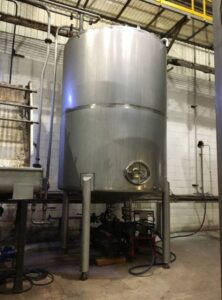
The company operates a large rendering plant that processes animal waste and food industry waste to produce proteins, fats and oils used in the oleo chemical, fuel, and feed industries. As a result of this process, the water tank and vickery would need occasional cleaning. The process water tank is shown in the image below:
It was during a nightshift that the man had been instructed to undertake cleaning duties on the process water tank, the vickery and the walls and floors in that area. The company provided pressure washers as well as a steam hose for cleaning down difficult areas where there may be tallow or other animal residues.
The steam hose was heavy and cumbersome to manoeuvre, with the uninsulated nozzle also becoming hot.. The man and a colleague therefore took it in turns to carry out the steam hose task.
After a period of time they stopped to have a break. While his colleague then went on to carry out other duties, the 23-year-old proceeded to finish the cleaning on his own.
He did this with the aid of a small cherry picker – attaching the steam hose to its basket. After the basket had been raised to the required height, the steam hose and nozzle spun round and steam began flowing into the cherry picker basket directly at him. He quickly turned his back to prevent his face being burned, while manipulating the nozzle of the hose away from him and lowering the basket of the cherry picker, at which point he was then able to run through to one of the deluge showers to cool his burn injuries. He was taken to hospital with steam burns to several parts of his body, which have left scars to this day.
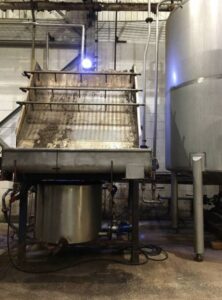
The vickery at the site
An investigation carried out by the Health and Safety Executive (HSE) found the nozzle fitted to the steam hose was unsafe as it did not have a trigger or other mechanism fitted to allow the operator to start or stop the flow out of the nozzle at the point of operation. It also found that the mixing valve and set-up for supplying hot water for cleaning purposes was not maintained in an efficient working order or in good repair. Supervisors at the site were aware that the mixing valve was passing steam, however no action was taken to investigate the issue or prevent it from happening.
HSE inspectors also found the maintenance and engineering team had no sound engineering understanding of the risks involved when setting up such a washdown system and how to mitigate or control those risks. The company provided information to HSE that there were no records associated with the maintenance of the valve, hose or nozzle.
Dundas Chemical Company (Mosspark) Limited, of Mosspark, Brasswell, Dumfries, pleaded guilty to breaching section 2(1) of the Health and Safety at Work etc Act 1974. It was fined £100,000 at Hamilton Sheriff Court on 18 August 2025.
HSE inspector Ashley Fallis said: “Had a safe system of work been in place then this incident would not have happened.
“The lack of appropriate risk assessment, method statements, training and supervision for both the maintenance team who installed the valve, and the operators tasked with using the system, led to a situation where those involved were unaware of risks or simple control measures.
“This catalogue of failures resulted in a young man sustaining very serious burns, to which he still bears the scars to this day.
“We will not hesitate to take action against companies that fail to protect their employees.”
Further information:
The Health and Safety Executive (HSE) is Britain’s national regulator for workplace health and safety. We are dedicated to protecting people and places, and helping everyone lead safer and healthier lives.
More information about the legislation referred to in this case is available.
HSE does not pass sentences, set guidelines or collect any fines imposed. Relevant sentencing guidelines must be followed unless the court is satisfied that it would be contrary to the interests of justice to do so. The sentencing guidelines for health and safety offences can be found here.
Public consultation opens on restricting PFAS in firefighting foams
Six-month consultation seeks views on UK REACH technical dossier and proposed restrictions.
The Health and Safety Executive (HSE), in its role as the Agency for UK REACH, today opened a six-month public consultation to gather stakeholder views on per- and polyfluoroalkyl substances (PFAS) in firefighting foams.
The opening of the UK REACH consultation links to the publication of the Annex 15 restriction report, which presents HSE’s scientific analysis and evidence base for potential restrictions on PFAS use in firefighting foams in Great Britain.
The consultation provides an opportunity for those who use foams from industry, and other stakeholders, such as trade associations, to comment on the proposals before the opinions are made and sent to the Defra Secretary of State, and the Scottish and Welsh Governments for a decision on whether to bring a restriction into law.
Dr Richard Daniels, HSE’s Director of Chemicals Regulation Division said: “HSE’s proposals have been developed through robust scientific methodology and where possible we have spoken with interested parties from across Great Britain. Now we are looking for more information from our stakeholders.
“We’re seeking evidence-based feedback on our analysis to ensure any future restrictions are proportionate, effective and tailored to Great Britain’s specific needs.”
This work takes forward the recommendation from our analysis in 2023 that PFAS in firefighting foams are prioritised for action ahead of other uses of PFAS, as firefighting foams are one of the largest sources of direct releases to the environment.
The consultation runs until 18 February 2026 and full details, including the restriction report and supporting documents, are available here. HSE has also published a Q&A document to help stakeholders understand the scope and limitations of the consultation.
Further information:
PFAS are persistent chemicals covering thousands of substances used across many industrial sectors
The consultation focuses solely on PFAS in firefighting foams and does not cover other PFAS uses or legacy contamination
Questions outside the scope of this specific restriction report should be directed to Defra
HSE is Great Britain’s independent regulator for workplace health and safety. HSE also has the role as the Agency for UK REACH under the UK REACH (Registration, Evaluation, Authorisation and Restriction of Chemicals) Regulations.
Publication consultation opens on restricting PFAS in firefighting foams
Six-month consultation seeks views on UK REACH technical dossier and proposed restrictions.
The Health and Safety Executive (HSE), in its role as the Agency for UK REACH, today opened a six-month public consultation to gather stakeholder views on per- and polyfluoroalkyl substances (PFAS) in firefighting foams.
The opening of the UK REACH consultation links to the publication of the Annex 15 restriction report, which presents HSE’s scientific analysis and evidence base for potential restrictions on PFAS use in firefighting foams in Great Britain.
The consultation provides an opportunity for those who use foams from industry, and other stakeholders, such as trade associations, to comment on the proposals before the opinions are made and sent to the Defra Secretary of State, and the Scottish and Welsh Governments for a decision on whether to bring a restriction into law.
Dr Richard Daniels, HSE’s Director of Chemicals Regulation Division said: “HSE’s proposals have been developed through robust scientific methodology and where possible we have spoken with interested parties from across Great Britain. Now we are looking for more information from our stakeholders.
“We’re seeking evidence-based feedback on our analysis to ensure any future restrictions are proportionate, effective and tailored to Great Britain’s specific needs.”
This work takes forward the recommendation from our analysis in 2023 that PFAS in firefighting foams are prioritised for action ahead of other uses of PFAS, as firefighting foams are one of the largest sources of direct releases to the environment.
The consultation runs until 18 February 2026 and full details, including the restriction report and supporting documents, are available here. HSE has also published a Q&A document to help stakeholders understand the scope and limitations of the consultation.
Further information:
PFAS are persistent chemicals covering thousands of substances used across many industrial sectors
The consultation focuses solely on PFAS in firefighting foams and does not cover other PFAS uses or legacy contamination
Questions outside the scope of this specific restriction report should be directed to Defra
HSE is Great Britain’s independent regulator for workplace health and safety. HSE also has the role as the Agency for UK REACH under the UK REACH (Registration, Evaluation, Authorisation and Restriction of Chemicals) Regulations.
HSE to lead investigation into death of George Gilbey
The investigation into the death of George Gilbey is now being led by the Health and Safety Executive (HSE).
George, 40, was working in Shoeburyness, Essex on 27 March 2024, when he fell to his death.
The involvement of Essex Police has now concluded. HSE will now lead the criminal investigation.
HSE inspector Natalie Prince said: “We have been a part of this inquiry from the outset, and we will continue to thoroughly investigate George’s tragic death as the lead agency.
“This will aim to establish if there have been any breaches of health and safety law.
“We are in regular contact with George’s family and our thoughts remain with them at this time.”
Further information.
The Health and Safety Executive (HSE) is Britain’s national regulator for workplace health and safety. We prevent work-related death, injury and ill health through regulatory actions that range from influencing behaviours across whole industry sectors through to targeted interventions on individual businesses. These activities are supported by globally recognised scientific expertise.