Company fined for not having compulsory insurance for its workers
Cheshire-based scrap merchant didn’t have employers liability compulsory insurance.
Issue came to light after visit from the Health and Safety Executive.
HSE reminding companies that having insurance not an ‘optional extra’.
Britain’s workplace regulator is reminding all company owners of their legal responsibility to hold Employers’ Liability Compulsory Insurance (ELCI).
The message comes from the Health and Safety Executive (HSE) following its prosecution of Mill House Metals, a scrap metal merchant based in Widnes, Cheshire.
The company was fined £1,000 and ordered to pay £2,000 towards costs after pleading guilty to breaching the Employers’ Liability Compulsory Insurance Act 1969. By law, employers are required to insure against liability for injury or disease to their employees arising out of their employment – it is compulsory insurance.
Liverpool Magistrates Court heard that following an incident at its Hale Road site, the HSE found that there had been no valid certificate of insurance between 18 April 2025 and 30 September 2025. As Mill House Metals Ltd were unable to produce a valid ELCI certificate, this meant that their staff had no means of pursuing a civil claim against the business had they been injured at work or contracted a work-related illness or disease.
Mill House Metals Ltd, of Hale Road, Widnes, Cheshire, pleaded guilty to breaching the Employers’ Liability Compulsory Insurance Act 1969. The company was fined £1,000 and ordered to pay £2,000 in costs at Liverpool Magistrates Court on 15 April 2026.
HSE principal inspector Emily Osborne said:
“Had Mill House Metal’s employees suffered a work-related injury or illness that warranted a claim for damages, they would have been denied a chance to claim the compensation as recompense for any pain and suffering they had endured.
“That is the purpose of ELCI. It is not a trivial optional extra, it is a compulsory requirement that is designed solely to protect employees.
“The law expects employers to take all reasonably practicable steps to prevent their workforce from being injured or becoming ill, but if incidents do occur then Employers’ Liability Compulsory Insurance cover is vital.”
This HSE prosecution was brought by enforcement lawyer Gemma Zakrzewski.
Further information:
The Health and Safety Executive (HSE) is Britain’s national regulator for workplace health and safety. We are dedicated to protecting people and places, and helping everyone lead safer and healthier lives.
More information about the legislation referred to in this case is available.
HSE does not pass sentences, set guidelines or collect any fines imposed. Relevant sentencing guidelines must be followed unless the court is satisfied that it would be contrary to the interests of justice to do so. The sentencing guidelines for health and safety offences can be found here.
Chemical company fined £3.8 million after investigation into serious chemical burns suffered by two employees
HSE investigation found clear failings leading to two separate incidents of exposure to caustic soda at Essex-based manufacturer.
Employee lost part of their leg in 2019 incident after stepping in puddle of caustic soda at West Thurrock site.
In 2022 a second worker needed skin grafts after suffering burns while decanting caustic soda at Grays site.
Industrial Chemicals Limited (ICL), a chemical manufacturing company based in Essex, has been fined £3.8 million after two employees at two separate sites suffered serious chemical burns as a result of exposure to sodium hydroxide, known as caustic soda.
In the most serious incident, an employee lost his leg below the knee. In the second, another employee sustained burns requiring skin grafts to heal.
Across both sites, HSE found a consistent failure to properly assess and control the risks associated with handling and containing hazardous substances.
First incident – West Thurrock, 6 December 2019
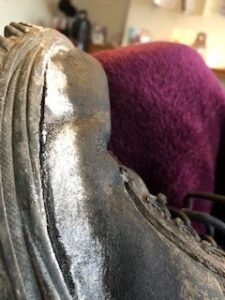
Michael Bartholomew, now 60, a father of two and grandfather of seven from Grays in Essex, was working as a chemical loader at ICL’s site at Old Power Station, Stoneness Road, West Thurrock when he stepped into a puddle of liquid suspected to contain caustic soda. The safety boots he had been provided with were not in good condition and did not provide adequate protection against the chemical — and had not been sufficiently tested against British Standards. Mr Bartholomew sustained serious burns that resulted in his leg being amputated below the knee. He has not been able to work since.
A Health and Safety Executive (HSE) investigation found multiple leaks of hazardous substances from pipework, valves, hoses and vessels across the site. There was no suitable system for the inspection, maintenance and testing of pipework and equipment to prevent or reduce the likelihood of leaks in the area where Mr Bartholomew was walking. Systems of work did not account for spillages, there were inadequate controls for clearing them up, the ground around the boiler house was unmade — enabling puddles to accumulate — and there were insufficient designated or enforced walkways to direct workers safely across the site.
In a Victim Personal Statement following the amputation, Mr Bartholomew said:
“I felt that this was game over for me. I would not be able to work or support my family. I miss my work and my work colleagues.
“Losing my independence and work is a huge loss and I feel I have gone through a grieving process as my work life was such an important and integral part of my life.
“I used to go to track days and drive different cars, I cannot do any of these things anymore…I used to take my grandchildren out fishing, I used to play football with them in my back garden, I can’t do any of these things with them anymore.”
A safety boot Mr Bartholomew was wearing when he received the injury
Second incident – Titan Works, Grays, 30 August 2022
At ICL’s Titan Works site on Hogg Lane, Grays (now closed), an employee was manually decanting caustic soda at 50% concentration using a hose into 25-litre containers, in order to top up intermediate bulk containers (IBCs) to the required concentration. After completing the task three times, he noticed that drips from the hose had fallen onto his foot, causing burns that later required skin grafts to heal. He has since returned to work.
The HSE investigation found there was no risk assessment or documented safe system of work for this task. Investigators also found that it would have been possible to automate the process entirely by bringing back into service an existing automatic IBC dosing plant with fixed pipework and remote controls — removing the need for manual handling of caustic soda altogether. Following the incident, the use of 25-litre containers was stopped, and IBCs were instead delivered to site already mixed to the required concentration, eliminating the risk entirely.
About caustic soda
Sodium hydroxide, also known as caustic soda, is used in the manufacture of washing and cleaning products. It is a white, odourless solid at room temperature and is strongly alkaline. It has a strong corrosive action on all body tissue, causing burns and frequently deep ulceration.
HSE guidance is clear that employers must take reasonable steps to reduce workers’ exposure to hazardous substances like caustic soda. The first priority is to prevent exposure altogether — for example, by changing how the work is done and making sure equipment and pipework are properly maintained.
If exposure can’t be avoided, it must be properly controlled using good working practices. Personal protective equipment (PPE) should only be used as a last resort and not relied on as the main way to manage the risk.
Industrial Chemicals Ltd, of Jupiter House, Warley Hill Business Park, The Drive, Brentwood, Essex, CM13 3BE, pleaded guilty to two charges of breaching Regulation 7(1) of the Control of Substances Hazardous to Health Regulations 2002. The company was fined £3.8 million and ordered to pay costs of £124,748 at Southwark Crown Court on 21 April 2026.
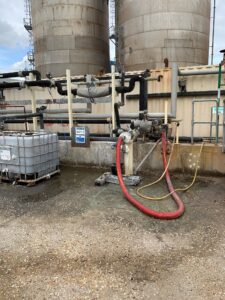
The Caustic Loading area from the ICL site
HSE Inspector Julia Gebauer said:
“This was a company operating with significant volumes of a highly corrosive material but had manifestly failed to put proper measures in place to protect their workers and prevent exposure.
“The consequence was two separate incidents at two separate sites – one of which resulted in life-altering injuries – that pointed to a pattern of avoidable risks that Industrial Chemicals Ltd could and should have prevented.
“That Mr Bartholomew didn’t have protective boots that were up to standard when he stepped in a puddle of caustic soda was only one of many failures that Industrial Chemicals Ltd have been held to account for.
“I hope the scale of the fine handed down brings some closure to the workers at the centre of this case and sends a clear message to employers that they must have proper plans in place to prevent their workers being exposed to danger.”
The HSE prosecution was brought by HSE enforcement lawyer William Bodiam and paralegal officer Chidimma Elechi.
Further information:
The Health and Safety Executive (HSE) is Britain’s national regulator for workplace health and safety. We are dedicated to protecting people and places, and helping everyone lead safer and healthier lives.
More information about the legislation referred to in this case is available.
HSE does not pass sentences, set guidelines or collect any fines imposed. Relevant sentencing guidelines must be followed unless the court is satisfied that it would be contrary to the interests of justice to do so. The sentencing guidelines for health and safety offences can be found here.
Manufacturing company fined £340,000 after worker seriously injured while cleaning machinery
Company failed to put suitable measures in place to protect employees.
Worker suffered long-term damage to his hand following the incident.
HSE guidance emphasises importance of safe isolation procedures before cleaning machinery.
A manufacturing company has been fined £340,000 after an employee was seriously injured while cleaning machinery at its site in Swindon.
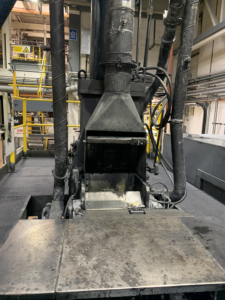
The 42-year-old man had been working a night shift for Tyco Electronics UK Limited at its premises on Faraday Road on 7 March 2023. He had been tasked with cleaning a machine used to manufacture pellets made from a mixture of raw materials. During the cleaning process, the worker manually raised the hydraulic ram inside the machine and opened the door. He then used his left hand to reach into the open space to clean the machine.
The machine mentioned
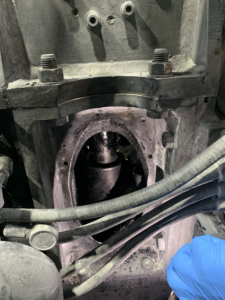
However, as he withdrew his arm, the door fell at the front of the machine and activated the hydraulic ram, trapping his limb. He managed to pull his arm free, tearing nerves and tendons, before shouting for help.
He required three operations to reattach his fingers and spent ten days in hospital. He attended Southmead Hospital twice weekly for dressing changes and physiotherapy. He continues to experience loss of sensation and movement in his fingers, although he has regained some movement in his thumb.
Close up of the hydraulic ram
An investigation by the Health and Safety Executive (HSE) found that Tyco Electronics UK Limited failed to put suitable and sufficient measures in place to prevent employees from being put at risk while cleaning the machine.
The investigation also identified that employees had not been provided with sufficient information and instruction on how to use and clean the machine safely. Training was found to be inadequate, and employees were not suitably supervised.
HSE guidance on safe use of work equipment highlights the importance of following safe isolation and lock-off procedures before carrying out any maintenance or cleaning work on machinery. Employers must ensure that equipment is properly isolated from all power sources and that systems are regularly monitored and reviewed to prevent inadvertent start-up.
Tyco Electronics UK Limited, of Company Secretariat, Faraday Road, Swindon, pleaded guilty to breaching Section 2(1) of the Health and Safety at Work etc. Act 1974. The company was fined £340,000 and ordered to pay costs of £5,145 at Swindon Magistrates’ Court on 17 April 2026.
After the hearing, HSE Inspector Emma Preston said:
“Machinery accidents during maintenance and cleaning are all too common, often with serious consequences.
“Workers should ensure that machinery is properly isolated from all sources of power so that it cannot restart during the task.
“Incidents like this can and should be prevented by following robust lock-off procedures.”
This prosecution was brought by HSE enforcement lawyer Neenu Bains and supported by paralegal officer Hannah Snelling.
Further information:
The Health and Safety Executive (HSE) is Britain’s national regulator for workplace health and safety. We are dedicated to protecting people and places, and helping everyone lead safer and healthier lives.
More information about the legislation referred to in this case is available.
HSE does not pass sentences, set guidelines or collect any fines imposed. Relevant sentencing guidelines must be followed unless the court is satisfied that it would be contrary to the interests of justice to do so. The sentencing guidelines for health and safety offences can be found here.
Waste management company prosecuted after worker crushed by excavator
Worker suffered life-changing injuries after being run over by a reversing 15-tonne excavator.
HSE found the company failed to protect pedestrians from moving vehicles in the yard.
A waste management company in Hampshire has been prosecuted by Britain’s workplace regulator after a man had both legs amputated when he was crushed by a 15-tonne excavator.
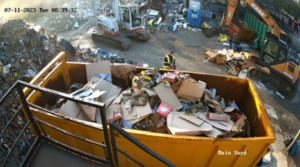
The 24-year-old man was working for R W Waste Limited at its yard in Shedfield on 7 November 2023. The excavator, operating in the same yard, reversed over him as he was sorting waste. Both of Mr Parrott’s lower legs were later amputated and he has been unable to return to work since.
An investigation by the Health and Safety Executive (HSE) found that R W Waste Limited failed to protect workers and other visitors to the site. The company had not put in place suitable arrangements to keep pedestrians safe while vehicles were moving around the yard.
CCTV screenshot of waste yard prior to incident
Health and safety legislation requires workplaces to be organised so that pedestrians and vehicles can circulate safely. Where large vehicles must reverse, employers must consider additional precautions and implement them where appropriate to protect those working nearby. HSE guidance on reversing states that most of these accidents can be avoided by taking simple precautions.
R W Waste Limited, of Botley Road, Shedfield, pleaded guilty to breaching Section 2(1) and Section 3(1) of the Health and Safety at Work etc. Act 1974.
At Southampton Magistrates’ Court on 16 April 2026 the court heard that the appropriate fine, after trial, would have been £180,000, which was reduced to £120,000 to reflect the company’s guilty plea. However, as the company had gone into liquidation and was unable to pay, it was ordered to pay a nominal fine of £1. No order for costs was made for the same reason.
HSE Inspector Nicola Pinckney said:
“The failures of this company has left a young man with truly life-changing injuries.
“He has not been able to work since.
“Unfortunately, this type of accident is sadly not uncommon in this industry.
“After the incident, and following enforcement action taken by HSE, the company did introduce a number of readily available measures that significantly reduce the risk of this happening again.
“We take these failures seriously and will hold those to account who fail to keep their workers and other people safe.”
This HSE prosecution was brought by HSE enforcement lawyer Julian White and supported by HSE paralegal officer Gabrielle O’Sullivan.
Further information:
The Health and Safety Executive (HSE) is Britain’s national regulator for workplace health and safety. We are dedicated to protecting people and places, and helping everyone lead safer and healthier lives.
More information about the legislation referred to in this case is available.
Further details on the latest HSE news releases are available.
HSE does not pass sentences, set guidelines or collect any fines imposed. Sentencing guidelines for health and safety offences can be found online.
Company fined after worker crushed by one-tonne block while inside HGV trailer
Man sustained life-changing injuries resulting in amputation when crushed under one-tonne block of concrete.
Investigation found the driver of a forklift truck involved in the incident had no training.
Company failed to protect workers from moving vehicles on its site.
A vehicle maintenance company in Worcestershire has been fined after one of its workers was crushed under a one-tonne concrete block.
The father -of-two, 35, had been working for Redditch-based BA Mobile Fleet Services Limited when the incident happened on 14 December 2023.
His leg injuries were so severe his left foot and lower leg subsequently had to be amputated, while he sustained serious injuries to his right leg. The man was also dismissed from his job after the incident.
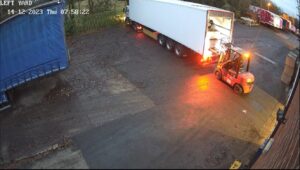
A CCTV still shows the moment just before the incident
The then 33-year-old had been inside an HGV box trailer as it was being loaded with the one-tonne concrete blocks. The vehicle was being loaded in preparation for a Driver Vehicle Standards Agency (DVSA) brake test. He had been inside the trailer with a colleague while a third worker loaded the blocks using a forklift truck. It was during this process that the forklift truck ‘nudged’ a stack of blocks inside the trailer, causing them to topple on to the man’s legs – resulting in his devastating and life-changing injuries.
An investigation by the Health and Safety Executive (HSE) found that BA Mobile Fleet Services Limited had failed to take appropriate precautions to segregate workers from moving vehicles on site. The investigation also identified that the company had not provided training to the forklift truck driver and they had not authorised him to operate such vehicles.
Preventing workplace transport incidents requires organisations to implement proven control measures consistently. This means conducting thorough risk assessments, maintaining equipment rigorously, and empowering workers to identify hazards before incidents occur.
BA Mobile Fleet Services Limited of Unit 2 The Works, Tanworth Lane, Redditch, pleaded guilty to breaching Section 2(1) of the Health and Safety at Work etc Act. The company was fined £30,000 and was ordered to pay £4,325 costs at a hearing at Kidderminster Magistrates Court on 15 April 2026.
HSE inspector Emma Page said:
“The injuries sustained here by this young man have been truly life-changing.
“Too many people are injured or killed every year in workplace transport related incidents.
“Companies should do all they can to ensure all workers go home safely to their families at the end of each day.
“We will take action against those who fail to do so.”
This HSE prosecution was brought by enforcement lawyer Edward Parton and paralegal officer Rebecca Withell.
Further information:
The Health and Safety Executive (HSE) is Britain’s national regulator for workplace health and safety. We are dedicated to protecting people and places, and helping everyone lead safer and healthier lives.
More information about the legislation referred to in this case is available.
HSE does not pass sentences, set guidelines or collect any fines imposed. Relevant sentencing guidelines must be followed unless the court is satisfied that it would be contrary to the interests of justice to do so. The sentencing guidelines for health and safety offences can be found here.