Secretary of State for Work and Pensions confirms new non-executive director for HSE
The Secretary of State for Work and Pensions has confirmed a new non-executive director appointment to the Board of the Health and Safety Executive (HSE).
Rebecca Emmett replaces Martin Esom, who left the HSE Board in March 2026, and brings with her a wealth of experience from the local government and public sectors that will help HSE continue to deliver on its 10-year strategy.
Rebecca is the Deputy Chief Executive at Basingstoke and Deane Council, having been appointed in 2022. She has a degree in environmental science and geology from Portsmouth University, and started her career as a consultant working for WSP undertaking geotechnical and contamination ground investigations.
A subsequent career change into Local Government led Rebecca to work for over 10 years in and around London leading a range of frontline services. This included roles at the London Boroughs of Croydon, Hackney and Southwark, as well as Three Rivers District Council. During her time at the London Borough of Hackney, Rebecca was responsible for leading the Council’s regulatory teams to support the delivery of the Olympic Park and 2012 Olympic Games.
During this latest round of recruitment to the Board, the Secretary of State also reappointed Debbie Gillatt as non-executive director (NED) for a further 5 years to the HSE Board.
Recruitment for new NEDs is an ongoing process as members come to the end of their terms.
It is managed by the Public Appointments team in the Department for Work and Pensions, our sponsor department, with involvement from our Board Chair, Sarah Newton.
HSE’S POLICY POSITION ON GREAT BRITAIN’S ASBESTOS CONTROL LIMIT
ANNEX 1
HSE’S POLICY POSITION ON GREAT BRITAIN’S ASBESTOS CONTROL LIMIT DECEMBER 2025
HSE has reviewed the latest international scientific, technical and workplace evidence on Great Britain’s (GB) asbestos control limit (CL), following HSE’s published GB workplace exposure setting process.
The review concluded that, currently, there is no clear evidence that lowering the GB CL in law would reduce current or future exposures and improve health outcomes.
Background
The review was undertaken in response to a recommendation in the 2022 Work and Pensions Committee (WPC) report into the Health and Safety Executive’s approach to asbestos management and action taken by the European Union (EU) to lower their equivalent occupational exposure limit (OEL) on 21 Dec 2025.
The asbestos control limit in Great Britain
The current GB CL is 0.1 fibres per millilitre (f/ml), measured as a 4-hour time-weighted average (TWA) as outlined in the Control of Asbestos Regulations 2012 (CAR 2012).
The EU’s occupational exposure limit OEL is currently 0.1f/ml as an 8-hour TWA. From 21 December 2025, a reduced OEL of 0.01f/ml will be introduced. In 2029 it will be reduced again, with EU Member States choosing between a limit of 0.002f/ml, when counting only wider fibres, or 0.01f/ml, when counting narrower fibres too.
GB’s CL expressed as a 4-hour TWA is historic and has been in place since 1970. The 4-hour limit can be viewed as more conservative than an 8-hour limit, as exposure is averaged over a shorter timeframe. Calculating exposure over 4 hours better reflects real life working practises and results in a higher reported fibre concentration than if the same exposure were averaged over 8 hours.
Purpose of the asbestos CL in Great Britain
Under CAR 2012, the CL is part of the legal definition and framework of higher-risk work with asbestos, known as licensed work. Licensed asbestos work can only be carried out by contractors who hold a licence from HSE and must follow strict requirements. These include notifying HSE before work begins, putting appropriate control measures in place such as protective equipment, completing an independent four-stage clearance process, and carrying out personal exposure monitoring and medical checks for workers. These requirements form part of a regulatory framework that ensures asbestos exposure is prevented where possible, and where it cannot be prevented, kept as low as reasonably practicable (ALARP). The CL is not a threshold below which exposures and consequent long-term cancer risks are regarded as acceptable.
All work with asbestos in GB, whether licensed or non-licensed, is governed by a framework that applies the hierarchy of controls. Dutyholders are expected to avoid disturbing asbestos where possible and, where work is necessary, to use methods such as wetting, removing materials intact, and shadow vacuuming, with respiratory protective equipment (RPE) as a final safeguard. Lower-risk activities categorised as non-licensed work are managed through proportionate controls that reflect the lower exposure risk.
The EU OELs work differently and are designed for the purpose of protecting workers if they are exposed to a harmful substance over a working lifetime. Unlike GB exposure limits, which use the ALARP principle to reduce exposures, the EU approach to asbestos control places greater emphasis on RPE, rather than on controlling the release of asbestos fibres at source.
Review of GB’s asbestos CL
The review considered whether there was sufficient evidence to inform a decision, and then whether the limit should be lowered after considering this evidence.
This drew on evidence from the 2022 WPC report, HSE’s 2017 and 2022 post implementation review (PIR), HSE and industry expertise, international scientific, technical and workplace evidence.
The review also considered the available evidence used by the EU when reviewing their OEL. The EU have estimated cancer risks expected to result from different levels of exposure to asbestos assuming these applied constantly over a working lifetime. These estimates are based on their assessment of exposure-response relationships derived from historical epidemiological evidence. While these estimates could be seen as useful benchmarks for the cancer risks resulting from different levels of constant working life exposure, they do not represent the risk among current GB asbestos workers. The GB CL operates within a regulatory framework that applies proportionate controls to different parts of the asbestos management system and requires exposures to be reduced to ALARP, rather than serving as fixed threshold above which exposures are accepted.
Additionally, lowering the GB CL would in practice bring most asbestos-related work, including for lower-risk activities that can already be effectively managed using existing control measures, into the scope of licensable activity, imposing significant costs on businesses without a corresponding reduction in exposure risk.
The review found:
that there is sufficient evidence and information available to estimate the potential scale of current and future exposures that might be influenced by any change to the CL.
the health outcome benefits of implementing a substantially reduced CL are not clear in the GB context given current requirements to already reduce exposures to ALARP.
lowering the CL in isolation is unlikely to deliver significant health improvements and that training, competence, site discipline, and regulatory enforcement have a greater influence on reducing the risk of asbestos exposure.
The evidence review has been assured by HSE’s Chief Scientific Adviser and the Workplace Health Expert Committee.
HSE also held an industry and technical expert engagement workshop in May 2025. This involved contractors, trade bodies, occupational hygienists, academics, and fibre monitoring specialists, who confirmed that most asbestos work is already designed to minimise exposure to well below the CL. They agreed that the current framework under CAR 2012, which requires exposures to be reduced ALARP, remains effective. Participants agreed that exposures can be kept below the CL with effective controls, but this is more challenging during high-risk tasks such as asbestos insulating board (AIB) removal due to gaps in compliance, training, and supervision. Stakeholders suggested that lowering the CL further would be unlikely to drive meaningful behavioural change.
Future work
HSE will continue to fulfil its role as an independent, evidence-based regulator to monitor emerging evidence and international developments, including the EU’s planned review in 2029, related to asbestos exposure risks. HSE will continue work to ensure standards are met in practice, recognising that worker behaviour and competence are key factors in minimising the risk of exposure to asbestos.HSE’s policy position is available at <INSERT LINK>
The Health and Safety Executive (HSE) has reviewed the latest international scientific, technical and workplace evidence on Great Britain’s asbestos control limit.
The review followed HSE’s published workplace exposure level setting process and concluded that the Great Britain (GB) asbestos control limit (CL), will remain at 0.1 fibres per millilitre (f/ml), measured as a 4-hour time-weighted average (TWA).
Undertaken in response to the European Union’s (EU) decision to reduce its occupational exposure limit (OEL) for asbestos, and the 2022 Work and Pensions Committee report on ‘HSE’s approach to asbestos management’, the review concluded that, currently, there is no clear evidence that lowering the GB CL in law would reduce current or future exposures and improve health outcomes.
HSE’s Chief Scientific Advisor Professor Andrew Curran said: “Our decision is based on rigorous scientific evidence and reflects our commitment to protecting workers through the most effective means possible. The current regulatory framework, which requires exposures to be reduced as low as reasonably practicable, already provides robust protection for workers handling asbestos.
“We have thoroughly examined the available science and consulted extensively with experts across the sector, and our conclusion is that the current framework provides the most effective protection for workers.
“In addition, we found that lowering the Great Britain control limit would in practice bring most asbestos-related work into the scope of licensable activity, imposing significant costs on businesses without a corresponding reduction in exposure risk.”
The review noted that there are practical difficulties of measurement at lower levels of exposure, which would provide a barrier to accurately implementing a lower limit, and could introduce risk.
The review found that most asbestos work is already designed to minimise exposure to well below the control limit through effective control measures, when requirements are followed. The review’s findings stated training, competence, site discipline, and regulatory enforcement have greater influence on reducing asbestos exposure risks than changing numerical limits.
HSE will continue to monitor emerging evidence and international developments, including the EU’s planned review in 2029. HSE remains committed to ensuring standards are met in practice, recognising that worker behaviour and competence are key factors in minimising asbestos exposure risks.
Ends
Company fined £350,000 after chemical tank collapse left worker with life-changing injuries
700-tonne tank containing calcium chloride was more than 30 years old and corrosion was first identified a decade before incident.
62-year-old left with life-changing injuries and not been able to work since.
Peterhead base handles thousands of ship movements each year.
A company has been fined £350,000 after the catastrophic collapse of a storage tank at its Peterhead premises which left a self-employed worker with life-changing injuries.
The Health and Safety Executive (HSE) investigated the incident, which occurred on 21 June 2023 at Tetra Technologies UK Limited’s offshore supply base. The base handles around two thousand ship movements per year, supplying North Sea oil and gas installations with deck cargos and quantities of fluids.
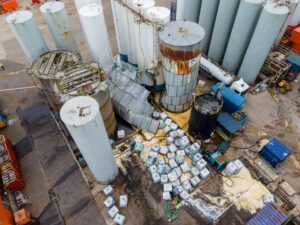
A still of drone footage captures the aftermath
Philip Moir, a 62-year-old self-employed rope access technician, was on site conducting surveys of storage tanks when Tank 7 — a bolted steel tank holding approximately 480,776 litres of calcium chloride solution weighing around 700 tonnes — catastrophically ruptured without warning.
Mr Moir was almost immediately immersed to chest height in the released fluid. He was subsequently found slumped over the wheel of a nearby cherry picker, which itself, along with a Ford Transit pickup, a small skip and the cherry picker — weighing twelve and a half tonnes — had all been displaced by the force of the escaping fluid.
The 700-tonne tank was more than 30 years old
Mr Moir sustained a double fracture of his spine and pelvis, lacerated liver, punctured lung, multiple rib fractures, fractured sternum, a fractured wrist, and extensive chemical burns requiring skin grafts. He has not worked since the incident and is unable to climb ladders or work at height, injuries described as life-changing.
HSE’s investigation, conducted by both regulatory and specialist inspectors, identified that the structural failure occurred around halfway up the tank shell, where the third row of plates split vertically along a bolted seam. Approximately 4.5mm of the original 5.5mm steel plate had been lost through corrosion over time, leaving just 1mm of steel unable to withstand the outward forces of the fluid within. Investigators found that the loss of any protective coating had left the steel surfaces exposed to aggressive coastal air, accelerating external degradation. The density of calcium chloride — more than one third denser than water — further increased the forces applied to the already weakened structure.
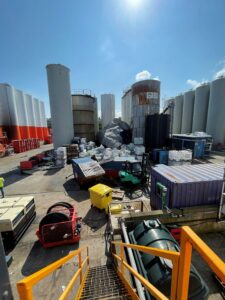
HSE inspectors arrived on site and took this photo of the scene
The tank was more than 30 years old and the manufacturer’s maintenance manual required six-monthly checks of seams and bolts, and annual external inspections for corrosion. An inspection in 2013 had already identified extensive outer surface corrosion over the lower section of the tank and corrosion at bolted connections, yet no remedial work was carried out on Tank 7. The company was unable to provide evidence of any regular inspection regime being followed in the years that followed.
On the morning of the incident, Tank 7 had been filled to capacity — a step taken to create space at the company’s Aberdeen premises — and failed less than thirty minutes after the final load was pumped in. HSE concluded that the failure of the tank was wholly foreseeable and preventable.
Following the incident, the company removed all bolted tanks from its sites and closed its Peterhead operation, relocating to its Aberdeen premises.
Tetra Technologies UK Limited of One Fleet Place, London, pleaded guilty to breaches under sections 3(1) and 33(1)(a) of the Health and Safety at Work Act etc. 1974. The company was fined £350,000 at Peterhead Sheriff Court on 13 May 2026.
HSE Inspector Mark Carroll said:
“This was a completely preventable incident.
“The corrosion that caused this tank to fail had been identified a decade before it collapsed, yet no remedial action was taken and there is no evidence that the required inspection regime was ever consistently followed.
“A worker has been left with life-changing injuries as a direct consequence of those failures.
“Companies have a legal duty to maintain equipment in an efficient state and good repair, and HSE will not hesitate to take action where that duty is not met.”
Further information.
The Health and Safety Executive (HSE) is Britain’s national regulator for workplace health and safety. We are dedicated to protecting people and places, and helping everyone lead safer and healthier lives.
More information about the legislation referred to in this case is available.
HSE does not pass sentences, set guidelines or collect any fines imposed. Relevant sentencing guidelines must be followed unless the court is satisfied that it would be contrary to the interests of justice to do so. The sentencing guidelines for health and safety offences in Scotland can be found here.
Road planing company fined after worker maimed by milling machine
Worker, who was 32 at the time, suffered life-changing injuries after leg became entangled in road milling machine.
HSE investigation found company routinely operated machinery without manufacturer’s safety guard fitted.
Employee’s leg had to be amputated at the scene by emergency services.
A road planing contractor in Leicestershire has been fined £92,450 after an employee’s leg became entangled in a road milling machine and had to be amputated.
On 14 February 2024, the 32-year-old employee, working for Power Plane Limited, was operating a road milling machine at Wade Road in Basingstoke. The operator’s foot became caught by the rotating milling drum, dragging him into the machine.
Photo from the scene
His right leg had to be amputated by emergency services at the scene to free him from the machine. The life-changing injury left him unable to work for more than a year. He continues to suffer long-term mental and physical effects, including PTSD and persistent pain, as well as having to adapt to living with a lifelong disability.
An investigation by the Health and Safety Executive (HSE) found that Power Plane Limited had failed to take effective measures to prevent access to the dangerous rotating milling drum of the road planing machine. The manufacturer’s ‘protective bow’, designed to restrict access to the milling drum, had not been attached to the machine. The investigation also found it was common practice for the company to operate milling machines without the guard fitted.
HSE guidance states employers must take effective measures to prevent access to dangerous parts of machinery. Mobile work equipment should be used in accordance with the manufacturer’s health and safety instructions.
Power Plane Limited, of Highway House, Asfare Business Park, Hinckley Road, Hinckley, pleaded guilty to breaching Regulation 11(1) of the Provision and Use of Work Equipment Regulations 1998. The company was fined £92,450 and ordered to pay £6,781 in costs at Aldershot Magistrates’ Court on 13 May 2026.
HSE inspector Peter Crees said:
“Every year, a significant proportion of accidents, many of them serious or fatal, are caused by poorly guarded work equipment.
“This was a wholly avoidable incident, caused by a failure to guard dangerous parts. Had the company simply fitted the manufacturer’s guard to the machine, this life-changing injury could have been prevented.”
This HSE prosecution was brought by enforcement lawyer Rebecca Schwartz and paralegal officer Farhat Basir.
Further information:
The Health and Safety Executive (HSE) is Britain’s national regulator for workplace health and safety. We are dedicated to protecting people and places, and helping everyone lead safer and healthier lives.