Handyman sentenced after illegal boiler fitting caused gas leak posing ‘immediate danger to life’

  • Dangerous boiler installation led to gas leak which ‘could easily have caused an explosion’.
  • Tenant in Birmingham property realised unregistered handyman Jaroslaw Mazan had lied about being on the Gas Safe Register.
  • Unqualified gas work can lead to gas leaks, fires, explosions, and carbon monoxide poisoning.

A self-employed handyman has been sentenced after carrying illegal gas work on a property in Birmingham after he falsely claimed to be on the Gas Safe Register. The work resulted in several defects, including a gas leak, which inspectors from Gas Safe Register branded an ‘immediate danger to life’.

In November 2023 Jaroslaw Mazan was hired to carry out the work by the landlords of the property.  The tenant witnessed him undertaking gas work and specifically installing the boiler, and realised that Mazan had lied about being registered with Gas Safe when they could find no evidence of this on the Gas Safe Register website.

An inspector from Gas Safe Register attended the property in December 2023 to carry out an inspection of the gas work, finding an immediately dangerous gas leak on the pipework to the boiler and several other, possibly dangerous defects.

The leaking gas pipe

This prompted an investigation by the Health & Safety Executive (HSE), which found that Jaroslaw Mazan carried out gas work without being competent to do so and without being registered on the Gas Safe Register.

HSE guidance states that only individuals who are on the Gas Safe Register should carry out gas work and that this work must be in accordance with appropriate standards. This guidance can be found here: Safety in the installation and use of gas systems and appliances.

While in this case nobody was injured, carrying out gas work without registration is illegal and potentially extremely dangerous. Unqualified work can lead to gas leaks, fires, explosions, and carbon monoxide poisoning.

At Dudley Magistrates’ Court on Friday 12 June, Jaroslaw Mazan pleaded guilty to breaching Gas Safety (Installation and Use) Regulations 1998, Regulation 3(3), Mr Mazan received a 26-week suspended sentence and was ordered to pay £500 in compensation to the tenant of the property. HSE does not determine sentences, which are set by the Court.

HSE Inspector Harry Shaw said:

“This dangerous boiler fitting was a disaster waiting to happen, and the resultant gas leak could easily have caused a lethal explosion.

“The tenant did the right thing – and quite possibly saved themselves from serious harm – by checking the Gas Safe register and alerting inspectors when they realised Jaroslaw Mazan was unregistered.

“My message to anyone getting gas work carried out is simple; always use a Gas Safe-registered engineer, and if you aren’t sure of someone’s credentials, it only takes two minutes to check.”

The HSE prosecution was brought by enforcement lawyer Matthew Reynolds and paralegal officer Stephen Grabe.


Further information:

  1. The Health and Safety Executive (HSE) is Britain’s national regulator for workplace health and safety. We are dedicated to protecting people and places and helping everyone lead safer and healthier lives.
  2. More information about the legislation referred to in this case is available.
  3. Further details on the latest HSE news releases is available.
  4. Relevant guidance can be found here L56 – “Safety in the installation and use of gas systems and appliances” Safety in the installation and use of gas systems and appliances
  5. HSE does not pass sentences, set guidelines or collect any fines imposed. Relevant sentencing guidelines must be followed unless the court is satisfied that it would be contrary to the interests of justice to do so.  The sentencing guidelines for health and safety offences can be found here.


Mining company fined after electrician killed at Europe’s only underground quartz sand mine

  • Colin Thwaites, who had spent his entire career in mining, died working for Lochaline Quartz Sand Limited.
  • Lochaline mine is the only underground quartz sand mine in Europe.
  • Mr Thwaites was struck by the blades of a fan which wasn’t sufficiently well-guarded

The operator of Europe’s only quartz sand mine has been fined after an experienced electrician was killed after being struck by the blades of a mine BORA fan.

Colin Thwaites, 61, died on 21 October 2024 while working at Lochaline Quartz Sand Limited’s underground mine on the Morvern Peninsula in the Scottish Highlands.

Colin Thwaites had worked in the mining sector all his life

Mr Thwaites, who had spent his entire career in mining and was the mine’s only time-served electrician, had arrived for his day shift to help restore power following damage caused by Storm Ashleigh. He was working alongside an apprentice to disconnect a communications cable near one of the mine’s BORA fans when the incident occurred. His colleague found him trapped in the fan, having suffered fatal injuries.

HSE investigation findings

The Health and Safety Executive’s (HSE) Mines and Quarries Unit carried out an investigation, with inspectors arriving at the mine the following day. Their findings identified a series of serious failings in how the fan had been modified, commissioned and maintained.

The fan involved had originally formed part of a single in-line assembly unit with a sister fan. In June 2020, the decision was taken at the mine to split this single unit into two separate fans. HSE investigators found that the hazards arising from this modification had not been properly identified or managed. No written risk assessment was produced, no commissioning documents were created, and no records of any management discussion about the separation could be provided.

The sister fan of the one involved in the incident – the two had originally been together as one unit

Critically, the splitting of the unit left the rotating parts of the Number 2 fan significantly closer to its intake guard than was safe. The fan blades were just 43mm — less than two inches — from the leading edge of the duct. The relevant guarding standard required a distance of at least 200mm, which could have been achieved through appropriate nose cone or cage-type guarding.

To cover the exposed intake, guards were fabricated on-site from two sheets of metal square lattice mesh, which HSE inspectors determined was poorly designed. The metal bracing straps were fitted on the outside of the mesh panels rather than the inside, providing no additional structural strength. The exhaust end of the fan remained entirely unguarded.

When inspectors examined the fan the day after the incident, the intake guard was found to be in a seriously degraded condition. Significant areas of mesh were missing, particularly around the fan’s impeller hub. Wire and mesh pieces recovered from the floor showed heavy corrosion on their broken ends, indicating they had been in that condition for some time — not freshly broken during the incident. Further pieces of mesh had been ejected through the fan during the incident itself. Had the guard been properly designed and maintained, it is likely it would have prevented the fatal incident.

Significant areas of mesh were missing, particularly around the fan’s impeller hub

Compounding these failures, the two fans had not been listed on the mine’s Mechanical Asset Register. No inspection checklists or maintenance records for them could be provided. While electrical inspections had been recorded, the degraded condition of the inlet guard had not been identified during those processes.

HSE took immediate and appropriate enforcement action against the company, who then engaged a specialist mining consultancy to achieve compliance.

Lochlaine Quartz Sand Limited, of European Technical Centre, Hall Lane, Lathom, in Ormskirk, Lancashire, pleaded guilty to breaching Section 2(1) and Section 33(1)(a) of the Health and Safety at Work etc. Act 1974. The company was fined £150,000 and told to pay a Victim Surcharge of £11,250 at Inverness Sheriff Court on 16 June 2026.

Kevin Wilson, HSE’s chief inspector of mines and quarries, said:

“This was a tragic and entirely preventable death.

“Colin Thwaites was a highly experienced mining professional with decades of service. He should have gone home to his family that day.

“Our investigation found that when the fan was modified, the risks were not identified. The guarding that was put in place was inadequate from the outset, and its deteriorating condition went unnoticed because there was no proper maintenance regime in place.

“Mine operators have clear legal duties to ensure equipment is safely commissioned and maintained. Where those duties are not met, the consequences can be fatal.”

Further information:

  1. The Health and Safety Executive (HSE) is Britain’s national regulator for workplace health and safety. We are dedicated to protecting people and places, and helping everyone lead safer and healthier lives.
  2. More information about the legislation referred to in this case is available.
  3. Further details on the latest HSE news releases is available.
  4. HSE does not pass sentences, set guidelines or collect any fines imposed. Relevant sentencing guidelines must be followed unless the court is satisfied that it would be contrary to the interests of justice to do so.  The sentencing guidelines for health and safety offences in Scotland can be found here.


Waste company fined £300,150 after teenager fractures leg in unguarded conveyor

  • 18-year-old’s foot slipped into unguarded conveyor
  • HSE investigation found no risk assessment in place
  • SRCL Limited fined £300,150

A company providing clinical waste management services has been fined after an 18-year-old employee sustained serious injuries while loading a bin conveyor.

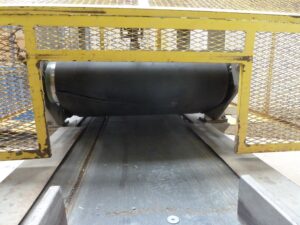
The young man was working for SRCL Limited at its site in Oldham on 21 November 2024, when his foot slipped into an unguarded conveyor channel. He sustained several serious fractures to his right leg.

Coveyor
Coveyor channel

An investigation by the Health and Safety Executive (HSE) found that the company had failed to carry out a suitable and sufficient risk assessment and failed to provide suitable guarding on the bin conveyor.

HSE guidance states employers must take effective measures to prevent access to dangerous parts of machinery or to stop the movement of any dangerous parts of it before any part of a person enters a danger zone. This will normally be by fixed guarding, but where routine access is needed, other measures may be needed to stop the movement of dangerous parts, for example by having interlocked guards or pressure mats. Further detailed guidance on safe working with machinery is available.

SRCL Limited, of Indigo House, Sussex Avenue, Leeds, pleaded guilty to breaching Section 2(1) of Health and Safety at Work etc. Act 1974. The company was fined £300,150, a victim surcharge of £2000 and ordered to pay £3931.85 in costs at Warrington Magistrates’ Court on 16 June 2026.

HSE Inspector Sam Eves, said:

“A young man at the beginning of his working life was failed by this company.

“This incident could have so easily been avoided by properly assessing the risks and applying the correct control measures to prevent access to dangerous parts of machinery.

“Companies should know that HSE will not hesitate to take appropriate enforcement action against those that fall below the required standards.”

This HSE prosecution was brought by HSE Enforcement Lawyer Gemma Zakrzewski and supported by Paralegal Officer Stephen Grabe.

More information:

  1. The Health and Safety Executive (HSE) is Britain’s national regulator for workplace health and safety. We are dedicated to protecting people and places, and helping everyone lead safer and healthier lives.  
  1. More information about the legislatioreferred to in this case is available. 
  1. Further details on the latest HSE news releases is available.  
  1. Relevant guidance can be found here Safe use of work equipment. Provision and Use of Work Equipment Regulations 1998. Approved Code of Practice and guidance L22 
  1. HSE does not pass sentences, set guidelines or collect any fines imposed. Relevant sentencing guidelines must be followed unless the court is satisfied that it would be contrary to the interests of justice to do so.  The sentencing guidelines for health and safety offences can be found here.   


Leisure firm fined after death of footballer electrocuted by floodlight

  • Albert Xhediku, 34, had been playing football with friends in Portsmouth.
  • He was electrocuted by a floodlight as he climbed a fence to retrieve the ball.
  • Parkwood Community Leisure Ltd failed to act on previous incident just weeks before.

A leisure facilities management company has been fined after a man was electrocuted while playing football in Portsmouth.

Albert Xhediku, 34, had been playing five-a-side with his friends on the all-weather pitch at Mountbatten Leisure centre on 17 January 2016. After the ball went out of play Albert climbed a fence to collect it. As he did so, he came into contact with a floodlight which delivered the fatal shock. Despite efforts by his friends to resuscitate him, later that day he was pronounced dead at the local hospital.

An investigation by the Health and Safety Executive (HSE) found the incident arose from worn and faulty wiring on the floodlight which Parkwood Community Leisure Ltd had failed to properly inspect and maintain. It was also found that this failing had been present for several years and no action had been taken to repair the equipment. This was despite a previous incident being reported to the leisure centre a month before Albert’s death when an off-duty police officer suffered an electric shock from the same equipment.

HSE provides guidance on the requirement to maintain electrical systems. This guidance establishes that electrical equipment should be maintained so as to prevent, so far as is reasonably practicable, danger to any persons likely to come into contact with the equipment.

Parkwood Community Leisure Ltd of The Stables, Duxbury Park, Duxbury Hall Road, Chorley, pleaded guilty to breaching Section 3 (1) of the Health and Safety at Work etc. Act 1974 at a previous hearing.  At Portsmouth Magistrates’ court on 16 June 2026 the company was fined £60,000 and ordered to pay costs of £40,000.

HSE inspector Dominic Goacher said:

“This tragic incident should never have happened.

“What followed was a long and complex investigation.

“We found that the electrical system of the floodlight that resulted in Albert’s death had already been identified by Parkwood as being in poor condition, yet they failed to take action to remedy the faults.

“This case is a stark reminder that effective systems must be put in place to properly assess and manage the risks posed by ageing infrastructure on their sites.

“As always, our thoughts remain with Albert’s family and friends and we hope the conclusion of this case can offer them some comfort.”


Further information:

  1. The Health and Safety Executive (HSE) is Britain’s national regulator for workplace health and safety. We are dedicated to protecting people and places, and helping everyone lead safer and healthier lives.
  2. More information about the legislation referred to in this case is available.
  3. Further details on the latest HSE news releases is available.
  4. Relevant guidance can be found here: the requirement to maintain electrical systems
  5. HSE does not pass sentences, set guidelines or collect any fines imposed. Relevant sentencing guidelines must be followed unless the court is satisfied that it would be contrary to the interests of justice to do so.  The sentencing guidelines for health and safety offences can be found here.



Two firms fined after worker fractures neck during platform collapse

  • Temporary wooden platforms collapsed during refurbishment project in City of London
  • Steve Zschoch, 60, described being ‘folded up like a concertina’ and has not been able to work since.
  • HSE guidance is clear temporary structures must be designed, installed and maintained to withstand any foreseeable loads.

Two construction companies have been fined after a drilling operative sustained fractures to his neck and back when a temporary platform loaded with concrete debris collapsed on top of him.

Steve Zschoch, now 60, was working for contractors Diacutt Limited on 23 February 2024 at a construction project at Paxton House in the City of London. The refurbishment project, which was being run by principal contractor Roots Contractors Limited, involved cutting openings through five concrete floors to create a service riser shaft.

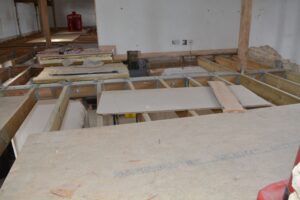
A temporary platform loaded with concrete debris collapsed on top of Steve Zschoch

Roots Contractors Ltd had instructed its carpenters to build temporary wooden platforms under each opening to collect the 16kg concrete cores and debris that were generated by the cutting.

Mr Zschoch had been cutting an opening on the third floor, working directly under one of the temporary platforms, when it suddenly gave way and collapsed on top of him, along with chunks of concrete that had not been cleared away.

He described being “folded up like a concertina.” He sustained injuries including fractures to his neck, his back and a bleed on his brain. He described the profound impact of the incident on his day to day life;

“The impact this incident has had on me has been life changing in so many ways, he said.

“Not just in mobility issues but in my confidence to do just about anything.

“Even simple domestic tasks, like using the launderette or going to the shops can overwhelm me now. Emotionally as well as physically.”

An investigation by the Health and Safety Executive (HSE) found that there was no design for the temporary platforms and no calculation had been made for the safe level of loading.

Steve Zschoch suffered a fractured neck in the incident

While an inspection form for the platform was completed, it failed to identify any issues with the design, and the person tasked to complete it was a not a competent temporary works coordinator.  We also found that although there had been a verbal instruction for workers to regularly clear the platforms of concrete and not ‘overload’ them, no safe level of loading was known, and there was no monitoring of whether the platforms were indeed cleared.

HSE also found deficiencies in the planning, managing and monitoring of the work by the contractor.

  • Risk assessments and method statements provided by Diacutt in advance were inconsistent and their requirements for the principal contractor to provide ‘crash decks’ were unclear.
  • There was no supervision of the drilling team by Diacutt management in the week leading up to the incident or on the day.
  • While operatives understood that they should not work directly below one another, there was a lack of coordination and clarity as to who should have been working where.

Temporary works must be carefully managed. The law says any temporary structure must be designed, installed and maintained to withstand any foreseeable loads which may be imposed on it and that it be only used for the purposes for which it was designed, installed and maintained. They should be inspected by a competent person on a regular basis. Guidance on temporary works is available at hse.gov.uk.

Roots Contractors Limited of Ewell, Surrey pleaded guilty to breaching The Construction (Design and Management) Regulations 2015, Regulation 16(2). The company was fined £19,333 plus costs of £5,548 at a hearing at Westminster Magistrates’ court on 11 June 2026.

Diacutt Limited of Croydon pleaded guilty to breaching The Construction (Design and Management) Regulations 2015, Regulation 15(2) and was fined £13,000 plus costs of £5,548 at the same hearing.

HSE inspector Lucy Ellison-Dunn said:

“People rightly expect that when they go to work, they are not put in unnecessary danger, and this  entirely avoidable incident had the effect of seriously injuring Mr Zschoch and ending his construction career much earlier than he wanted.

“Those providing temporary works have a duty to ensure that any temporary structure is properly designed and constructed to withstand any foreseeable load that might be imposed on it.

“This means having appropriate arrangements in place to manage temporary works.  Contractors should ensure all construction work is properly planned, managed and monitored to ensure workers can carry out their work safely.”

The prosecution was brought by HSE enforcement lawyers Chloe Ward and Jon Mack, supported by Thomas Smith.

Notes to Editors

  1. The Health and Safety Executive (HSE) is Britain’s national regulator for workplace health and safety. We are dedicated to protecting people and places, and helping everyone lead safer and healthier lives.
  2. More information about the legislation referred to in this case is available.
  3. Further details on the latest HSE news releases is available.
  4. Relevant guidance on temporary works is available can be found here and also about the duties of contractors to plan, manage and monitor construction work.
  5. HSE does not pass sentences, set guidelines or collect any fines imposed. Relevant sentencing guidelines must be followed unless the court is satisfied that it would be contrary to the interests of justice to do so.  The sentencing guidelines for health and safety offences can be found here.