Press release: Government’s response to the Taylor review of modern working practices

The Low Pay Commission (LPC) welcomes the Government’s response to the Taylor review of modern working practices

Bryan Sanderson, Chair of the Low Pay Commission said:

The LPC’s view has always been that ‘good work’ is relevant to all workplaces, irrespective of earnings or hours worked, and we were pleased to see this set out in the Taylor review. In particular we supported the review’s highlighting of practices for some low-paid workers, which in some cases result in one-way flexibility benefiting only the employer.

As such, we welcome the Government’s response to the review and look forward to considering the potential of a premium rate of the National Minimum Wage, as well as other possible solutions to the issue of one-sided flexibility. We will use our experience, knowledge, and analysis and work with our stakeholders to provide evidence-based advice to the Government.

We are particularly pleased that the Government has committed to implementing the recommendation on payslips that we made in our Spring 2016 Report. This required employers to provide hourly-paid staff with a payslip that clearly states the number of hours they are being paid for. Government has gone further than this, extending the right to payslip to all workers, not just employees. This will make these rights easier to both communicate and understand and therefore aid compliance

Notes: 1. The Low Pay Commission is an independent body made up of employers, trade unions and experts whose role is to advise the Government on the minimum wage. The National Living Wage is the legally binding pay floor for workers aged 25 and over. The other minimum wage rates comprise: the 21-24 Year Old Rate, the 18-20 Year Old Rate, the 16-17 Year Old Rate and the Apprentice Rate. 2. The LPC’s remit prescribes different requirements in relation to the NLW than for the four other bands of the minimum wage. For the NLW we are asked to make recommendations on the pace of increase towards a target: an ‘ambition…that it should continue to increase to reach 60 per cent of median earnings by 2020, subject to sustained economic growth’. For the other rates we are asked to ‘help as many low-paid workers as possible without damaging their employment prospects’. 3. Our full recommendations for April 2018 and underpinning analysis were published in our 19th report. The rationale for our recommendations is also included in a letter from the LPC Chair to the Secretary of State for Business, Energy and Industrial Strategy.

Press enquiries

8th Floor Fleetbank House 2-6 Salisbury Square London EC4Y 8JX

Email lpc@lowpay.gov.uk

Telephone 020 7211 8772

Out of hours 07720 212676

Share this page

Share on Facebook Share on Twitter


News story: UK Chief of Defence Staff reaffirms commitment to Australia

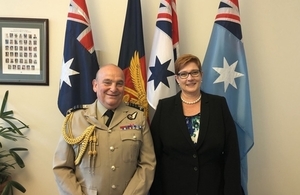
Chief of Defence Staff Sir Stuart Peach and Australian Minister for Defence Marise Payne. Copyright @MarisePayne. Chief of Defence Staff Sir Stuart Peach and Australian Minister for Defence Marise Payne. Copyright @MarisePayne.

During a visit to the country, Sir Stuart Peach met his Australian counterpart, Air Chief Marshal Mark Binskin AC, to discuss how both countries’ Armed Forces can work together on a number of fronts.

Sir Stuart also met with the Australian Minister of Defence, Senator the Hon Marise Payne, to discuss an aligned approach to both global and regional issues, such as North Korea, Iraq, Syria and countering terrorism.

Both nations are already part of the Five Eyes defence relationship and work together on tackling shared threats, but are seeking to build upon this further.

Whilst in Canberra, Sir Stuart laid a wreath at the tomb of the unknown Australian soldier in the Australian War Memorial and met the Director, Dr Brendan Nelson.

The Chief of Defence Staff Sir Stuart Peach said:

From the First World War right up to the fight against Daesh, the UK and Australia have stood shoulder to shoulder as the strongest of allies. We work together on a range of regional and global challenges, advocating and defending the rules-based international system and promoting rule of law as the basis of peace and security.

Our strong defence and security relationship reflects a modern and dynamic partnership. We learn from each other as our soldiers train together, we collaborate in defence science and technology and I have no doubt our partnership will continue to go from strength to strength as we face upcoming global challenges together.

Published 7 February 2018
Last updated 7 February 2018 + show all updates

  1. Amend to copyright.
  2. First published.


News story: Update: Brighton office

Published 7 February 2018

Last updated 12 February 2018
+ show all updates


  1. Updated following resolution of maintenance issue and reopening of the office.

  2. First published.


News story: National College for Nuclear opens its doors in Cumbria

The UK’s National College for Nuclear was offically opened today in Cumbria.

The UK’s National College for Nuclear (NCfN) – a £7.5m two-story college at Lakes College, Lillyhall – will bring a new way of teaching to students while bridging the gap between further education colleges and university, and the workplace.

Sellafield Ltd and EDF Energy are leading industry input into the college which is based at two sites – Lillyhall and Bridgwater & Taunton College, Somerset – helping to ensure its curriculum and qualifications are based on employer need.

The college is one of five government funded national colleges that will deliver high-tech technical training to thousands of learners across England.

Dame Sue Ion officially opened the college in Cumbria, and said:

This new training facility will provide access to world-class technology to individuals looking to start or further develop their career in the nuclear industry.

It is an exciting time for the industry, and it is encouraging to see investments by government, industry and academia into facilities like the NCfN. The nuclear sector is really taking an active role in training the workforce of tomorrow.

The college combines theoretical work with hands-on experience. There are virtual reality rooms to provide students with experience of working in a nuclear environment, an engineering workshop is equipped with the latest technology, laboratories and simulated ‘restricted’ areas give a detailed view of the work involved at a nuclear plant.

Colin Reed, NCfN Board Chair said:

I’m excited about the opportunities that this brand-new training facility will offer young people at Sellafield, in the supply chain and globally once they’ve completed their courses.

Sellafield Ltd and EDF Energy will work alongside Lakes College and Bridgwater, plus higher education providers University of Cumbria and University of Bristol, and aim to train 3,500 people by 2020.

Sellafield’s mission is changing as we transition into a fully-fledged environmental restoration project. This will require re-training and reskilling of our staff and a new pipeline of talented individuals with higher level skills across a range of disciplines.

NCfN northern site operations director, Les Agnew said: “The college has taken 12 months to build, and offers a range of qualifications, from post-16 access courses through to degrees. Subjects include robotics, systems and mechanical engineering.

“Lakes College, who will deliver the curriculum, have a new nuclear staff of five who have professional nuclear experience and academic qualifications.

“We have been able to invest in world-class technology thanks to initial investment from government, and sponsorship from companies in the North West. I can’t wait to have a full college of 300 students, some full time and others on block release, meeting the needs of the industries in Cumbria.”


Press release: Planned Israeli settlement: statement by Minister for Middle East

The UK strongly condemns the Israeli government’s decision to establish a second new settlement deep in the West Bank in less than a year. These plans could involve the retroactive ‘legalisation’ of the outpost of Havat Gilad.

Settlements are illegal under international law and undermine the physical viability of the two-state solution. We call on both parties to refrain from actions which make peace more difficult.