Thank you Mr President.
The Security Council has long recognised that the situation in Yemen threatens international peace and security. It has caused the world’s largest humanitarian crisis, which gets worse by the day. The conflict creates ungoverned spaces in which terrorists can operate, poses security threats to countries in the region and international shipping, and fuels regional tensions. While international attention is rightly focussed on the horror that continues to unfold in Syria, this Council must not ignore the appalling situation in Yemen.
We have a duty to respond using all the tools at our disposal. We must show unity of effort and purpose to put an end to this terrible and destabilising conflict. That is why we have tabled this resolution before us today.
Mr President,
The UN sanctions regime is a critical tool that we must use to pressurise the individuals and organisations bent on undermining peace and security in Yemen.
We welcome the work of the Panel of Experts, who have played a key role in supporting the Sanctions Committee to carry out its mandate, including through the provision of recommendations regarding the implementation of measures decided upon in Security Council Resolutions 2140 and 2216. It is vital that this work, the work of the Panel of Experts, continues.
Furthermore, we in this Council must not ignore the growing ballistic missile threat emanating from Yemen, which gravely threatens international peace and security. Attacks such as those launched on 22 July, 4 November and 19 December against civilian targets in Saudi Arabia are unacceptable. They undermine the prospects for peace, prolong the conflict, and put civilian lives at risk. This Council must speak out with a united voice against such attacks. We can do this by voting in favour of the resolution before us today, which strongly condemns these attacks.
The United Kingdom is deeply concerned that Iran has failed to take the necessary measures to prevent the direct or indirect supply, sale or transfer of short-range ballistic missiles, missile propellant and unmanned aerial vehicles to the then Houthi-Saleh alliance, as reported by the Panel of Experts. We agree with the Panel’s assessment that in light of this, Iran is in non-compliance with paragraph 14 of Resolution 2216.
Iran – and other states who violate the Security Council Resolutions – must be held accountable for this. This Council needs to stand firm in the face of state non-compliance and send a clear message that it will not be tolerated. This is what the UN Charter demands from us: to respect the obligations arising from treaties and other sources of international law.
Mr President,
We are also deeply concerned by the growing humanitarian crisis in Yemen. A record 22.2 million people are now in need of assistance – 3.4 million more than last year. Last year’s UN humanitarian appeal was only 70 per cent funded, and this year’s appeal stands at $2.96 billion. We encourage all member states to respond fully to this appeal. Restrictions on vital humanitarian access continue to be imposed by all parties to the conflict. The impact of access restrictions on the people of Yemen are made clear by the UN Panel of Experts and therefore this resolution before you calls for full and unfettered access for humanitarian and commercial cargo through all of Yemen’s ports, including Hodeidah and Saleef, and for supplies to be increased beyond pre-November levels.
This year is an important year. With a new UN Special Envoy in place, it is vital that the international community redoubles its efforts to achieve a political solution to the conflict. We call upon all parties to the conflict to resolve their differences through dialogue and consultation and refrain from provocation. Until an enduring political settlement is reached, we must maintain the sanctions regime to deter those who would otherwise use violence to achieve their political aims.
The United Kingdom has worked hard with all Council members in order to reach consensus on a resolution which responds to our concern at all the ongoing political, security, economic and humanitarian challenges in Yemen, and the threats arising from the illicit transfer and misuse of weapons. Today we have spent over five hours in detailed talks with delegations, and have proposed a number of compromises. I am personally grateful for all of your patience today. We have sought to agree a text which provides a balanced and impartial assessment of the situation in Yemen but which does not shy away from calling out those whose actions undermine international peace and security. Today we need to show that we in this Council are unified against the threats to Yemen’s future. We must also send a clear message that we support the independence and integrity of the UN Panel of Experts. We in this Council rely on these independent expert international panels. We may not always like all of their reports. We may find their conclusions politically inconvenient. But if we want the United Nations to function, we need to support them in their work.
Those who do not vote in favour of this resolution today are preventing us from sending a clear message to those that seek to undermine the peace and security in Yemen and the region beyond. They are also failing in their duty to do all they can to uphold the international rules-based system and hold those states that violate resolutions agreed by this Council to account.
With this in mind, I strongly urge now you now to vote in favour of the resolution before you.
Thank you Mr President.
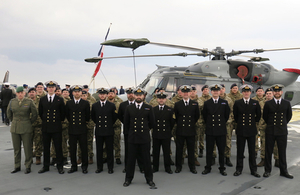 847 Naval Air Squadron stand to attention next to one of two Wildcat helicopters. They have deployed for five months with the Jeanne D’Arc. Crown Copyright.