Press release: Actions to tackle exploitation and abuse agreed with UK charities

A number of actions were today agreed to drive up standards in the aid sector at a Safeguarding Summit co-hosted by the Department for International Development (DFID) and the Charity Commission.

This follows a challenge to UK-based international development charities by the International Development Secretary, Penny Mordaunt, to come up with ideas and initiatives to ensure we protect the people we are here to serve.

Major UK charities, the Charity Commission and DFID have agreed upon initiatives to be taken forward to improve safeguarding standards.

This shortlist of actions includes immediate short term measures, and longer term initiatives to be developed in the coming weeks and months.

These include:

Creating an independent body to promote external scrutiny and ensure the highest possible standards across the aid sector

  • The summit agreed to explore an international safeguarding centre to support organisations to implement best practice on safeguarding and maximise transparency in the sector.
  • This could include conducting safeguarding reviews, offering guidance and support to organisations, and a deployable team of experts on sexual exploitation and abuse who can advise organisations on the ground.

Introducing new standards for vetting and referencing across the sector

  • All organisations agreed the importance of an urgent review of referencing in the sector.
  • The summit agreed that vetting and referencing standards are required for: UK-based staff; international staff; locally-employed staff – to ensure no offender can fall through the cracks.

Ensuring whistle-blowers and survivors of exploitation and abuse get the counselling and support they need

  • The Summit agreed to plan for a systematic audit of whistleblowing practices across the sector to ensure individuals feel able to report offences.
  • It also identified the importance of developing and implementing mandatory standards which would make organisations accountable to beneficiaries – ensuring those receiving aid are able to identify and raise concerns.

Changing organisational culture to tackle power imbalances, encourage reporting, take allegations seriously and hold people to account

  • The summit agreed annual reports would be made more transparent, with specific information published on safeguarding including the number of cases.
  • Mandatory inductions on safeguarding for all staff should be introduced to ensure any issues are identified and acted upon.

Ensuring concerns are heard and acted upon

  • The summit agreed the vital role of establishing clear guidelines for referring incidents, allegations and offenders to relevant authorities – including the National Crime Agency.

In addition to the actions agreed at today’s summit, DFID will continue to ensure small charities are supported during this process.

Notes to editors

~ On 12 February, the International Development Secretary announced a series of actions to tackle sexual exploitation and abuse in the aid sector. The fourth of the five actions was “to co-host a safeguarding summit with the Charity Commission to agree a set of actions to strengthen safeguarding processes and mechanisms, including around staffing and recruitment.

~ The Charity Commission has announced a suite of measures to help ensure charities learn the wider lessons from recent safeguarding revelations involving Oxfam and other charities, and to strengthen public trust and confidence in charities. This includes a new Charity Commission taskforce to handle the recent increase in safeguarding incident reports.

~ Penny Mordaunt challenged UK-based international development charities, regulatory bodies and independent experts to drive up standards and to agree practical tools, processes and protocols to ensure the aid sector protects the people it serves. As part of this, Ms Mordaunt confirmed that:

  • DFID will put in place new, enhanced and specific safeguarding standards for the organisations the department works with. These standards will include an assessment of codes of conduct, how organisations identify and respond to incidents, and how their risk management places safeguarding and beneficiaries at its very core. New funds to organisations will not be approved unless they pass the new standards.
  • All 179 UK-based charities that work overseas and receive UK aid have responded to the letter from the International Development Secretary giving DFID their statement of assurance on four key areas, including their safeguarding environment and policies, their organisational culture, their clarity and transparency, and their handling of allegations and incidents.
  • DFID is following up with 37 organisations to gain further clarity on their assurance.
  • Of the 179 charities that have provided returns, in response to assurances sought by DFID, 26 have made serious incident reports to the Charity Commission. In total, the 26 charities have reported 80 incidents broadly related to safeguarding issues; some of these reports relate to incidents that occurred prior to April 2017.

~ This summit builds upon the action already taken by DFID in response to allegations of sexual exploitation and abuse in the aid sector, including:

  • Establishing a new Safeguarding Unit in DFID to urgently review safeguarding across all parts of the aid sector and catalyse further action to ensure everything is being done to protect people from harm, including sexual exploitation and abuse.
  • Appointing Sheila Drew Smith, a recent member of the Committee on Standards in Public Life, to bring her expertise to support DFID’s ambition on safeguarding. She will report to the Secretary of State directly and will Chair the Safeguarding Summit.
  • Writing to every UK charity that receives UK aid insisting that they set out the steps they are taking to ensure their safeguarding policies are fully in place and confirm they have referred all concerns they have about specific cases and individuals to the relevant authorities, including prosecuting authorities. A similar request has been sent to non-UK charities and other DFID suppliers, including those in the private sector.
  • Agreeing with Oxfam that they will withdraw from bidding for any new UK Government funding until DFID is satisfied that they can meet the high standards we expect of our partners.
  • Continuing to work with UN Secretary-General António Guterres to stop abuses under the UN flag and we have introduced specific clauses in our funding agreements with a number of UN agencies to take every action possible to prevent all forms of sexual exploitation and abuse and take robust and prompt action in response to any allegations.
  • Concluding a review of allegations of sexual harassment and misconduct involving DFID staff

~ Speeches made at the Safeguarding Summit by International Development Secretary, Penny Mordaunt; Chair of the Charity Commission, Baroness Stowell; and DFID Permanent Secretary Matthew Rycroft, can all be viewed online.


Press release: Shorter hopes for a symbolic year for women in Lebanon

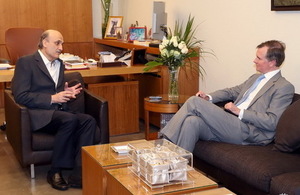
Ambassador Shorter meets Lebanese Forces leader Geagea Ambassador Shorter meets Lebanese Forces leader Geagea

British Ambassador to Lebanon Hugo Shorter met with the leader of the Lebanese Forces Party Samir Geagea.

After the meeting Ambassador Shorter said:

I had a good meeting today with the head of the Lebanese Forces Party, Samir Geagea. Our discussions covered a range of issues including the upcoming parliamentary elections in May. I am hopeful that the Lebanese Forces are considering positively the inclusion of more female candidates on electoral lists.

It is a symbolic year for women in the UK with the celebration of 100 years of women suffrage. I hope it will be a symbolic year for women in Lebanon, with the elections representing an important opportunity to boost inclusion and representation of women.

Published 5 March 2018


News story: National Apprenticeship Week 2018 – as it happens

Secretary of State for Education Damian Hinds MP and Sue Husband, Director of the National Apprenticeship Service at the NAW 2018 launch event at BBC Broadcasting House.

The 11th National Apprenticeship Week (#NAW2018) will bring together employers and apprentices from across England to showcase the success of apprenticeships whilst encouraging even more people to choose apprenticeships as a pathway to a great career.

Monday, 5 March

National Apprenticeship Week 2018 commenced with an event at the BBC and the announcement of a new ground-breaking apprenticeship programme.

With speakers including Secretary of State for Education Damian Hinds MP, Claire Paul, the BBC’s Director of Leadership Development and New Talent, Sue Husband, Director of the National Apprenticeship and hosted by BBC Home Affairs Editor Mark Easton, the event showcased why apprenticeships work and people should choose an apprenticeship as a pathway to a great career.

Apprentices addressing the audience included Rachel Coburn and Jonathan Chappell-Seetayah, both from the BBC; Katherine Sweeting, Andrew Fuller, Prem Lama, Roseanne Mills and Martina Tredgett from the RAF; Jamala Osman from Barclays; and Caitlin Stuart from Troup Bywater + Anders.

Apprenticeship & Skills Minister Anne Milton shared breakfast this morning with apprentices from Kelloggs, based in Manchester. The visit gave the Minister an insight into the apprenticeship programme delivered by Kelloggs. The Minister then visited St Ambrose RC High School where she attended a 10K Talk before chairing a roundtable with young people to discuss their views and their perceptions of apprenticeships.

Apprenticeship and Skills Minister Anne Milton sharing breakfast with apprentices from Kelloggs

Northern Saints Church of England Primary School in Sunderland gave the thumbs up to a shop floor visit at Unipres UK – on day one of National Apprenticeship Week. These potential future apprentices received a tour of the shop floor from apprentices, before witnessing fanuc robots in action too.

Our hastag #NAW2018 and National Apprenticeship Week were both trending on Twitter throughout launch day.

Get involved

Full details of the events happening across England can be found on the events map.

Events and activities for the week will be shared on Twitter and LinkedIn over the week, and event images will also be made available on Flickr.


News story: 2018 Groceries Code Adjudicator annual sector survey

Take part in the survey on the YouGov website

The Groceries Code Adjudicator (the GCA) has launched her fifth annual survey of the groceries sector. The annual survey allows the GCA to collect the most comprehensive set of views on current Code-related issues facing suppliers.

The GCA is seeking experiences and views from suppliers and others in the sector on how the 10 regulated retailers are complying with the Groceries Supply Code of Practice.

The survey will be an important source of information for the GCA about current retailer practices and changes over the past twelve months. The information provided will help the Adjudicator focus her attention for the year ahead.

All the information you provide is treated in strict confidence.

All answers are collated and analysed by YouGov and respondents are not identified to the GCA without their prior consent.

The results will be presented at the GCA Conference on 25 June 2018.

The survey will be open from 5 March 2017 to 22 April 2018.


Press release: Foreign Secretary statement on Syrian ceasefire

I am deeply concerned by the continued military campaign against the civilians of Eastern Ghouta and credible reports that Russian aircraft are actively participating alongside the Asad regime, contrary to the Security Council’s demand in UNSCR 2401 for a 30-day ceasefire in Syria. The areas suffering from bombardments are civilian populated areas.

There are reports of a death toll of more than 600 civilians in the last two weeks, including 200 airstrikes and over 100 killed since Russia voted in favour of the ceasefire. All this in an area that, lest we forget, Russia itself announced as a de-escalation zone through the Astana Process.

The main Opposition armed groups on the ground are involved in the UN-led Geneva process and Russia’s own Astana process and have clearly committed to full implementation of the UNSCR. These groups are not terrorists – they support a negotiated political solution to the crisis in Syria. Having voted for UNSCR 2401 less than a week ago, Russia has a responsibility to ensure implementation of the ceasefire.

The people of Eastern Ghouta have endured enough, among broken promises of ceasefires and humanitarian pauses. We demand that Russia and the regime cease hostilities immediately and ensure the sustained delivery of humanitarian aid to Eastern Ghouta and medical evacuations, as called for by the UN Human Rights Council this morning in a UK-proposed Resolution. The people of Eastern Ghouta can wait no longer.